
Month: February 2023

  • Possessions

    I paused to take one final stock of the room. When I looked out of the window, I could see the mezzanine balcony. I doubt he had stood there, looking at it as I did. From his vantage point on the bed, he’d have seen the far wall. Photos, an album of life. I sat for a while on the bed, looking at a suitcase that wrapped up the last remnants of a life.

    But one day, years after the convergence has begun, you cannot only sense the inward trajectory of the walls, you can begin to see the terminal point in the offing even as the terrain that remains ​before you​ begins to shrink at an accelerating pace.

    the three infirmities amount to the same sentence: the narrowing of life at the far tip of the diamond. Step by step, the stomping grounds of these friends had shrunk from the world itself, to their country, to their county, to their home, and finally to a single room where, blinded, breathless, forgetful, they are destined to end their days. Though Abacus had no infirmities to speak of yet, his world too was shrinking. He too had watched as the outer limits of his life had narrowed from the world at large, to the island of Manhattan, to that book-lined office in which he awaited with a philosophical resignation the closing of the finger and thumb. 

    The Lincoln Highway, Amor Towles

    In the second half of my life, I am now able to visualise this a lot more easily. There is something bittersweet about this. Like when I give away clothes. I am sometimes forced to pause for a minute because a particular tee would trigger memories of a different time. A different me. And by giving it away it is almost as though that part of me is now beyond retrieval.

    Later, when I got home, I looked around. The contents of our life, now. I’m sure all of it is subject to change. Home is after all a construct of the past, present, and future.. Things that point us to the past and helps us remember it as we grow older. Things that point us to the future, and help us visualise it the way we are imagining it now. And things that point us today to our self image. The things we possess, and the things that possess us. What would happen when they all start shrinking? As we clutch what we can remember of the past, struggle to imagine what can change in the future, and watch our self image shrinking? I suspect that is how the physical space too starts shrinking. Or maybe it works both ways.

    As I think about that suitcase now, and the remains of a lifetime, I wonder if he would have liked them to be in ‘the foreign object‘, a part of his happier days, which I had appropriated a decade later. I have no idea what will happen to the latter when I am gone. A cross-section of a life that no one needs to remember. And it makes me wonder as I look around again, all of these possessions which seemingly give our life meaning now, only have that meaning when we are around.
  • This is not Propaganda

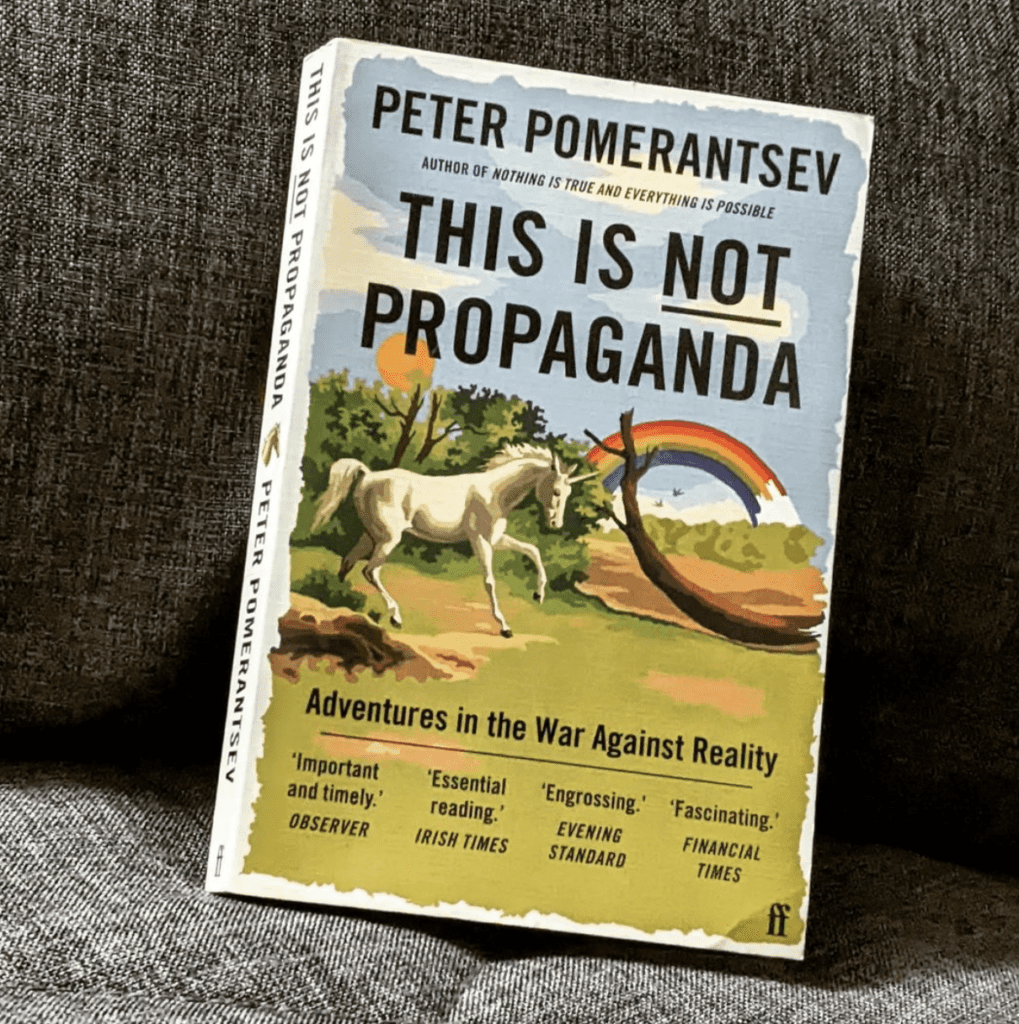
    Peter Pomerantsev

    As the old joke goes, ‘Truth will prevail’, but no one said whose truth! I think if there is one book you should read to understand the sociopolitical information warfare on social media happening daily, this is it. From Mexico to Manila and London to Kiev, there is a playbook that is being followed to distort reality. The same tools that were originally used to create revolutions are now being used by autocrats to gain and hold power. More information was supposed to be more power, but it also provided new ways to silence dissent. Censorship through noise. And where did it all begin? In Russia. Peter Pomerantsev has a first-hand experience of how it all started. Forty years ago, his parents were forced out of Kiev (then part of the USSR), and their journey since then serves as a great narrative guide. 

    The book is divided into six parts. The first part uses examples like Rappler vs Duterte (Philippines’ version of Trump in the US and Bolsonaro in Brazil) and Lyudmilla Savchuk, who exposed Russia’s troll farms, to show how new instruments of information are being used to break people. Russia denies connection with the troll armies, like every other state – Turkey, Bahrain, Azerbaijan etc – that uses similar means. 

    The second moves to Latin America and EU to show how entire resistance movements have been dismantled. Clever rulers have found ways to remove the clarity around the ‘enemy’ by coopting the language and tactics as those who fight oppression. Srđa Popović knows a thing or two about the original playbook. A Serbian political activist, he was a leader of the student movement Otpor!, which was instrumental in toppling Serbian president Slobodan Milošević. He has since then trained activists in Georgia, Ukraine and Iran. It’s an irony that his manuals and courses are being used against the very purpose for which they were created, and it’s now come down to an arms race of tactics and technology between guys like Alberto Escorcia and Mexico’s corrupt politicians. Russia invaded Estonia in 2007 without setting foot in it by mimicking the entire playbook and using Estonia’s own pro-Russian citizens in protests. Another trick is to state that genuine protesters are being paid by the US. From Facebook to Discord there are people being recruited and systematic strategies being used to undermine pro-democracy efforts.

    The third part is on how one nation is able to ‘invade’ another without real contact by blurring the idea of war vs peace and domestic vs international. War is no longer in just physical space, it is hybrid, non-linear, full-spectrum (all terms used by experts) and is focused on decaying the opposing group/country from within. Information warfare is the first play and the military follows, if required. Russia’s attack on Ukraine in 2014 is the classic example. “Faced with wildly conflicting versions of reality, people selected the one that suited them.”

    The fourth explains how, without a tangible idea of the progress and future, anything goes! When Putin invaded Crimea, he first said there were no Russian soldiers there, and then later casually said there were. Replaced one reality with another. Another example – 76% of Trump’s statements in the election were mostly false or untrue! The case made for these distortions is that objectivity anyway doesn’t exist. Related to this is the glorification of the past. ‘The twentieth century began with utopia and ended with nostalgia. The twenty-first century is not characterised by the search for newness, but by the proliferation of nostalgias’. And in the era of ‘soft facts’, we can know everything happening in Aleppo and pretend to not see it.

    Pomerantsev sets a prelude for Chapter 5 with his own confused identity in childhood – British or Russian? When old notions of identity around demographics and religion get blurred, all politics now revolves around ‘identity’ they can create and use for their own ends. The story of Rashad, one of the founders of Hizb in the UK, who was early into this game but now works to dismantle it, is fascinating. This part also has the working of the Brexit campaign. Eighty types of targeted messages for 20 million people. Animal rights, environmentalism, gay rights, potholes all somehow made to connect with Brexit. And it all began in Russia. Starts by Pavlovsky for Yeltsin, but polished by Putin. 

    The final part is about the future – China, but begins with Nigel Oakes, founder of SCL, whose game was repurposed by one of its other founders to create Cambridge Analytica. China is well on its way to target people with demographic, psychographic and behavioural patterns. The book ends with a brilliant closure – of the subject as well as the personal history.

    While the wiring is clear, what remains to be seen is the second order consequences of this combination of trolls, psyops, dark ads, bots, soft facts etc. Not just at an individual or societal level, but at a species level. The book is extremely well-researched and has a narrative and language that is easily accessible. The interweaving of the personal narrative is at once sharp and seamless. This is a book I’ll hugely recommend. 

    P.S. I wish he had also covered India too, the playbook is being religiously followed here!

  • Clarity begins at home

    Maybe it’s a 40s thing, or maybe it’s just me projecting my top-of-the-mind thought on to others, but these days, ‘the place to retire to’ is a recurring theme in many conversations with friends. Once upon a time, in line with Pico Iyer’s “Home is not just the place where you happen to be born. It’s the place where you become yourself”, Bangalore was an obvious choice. A few years ago, Cochin got back into the consideration set, as I veered more towards who I was than what my self image was. The mind and its narratives.

    During a recent trip to Cochin, when a classmate described my school-self to D, I had a moment straight out of a Kazuo Ishiguro book. He is one of my favourite writers, and at least two of his books feature narrators with flawed memory constructions. In the books, it is fascinating to watch the peeling of reality against the narrator’s reconstructions. Ishiguro is kind, and usually brings the narrator down gently. In my case, I was first shocked to realise how I was like one of his narrators, and then pleasantly surprised at how my friend remembered me. Maybe he was being kind. But this isn’t the first time. When a similar recollection about me had happened with one of our other classmates during a reunion a few years ago, I had brushed it off as his false narrative. Because my own perception of who I was then was different. But after this, I realised that this was the key to Cochin behaving like a magnet!

    In Capital, Rana Dasgupta wrote – ‘when one becomes homesick, it is not a place that one seeks, but oneself, back in time.’ Despite my conscious mind’s narrative constructions, my subconscious probably remembers it more accurately. It remembers someone whose sense of humour did not have the cynicism that an adult life gifted it. Someone whose whistling skills seemed like magic to his friends because it was not self-conscious. Maybe, by pulling me back to a place, the mind believes it can also pull me back to a time and a self that was happy with itself. That him who I was.

    And maybe it’s not just that. Before I left Cochin, I made it a point to visit an old hangout. An aunt’s home. My mother’s cousin, whose granddaughters were roughly my age, but insisted on calling me ammava (uncle) especially in public. My memories of that place and my aunt, and these I am sure of because there are physical spaces that could testify to it, are ones I cherish and am deeply grateful for. The place and the person brought a sense of warmth and security to a teen life that was troubled by loss, and a mind that did not even realise it was unmoored. I see the afternoons and evenings I have spent there as an incomparable act of kindness. A refuge from the world at large.

    So maybe what drags me back to Cochin is a little more than who I was. It is also about those around me at a certain stage of my life. The friends who made me feel special. The people who made me feel secure. And places that are so deeply etched in my memory that it would be impossible to feel lost even now. Even as I realise that the places and people may no longer be around and that this construct is one that fits the current idea that I have of myself, I also think that somehow the mind will conspire to project an environment that can anchor me.

    P.S. As I began writing this, I had an intense sense of deja-vu. Very meta. I had gone through these thoughts before, I was sure. And indeed I had. That is somehow reassuring.

  • Atomic Habits

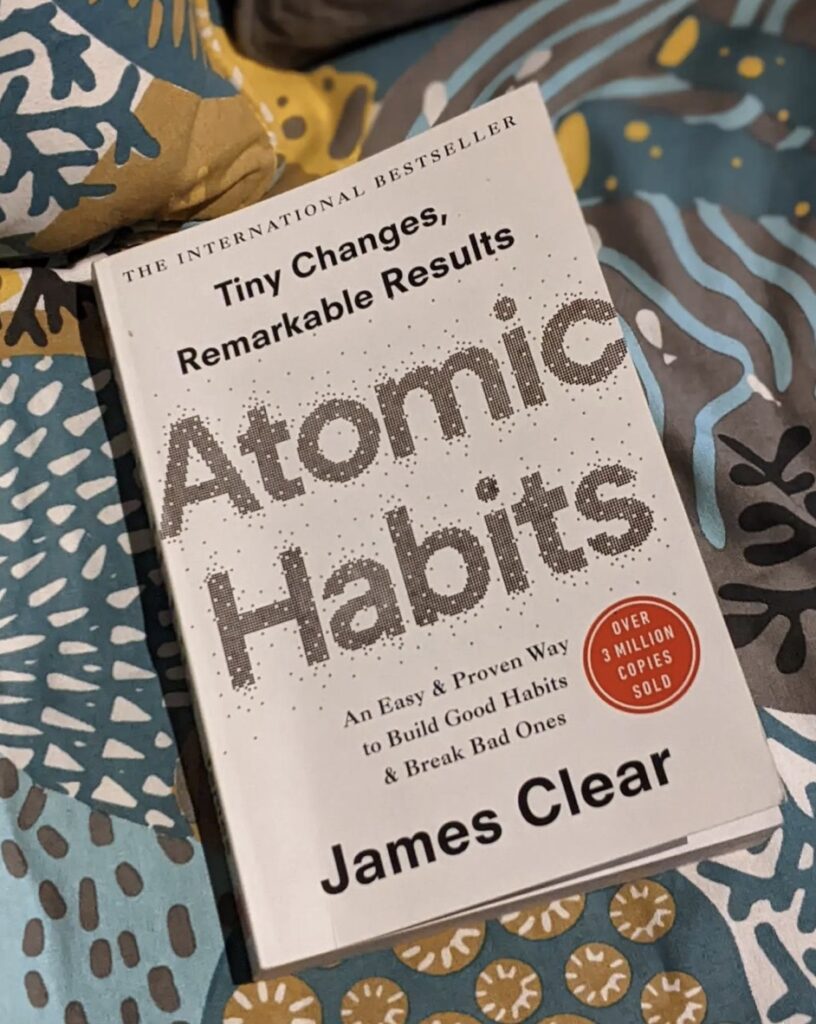
    James Clear

    Given that I read The Power of Habit a while back, and have been a subscriber to James Clear’s newsletter for a while, I should have read this a long time ago. But better late than never. 

    He begins by explaining how small changes can make a big difference over a period of time. Positively and negatively. ‘Habits are the compound interest of self-improvement.‘ Hence the word atomic – small, part of a larger system, and the building blocks of great results. 

    I think one of the best insights of the book is the three layers of behaviour change framework – outcomes, processes, identity. While most people focus on outcomes, systems (processes) are a better way. ‘ You do not rise to the level of your goals, You fall to the level of your systems.‘ But the best way is to focus on the ‘identity’ – the person you want to become. The first stop is to figure out one’s habits, which tend to be quite a few over a period of time. As per research, apparently 40-50% of our daily actions are habits. And many of them are not even consciously-created ones. A habit, as Clear brings up right at the beginning, is a routine or behaviour that is performed regularly – and in many cases, automatically. From an evolutionary perspective, ‘Habits are, simply, reliable solutions to recurring problems in our environment‘. And that means, nature has its own way of creating things that reduce our cognitive load. 

    He then proceeds to breaking down the process. The process of building a new habit (or getting rid of one) has four steps – cue, craving, response, and reward. Correspondingly, to create a good habit, make it obvious, make it attractive, make it easy, and make it satisfying (and their inversion to get rid of a habit). These make up the Four Laws of Behaviour Change. The remaining chapters are all about bringing this to life. From managing one’s environment to the role of friends and family, fixing procrastination, using commitment devices and motivation rituals, reducing friction, how to stick to good habits, and even automate them when possible. By the time you read the end of this part, you have a fantastic table that can be quite easily applied. 

    I liked the last 50-odd pages the most because of my own interest in the topics. The perspectives on the role of nature and nurture – ‘genes can predispose, but they don’t predetermine‘, and how to determine the game where your odds of success are higher. Habits are easier when they align to one’s natural abilities. ‘Boiling water will soften a potato but harden an egg. You can’t control whether you are a potato or an egg, but you can decide to play where it’s better to be hard or soft.’ 

    He also brings up the downsides of even good habits, the importance of reviews and realignment, and how one can break the beliefs that are holding one back. Becoming the best version of yourself requires you to periodically edit your beliefs and worldview, and expand your identity. 
    Some of the frameworks have been inspired by others (and Clear makes sure he mentions those) but through framing, easily relatable examples, and ways to implement them in daily lives, he makes application very easy. This is a must-read book, especially if you’re in your 20s and 30s. From experience, compounding is probably the most underrated phenomenon. The earlier you start, the better. ‘The costs of your good habits are in the present. The costs of your bad habits are in the future.’