Month: July 2022

  • Moral Signs 2

    “It’s these times. Morality is a moving target”

    Robert Folger, Snowpiercer

    A ‘grandchild’ at work wants to move to an edtech. She is convinced it’s an ‘opportunity that she won’t get later’. I contest on both counts. She is immensely talented, and given her work ethic, it is easy to see that she will be an absolute star. I would like her to do well, but it is an organisation I have actively talked against – IRL and on Twitter – and there is enough proof of its misdeeds. She wasn’t aware of this, and is nonplussed, but doesn’t want to turn back now. I bring up our debates on how she felt Seagram’s “Men will be men” was legitimising misogyny, and furthering a regressive world view. That got us on to morality. I remembered the ‘professional’ version I had written a while ago and sent it to her. I also remembered that I had meant to write this personal version earlier.

    Morality and self image

    (from the previous version)

    “We’re living in an era of ‘woke’ capitalism, right? I’m Nike, I pretend to care about black people. You pretend to hate capitalism and buy my trainers.”

    “Industry” (BBC/HBO)

    This pretension helps us retain our self image while consuming the things and experiences. There is narrative cohesion while avoiding uncomfortable truths. And sometimes, even some virtue signalling. 

    In general, the world is hyper competitive, and the choices we make might not sit well with self image, especially when morality is also at play. In the post, I had brought up the point that having a moral compass means saying goodbye to what would be considered lucrative opportunities. Even more so in the last few years. Crypto, real money gaming, fintech, edtech – the big pillars of the recent startup boom – all have moral loopholes (generalising). Same goes for Big Tech. But now regulation and external factors are catching up.

    The self image is gloating with “the arc of the moral universe is long, but it bends toward justice.” (Dr. Martin Luther King Jr.) But everything is a cycle.

    Let’s go beyond work and take say, entertainment. Recently, I tweeted

    You can catch many discussions on Saudi blood money around the web. If one were absolutely moral, one should immediately stop watching these sports. I don’t watch any of these, but that’s largely because I am uninterested.

    And anyway, I can make similar cases against movies and every other general consumption – apparel, on-demand deliveries, house help, and practically every daily touchpoint. It isn’t easy for me to slither out of everything.

    As you can see, being very objective about one’s own morality is dangerous for self image, and thus sanity. Maybe that compromise is the origin story of cancel culture (canceling on Twitter only, not in life). While I can see how that helps self image, I also do believe there is a limit to not being objective about oneself.

    Morality is plastic

    The Activa is being sold to the husband of one of the housekeeping staff at the apartment. He comes by on a Saturday evening, after his daily labours, and shows me his Aadhar card on a taped-up plastic-covered mobile phone. He doesn’t know how to forward it, so he’d give me a photocopy, he says. He also insists that I count the cash. He seems very particular that I treat the entire transaction with the dignity it deserves, including our price negotiation. It furthers my own narrative about why I shouldn’t give it to him for free, but hey, I am watching me. I know that an equal reason is that this amount is part payment for something I have been eyeing. Something I don’t need but would like to have. I tell myself that he and his family will be rid of a few commute problems at a lower cost. That it’s a net positive.

    There is an intense discussion happening in the apartment WhatsApp group – a couple of street hawkers (no, not fancy bikers) have set up shop on the pavement and the residents are worried about the area becoming a hub, and thus creating bigger problems. I see the case for shooing them away though I won’t voice it. I also won’t voice the contrarian view – D and I didn’t want to trigger a WhatsApp war. I see one of the hawkers when D and I go for a stroll after dinner. He is selling plastic items, and is using one of his buckets as the seat. It is around 9PM on a Saturday night. He is older than I am, and I begin to think about my conversation in office about how our chairs aren’t ergonomic enough.

    A moral operating system

    I used to judge myself by the only morality is action, but I couldn’t handle all the trade-off. I also realise that this entire conversation is from a position of privilege. And that my estimation of how easy that makes it, is woefully lowballing it. I remind myself that there is no morality in nature, only causality (Jonathan Haidt). Maybe we need to evolve a lot more if we need morality and practicality to co-exist. And maybe that won’t happen.

    So what can I do? I can stretch myself and do the right thing even if it takes me away from my comforts. I can recognise the limits, and stop being judgmental of self and others.

    Yesterday I was clever, so I wanted to change the world. Today I am wise, so I am changing myself.

    Rumi
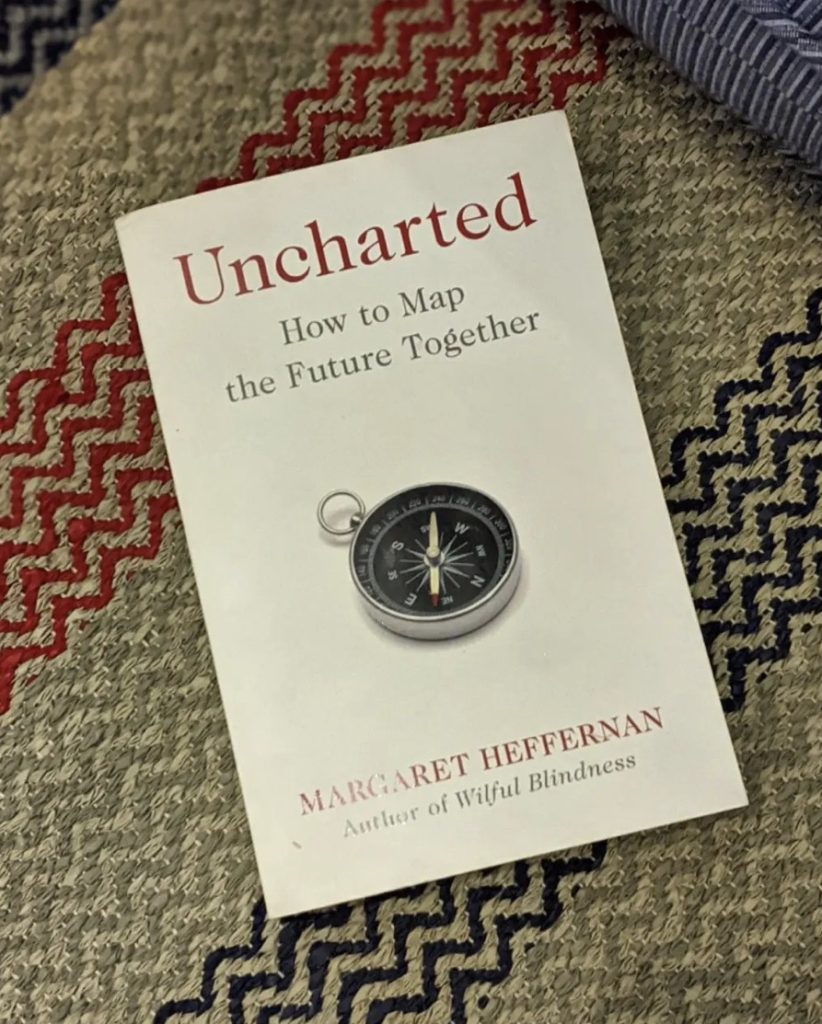
  • Uncharted

    Margaret Heffernan

    From the time imagination and projection became a part of our survival toolkit, our species has been finding more and more ways to be certain. But as the world becomes increasingly complex, certainty is more difficult to find. ‘We live in a world of irreducible uncertainty‘. So how does one think about the future, at not just the individual level, but at organisation, societal and civilisational levels? Margaret Heffernan moves through history, business narratives, science, and her own relationships to offer perspectives.

    The book is divided into three sections to take us through multiple concepts. The first section uses history to set the context for our ‘addiction to prediction’. We convert history into smooth flows of continuity and manifest destiny whereas events weren’t inevitable but a series of choices, complex and contingent. In addition to pointing out how even professional mathematicians find probability counterintuitive, she also shows how we quickly accept the propaganda of predictions and ‘leave ourselves open to those who profit by influencing our behaviour’. Even in our individual lives, everything from personality tests (MBTI) to genetic profiling is used to typecast despite humans being complex. The big danger is in confusing complex systems for a complicated process. The lessons in this section is that neither history nor genetics nor models can say with certainty how the future will unfold, and what we lose when we try to automate our way into efficiency is the system’s robustness. 

    The second section has a bunch of examples on how people, companies and societies have navigated the future. It brings out the importance of experiments, scenario planning, and creating a shared understanding. Scenarios ‘illuminate the contingencies, contradictions and trade-offs of the real world, where no one interest or single perspective is in control‘. At an individual level, there are some excellent examples of artists whose projects are defined by uncertainty. The Future Library was one I found very interesting – Katie Peterson has planted a thousand trees in a forest outside Oslo. Once a year, for a hundred years, authors will submit manuscripts commissioned for the book. It could be poems, stories, a novel, or even a sentence, but no one else can read it until a hundred years from now! This approach is in stark contrast to the ‘brand you’ concept of fixed positioning. At a broader level, there are examples of ‘cathedral projects’ like CERN, whose by-products have revolutionised multiple industries, and yes, given us the internet too! The Human Genome Project is another example. They are destined to last longer than a single human lifespan, and have to adapt to changing needs, tastes and technologies, relying on human imagination and the willingness to explore, to succeed. ‘They are voyages of discovery in uncharted territory.’ 

    The final section is all about the importance of being human, and coming full circle, how we can prepare ourselves better for the future. Using examples of individuals, companies like Nokia, and a civilisational crisis like AIDS, the author highlights how human relationships helps us solve problems which are uncertain even from a ‘where to begin’ perspective. Human ingenuity manages to create emergent solutions. The penultimate chapter is a fantastic presentation of death as a feature, not a bug, and treats it with dignity and respect. 

    This is a book that creates an excellent narrative for the times. While we extoll AI and its ability to make our lives better, the focus here is the human ability to ask better questions, share ideas, and find solutions. In our search for efficiency and metrics, we tend to forget the creativity and imagination prowess of the human mind that has brought us so far. There are no readymade solutions in the book to tackle an uncertain future, and that is the precise point it makes. It offers perspectives and possible approaches, and despite the tough and diverse subjects it deals in, is optimistic and very accessible.

  • The ride of a lifetime

    The year was 2008. For 7 years, I had been serving as a palliative care owner to second hand two-wheelers. This included manually-powered visits to workshops every other day, to the extent I had called the original one Potential Honda, because it was Kinetic only occasionally! And that’s how I finally decided to take the bold step of buying a brand new two-wheeler for the first time in my life, at double the cost of my mobile. I bring that up because now Activa competes with the likes of Apple and Samsung for the share of wallet!

    Fast forward to 2013, when D got herself a four wheeler, and a driver, I cajoled her into letting me use both, and stopped using the Activa for office commute. But it still was my go-to vehicle for chores. From about 2016, I became an Uber regular, but the Activa continued its role. I think it was the pandemic, and then the zoning out that separated us.

    And thus, here we are in 2022, and I am wondering how does one say goodbye to a partner who has been with you in your 20s, 30s and 40s! But I have to. Unlike the foreign object and these guys, the maintenance effort is not trivial. It doesn’t help that it needs a fitment certificate later this year!

    And thus this thank you post. To a relationship in which I cheated on you with another two-wheeler only once – when they insisted I use a wheelchair when going in for an angioplasty last year. To a relationship in which we got hurt just once – back in 2010 in Austin Town on a rainy night. I remember crying that night, as I picked you up and continued home, because a truckload of things made life seem so unfair. I am older and a little wiser now, and life doesn’t seem very unfair, but I thought of the lifetime we’ve been through and blinked back tears, when I stood gazing at you before I put you up for sale.

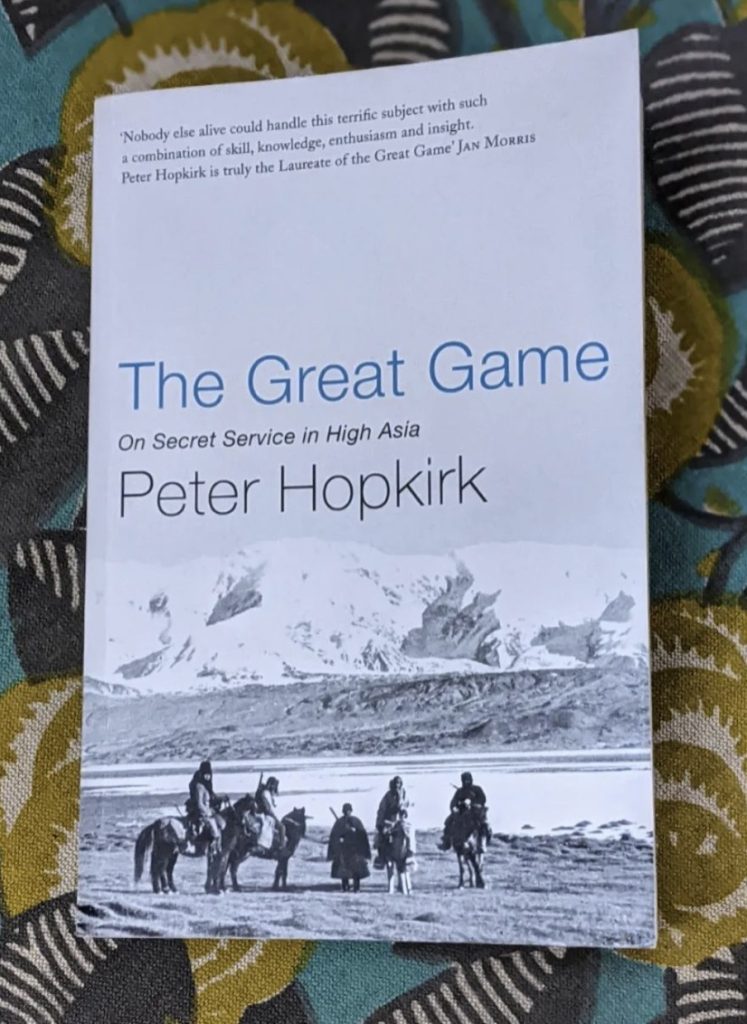
  • The Great Game : On Secret Service in High Asia

    Peter Hopkirk

    I first came across “The Great Game” in Sherlock Holmes. Not the series, the book! The phrase is attributed to Captain Arthur Conolly (but made famous in the book Kim), and fittingly his last moments in 1842 in Bokhara, a classic Great Game location, is where Peter Hopkirk starts his narrative. The Great Game was the name given to the diplomatic and political confrontation between two empires – British and Russian – across Central and South Asia that happened through the nineteenth century and the beginning of the twentieth.

    The British felt that the ultimate aim for all of Russia’s expansions in the Central Asian region was its crown jewel – India, and the Russians didn’t take kindly to any attempts made by the British to block these advances. While a lot of it seems like shadowboxing, it involved intrigues, treachery, and adventures featuring individuals on both sides, Sultans and Shahs and minor chieftains, and sepoys and Cossacks fighting for every inch and fort. 
    When it all began between Victorian Britain and Tsarist Russia, over 2000 miles separated them, and by the time it ended in early 1900s it had come down to 20 miles. The book features the military personnel and politicians on both sides, many of whom made dangerous trips in the guise of traders and holy men into areas where no white man had been before, and in some cases, gave up their lives to seek information that would strengthen their respective empires. Across the 1800s, the British explored the many paths that Russia could use to conquer India, even as Russia increased its sphere of control across Central Asia. Beginning with France, the Ottoman Empire, the Persian empire, and then Tashkent, Samrkhand, Bukhara, Khiva and Afghanistan, and towards the final stages Tibet, China and Japan, this was Monopoly being played at global levels and possibly the longest and most intense geopolitical conflict the world saw before the Great War. Ironically enough, in that war, the former foes were allies. 

    In the context of the US leaving Afghanistan, this book, written in 1990 offers a fantastic lesson in history – not of the Soviets in the late 1980s, but the humiliating and tragic withdrawal of the British in the 1840s when they tried to displace Dost Mohammed with their favourite Shah Shuja. Peter Hopkirk tells history the way it should be told – a very accessible narrative, full of excellent details, and practically recreating entire episodes for the reader. If you like history, this is a must-read. If not, it’s still a treasure trove of excellent, old fashioned intrigue.

  • Notion States 2

    For a while now – since 2010, I have felt that the nation state (or notion state really) is a shared mental model which is nearing its expiry date. But like other intersubjective realities (money, god), we are reluctant to let go of it. That’s why I found it interesting when Aakar Patel spoke about how nation states are quite inefficient.

    It’s quite true. All you need to do is think about the movement of people and objects and you’ll figure it out for yourself. And while the state has begun using things like Aadhaar to increase legibility about its citizens , and thereby increase efficiency (and further nefarious interests), it is advancing at incremental levels, while the world is moving exponentially.

    Not to mention that the nation state is an instigator and participant in one of the most net-negative things humanity has been continuing – wars! And these days, it’s not just the ‘simple’ human conflicts any more. In the digital space that we spend a lot of time in, and in which we have created identities, state surveillance and deliberate offences using things like ‘zero days’ against its own citizens and enemy states are all contributing to equal if not greater retaliation. In fact, this can actually lead to physical losses too thanks to hacking of power grids, nuclear facilities, healthcare systems and so on.

    So how is this glorified middleman holding on? I think a big reason for the popularity of the nation state is the sense of identity it fosters. Along with religion, nationalism continues to be a superpower. The line on paper is strong even if culture ignores it. Think Delhi and Lahore vs Delhi and Chennai.

    However along came the internet, which has a way of disposing inefficient middlemen. It has massively accelerated the geographical movement of ideas, and increasingly that now includes identity. As Fukuyama points out in Identity, as we moved away from agrarian societies with a strict hierarchy to technology-driven societies with multiple social classes, pluralism, diversity, and choice emerged and identity started becoming increasingly complex. By early nineteenth century, there was a fork – universal recognition of individual rights, and collective recognition. Arguably, Fortnite and LGBTQ rights can increasingly unite people more than a national flag does.

    However, given that the internet has destroyed many things without finding a remotely appropriate replacement, I also began to think of a ‘for’ case. One other relevant intersubjective reality we can learn from is money. In the case of money, once upon a time, different geographies had different systems. Vulnerability in one was of less concern to another. But now, it’s all interconnected, and thus fragile. Even in a nation state dominated system, covid just took over the globe and in addition to lives, had a telling effect on the economy. No country was really spared. So it’s important to ask what would happen if no barriers existed. Is it always good to completely remove friction? There is more. Money is also dependent on the rule of law, and its enforcement by physical force – one of the tasks of the nation state. A big concern with crypto is this enforcement.

    And to now expand this line of thought, what happens to governance? Many evils are kept on a leash because of regulation. Who is accountable for rights and duties of citizens? Minorities might not be in a great place now but without the pretence of the state that pretends to care for them, what happens? What becomes of those who are economically not contributing to the system – the old, the infirm, the less-educated and so on?

    One thought is that there will be a replacement and it won’t be all binary. It will move in stages. For instance, money seeks efficiency too. And it is interesting that money itself, at least in form to begin with, is being challenged by the blockchain. On a related note, our lives are increasing moving into the digital domain, where the nation state’s borders are mostly irrelevant. This means the state’s playbook for regulation cannot be deployed automatically. The worry though is that all this might end up breaking things faster than we can find a replacement, even if it is a notional one!