In The Constraints on Freedom, I had brought up the impact of the loss of three basic freedoms at a personal level. The freedom to disobey, the freedom to go somewhere else, and the freedom to create new social arrangements. A big lesson from the book I got it from is that even at a civilisational level, ‘the map is not the terrain’ i.e. the granular trade-offs, impacts, and daily wins and losses of different societies don’t get covered in broad strokes. At an individual level, therefore, mapping one’s worldview and practices purely according to popular discourse and aping lessons from ‘experts’ blindly is probably not a great idea. This post is a start to framing my own can-need-want list and specific actions I would like to take to give myself (and hopefully some others around me) more basic freedom, and a bit more. I am framing this around three aspects.
(more…)Month: February 2022
-
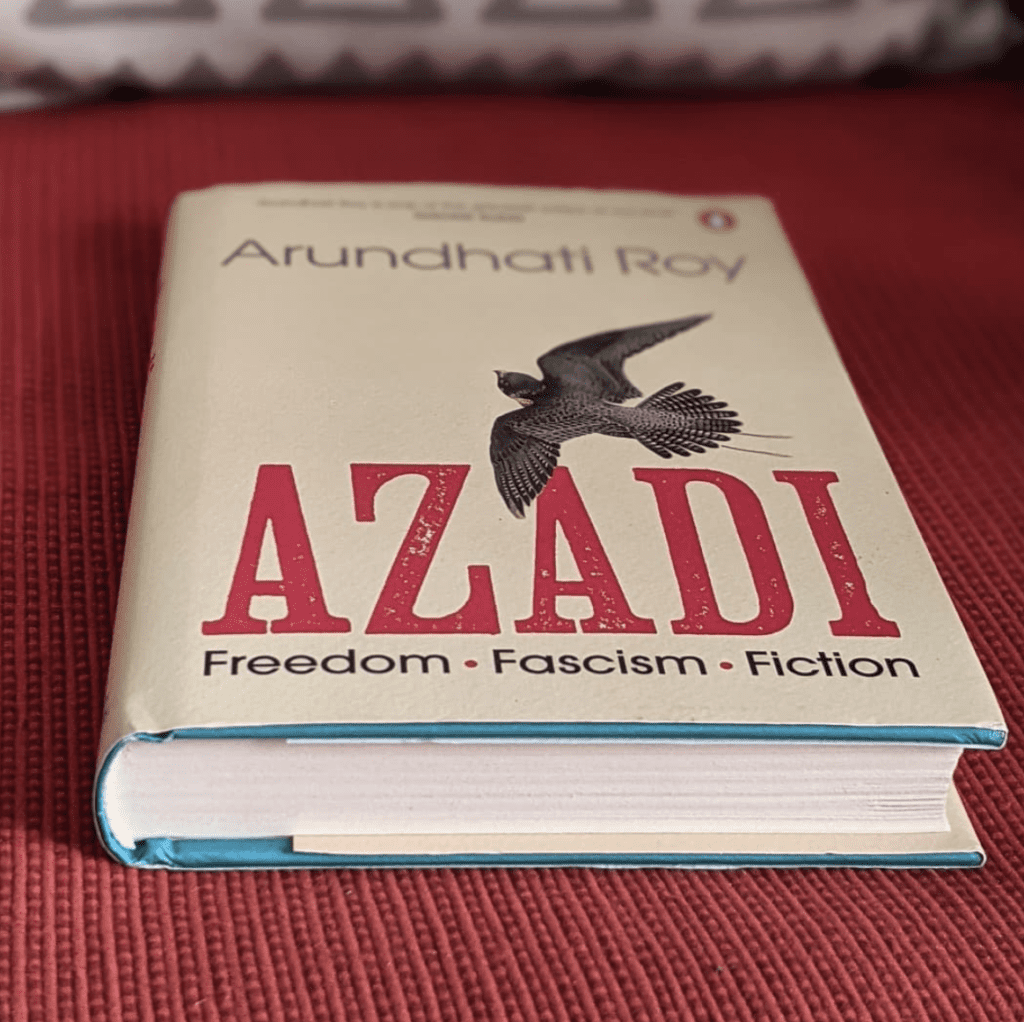
Azadi
Arundhati Roy
As always, I must admit a bias for Arundhati Roy. For being an author who has consistently been vocal about rampant capitalistic greed, class prejudices, and more recently, the conversion of India from a democracy to a fascist state. And in doing all this, she holds an uncompromising mirror to those of us whose privilege affords us the luxury of living in bubbles whose walls are impermeable. For now.
The book has 9 essays that contain the above, and also touch upon the role of fiction in imagining, processing, and communicating it. Lal Salaam Aleikum, says Anjum, in The Ministry of Utmost Happiness. The book has recurring themes – Kashmir, NRC, CAA, RSS – but I think repeating them is worthwhile, so that the gravity is understood.
Kashmir, whose special status, or limited autonomy, granted under Article 370 of the Indian Constitution, was revoked on 5th August by the Indian government. Followed by Narendra Modi appearing on television on 8th August to announce a lockdown of 7 million people so that they could enjoy Indian democracy and progress while living under military occupation. Google Trends surges showed a repeat of plunder patterns from history – “marry a Kashmiri girl” and “buy land in Kashmir”. Women and land. But that’s only the larger population. The nation has higher ambitions. For instance, access to rivers and other natural resources. And so does the ruling party – “One Nation. One Constitution”. Enforced not just with the might of the state machinery, but the 600000 members of the RSS.
NRC, the seeds of which were sown in 1837 when the British made Bengali Assam’s official language. Though revoked in the 1870s, it set the stage. In the late 1890’s the British encouraged Bengali Muslims to become workers in the tea plantations, causing an influx that was first met with affection by the natives, but soon turned to discord. Borders were redrawn regularly, and 1947 and 1971 caused a further inflow of populations, and after decades of violence and antagonism, we now have the NRC, whose updated list was published on 31 August 2019. With 1.9 million missing. It didn’t really make the rulers happy because almost half of them are non-Muslims. Predictably, Justice Gogoi ordered the transfer of the chief co-ordinator of NRC, giving no reasons.
And then there is the Citizenship Amendment Bill, passed on 11 Dec 2019 as the CAA. Students of Aligarh Muslim University and Jamia Millia Islamia University reacted first. Shaheen Bagh followed. The larger agenda of both NRC and CAA – controlling citizenship. After all, as Hannah Arendt said, “Citizenship is the right to have rights.” And what we are seeing is the systematic disenfranchisement of Muslims and making them second class citizens.
All of the essays lay out how the RSS and BJP keep things on boil at all times- NRC, Pakistani Jihadis, Kashmiri terrorists, Bangladeshi ‘infiltrators”, Ram temple, and always, Muslims. Ready to be poured gasoline on, and lit. And backed by a propaganda team – from Bollywood A-listers to sportspersons to media. All components of the fascism playbook, and the regime has the checklist – strong man, ideological army, Aryan superiority, dehumanising of the “internal enemy” and mob justice (113 deaths by mob violence since 2015 – The Quint), propaganda machine, the attacks on academia and assassinations when required, the coteries of businessmen and film stars.
And the systematic takeover of democratic institutions, as the police get communalised, judiciary abdicate their duty, and the media just want to be lapdogs. Case in point -“Desh ke gaddaron ko, Goli maaro saalon ko”, said Kapil Mishra, who is back in the streets after a very brief interlude. Meanwhile, Justice Muralidhar who was furious with the Delhi Police for not taking action against Mishra, got midnight orders to move to his new assignment in the Punjab High Court.
The pandemic is an opportunity to set many things right. But it doesn’t seem to be going in that direction. For instance, the early days saw vast populations being forced back to their villages and small towns just so they could have some dignity. A reminder of the days of partition – class being the driver instead of religion.
There is a high likelihood that reading this book and reviewing it will soon be deemed anti-national. As a college lecturer pointed out to Arundhati Roy, among the items recovered from alleged couriers for the Maoists were books she had written. “They’re laying a trail – building a case against you.” Meanwhile, with plans for Nepal and Sri Lanka, the RSS seems to be seeking its version of the German Lebensraum (living space), which the Nazis used to formulate their Generalplan Ost policy – genocide, ethnic cleansing, and colonisation of Central and Eastern Europe . The world can pay heed now, or pay the price again for letting a fascist regime pursue its will. The voices in Kashmir and against NRC and CAA is the same – Azadi. And as Kanhaiya Kumar stated, not from India, but in India.
-
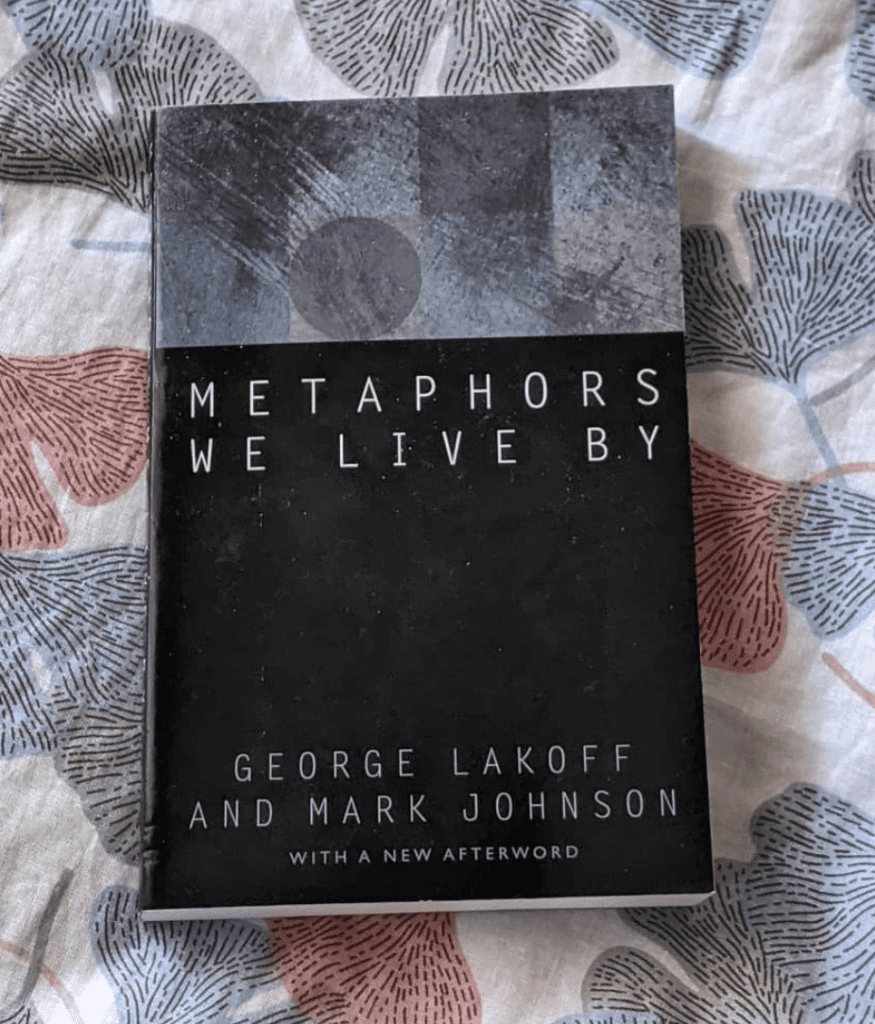
Metaphors we live by
George Lakoff, Mark Johnson
In “How Emotions are Made“, Lisa Feldman Barrett wrote how concepts, goals, words all help the brain frame any new stimulus it receives and that by reframing concepts and looking at them more objectively, we can reshape what emotions are surfaced, and thus exercise free will. But how does one go about that? In the vast scope of “Metaphors we live by”, we get an answer to that too.
Metaphorical concepts are so ubiquitous in our thoughts and deeds that we don’t even realise they exist, let alone their effect on how we think about everything from business and ethics to marriage and poetry. Conceptual metaphors allow us to use the inferences in domains we can sense (space, objects etc) on other domains of subjective judgment. In a way, this is how we are able to transmit ideas and create a shared understanding. We often ascribe this to language, but it actually begins with metaphorical concepts.
The light bulb goes off in the first few pages, when the authors use “Argument is war” as an example. It’s because war is the metaphor we have used at a concept level, that the words we used to describe it are about winning/losing it, or “your claims are indefensible” or ‘He demolished my arguments” or “I attacked his weak points” and so on. Another example to think of is “time is money” – you use spend/save/run out of/invest to describe time.
In addition to the structural metaphors above, there are oriental metaphors, which provide a spatial orientation, and are based on our physical and cultural experiences. For instance, happy (spirits rose), consciousness (woke up), control (top of the situation), more (numbers went up), future events (what’s up), good things (looking up), virtue (high standards) are all “up”, while their opposites are down.
A thing to note is that a concept can have multiple metaphors e.g. Ideas are food (half- baked), people (father of modern physics), plants (fertile imagination) and many more. Another interesting part is the grounding of concepts. For instance, how we conceptualise the non-physical in terms of the physical. Harry is in the kitchen (which is spatial), in the army (social), in love (emotional).
The book further talks about the structuring of our experiences – experiential gestalts, as well as coherence of metaphors (including overlaps of metaphors, how they affect form, and how they can ultimately create realities. It also gets into very interesting territories – the nature of truth, objectivism and subjectivism. It points out how both miss the part that we understand the world through our interactions with it, and proposes an Experientialist alternative.
Since I started reading the book, I have been watching the words I use (” I am running late”, “I don’t think we should spend more time on this”) and imagining different metaphors. Because by changing the metaphors we live by, we can change our everyday life, and our future. This is far from an easy read, but even (more than) 40 years after it was first published, it is still pathbreaking.