A couple of weeks ago, I wrote about how the book “Behave” gave me insights on the ‘why’ behind the mindsets I have in life. Since mindset isn’t something you can leave at home, there is some impact on the professional front too.
Work
As I had mentioned, my OS has a few known features (uncharitably, bugs) – the scarcity mindset, a low regard for familial bonds and (until recently) friendships, and a belief that in a crunch the only person one can depend on is self. This has led to some obvious implications and some not-so-obvious ones at work.
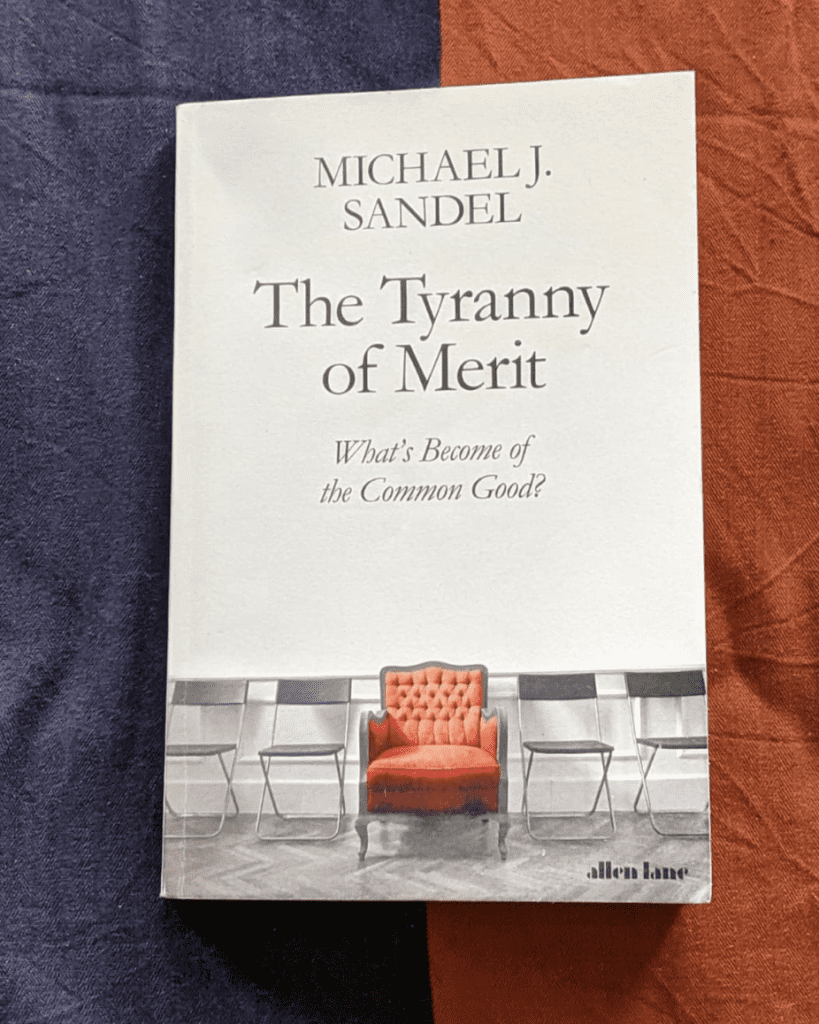
If I go by my blog posts, it was in 2004 that the thought first occurred to me – “humankind protests against all kinds of disparities – race, sex, age etc..but aren’t institutions like IIMs promoting discrimination based on intellectual aptitude“. I did not know the word meritocracy then (coined by Michael Young in 1958, who saw it as a dystopian concept), but since 2015, the word and the world it has created has been appearing in many of my posts. That’s why this was a book I was looking forward to. And it didn’t disappoint. Despite an American context, it peels the layers, and the insights are universal.
Meritocracy began as a remedy, and its earliest proponents probably understood that while it may not be able to bring about equality, it could help create mobility across the levels of society. Unfortunately, it has increasingly moved away from that purpose too, and has now created a system where those are already privileged have a disproportionate advantage over those who do not. And no, education, especially the way it is now, is not a solution. And anyway, mobility can no longer compensate for inequality. Meritocracy was a means to an end, but I can’t help but think that its progress is mirroring that of a related “inter-subjective” concept – money, which is now an end in itself.
The author begins with the recent success of populist movements – Trump, Brexit – some of which are a threat to democracy, and provides his perspectives on why they were able to rally people. The answers lie beyond the usual suspects – backlash against racial, ethnic, gender diversity, and the dislocation caused by globalisation. In short, a technocratic way of conceiving public good, and meritocratic way of defining winners and losers. The former removes moral arguments from public discourse and treats them as matters of economic efficiency. The technocratic version of meritocracy de-links merit and moral judgment, by defining the the common good only in economic terms, and equating it to GDP. The latter creates hubris among the winners by deeply embedding the thought that their success is all their own doing without luck or privilege playing any part, and humiliation and resentment among the losers, by making it seem that their status is purely their fault. The author does an excellent job of highlighting this change through the American political rhetoric, and the “you deserve it” narrative in everyday life.
For the longest while, education was the ticket to the “American Dream”, but this has created damage on multiple counts. It has eroded the self esteem of those who have not gone to college, devaluing their contributions, and making it seem the sole reason for their lot in life. It has also promoted credentialism, the “last acceptable prejudice”, making a college degree a pre-condition for dignified work. “Smart vs dumb” began to replace “just vs unjust” and “right vs wrong” in public discourse and policy. Democratic institutions too became the exclusive preserve of the credentialed class (in the West) making it less representative. The author shows how the support base of various parties have changed over decades, alienating the working class and adding to polarisation.
There is a fantastic section on whether we deserve our talents, or are responsible for the value that society happens to place on them. While he acknowledges the effort involved in success, there really is no question on the importance of talent in the overall equation. Another part that really proved to me how I was conditioned to accept meritocracy was the exploration of free-market liberalism and welfare state liberalism’s alternatives to meritocracy. In the first, the author quotes Friedrich A Hayek, when pointing out that “Market outcomes have nothing to do with rewarding merit. Merit involves a moral judgement about what people deserve, whereas value is simply a measure of what consumers are willing to pay for the goods and services sellers have to offer“. In the second, he quotes John Rawls, “If people competed on a truly level playing field, the winners would be those endowed with the greatest talent. But differences of talent are morally arbitrary as differences of class“. Later in “Success Ethics”, he uses Frank Knight’s “..meeting market demand is not necessarily the same thing as making a truly valuable contribution to society.” Also useful was the nuance between deserving and entitled, and the rabbit hole of moral thinking it opens up. The author also provides recommendations on how we can attempt to fix this tyranny – in the domains of education and economics.
Why is all this important? Technology is making more and more jobs extinct, and my generation is already feeling the pain. Beyond the economic aspects, work also makes huge contributions to meaning, dignity, and does its share of removing our fear of becoming obsolete and irrelevant. Contributive justice, as opposed to the distributive justice that both sides of the political spectrum are attempting to achieve. To quote R.H.Tawney, “Social well-being… depends upon cohesion and solidarity…Individual happiness does not only require that men should be free to rise to new positions of comfort and distinctions; it also requires that they should be able to lead a life of dignity and culture, whether they rise or not.” By promoting meritocracy and free-market evaluations of our contributions, we are increasingly removing that agency from a human’s life.
If there’s one thing that Stoicism has taught me, it is that the good fight is not with the world, but yourself. Many of the books I read and observations I try to make on family are to get a better understanding of the ‘why’ behind my thinking. Among the many things that “Behave” gave me insights on was this, and an explanation for how siblings can be very different in terms of mindset and behaviour, despite inheriting not just ‘nature’ but sharing ‘nurture’ too.
‘Another dogma was that brains are pretty much wired up early in childhood – after all, by age two, brains are already about 85% of adult volume, but the development trajectory is much slower than that. …the final brain region to fully mature (in terms of synapse number, myelination, and metabolism) is the frontal cortex, not going fully online until the mid twenties.‘
“…the brain is heavily influenced by genes. But from birth through young adulthood, the part of the human brain that most defines us (frontal cortex) is less a product of the genes with which you started life than of what life has thrown at you. Because it is the last to mature, by definition the frontal cortex is the brain region least constrained by genes and most sculpted by experience. This must be so, to be the supremely complex social species that we are. Ironically, it seems that the genetic program of human brain development has evolved to, as much as possible, free the frontal cortex from genes.”
Brain Pickings has been one of my favourite websites for a long time, and thus, this book automatically went into the wishlist. But as with many good things, it took a while to get into the cart! This is not a book that one can (or should) categorise easily, but as a reader, what I got was an appreciation of the essence and texture of life, and its interconnectedness. The book, I’d say, is poetry delivered in prose. A good thing for people like me who cannot appreciate the former! I read the title -“Figuring”, both as exploration and understanding, as well as mathematics being the language of the universe, but I am guessing it’s the first that the author intended.
The narrative is guided by the lives of many people. Some of them easily known, and some others not famous enough, unfortunately and unfairly. The book begins with Johannes Kepler, who would “quarry the marble out of which classical physics would be sculpted”. The stargazer, writer of science fiction, whose North Star was the discovery of truth, irrespective of what society thought of it. Including an insight far ahead of time – “The difference between the fates of the sexes is not in the heavens but in the earthly construction of gender.”
Maybe the narrative was constructed with intellectual successors in mind too. And it’s probably through the years of sifting through content for the blog that the author found connections between the historical figures – events, mutual friends, pure chance, dates. And thus it is that we reach Maria Mitchell, “besotted with the splendour of the cosmos”, all of 12 years old, catching an eclipse, and beginning her journey towards becoming America’s first professional astronomer. She would hold Mary Somerville, Elizabeth Barrett Browning, and Caroline Herschel as examples of the era’s “few women of genius who have become the successful rivals of man in the paths they have chosen.” Ada Lovelace has a brief cameo here too.
In 1825, Margaret Fuller is fifteen, and writes that “I am determined on distinction”. In 1845, she would author “Woman in the Nineteenth Century” that “lit the Promethean fire of possibility for women”. Even as her intellectual life soared, there were very few highs in her personal life. Much like Emily Dickinson, whose hundreds of poems were “verses of unambiguous beauty that thrill and taunt with their ambiguous meaning”. Though she was not well-known during her lifetime, she is now regarded as one of America’s foremost and unique poets.
Harriet Hosmer started her battles against expectation and convention fairly early in life, but with that also came the awareness that “everyone and everything we love is eventually swept away”. And yet she gave humanity a distinct perspective of what is possible as an artist and a human being.
The last recipient of the intellectual torch (in the book) is Rachel Carson, a relatively more contemporary figure. In another show of narrative mastery, the author links Carson’s story to its beginning – Lise Meitner, a pioneer in nuclear physics, whose scientific discoveries would have malevolent applications. A turning point for science and humanity. As Rachel Carson would observe years later, “We still talk in terms of conquest. We still haven’t become mature enough to think of ourselves as a very tiny part of a vast and incredible universe.. We’re challenged, as mankind has never been challenged before, to prove our maturity and mastery – not of nature but of ourselves.” Rachel Carson showcased and ignited the questions and fights that have now become global environmental movements.
The book forces us to ask the essential and existential questions – what makes a good life, what does it mean to live one that positively impacts humanity? And to me, whether it is worth it. Meanwhile, to note that along with these personalities, there are also giants in the periphery, who are probably more popular – Ralph Waldo Emerson, Charles Darwin, Nathaniel Hawthorne, Walt Whitman, and so on.
As I wrote before, the book is difficult to categorise not just because of its narrative style and content, but also because of the multitude of themes it covers – feminism, Transcendentalism, queer relationships, the stars in the sky and the life on the ocean floor – all from the perspective of “the pale blue dot” and its sentient beings.
P.S. With 100 pages to go, I had a visceral experience of the transience of life – a heart attack! Such is life.
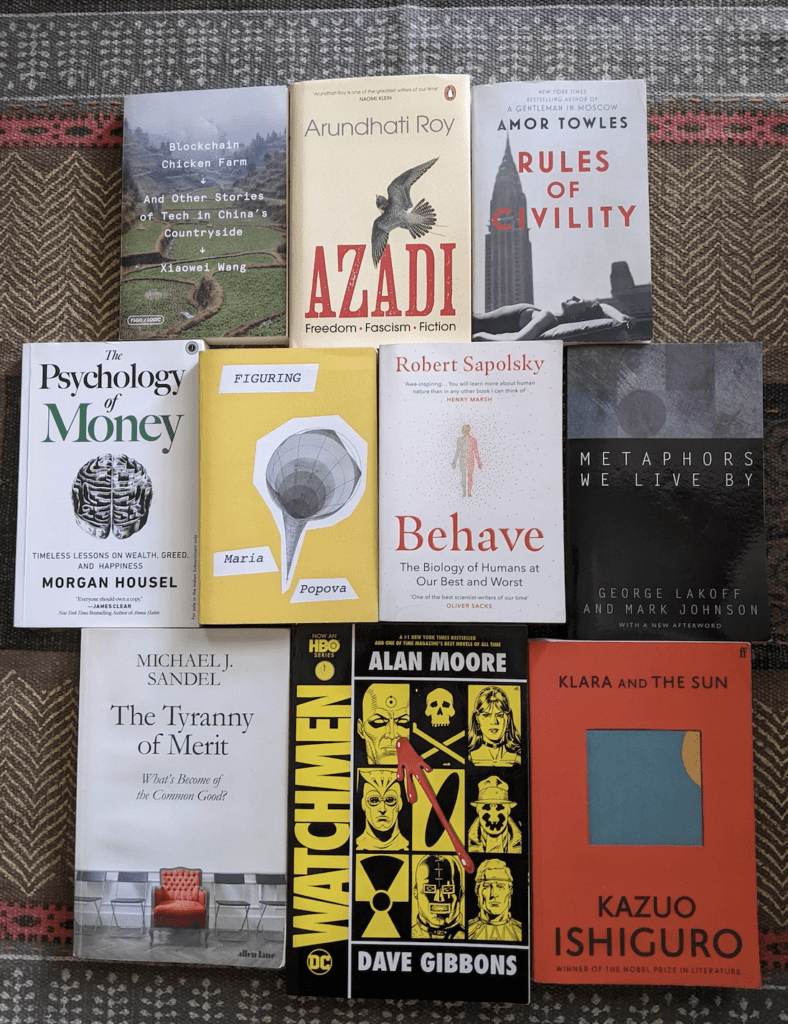
Oh well, since Gates doesn’t have a monopoly these days, I thought I’ll continue this from last year and the year before. Actually, it’s for a couple of reasons. One, I think there are underlying themes in my reading every year, which will be interesting to examine years later. And two, if someone chances upon these, they will hopefully be able to discover new books and themes for themselves. The shortlisting was tougher this year, because the list was slightly bigger, and the quality of books was also great. My long list from the 50 books I read this year was closer to 20, and I’ll mention them in the relevant places.