Month: December 2021

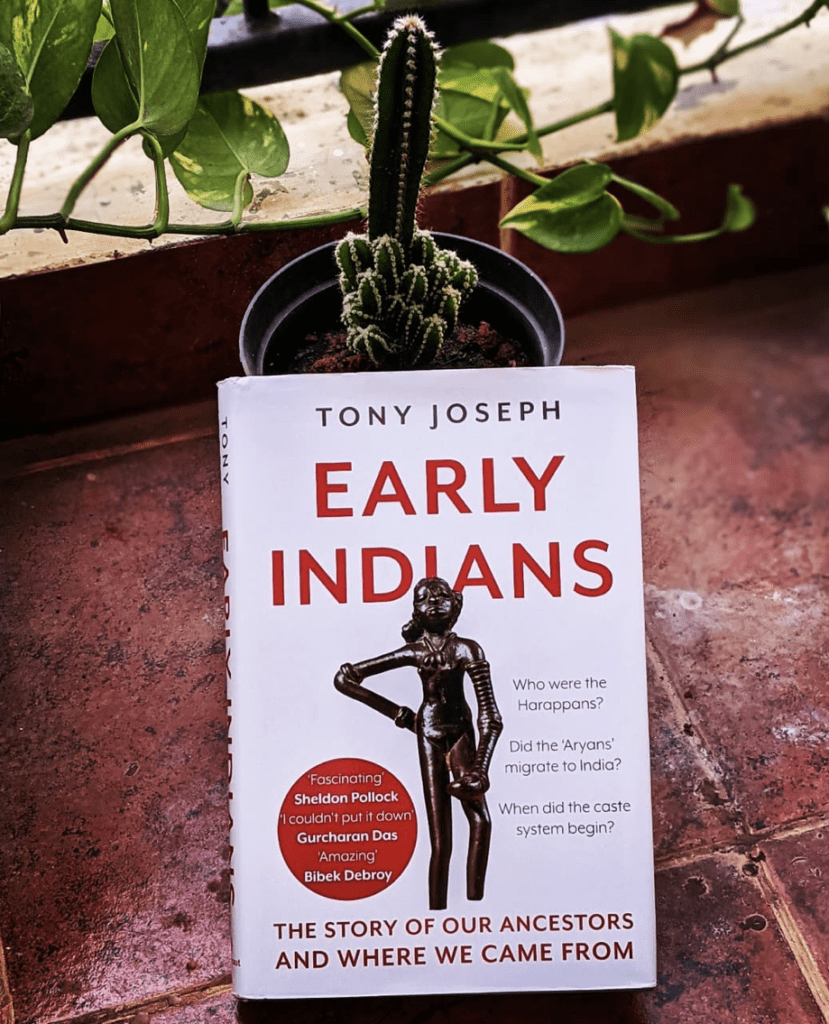
  • Early Indians

    Before I get to how wonderfully interesting this book is, I have to say I am surprised it hasn’t been banned yet! It easily, and scientifically I would add, dismantles all of the Indigenous Aryans and Out of India Aryan migration theories that have been doing its rounds on not just WhatsApp but larger forms of media, and encouraged by the current powers that be! 

    Tony Joseph starts right from the beginning to answer the questions, “Who are we Indians? Where did we come from?” The beginning is about 65ooo years ago, when Homo sapiens decided to venture out of Africa, and subsequently entered the Indian subcontinent. Although if you ask an archaeologist, the answer would be 120000 years! They are referring to the first group of modern humans who left behind archaeological evidence. The 65000 comes from the geneticists who are talking of humans who left behind a lineage that is still around. 

    The author uses the metaphor of a pizza to show how we got here. The First Indians, from the previous paragraph, forms the base. The story of the next layer – the sauce- begins in the Levant (West Asia), where approximately 20000 years ago, hunter-gatherers were being stressed by the glacial period that turned many areas uninhabitable. Many centuries of experiments on gathering and processing food later, when plant and animal domestication began to see success, some Zagrosian (region of Iran) herders reached Balochistan, around 7000 BCE, mixed with First Indians and formed the basis of the Harappan Civilisation. 

    I don’t think we appreciate the Harappans enough. They were really advanced for their time, in their unique practices and outlook, across multiple facets of what we call civilisation. Public infrastructure, weight standardisation, jewellery and pottery, they excelled at many things. They were around for over 6000 years, created the Dravidian languages and were the ancestors of all Indians. There are some word examples that show the connection between Elamite – an extinct language spoken in a region that is part of present day Iran – and Tamil, Malayalam, Telugu. The occurrence of places ending with vali/oli in Western and Southern India is because of the Proto-Dravidian language connection as (some of) the Harappans started moving southwards when their civilisation collapsed. Fascinating stuff! 

    Back to the pizza. The Aryans were the “cheese” who arrived from the Steppe around 2000 BCE. It was the Aryans who brought in the Indo-European languages. They originated in the Kazakh Steppe and moved across Southern Central Asia and then South Asia. And yes, the earliest Vedas postdates the Harappan civilisation. So it’s not as if the Harappans were the Aryans! The present day Indian population is a product of the intermingling of two sets. ANI [Ancestral North Indians – made up of Harappans (First Indians + Zagros agriculturalists) + Steppe pastoralists] and ASI [Ancestral South Indians – Harappans + First Indians (south)] In addition we have toppings in the form of Austroasiatic and Tibeto-Burman language speakers as well as Greeks, Huns, Sakas, Parsis, Mughals etc. 

    There are three distinct areas of science that have contributed to our understanding (even if it is not complete) of the answers to the two questions. Archaeology, genetics and linguistics. They have their “little” differences, but collectively, they have provided substantial scientific proof. 
    And now, after everything that happened from then until the present day, if we ask who is the best representation of Indians at this point, the answer is a tribal woman, because she carries the deepest rooted lineage. Adivasi (first inhabitant). How ironical given the way we treat them! Civilisation and progress! 

    A must-read if you are even remotely interested in history.
  • An incognito good life

    For a particular generation, Wet Wet Wet’s “Love is all around” from the soundtrack of “Four Weddings And A Funeral” is a special song. And thus, catching Andie MacDowell (yes yes, Sex, Lies, and Videotape too) in Maid was a pleasant surprise. She plays Paula, mother to Alex, played by her real-life daughter Margaret Qualley, and grandmother to Maddy, Alex’s daughter.

    Paula is an artist, reasonably disconnected from reality. Probably her way of coping with the unpleasant things that happened earlier in her life. In Episode 3 (Sea Glass), we see her preparing for an art show. (Minor spoiler ahead) When Alex (who did a lot of heavy lifting literally and otherwise) drives her to the gallery, it turns out there is no show. Paula had completely misread some charitable comments made by the curator! She might have been a flavour at some point, but is now middling, at best.

    At dinner on the same day, Paula and Alex squabble, with Paula delivering a low blow. But the next day, when Alex returns to her (temporary) home in the evening, she finds that Paula was there earlier, and had painted a wall mural for Maddy. Maddy gets all giggly and excited.

    And all that was one part of the context. The second part is what I have been reading in ‘Lives of the Stoics‘, around the same time. ‘We naturally care what people think of us; we don’t want to seem too different, so we acquire the same tastes as everyone else. We accept what the crowd does so the crowd will accept us. But in doing this, we weaken ourselves. We compromise, often without knowing it; we allow ourselves to be bought – without even the benefit of getting paid for it.‘ 

    I thought about it in the context of Paula’s exhibition vs mural. Exhibiting one’s expressions (art) to a crowd which is seemingly interested in such things vs delighting her daughter and grand-daughter. I understand it does not always have to be an either-or, but I think we subconsciously optimise for one or the other, and neurons wire together etc.

    As I have written before, when the ‘why’ of creation changes, so does the ‘what’. And there are many slices to this. For instance, doing something because it gives me joy vs doing it for validation from ‘Instafam’ or Tweeps. And not just validation, but validation at scale – ‘We have created a world where we reward the manipulation of quantities more than the appreciation of qualities.’ ~ Roger L. Martin. There is another slice, more on that later.

    For some time now, I have consciously tried to avoid this direction, and instead, focused on a different path. From experience, it is a matter of training one’s mind, and being mindful of the distractions. Easier said than done, especially when a staged presence has a direct implication on things like employability. But possible.

    For me, success is not a public thing. It’s a private thing. It’s when you have fewer and fewer regrets.‘ ~ Toni Morrison. For instance, something I am grateful for is the ability to make people laugh. Not a prepared standup act, but something on the spur of the moment, with a bunch of contexts built in. These days, when I am able to make D laugh, I consider the day a success. I also find the opportunity to make friends and colleagues smile rewarding.

    Not that I don’t share random wordplay on Twitter, or don’t find validation pleasing, but I am increasingly becoming ok not getting it either. Just being able to do it makes me happy. ‘To have but not want, to enjoy without needing.’ 

    And then there is the other slice. The work on this continues, but that’s another post.

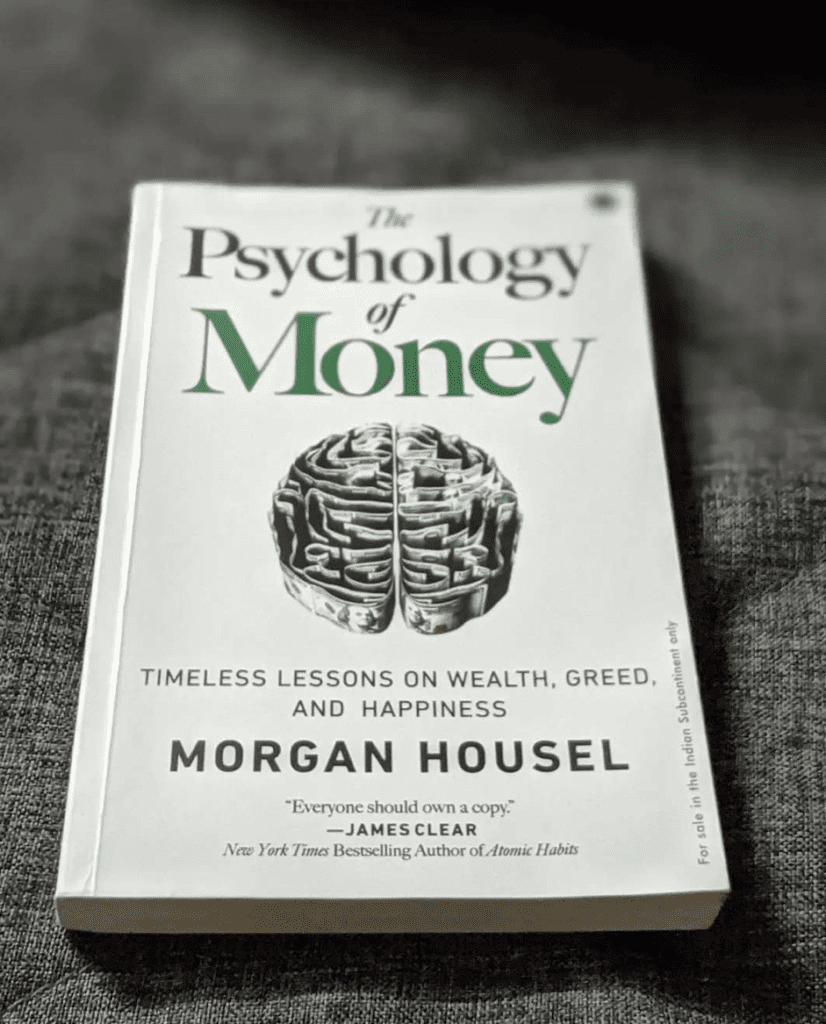
  • The Psychology of Money

    Morgan Housel

    My job is at the intersection of marketing and personal finance, and that’s the reason why I appreciate this book even more. It is a difficult subject to communicate, but a job that needs to be done. What makes The Psychology of Money really good is that it views money not (only) through the technical lens, or the “get rich” advice, but explores the emotional aspects of personal finance, and then articulates in a way that is relatable. I might be a little biased because I subscribe to the author’s worldview, and apart from index fund investing, have exactly the same approach. But I think everyone should read this book, because, as the author quotes (Voltaire), “History never repeats itself; man always does.”

    I will try not to paraphrase the lessons because they need to be read in the author’s narrative style for them to (hopefully) sink in. He begins with calling out the fact that personal finance is well, personal, and while there are definitely rules in finance and investing might, one’s behaviour is based on one’s experiences and emotions. And some of it is very generation specific. For instance, the idea that one is entitled to a dignified retirement life took root only in the 1980s! 

    He then moves on to risk, and the role of luck, followed by the importance of knowing what you really want, and then, some excellent illustrations of the “magic pill” – compounding – at work. The next couple of chapters make some key points that are often ignored- the difference between getting wealthy and staying wealthy, and the importance of “tail events”.

    The definition of “freedom” is something I could completely relate to. I’d flip the original maxim for a quick understanding – “money is time”. The more agency over time I have, the happier I am. The next two chapters about wealth are extremely insightful – no one is as impressed as your possessions as you are, and spending money on showing others that you have money is the fastest way to lose it! Wealth is income not spent, and it increases optionality. And while, one cannot control externalities, what is possible is an efficiency in savings. “One of the most powerful ways to increase your savings isn’t to raise your income. It’s to raise your humility.” 

    The following chapters get deeper into the how emotions play a large role in financial decision making, how it is better to be reasonable than trying to be coldly rational, and also, how important it is to leave room for error. I really loved the Benjamin Graham quote – “the purpose of margin of safety is to render the forecast unnecessary.” This is also important because our own desires and notions of happiness change with time. There are also some nuanced perspectives on optimism, and my views about it have changed now! 🙂

    Another extremely important lesson is not taking financial cues from others without really understanding what game they are playing – what are they optimising for, and why. e.g. day traders vs long-term investors, at a transactional level. The author uses the final chapter to show what he is aiming for, and therefore the rationale behind his own investments. 
    As I mentioned earlier, the author’s goals resonate with me – “..you only do the work you like with people you like at the times you want for as long as you want.” But at the risk of repeating myself, I think this book will help you frame your relationship with money, irrespective of where you are in your thinking and understanding of personal finance. So I insist you read it! Now!

    P.S. The postscript is an excellent read on how the US economy and its people got to where they are, both in terms of macro economic events and trends, and expectations. It’s superbly insightful in terms of understanding consumer psyche. Wonder if someone has done this for India.

    The Psychology of Money by Morgan Housel
  • Ex-communities

    One of the pleasant side-effects of the pandemic in Bangalore is the (relative) reduction in time to get to places. That meant I didn’t grumble much when we had to make a trip to Jalahalli. The original plan was to use the Metro but thanks to the reduced time, we took a cab. Typical tourist behaviour! (For Whitefield residents, Jalahalli is practically tourism)

    Our destination was somewhere inside the HMT kingdom and on our way back, as the sun began its descent, the backseat of a car was a great place to reflect on folks spending their Sunday evening. Using HMT and time together is predictably Facebook meta, but there is a poignance in the vestiges of a once thriving community. A cinema, an officers club, an auditorium, a playground, a hospital and even a museum, all centred around a factory. Someone’s vision of a self-sufficient ecosystem.

    And like all ecosystems, it has a shelf-life. But parts of it persist, and the crowd in the playground, where two cricket matches were being played simultaneously, was proof of that. It reminded me of the university campus, and a phrase I had used for it almost a decade ago – islands in time.

    I am probably biased because I am an 80s kid. Technically 70s, but hey, what’s a couple of years in a few decades? I think the ecosystems that I experienced in the 80s gave people a shared identity. And I could not help but juxtapose this with apartment life. Yes, we call it community, but how many really are?

    I also believe we have been moving relentlessly towards a more individual-centric was of living. Technology and specifically mobile internet has accelerated it. Ironically, the pandemic was a speed breaker that made us realise our shared existence in isolation, but the lesson, I pessimistically believe, won’t stick. Algorithms ensure that our digital consumption is a warped version of reality tailor-made for the individual. And when everything from food to self actualisation is a swipe away, community gets played differently.

    One shift is from real to digital. I am old enough to remember the first years of the consumer internet (in India, at least) and the online communities then. IRC, anyone? 🙂 And the early days of Web 2.0 – from Google Reader to Del.icio.us to Twitter. Yes, these ecosystems too have a shelf life. The internet has matured, and by definition, that is a loss of innocence. And likes and ‘fams’ simultaneously reveal and exacerbate the malaise within. I happened to be reading Behave, and found this paragraph relevant here –

    …neighbourhoods readily communicate culture to kids. Is there garbage everywhere? Are houses decrepit? What’s ubiquitous – bars, churches, libraries, or gun shops? Are there many parks, and are they safe to enter? Do billboards, ads and bumper stickers sell religious or material paradises, celebrate acts martyrdom, or kindness and inclusiveness?

    Look around, across real and virtual neighbourhoods, and think about what you see. Maybe it’s me, but it is indeed ironic that the era of hyper-connectivity creates an inherent sense of disconnectedness. Not just from others, but from the self too. That, is a dangerous place to be.