Month: November 2021

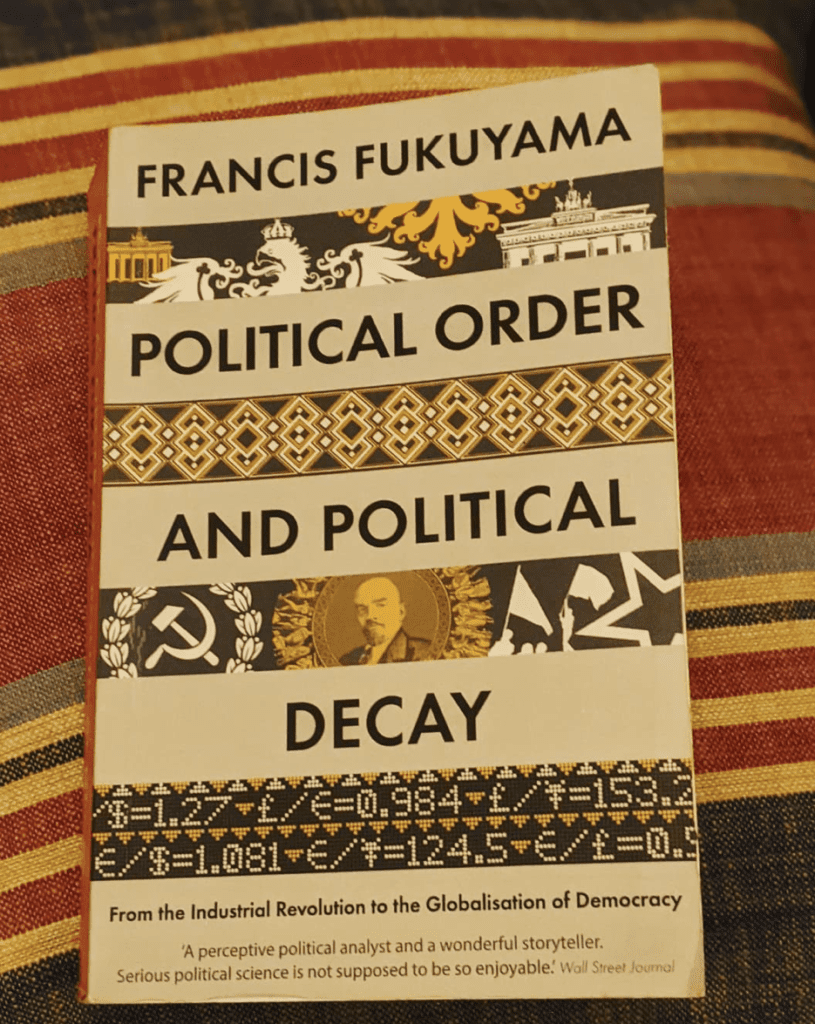
  • Political Order and Political Decay

    Francis Fukuyama

    The first volume – The Origins of Political Order – went straight into my favourites, and so does this one. While the former was about the components of a stable state, and how political institutions developed differently in various parts of the world, this book begins at the dawn of the Industrial Revolution and shows how state, law and democracy developed to their current state, by (also) considering three additional dimensions of socioeconomic development – social mobilisation, idea legitimacy, and economic development. The industrial revolution and the economic growth that followed caused a movement to urban areas, where new social groups were formed based on fluid identities. This mobilisation serves as a foundation for changing political institutions with new ideas. The book also throws light on the various reasons for the decay of institutions, and offers directional thoughts on fixing them. 

    The author frames the development of the stable state by asking how a country can “get to Denmark”, which is the benchmark for an ideal state. While there is some specific focus on the US, also warranted by its early and unique path to democracy, the depth of analysis that has gone into many countries, across Asia, Latin America, Africa, Europe, is just astounding! History, economics, policy, geography, (with critique and usage of content from another favourite book – Guns, Germs & Steel), culture and many other facets, all going into understanding the state of politics in a particular country. There are many routes to modern government, including the necessities that war creates (“unfortunately”, Latin America never had its share, and Europe had plenty of it – both have class stratification, national identity, and geography to thank) and peaceful political reform. And once there, the principle of effective government is meritocracy, the principle of democracy is popular participation, effective states operate through law, but law can be an obstacle to appropriate levels of administrative discretion – how is balance achieved? The material is phenomenally complicated, and bringing it to this level of accessibility is something the author should be credited for. 

    The first part of the book focuses on parts of the world that experienced liberal democracies first – Europe and the US. It also analyses why Germany has an uncorrupt administration while Italy and Greece are plagued by corruption. In the former, how is state strength related to organised crime? How does cynicism and social distrust get culturally embedded? How were Britain and the US able to reform themselves from patronage-led public sectors? And why was Britain able to get there faster than the US? An active middle class accelerated Britain while US got a unified business community and middle class professionals only in the late nineteenth century. At a broad level, we learn early that the sequencing of events matters greatly. Countries where democracy preceded state-building (US) have had higher problems in achieving high-quality governance than those who inherited modern states (Germany, through some excellent civil service reform and an educational system) from absolutists. And that democratic societies without a strong national identity have trouble unifying the population with a common narrative. 

    The second part deals with parts of the world that had been colonised – Latin America, Asia, Africa, and the Middle East. When the imperial powers left, many of these nations were neither fully Westernised nor able to retain their traditional political organisation. However, there are success stories like Costa Rica, which according to many frameworks should have become a banana republic. There are also disasters, like Argentina, which, blessed with climate and resources, should have become a model country. The reasons are complex, and Sub-Saharan Africa vs East Asia is a great example of different development paths. In both areas, as well as Latin America and the Middle East, states that had strong institutions were able to reestablish them, while those that didn’t struggled. Interesting to note that African ethnic groups are largely a modern phenomenon, created or at least consolidated in postcolonial times! The specifics of the Japanese system and how their military-led nationalism has evolved until the present day is also fascinating. The problem that East Asia now faces is making the state accountable. The nuanced difference between rule by law (state using law for its ends) and rule of law (law binding on the state) is superbly explained. In the Middle East, the threat is that popular mobilisations risks being hijacked by religion. 

    Part 3 focuses on democratic accountability and goes back in time to the period after the French and American revolutions to see how democracy spread. The timing in various countries vary depending on the changing relative positions of social classes – middle class, working class, elites, and peasants. The rise and growth of middle class was a great catalyst to democracy. While doing this, it raises a question extremely important for the current times – with increasing globalisation and technological advances, the middle class is getting hollowed out. What happens to democracy then? 

    The final section of the book is on political decay, and there is a heavy focus on the US, which has now gotten tied up in the very checks and balances it had set up to protect democracy. In the author’s words, “there is too much law and too much “democracy” relative to the American state capacity”. It has now become a vetocracy, with economically powerful special interest groups and the judicial arm having hijacked the system and preventing reforms. No modern book can avoid China, and this is further proof. The author sees the Chinese model as the biggest nondemocratic challenge to the idea of liberalised democracies. How will the Chinese middle class behaves in the next few decades? Even as it grows, will it be content to live under a “benevolent” one-party dictatorship? 

    I think I will re-read both volumes, they are such treasure troves of information. If you like books that explain the system of the world, this is a set you most definitely should pick up. 
  • Ironhill

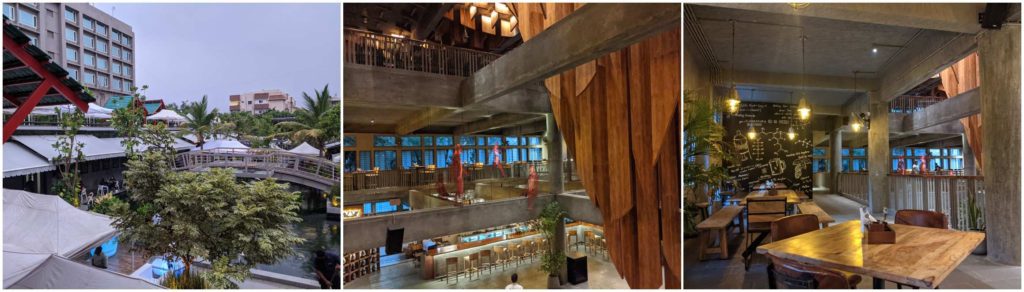
    Back in April, my Insta feed was full of urban Bangaloreans who couldn’t be in Maldives and had to make do with Marathahalli, specifically Ironhill. It’s touted to be India’s largest microbrewery. The place is a combination of the Venice-meets-Varthur look (and smell) perfected by Big Brewsky and Hoot in the open areas, and an 80s industrial grey vibe-meets- rustic chic interior that’s spread across at least three floors. When we called to reserve, we were told that it was already full for the weekend, and we could take our chances walking in. At 5.30, we were able to get a table, though inside, and sat amidst a mix of multi-generational family crowds, and pouting beings scouting backgrounds for their Insta fam.

    The only reason I’d visit any place in Marathahalli is craft beer, and thankfully 6 out of the 8 beers were available. I use thankfully very loosely, because after running through the samplers, we settled on the least offensive Sincity Cider and Wonderland Wheat. This only verified my hypothesis that if in Marathahalli, abandon all hop!

    Since my intake of spice have been put on ice for a while, we started with the Tandoori Malai Chicken dimsum. It seemed to have spent quite some time in transit, and that meant our relationship with it was lukewarm. Next up was the Moroccan Chicken skewers, which were a bit spicy but enjoyable. The safest bet when it comes to pizza is usually the BBQ Chicken and true to form, this one too was decent.

    The service is quite friendly and prompt, and our bill came to a little less than Rs.2000. Overall, you won’t miss anything if you don’t visit.

    Ironhill, 90/7 & 90/8, Outer Ring Road, Marathahalli, Ph: 9606044623/4

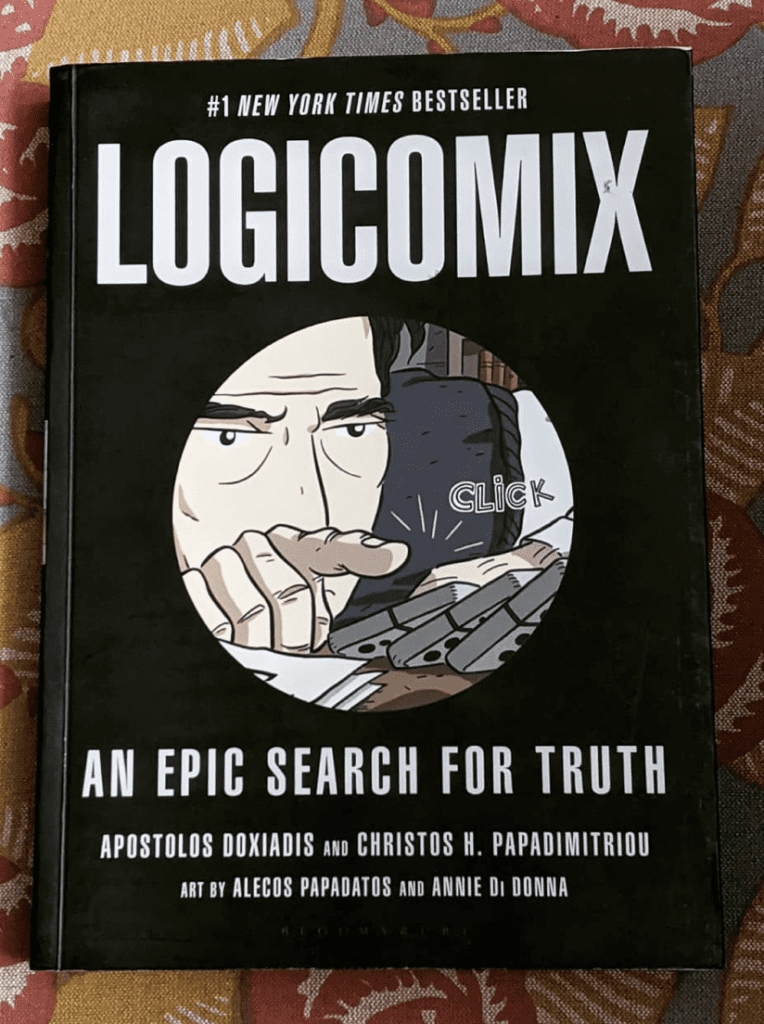
  • Logicomix

    Apostolos Doxiadis, Christos H. Papadimitriou, Alecos Papadatos (Illustrator), Annie Di Donna (Colorist)

    I have to confess I gamed this a little. This is my 300th review on goodreads, so I wanted it to be a special. So I chose a unique book – a graphic novel whose title also includes “an epic search for truth”. And thankfully, it was a fantastic experience. 

    While the story is based on the life of Bertrand Russell, it is presented through the different perspectives of its makers too. In a sense, we get to see the debates they had and how they progressed on the storytelling. Self-referential is a multi-meta when we’re talking of logic, and paradoxes! Russell is a mathematician but mathematics is also his language to engage with philosophy and thus “the truth”. Indeed, it is difficult to draw clear lines between the two deep subjects, and it only gets deeper when you add logic into the mix. The journey is as spiritual as it is scientific. And many believe it is solvable. To quote Hilbert, “In Mathematics, there is no Ignorabimus (Latin for “we shall not know”). As Russell continues to work on his Herculean task of establishing a logical foundation for all mathematics, he crosses paths with some of the foremost thinkers of the era, and probably of all time. Kurt Gödel, Ludwig Wittgenstein, Alfred North Whitehead, Henri Poincaré and so on. (the creators note that some instances have been created for narrative purposes)

    The story is rendered in flashback mode, as Russell is asked to lend his voice to those who oppose US involvement in WW2. I found it a perfect setting as he practically narrates his life thus far, and in the end, his response to the protesters pretty much summed up what he learned from his life and his quest. Though the novel is primarily about Russell’s pursuit, it also gives the reader a view of his life in the real world – his lonely childhood, his many marriages, his friendships, his relationship with his student Wittgenstein, his passion to bring a sense of order, the connection between madness and logic, and his stance on the two world wars. All of this makes it a deeply layered book with some wonderful thoughts. “The tragic loneliness of every human being. The finiteness and profound futility of life”

    But I think the reason why I loved this book was also because it resonated a lot with my perspectives, my affection for logic, and the lessons I have learned when I have tried to bend reality to fit it. (“Sure, Frege, Russell, Whitehead were excellent map-makers, but maybe eventually they confused their reality with maps” “All the facts of science are not enough to understand the world’s meaning“) This also leads to a lot of over analysis. (As Russel writes, “Like me, he was constantly analysing everything, a habit deadening to the emotions“). And something about the genesis of it all – “Maybe what brings them to logic is a fear of ambiguity and emotion“. But of many moments, I think my favourite is when Wittgenstein survives a near-death experience and understands that”The meaning of world does not reside in the world“.

    Even if you’re not into graphic novels (I am not), this one is a must read.

    P.S. If you have read similar books, do share.

    Logicomix : An Epic Search for Truth
  • Next change

    This little phrase is from the PT classes of the 80s – the command to change the drill pattern. I was reminded of it as we started making our way back into the real world after 18 months.

    After a whole lot of deliberation, we began a hybrid model at work in mid- September. To be honest, I wasn’t exactly thrilled, primarily because of two reasons. One was the obvious one – the rigours of the daily commute. In addition, I felt that I was more productive at home. But it wasn’t so bad. Not so surprisingly, the time for commute has been cut by half as most folks are still WFH. I continued to read on the way to office, but instead of watching a show on the return journey, I chose a favourite pastime – people gawking. Maybe I’ll get back to shows after the initial days and/or when the commute time starts matching the episode times! And surprisingly, I found a strange comfort in being in office. Despite the chaos of many people in nearby cubicles being on different calls, getting to meet old friends, and new ones whom I had only met online, was very pleasant. Not to mention a certain reassurance of watching people work towards the same goal.

    Life had changed quite a bit too. D and I used to spend Saturday evenings discovering new eateries or revisiting favourites. But now, even though we have the option, we prefer staying at home with sundowners on the balcony, and ordering in. Thus, weekly excursions have become fortnightly. We still look forward to travel though, though we still don’t know when we will get back to it.

    I wrote this post for a couple of reasons. One, the usual premise – how would this read a decade from now? A good test to understand how my mind has remembered the return to civilisation. The other is to remind my later self about a few lessons learnt. One, while neurons that fire together might wire together, there is also a certain unpredictability of attitudes – as evidenced by my reaction to the return to office. The mind, in many respects, remains unfathomable, in its capacity to both resist change, and to normalise. Two, being able to change one’s mind is a superpower, especially as one gets older. And three, in many of the daily interactions one takes for granted, there is an inherent joy that sometimes gets obscured.