Month: October 2021

  • The Gollancz Book of South Asian Science Fiction

    Tarun K. Saint (Editor), Manjula Padmanabhan (Foreword)

    Once upon a time, the only fiction I used to read were those written by Indian authors. The reason was a relatability to the contexts and references. The only exception was science fiction, in which the situation was exactly the opposite. After I read Strange Worlds! Strange Times!, I realised that a further exploration of Science Fiction from this part of the world was warranted. And that’s how I picked up this book. Though the title has ‘South Asian”, the entries are from only India, Pakistan, and Bangladesh. It’s a collection of 28 works – mostly prose, with some poetry, and many stories actually fall under the broader ambit of speculative fiction. As with other fiction, there was an immediate affinity for many of the contexts and references in this book too. While the premise in many were promising, I really liked only a handful. 

    Harishankar Parsai’s “Inspector Matadeen on the Moon”, translated by C.M. Naim, is satire on full throttle and takes some excellent digs on the police force, bureaucracy and attitudes of citizens. Anil Menon’s “Shit Flower” has wordplay in the title itself, and continues that trend all through the story. But set in a Mumbai of the future that has suddenly lost control of its “bowels”, it also has a wonderful take on life and memories, while taking jabs at organised faith. 

    Shovon Chowdhury’s “The Man who turned into Gandhi” imagines Gandhi in contemporary times and is packed with humour and irony. Tarun Saint, also the editor of the book, authors “A Visit to Partition World”, with the story set in a “Westworld” with a Partition theme. A very interesting idea that I think might actually happen at some point! Mirror-Rorrim by Clark Prasad is an exciting thriller with its protagonists trying to solve mysteries across both identity and time. And it has Star Trek references! Manjula Padmanabhan’s Flexi-time is an intriguing mix of “Arrival” and Indian idiosyncrasies. 

    “The Other Side” by Payal Dhar features a young girl who discovers family secrets in an authoritarian future. Aliens and railways collide in the racy 15004 by Sami Ahmad Khan. The inspiration for “The Last Tiger” is evident – “modelled on the Great Leader from the early 2000s”. A satirical tale on an unusual Republic Day event involving the last tiger. Rimi B Chatterjee’s “A night with the Joking Clown” has a cyberpunk feel to it but also has a view on genders and relationships. Vandana Singh’s “Reunion”, the last story in the book, introduced me to cli-fi (climate fiction!) and made me wonder if the scenario she describes is the future. 

    Overall, if you want to to get a sense of Science/Speculative fiction from this part of the world, give it a shot. 

  • A digital multiverse

    It was towards the end of 2020 that I came across Roblox and wrote Metaverse : Get a second life. Since that post, Mathew Ball has written the definitive primer on the Metaverse1, and if you’re interested in the subject, it’s a must-read. The word “metaverse”, ICYMI, was coined by Neal Stephenson in Snow Crash, and the book is being referenced in many recent conversations. In fact, Stephenson has been quizzed for years, each time we seem to take a step in this direction, and his comments continue to be prescient, insightful and hugely creative. This one, from 2017, in Vanity Fair, is a favourite, and contains, among other succinct gems

    The purpose of VR is to take you to a completely made-up place, and the purpose of AR is to change your experience of the place that you’re in.

    Neal Stephenson
    (more…)
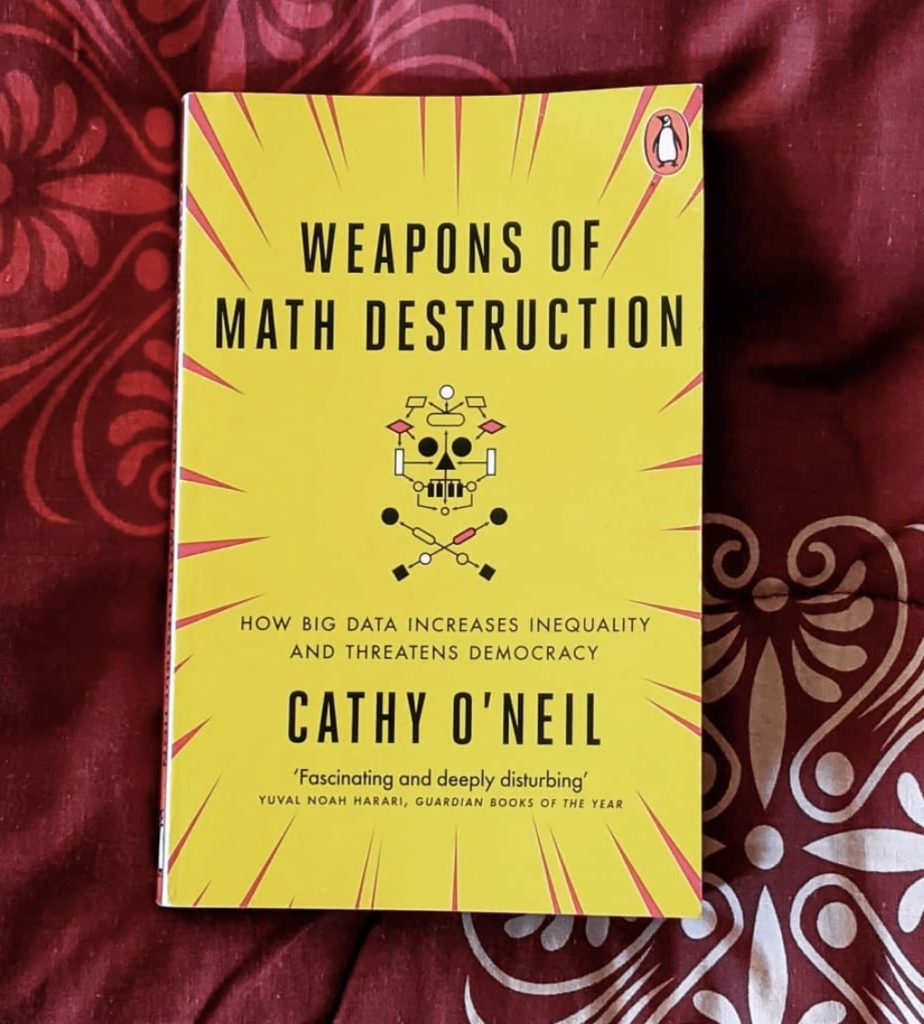
  • Weapons of Math Destruction

    Cathy O’Neil

    Humans have had biases for the longest while. But they have come a long way from from the simplistic ones that helped the species band together and survive, or even the the heuristics we have applied and continue to use at an individual level. As search engines and social networks move from tools to utilities, we have now begun to see the dark side of “software is eating the world” – when biases and discrimination are being codified into systems, resulting in blind discrimination that widens inequality by preventing people from climbing out of poverty, unemployment, homelessness and all the things that we as society should be ashamed of. 

    The author, thanks to her education and experience, is well placed to write on the subject. She calls the mathematical models or algorithms WMDs – Weapons of Math Destruction. They have three common characteristics – scale, opacity and damage. To elaborate, they typically use data sets to create scoring systems that evaluates people in various ways. Most of these systems are proprietary. The scale at which these systems operate is really large, and therefore the damage they cause is also equally massive. Most of the people affected don’t even realise they’re being discriminated against and sent on a downward spiral. And most importantly, there is no feedback loop to make the system better. 

    The author frames it very well through examples across life stages – how teachers and students are evaluated in schools and universities, how employees – potential and existing – are screened, how online ads for predatory services like payday loans are targeted, how insurance premiums are decided, how law and order systems end up “creating” criminals simply based on location data, and perpetrates injustice, how scheduling software destroys any sense of work-life balance. These are not dry, statistical examples, but backed by stories of actual humans devastated by an unfeeling algorithm, with nearly no chance to work their way out of it.

    In the future, what really stops us reaching “Minority Report” scenarios? Arresting people because they could be potential criminals, screening applicants based on health issues they could have in the future, and so on. And since everything is based on users sharing data, it seems certain that privacy will come at a price. In the past, when greed and business “progress” began to have harmful effects on society, the government stepped in and put laws in place to safeguard us. But now governments themselves use these systems! We still have a chance to work our way out of this and bring back dignity. For instance, the European model, in which data collection must be approved by the user and is opt-in, and the reuse of data is prohibited. 

    But will we? In our efforts to remove biases, we have ended up creating systemic monstrosities that lack empathy, and only focus on efficiencies. Those who learn to game the system profit. Winners keep winning, losers keep losing, as fairness is forgotten because entire business models are built on them. As the author rightly points out, “The technology already exists. It’s only the will we’re lacking.” And that, really, is the problem, because “Algorithms are opinions embedded in code”. An important book for the times we live in, and the future.

  • Subjective Objectification

    D and I watched Crime Stories: India Detectives on Netflix a few days after it was released. The episode that saddened both of us was “Dying for Protection”, which was based on the murder of a sex worker. Not surprisingly, it turned out to be the subject of discussion on a Saturday late evening, which these days are spent on the balcony, in the company of spirits, watching the sun and the world part ways. Yes, that is privilege.

    (more…)
  • How Fascism Works

    Jason F. Stanley

    In “The Origins of Political Order“, Francis Fukuyama talks about three institutions that have to be in stable balance for democracy to take root and thrive – the state, the rule of law, and accountable government. When that doesn’t happen is when we get contemporary Russia or China. But in various countries, there has been a sharp spike in fascist organisations, either overt or covert, and a polarisation in political discourse. Nations such as Myanmar, India, Poland, Hungary and even the United States may not be called fascist at this point, but are increasingly vulnerable. 

    In “How Fascism Works”, Jason Stanley looks at the structures that are common to Fascist movements – the ten tactics that are the pillars on which the narrative of “us vs them” is created and reinforced. A mythic past that breaks down common history and is rewritten to support the Fascist vision for the present and future. Propaganda that twists democratic ideals to serve their purpose. Anti-intellectualism that attacks universities and academia in general who might challenge their ideas. These three work in tandem to create an “unreality”, followed by the onslaught of conspiracy theories and fake news.

    Group differences are then highlighted, and scientific support for hierarchy is formed. As divisions multiply, victimhood among the dominant population is stoked the moment any minority moves towards progress. As gender equity advances, patriarchy gets threatened, increasing sexual anxiety, which is used to fuel conflict even further. Law and order is then cast as a tool for the majority “us” to be used against “them”. The narrative of us is most applied in the rural heartland, where “our” pure values and traditions still survive. And finally, unions and any social organisation that tries to build unity among diverse citizens is dismantled. So is public welfare since “they” are exploiting “our” generosity. 

    The nation replaces the state, creating a group identity, and using a sense of collective victimhood to call for the defence of that shared identity – ethnicity, religion, skin colour etc. Pluralism and tolerance are targeted in order to isolate “them”. The nation then artificially creates the conditions that would legitimise ethnic cleansing or genocide. 

    If you live in India, as I do, you are bound to recognise a lot of these – the pure Hindu past, love jihad, the sacred cow and lynching of Muslims, attacks on universities, imprisonment and/or killing of writers and activists, the biased use of law and order, and so on. The plight of the Rohingyas in Myanmar is a nearby example too. So is the United States under Trump. 
    There is a systematic normalisation that would make any charge of Fascism seem like an overreaction. This too is part of the process. The way to combat this is by first understanding the tactics, see them for what they are, and share the perspectives widely. That’s why this book is an important read for everyone.