Thanks to Natasha Puri and Pepper Content, for a dash of nostalgia and excitement for what the future holds.
Also thanks to YouStory for covering it.
P.S. There is some issue with the text on the page, so watching the video might be a better idea.

Charles Allen
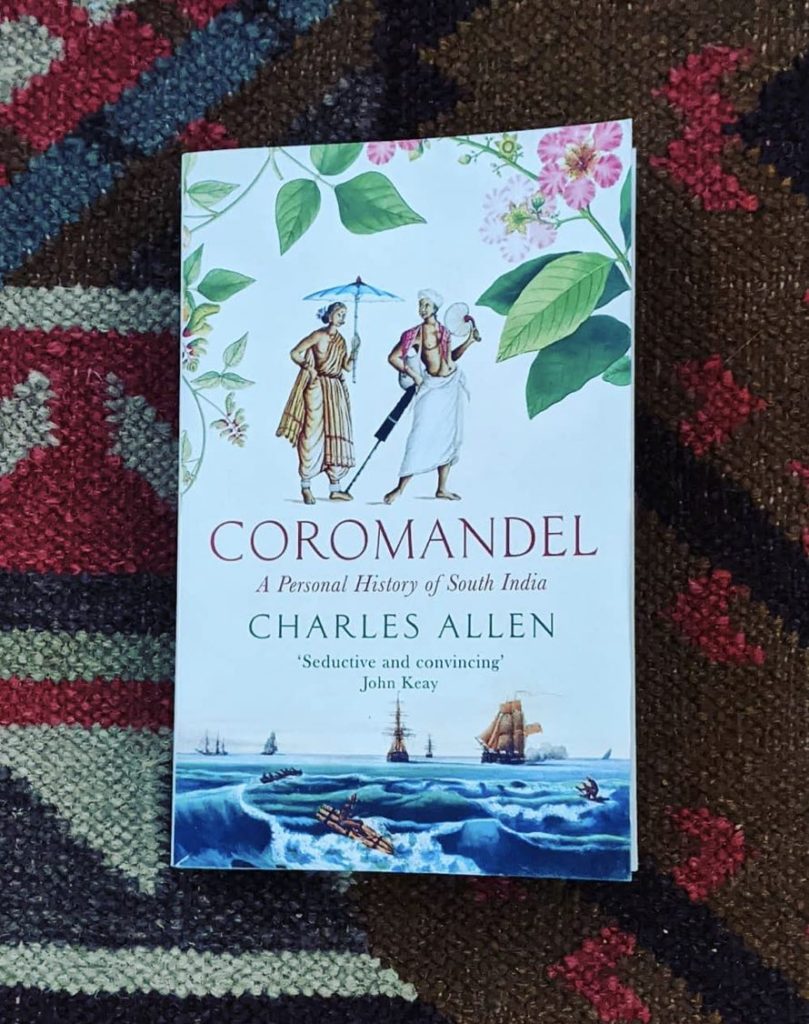
For once, I’d judge the book by its cover, because the multiple themes, the detailing and the overall quaint, charming imagery are a good representation of what the book will deliver. While the title of the book is an indication of its focus, it actually does more in terms of coverage, and provides a fantastic narrative of South India – historical, social, societal, cultural and political facets.
Over a period of time, history becomes stories, then legend, and finally myths. This is the journey that Charles Allen undertakes, and while he smartly calls it a “personal history” to avoid religious minefields, it is a comprehensive and erudite discussion.
He begins at the end of the subcontinent – Cape Comorin (Kanyakumari) and traces the tectonic shifts that created the Indian Plate, which we know as the Deccan, and its rock walls on one side – the Western Ghats, with Palakkad providing the only gap until the railways were built in the nineteenth century. The rest of the first chapter provides a good summary of the hunter-gatherer populations that resided in this part of the world in the Mesolithic era.
There’s then a detour – to the North and the Harappans. It also contains a clear, scientifically backed commentary of the Aryans, the location of the Saraswati and the connection to the Zoroastrians, the historical account of the Vedas, and the epics – Mahabharata and Ramayana.
We then return to “Agastya’s country”, early Tamil literature and the sage himself, who is credited with bringing Sanskrit to the South. The chapter clarifies and rebuts the paradox of him (also) being the person who brought Tamil to the South! This chapter is also interesting because it touches upon the origins of Vishnu and Shiva in mythology. The next few chapters were quite an eye opener for me, because it showed how both Jainism and Buddhism were dominant in the south, including Kerala. To the extent, where even Sabarimala, Ayyappa’s abode, has its origins in Buddhist shrine. Dharmashasta’s devotees chanting Swamiye Saranam Ayyappa seen side by side with Buddham saranam gacchami. Fascinating! It also captures the reasons behind the migration of Jains to the South, whose ranks include the first great emperor of India – Chandragupta Maurya. Speaking of empires, the Chola, Chera and Pandya dynasties were the result of a three way split between brothers who didn’t want to share power.
A following chapter throws light on one of the most under-acknowledged dynasties in India, who ruled for almost five centuries – the Satavahanas. Muziris finds a mention too, as the primary trading port for Romans. In other international voyages, we find Bodhidharma, the South Indian monk who exported Mahayana Buddhism to China – which became Chan and finally in Japan, Zen. But contrary to pop culture, Shaolin kung fu wasn’t something he introduced to China.
“Juggernaut” covers the origins of Vishnu (including the avatars) and Shiva in greater detail, and is made even more interesting by the suggestion that the lord of Puri was (again) originally a Buddhist shrine. Apparently ‘palli’ was the original term for ‘vihara’ and in Kerala, it became the common term for any non-Hindu place of worship. This section also covers Adi Shankara and his role in resurrecting Hinduism. Chapter 8 finally gets us to the title, which is appropriate from a historical perspective too – its first appearance was only in 16th century maps. That also brings us to Vasco Da Gama’s terrorism, and the slow but steady entry of European powers in the Deccan. The next chapter is a deep dive into Malabar and Kerala in general, and I learned a lot – the origin of the Nambudiris and Kerala’s caste order, the context of Vivekananda calling Kerala an asylum, and that Narayana Guru had a quarrel with Gandhi during the Vaikom satyagraha. The final chapter is named after Tipu, and it also covers the rise of Islam in the South.
The endnote is a must read, and shows how nationalist forces have been trying to reshape historical narratives for a while now. It also contains a good perspective on how the cleansing of textbooks in the early 80s and their glossing over of communal clashes actually provided ammunition to those who reverse engineer history to meet their interests.
What I really loved is the systematic deconstruction of mythology into its historic components, with an amazing amount of detail. As a person who loves both mythology and history, it was an absolute treat!I am quite miffed at myself for not having read Charles Allen earlier, but plan to rectify that for sure! If you’re interested in history, this is a book I cannot recommend enough.
In my long-running Twitter thread on Malayalam movies, I posted this after I watched Sara’s.
It also reminded me of a post I had in drafts. I had left it unfinished because I wondered if it was too preachy. But hey, what’s a blog for?
Every now and then, I find myself in conversations with women in their late 20s and early 30s on the subject of parenthood. Stop! Rein in your imagination! These only happen because I am in my early 40s and they see me as someone who seems to have survived a couple of decades of being one half of a DINK couple. And no, I obviously don’t initiate the conversation! So I thought a little primer would be a good way for me to structure my experiences and perspectives.
It’s that time of life: Evolution has programmed the gene to make sure it transfers itself to the next generation. And the gene, through the body and the chemicals within, has some amazing ways to get aggressive and passive aggressive when it senses that it’s time for you to do its bidding. Its fingerprints can even been seen in societal architecture but we’ll get to that in a bit. A book I can recommend to get an understanding of the gene’s machinations is Robert Wright’s The Moral Animal. The phase, I think, lasts from the late 20s to the mid-late 30s, and is definitely a crossroads.
This is also the time when you will be interrogated by everyone who thinks they’re either family, or an employee of the Census Commission. I initially got irritated, and then started using everything from lack of knowledge to erectile dysfunction to traumatise people. That finally stopped all questions. Giving different reasons to different people at the same time is a nice side-game too. But seriously, “reproduction as a way of validating one’s existence” has been around so long that most people don’t even realise there is an option!
It takes two and has to be talked through: These days, three is also common, but I’ll stick to basics. If I have to be honest, I was always sure about this but didn’t have that conversation with D early enough. To this day, I think I did wrong by her. I just kept kicking the can down the road until our early 30s. She is most definitely happy with the decision now, but I could have probably saved her some heartache if I had been proactive. I believe it’s better if it is a conscious decision by both parties. A discussion that includes the reasons. It could lead to a postponement and not a complete cancellation. And probably a review of the decision every couple of years to see if you still feel the same way.
I know that makes it sound like a business review, but it probably comes from the original reason for my decision – having kids has zero ROI. Yes, I acknowledge that there might be intangible and probably tangible emotional benefits, but I was (and continue to be) skeptical. Even about the unconditional love of motherhood. It is the nature of the mind to have expectations, and parenthood is not exempt from this. I wouldn’t want myself or another human being to go through this. My other big reason is a potential loss of my perceived freedom. I didn’t like the trade-off. Most importantly, I am conscious that there really is no undo button once you embark.
It is important to think through implications: Over a period of time, civilisation has created a life script that includes a family unit with kids as one of society’s principal pillars. This is the societal architecture I mentioned earlier. When you step out of the script, you will notice a difference in the structuring of groups you were once part of. People change with life stages – after getting married and most definitely after becoming parents. Their social circle changes too, as they become parts of communities that have similar routines and schedules. The conversations will shift too, to include kids’ education, and extra curricular activities. Travel tends to get planned around school vacations, and the residence is adjusted to be near the school. And yes, there will be birthday parties. From experience, being adults without kids at a kid’s birthday party is a reasonably good torture method. Thankfully, if you behave appropriately, the invites will stop. But seriously, there is a definite impact on your social life, though I think that might become less of a problem now with the increasing number of couples delaying or choosing not to have kids.
An apprehension I keep hearing of is the “who will take care of us when we are old?” Usually this is a quick conversation when I point out how they (we) are taking care of our parents. I am also reasonably confident of retirement communities becoming a norm in the next couple of decades as a generational cohort with money retires, and also understand that their children have their own lives. Yes, you do have to plan your retirement well, and if your plan involves being dependent on your child, well…
No, you won’t automatically get bored in your 40s if you don’t have kids. And no, you don’t even have to be a pet parent, although that is something I increasingly see. But yes, it’s good to cultivate interests.
A last point, and it’s actually a couple of hypotheses. Becoming a parent, I think, makes one more empathetic, because of the daily challenges. These daily challenges also provides the confidence to handle unpredictability. No, you don’t have to become a parent for either, it’s just an observation.
It’s personal and not a crusade: Back in 2016, Indigo’s “quiet zones“, where children under the age of 12 were not permitted to sit, made several parents fume. Having been at the receiving end of several kicks mid-flight, and jolted out of sleep/reading by kids who thought I was part of the airport “playground”, I was quite happy about this. I do understand parents might be under a lot of stress, but there are limits on how much consideration they should expect from others for a decision they made!
Having said that, if you opt not to have kids, you don’t need to crusade for making this everyone’s choice. After all, remember how irritating it was to be at the receiving end of the opposite crusade? It’s a decision like any other – marriage/single/live-in, invest in FD/MF/land/stocks/crypto, buy/rent a home – and different people choose different things. So long as one is happy, understands the implications, and does not inconvenience others, all’s good.
In essence, it is an important decision1 and though that it’s near impossible to predict happiness later in life, you might want to put a regret minimisation2 lens on it too.
1 How People Decide Whether to Have Children
2 7 Reasons Not to Fear Regret About Not Having Kids
Further Reading
Nick Chater
I think the name of the book is a meta play, because the book convinces you of just that -“the mind is flat”. It is also the most convincing case I have read against AGI (Artificial General Intelligence), even while showing why we have had successes in narrow AI. Before you think it’s an AI book, it’s not, it’s about the human mind. We think of our mind having depths that we cannot fathom at this point, consisting of inner motives, beliefs and desires, many of which are unfathomable to us, and that behaviour is just a superficial aspect of it. This book argues that no such depths exist. The mind is flat.
But what the mind is, is an excellent and immediate improvisor of actions, and beliefs and desires to explain the actions. My mental (re)action was “no way”, even though a part of this was familiar to me thanks to “How Emotions are made”. The author divides his case into two parts – the first part dismantles the perceptions created by classic psychology about beliefs, desires, hopes, and aims to prove that there is no “inner world”, and the second part provides an alternate theory – memory traces of previous momentary thoughts and experiences.
What really works is the accessibility of the narrative and how it is structured. It’s never a “believe me because I told you so”. Instead, we are led through a series of visual and thought exercises that question our understanding of reality. Slowly, a shallow world of improvisations are revealed to us. The mind works on “precedents, not principles”, and our emotions are creative acts made by a superb interpreter – our mind. With multiple examples, he shows our capacity to create “meaning” from nothing. Our inventiveness is brought out by the metaphors we live by, which are not always bound by “cold logic”. And that’s why we are able to create AI in areas where solutions are precisely defined. A general AI would require imaginative interpretations, something humans are very good at, but not really able to explain how!
This does lead to my favourite “free will vs determinism” debate, and once again, the answer is that at any point, despite the determinism that has happened because nature and nurture, we have the freedom to change our mind. But then again, if it is flat, what’s there to change? Or does it contain a coda of traditions and precedents in the form of genes? While we create meaning from nothing, our quest for the depths of the mind is also perhaps a need to find “meaning”. I’ll leave it at that.
