
Month: July 2021

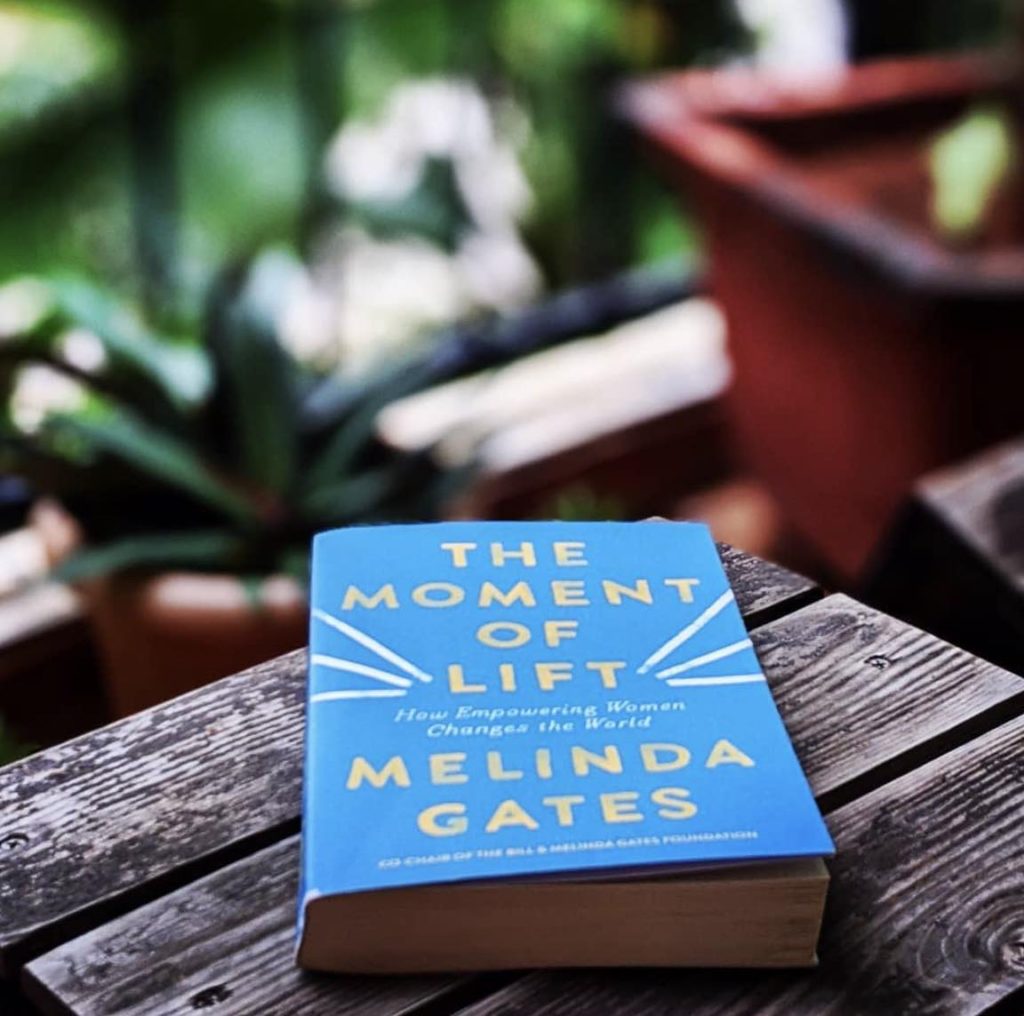
  • The Moment of Lift

    Melinda French Gates

    “When we invest in women and girls, we are investing in the people who invest in everyone else.” That’s indeed how we can change the world, and the best part is that despite the tremendous experience she has on the subject, Melinda French Gates neither makes the book prescriptive, nor makes it about herself. 

    The book is only about 270 pages, but it covers a whole lot of ground. From maternal and newborn health, to the importance of contraceptives and family planning, to education for girls, the unpaid work that women do, and gender inequity in the workplace, it is clear that nothing in this context is an isolated problem. And to solve them, the work has to be done at both the macro and micro level. While many of the anecdotes are heartbreaking, it is a testament to the narration that one closes the last page with hope. 
    There are two things that impressed me a lot. The first is an intellectual honesty with which she approaches each subject. Right from “American billionaires giving away money will mess everything up” – she provides the reasons for this towards the end of the book, and there is a tremendous objectivity at work here. The second is the understanding that there is much learning to do. Several times in the book, she admits that she writes from a position of privilege, and there are aspects that took her time to grasp. But she spends the time to listen and learn. That’s also why she lets others tell their stories. 

    These are women in Africa and Asia who have been directly affected, but have had the courage and will to create a solution. There is compelling data, but what’s more moving is the humanity of it. The school on a railway platform, the BandhanTod network, Avahan – simple things that one wouldn’t think is a problem, or access to necessities one takes for granted, is a struggle for many others. Leymah’s story about the Liberian Women’s initiative carried an important lesson about how successful social movements needed a combination- strong activism and the ability to take pain without passing it on. That second part underlines why women are best placed to heal the angst that the world experiences every day. 
    The only exception (to letting others tell their story) is when she believes that her own experiences can get people to think differently. I found her perspectives on marriage and empathy at the workplace extremely insightful. 

    In the book, Melinda, quotes Mary Maxwell Gates – “From those to whom much is given, much is expected”. From whatever I have read, Melinda French Gates is on it! It is not just the empathy she shows towards those who are less fortunate, but the active steps she has been taking to overcome the obstacles that hold women back. The book is a compelling read, and a great learning experience.
  • If it makes me happy…

    In a workshop I attended recently, the trainer made an interesting point that being a little selfish and taking care of our own needs first will actually enable us to help others better. Around the same time, I also read this very interesting post on the conversational gambit. Extremely helpful for those of us who aren’t good at going from zero to conversations quickly. Put simply, ask a question. The one that stuck with me was “When were you happiest?” I directed the question inwards and got some answers. Then I upped it to “What will make me happy?” That was complex, but something I heard recently gave me some direction.

    People say that what we’re all seeking is a meaning for life. … I think that what we’re seeking is an experience of being alive, so that our life experiences on the purely physical plane will have resonances with our own innermost being and reality, so that we actually feel the rapture of being alive.

    Joseph Campbell
    (more…)
  • The Origins of Political Order

    Francis Fukuyama

    Once upon a time, humans moved around in bands. Then there were tribes, and then there were states. States and the societies that make up its population have developed a bunch of institutions (defined as “stable, valued, recurring patterns of behaviour”), some of which are uniformly present across the globe, and some not. How did this variation happen?

    Why is every country not a democracy, which is largely accepted as the best trade-off for all concerned? How did different countries reach their current form? That’s what this book is all about – how did different countries develop institutions that currently make up their current society and state?

    (more…)
  • A System 3 path to brand building

    I wouldn’t claim that Daniel Kahneman’s Thinking, Fast and Slow is an easy read, but if you persist, you can get a lot of insights on cognitive and behavioural biases, the heuristics we pick up and use, and the experiencing and remembering selves. I definitely started “watching” myself a lot more! But the main theme of the book is the difference between our two modes of thinking – Systems 1 and 2. System 1 is fast, automatic, and always in use, mostly unconsciously. System 2 is slow, methodical, logical and conscious. This also means that System 1 links new inputs to existing patterns to make sense of it rather than create a new understanding.

    I have tried to apply this in my line of work – marketing, specifically communication. The application is fairly simple in say, ecommerce because the messaging/design can (and is) tweaked to play to the heuristics and biases the human mind has. Investments are a totally different beast altogether given there is rarely any instant gratification and definitely no gimmicks and giveaways. It also doesn’t help that our attention span as users is decreasing fast! Nudges ain’t easy. In that context, I have wondered if the two systems are too binary, and whether there is a middle path.

    (more…)