
Month: May 2021

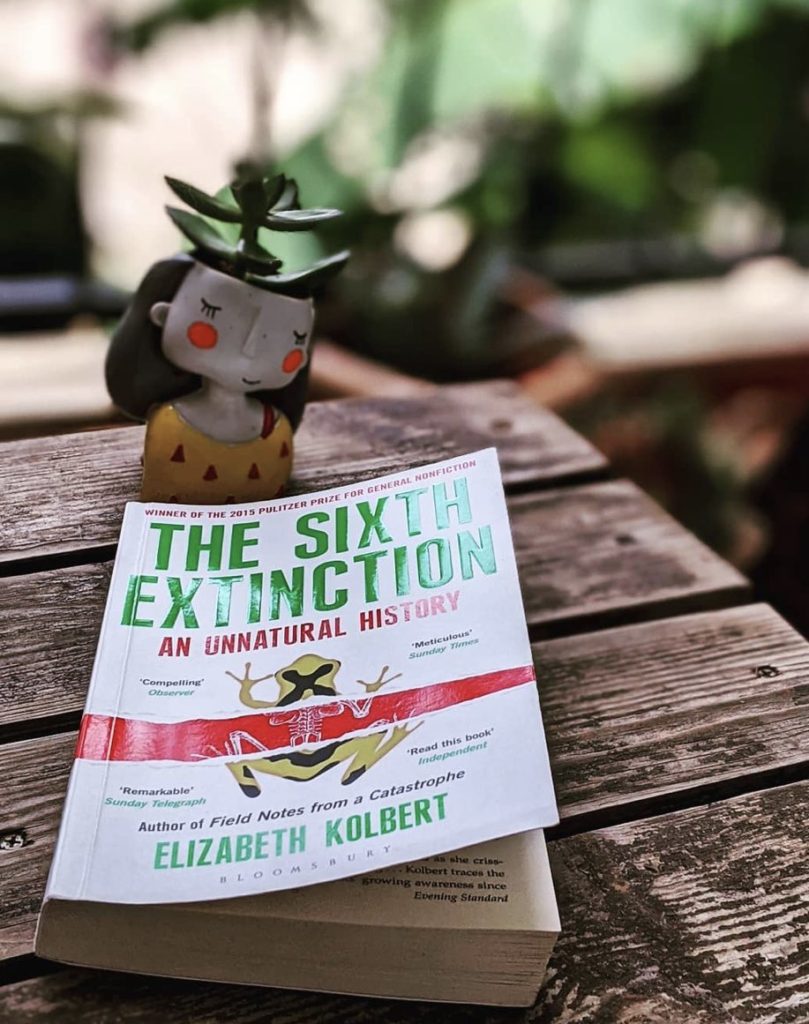
  • The Sixth Extinction

    Elizabeth Kolbert

    A pandemic is probably the best time to read a book on mass extinctions. Or not, depending on taste. 

    But this is a book I thoroughly enjoyed, even though I am not really a big fan of nature – plants or animals or for that matter, some humans either! Some of it is because of the many, many things I learned, and some of it is the accessible narrative style of the author – it evoked the sense of curiosity that I had for science in general as a child, and I confess, infused that sense of romanticism in science that I haven’t seen in a long time. 

    It is scientifically interesting to see how concerned we are about the pandemic, when, earlier this century, a species of Chytrid fungi (a genus had to be created for it, and it is called Bd for short) systematically started killing of frogs across continents. Making many of them endangered species. Or the Geomyces destructans, that killed off bats to the tune of 6 million! 

    Until the end of the 18th century, the idea of extinction did not exist. It then moved to a “uniformist” view that each species struggled and vanished. Then the discovery of the asteroid impact happened. The current version accommodates both lines of thought- long periods of nothing happening and then one cataclysmic event. It involves oceans, rising and falling, tectonic shifts, global warming and cooling etc and yes, an asteroid too. On a related note, there is also a small parallel narrative on Darwin, The Origin of Species and how it weighed in on the extinction debate.

    The last 500 million years are divided into three eras, and a lot more periods. While there have been extinctions, in isolation and clusters, and mass extinctions occur every 26 -30 million years, the short list contains only the “big five”. The most famous one is the one that features the asteroid. That was the last one, which happened 66 million years ago, in the End Cretaceous period, leading to the extinction of 75% of species. The ones before were 201 million years ago -that led to the dominance of the dinosaurs, but killed 75% of species that existed then, 252 million years ago – the biggest one that knocked off 96% of all species, 375-360 million years ago – killing 70% of species, and 450-440 million years ago – 60-70% again. The sizes and descriptions of both the tiny organisms and the megafauna that lived, co-existed, and died is fascinating. 

    The name of the book, as you might have guessed, comes from the possibility of the sixth event that could be added to the big 5. From all the evidence so far, humans will most likely be the cause, but the twist is that we could be the victims too. In the context of the larger lifespan of earth, a short while ago, a species created a way to go beyond only the genetic code to store and distribute information. Language. They then found ways to communicate and collective think about and solve “problems”. And we’re here now. 

    The book gives a lot of food for thought, but more importantly, at least to me, invokes a sense of curiosity and awe. A lot thanks to science, and some because of the variety of places she visited to write this book. The moment she narrates, while on a tiny island at the edge of the Great Barrier reef under a starry sky – For a brief moment I felt I understood what it must have been like for an explorer like Cook to arrive at such a place, at the edge of the known world – sums up the effect of the book very well.
  • An efficient existence

    The Cyberiad by Stanislaw Lem is a book I recently read, and loved. It was written in Polish in 1965, and translated to English in 1974. Lem wasn’t an author I had heard of, despite having read many science fiction anthologies. An online post that extolled him at the cost of my favourites like Asimov was what led me to this book. (I would have linked it, but I’ve forgotten how I found it!) Lem has been translated into 41 languages and has sold 30 million copies. But he was rebuffed by quite a few American writers including Philip K. Dick, multiple times, because he was perceived as being annoying, and had commented that American writing was “ill thought out, poorly written…” Also, his belief was that the only true motive for writing was to contribute to literature.1

    It made me think of a post in one of the newsletters I often recommend to folks – Taylor Pearson‘s The Interesting Times. As I tweeted sometime back, his writing is centrifugal – pointing to books, posts and ideas, and centripetal – goes deep into an idea and provides food for thought (the latter is different from what Austin Kleon meant in the original framing 2). The specific post I am referring to – 4 minute songs, which was about certain rules that a creators need to follow if they want their work to be consumed and appreciated, was the latter, and made me reflect. I wondered whether, even at an individual level, we are increasingly optimising for others’ consumption over our own expression.

    (more…)
  • 12 Rules for Life

    Jordan B Peterson

    Though the book is categorised as “self help”, and has the kind of material that would qualify it for that label (if you’re so inclined), I read it more as a bunch of perspective on living and being. Or rather, Being, as the author prefers. And perspectives there are – the psychology professor and practitioner refers to the thoughts of everyone from Nietzsche, Solzhenitsyn and Dostoevsky to Milton and Jung. Not to mention theology – Tao, Buddha and especially the Bible play a part too. To the extent that even the Pareto principle gets connected to a Bible reference.

    (more…)
  • Front tier journeys

    Remember the early days of the pandemic, when we played alphabet soup with economic recovery? One has to be extremely optimistic to consider the much-touted “V” now, and there’s increasing consensus around “K”. There’s something subliminal about the former sounding like “we”, and the latter sounding like, well, K, signalling that we don’t care. And that’s why I began thinking of how those in the upper part of “K” are utilising their wealth. In addition to using it to create more wealth, that is.

    I think there are at least two expansion narratives at play. One is seeking new “real” frontiers. This is a centuries-old pattern – the Americas, Silicon Valley – until geography has been tamed. We’re now on to “colonising” Mars. The metaphor is clear. The other is digital frontiers, where our time and mind space is being increasingly spent. Both are about escaping the confines of reality as we know it now.

    (more…)
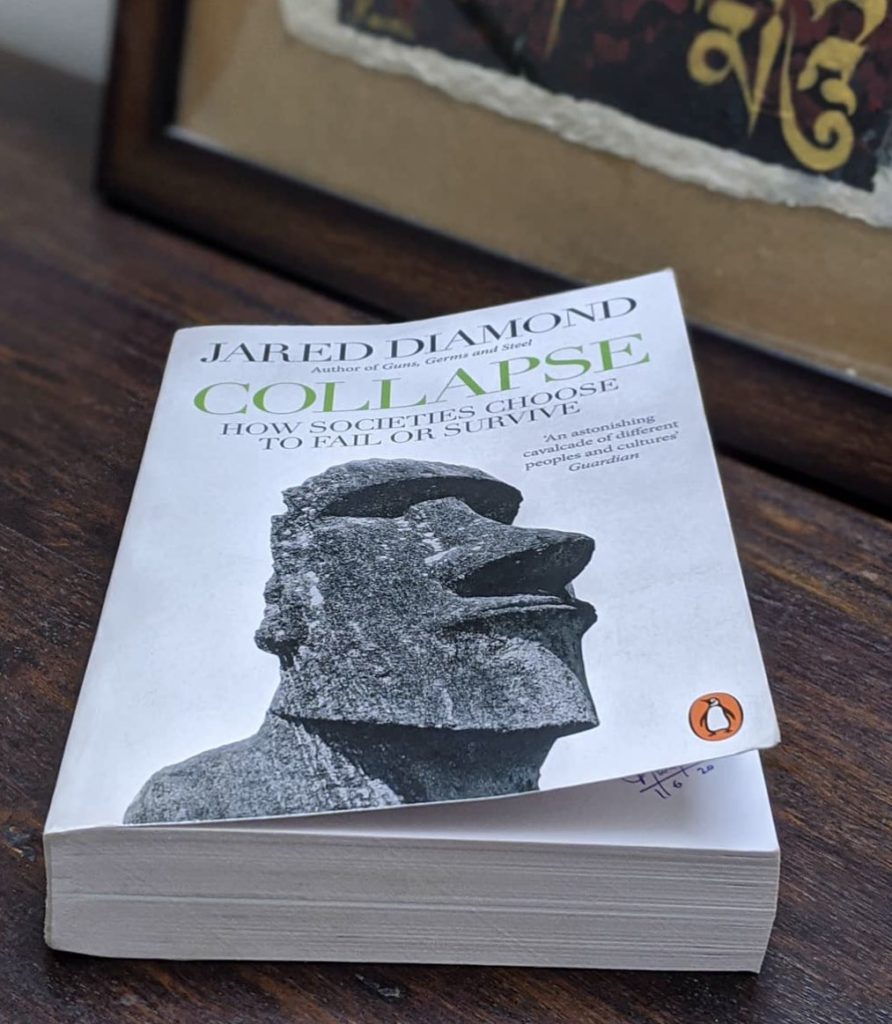
  • Collapse

    Jared Diamond

    Jared Diamond’s Guns, Germs & Steel ranks among my favourites. Insightful and full of perspectives. While that book was about how and why civilisations unfolded differently around the globe, this one is on why many of them collapsed. The author defines collapse as a”a drastic decrease in human population size and/or political/economic/social complexity, over a considerable area, for an extended time.” He then uses a five point framework to analyse multiple examples, spanning time and geography. The five points are environmental changes, climate changes, hostile neighbours, decrease in trading partners, and finally, society’s response to the above. 

    The author starts with contemporary farms in Montana and then moves on to the Mayans in South America, the Easter Islands natives, the various Viking communities across continents, and the Native American Anasazi to apply the five point framework and understand the causes of their downfall, and sometimes survival. He then examines modern societies and their challenges – Rwanda, China, Australia, and the interesting case of neighbouring countries that went in opposite directions – The Dominican Republic and Haiti. Strangely, this is despite both countries having a history of dictators. 

    The last portion of the book delves into what caused societies to make disastrous decisions, and the impact of big businesses on the environment. The latter is not always a negative, and there are some excellent examples of large corporations realising that doing good can actually help the bottomline. There is also a very interesting section on the responsibility of individual consumers.

    While we still may not know exactly what happened, there is a fair amount of convincing logic in the author’s hypotheses on how and why civilisations collapsed. And it gets more interesting when we look at the problems we are facing now. On one hand, the scale of the problems are indeed much higher. But on the other, there have been technological advances that can aid us. How much of a counterbalance is one for the other? And as one of his students asks, what was the islander who cut down the last tree on Easter Island thinking as he was doing it? Are we too, frogs in boiling water? Do we have landscape amnesia which prevents us from seeing the changes around us? 

    The book is not easy though, and sometimes one wonders whether the depth of research shared in the book takes away from the narrative flow. However, if the subject is interesting to you, it’s a read that will enlighten.