Month: March 2021

  • Default in our stars

    The thought first occurred to me a couple of years ago, when I realised that thanks to outsourcing and automation, we would struggle today to do many things that were once life skills. We also lost a little more than that – learning.

    Sometimes directly, and sometimes, through the interactions with the world, they facilitated a learning experience that taught one how to navigate the world and the different kinds of folks that made up its systems. 

    Regression Planning

    It was continued with a bit more specificity in a subsequent post.

    Instagram, Facebook, Tinder, Spotify, Netflix, Amazon – everything is a feed of recommendations, whether it be social interactions, music, content or shopping! Once upon a time, these were conscious choices we made. These choices, new discoveries, their outcomes, the feedback loop, and the memories we store of them, all worked towards developing intuition. 

    Intelligence, intuition and instincts. The journeys in the first two are what have gotten the third hardwired into our biology and chemistry. When we cut off the pipeline to the first two, what happens to the third, and where does it leave our species?

    AI: Artificial Instincts
    (more…)
  • The Complete Calvin and Hobbes

    Bill Watterson

    I remember saving up credit card reward points for a long time and finally being able to afford this – more than a decade ago. It had a pride of place in my bookshelf, but I never really read it, mostly because I used to read the strips online and in newspapers. During the Covid lockdown, books weren’t getting delivered. It was the perfect time to pick up an all-time favourite.
    The set consists of four books, each around 370 pages. I didn’t read them in one shot, and took a break after each book. The first book begins with an introduction to the life, thoughts, and philosophy of Bill Watterson. It’s an amazing story of belief, values, and perseverance. Some of it did remind me of Calvin’s Dad. 🙂

    (more…)
  • 2020 (1)

    First published in Adgully

    It’s technically a new year, but as the quip goes, it does feel like December 93rd 2020. More like a sequel than a new movie. Familiar characters and themes, with some new plotlines. And hence the title, for a short take on learnings in 2020, and the trends expected in 2021. 

    In light of the pandemic, what narratives are good for the brand?

    The consumer’s needs might not have changed, but the relative priorities, ways of achieving them, and expectations from brands most definitely have. At least in the medium term, health and safety (physical, mental and financial) will remain important themes. That would explain why many brands have attempted to hop on to these narratives. While it works easily for say, water purifiers, it might be a threadbare argument for mattresses and shirts. But yes, Ayur is arguably the most powerful four letter word in business now!

    The abruptness of 2020 has also given us time for reflection and recalibration. One of the related changes has been increased participation in societal issues. But a brand pursuing cause marketing because everyone else is doing it might result in some caustic feedback!

    What has also changed are rituals – commute to family time to entertainment and so on. The narratives might not have changed yet, but the contexts have. Social screening (movies) and Zoommates are all adaptations to these contexts. But soon, radical redesigning of products and experiences will lead to narrative shifts as well. 

    With chimeras all around, how do we frame it better?

    Many aspects of our life are chimeral now – still retaining their individuality, and yet to find the balance of a hybrid. Think about it – working from home, but recreating the office online. Digital transformation, and craving physical interaction. Learning new skills, while trying to avoid burnout at work. This operates at societal levels too. On social channels, we talk about being more empathetic. But we also have mobs that seem to have been born outraged! 

    These chimeral contexts have an impact on segments and personas, as well as how narratives can be delivered. If we go by Superbowl ads, humour is making a comeback, but we aren’t LOL yet. Brands are still playing Minesweeper because they, and their endorsers are susceptible to cancel culture. Even a logo needed to dress up because one person insisted we all share the perception! Narrative control is a chimera, an illusion. I expect brands to soon have influencers on stand-by to combat trolls and bots! 

    And if the action is everywhere, where is the narrative best delivered?

    There is no mainstream, there are many streams”. With mobile screen time continuing to rise, and OTTs having a dream run, both branded content and product placements will spike. Even more immersive is gaming – you can have an epic life in Fortnite, and (ironically) join the war to save reality! But we are un-screening too. From podcasts to the ambient, and omniscient Alexa. Does your brand have an Alexa Skill yet? 

    Newer platforms offer further scope for narrative renditions in all forms of reality – mixed, augmented, virtual in addition to our normal agreed upon version. And as digital transformation accelerates, marketers are being empowered with automation and no code tools to deliver these. But the tech landscape is also rapidly changing with impending regulation, and privacy concerns. 

    We’re going through an era of institutional realignment – political, societal, financial and so on. The points I have made are more possibilities than spoilers. We might think we have seen this movie before, but we should wait for the release. Multiplex or OTT, you think?

  • Exhalation

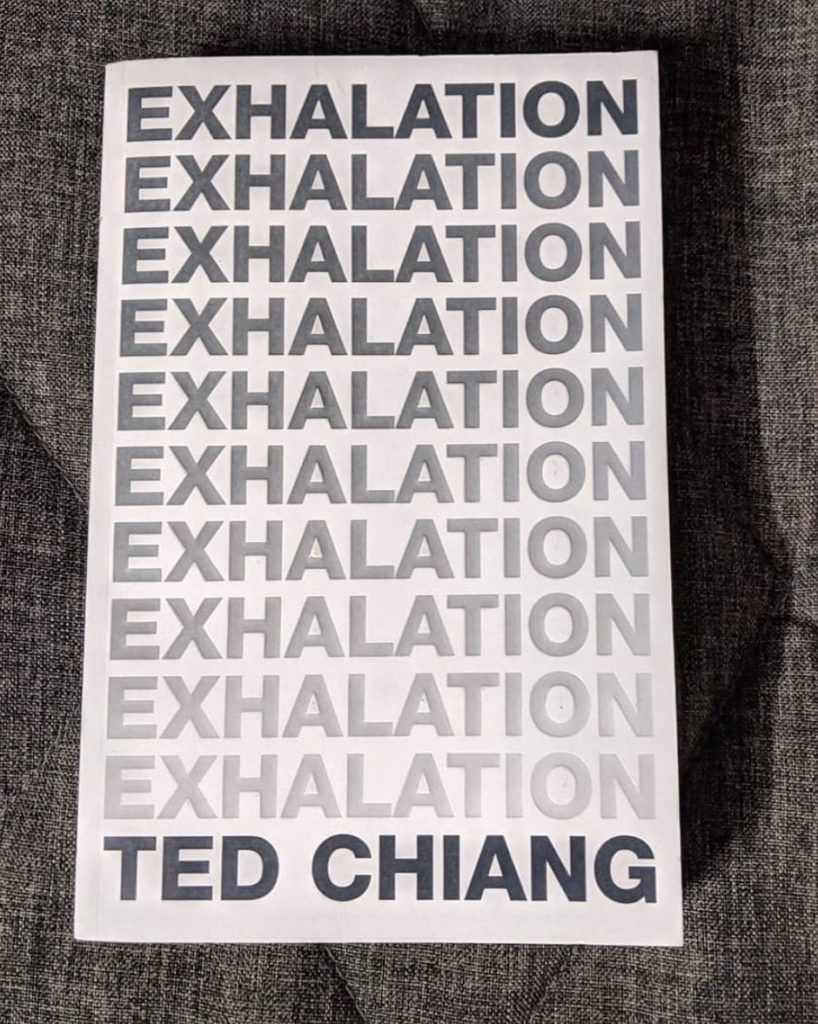
    Before I start, I have to ask, when is the next collection coming out? Can’t. Wait. I read “Stories of Your Life and Others” about 2.5 years ago, and was blown not just by the quality of the stories, but by the sheer range of subjects from physics and mathematics to language and theism, not to mention artificial intelligence. Exhalation has nine stories, and each of them is a work of art.

    I tried to deconstruct Ted Chiang’s magic, and for me, it came down to three aspects – the imagination to think up the most original and profound questions, the skill to weave it into scenarios that make it relatable and accessible to the reader, and the ability to articulate his perspectives in such a way that one is forced to engage with them and construct one’s own thought exercises!

    “The Merchant and the Alchemist’s Gate” is Arabian Nights in terms of setting as well as nested storytelling but beneath all that is a dizzying tale of time travel that questions whether one can really change the past. “Exhalation”, after which the book is named, has an alien setting but with a dash of steampunk and robotics. The core of it though is what makes it profound – entropy and its inevitable conclusion. “What’s expected of us” is the first of the stories that deal with free will, and goes directly into the heart of it, with a first person narrative of one’s reaction when confronted with immutable proof that it doesn’t exist! The Lifecycle of Software Objects is an excellent take on artificial intelligence, with clear parallels to parenting, and the underlying thought that “experience is algorithmically incompressible”and that the “common sense that comes from twenty years of being in the world” cannot be achieved by compiling heuristics. The parenting theme continues in “Dacey’s Patent Automatic Nanny”, but in a different direction, definitely sadder.

    “The truth of fact, the truth of feeling” is simply brilliant, and has two stories that show the parallels when there is a fundamental shift in technology, both around memory. If I really had to choose, this one would be my favourite. The Great Silence is a poignant juxtaposition and a sharp commentary on what we’re missing out on by rampaging through other species. Omphalos is a very interesting take on creationism, and a contemplation of how it would be if humanity were really the reason for the universe, and were literally too, at the centre of it. “Anxiety is the dizziness of freedom” is the last story, and probably the most imaginative. It mixes parallel universes and free will, and delves into the meaning of the latter when many parallel “branches” (emanating from a decision) are playing out.

    No story is the same, or even similar. When I read some authors, I think to myself that if one really had to write, then this should be the benchmark. In speculative fiction – my favourite genre, Ted Chiang is that author!