Month: February 2020

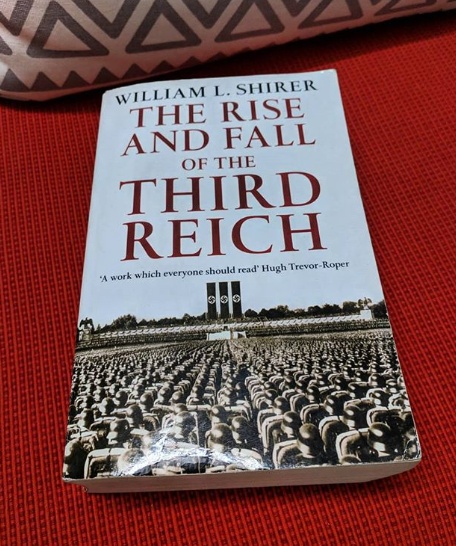
  • The Rise and Fall of the Third Reich

    William L. Shirer

    What a fascinating read! The second world war was one of the most defining events of the contemporary era, and The Rise and Fall of the Third Reich provides a fantastic view of what happened in Germany between 1930 and 1945, chronicling the ascendance of Hitler and the Nazi Party and its eventual demise.

    Hitler’s dream was to establish a Reich that would last a thousand years, though it finally managed just about a dozen. But in those few years, he managed to give the world the kind of shock it had probably never experienced before.

    The book actually begins much earlier, and traces Hitler’s early life, his disenchantment with the socio-political environment prevalent in Austria and Germany, and his entry into regional politics. Through smart thinking, astute use of the economic depression, a lot of outmaneuvering of politicians far bigger in stature than him, and quite some luck, he took himself to a position where the nation was practically begging him to seize control. It is amazing to see the number of instances long before he gained power when a small change would have led to a different history than the one we are familiar with.

    His baby steps into expanding Germany’s borders through cunning and then brute force, his affection for the largely ineffectual Mussolini, the poor judgment and horrendous miscalculations exhibited by the European powers, Stalin’s greed, all led to a state of affairs that made war inevitable. Germany dominated the early period, the Blitzkrieg tore through defenses, and it is astonishing to see how close they came to taking over all of Western Europe early in the war, in addition to Scandinavia and Eastern Europe. Through the mid to late 30s, what is also evident is Hitler’s own iron will, determination and political astuteness using which he outplayed his opponents over and over. But in Stalin, he met his match, and he underestimated the man and his country’s military strength. A costly mistake.

    At some point, Hitler’s megalomania took over, and his downfall began. His allies, the Japanese, didn’t help the cause much by drawing the US into the war. He repeated history by disastrously opening two fronts in battle. He also misread the importance of North Africa and the Suez. But it is chilling to note that with a little patience and by sticking to strategic alliances, he might not have lost the war at all. The Rise and Fall of the Third Reich also covers the role played by several inept leaders of the German armed forces in bringing and keeping Hitler in power, and their inability to stand up to the dictator, even as they realised that he was leading their country into disaster. Also described in detail are the several plots that were hatched to assassinate Hitler, including Operation Valkyrie.

    This is a commendable piece of work – not just for chronicling an important piece of history, but for the painstaking research that must have gone into it, and the control on a narrative with so many moving parts, all of which are important.

    At 1100+ pages and the smallest possible font, The Rise and Fall of the Third Reich is not an easy read. But if you have any interest in history, and the war that shaped the modern world, this is a book you should definitely invest in.

    The Rise and Fall of the Third Reich

  • Punkah House

    Punkah House has its fans, and they have been recommending the place for a while now. But we really didn’t have the appetite to negotiate traffic, and kept postponing the visit until we got one of those weekends when people leave Bangalore for a long weekend and transport it to the past. That also meant that we arrived earlier than anticipated. Not complaining, since we hopped over to the church of Magnolia (judging by the lines of those of us who waited patiently in a queue for salvation) to get ourselves some banana pudding for later.

    Punkah House is undeniably classy, and barring the honking, manages to keep the chaos of 12th Main out. The decor and wicker furniture on the first floor, where we sat, would remind you of an older era of clubs. There are other sections too, each with a distinct nuanced layer over the broad colonial theme.

    The menu follows this with dishes from the subcontinent with a lot of representation from Ceylon and Burma and of course, India, albeit with a contemporary twist. An amuse-bouche arrived – sago with a zingy sauce – even as we were debating over drinks – which one to order, that is! D chose a Tokyo Tomo, and I asked for the Brigadier. The first has sake, lime and a mild pandan leaf flavoured gin, altogether quite refreshing. The Brigadier’s presentation is quite something, and bourbon, absinthe and bitters made for a fantastic drink that one could nurse for a long time!

    The Chorizo and lentil Goa vada was intriguing enough for us to try, and it delivered an excellent texture in addition to the combination that worked well together, helped by a spicy chutney that came along! We then went into zombie mode and ordered an Old Bombay Brain Scramble hoppum. I know appam (from my homeland) and hopper (from Lanka) but it seems the combination is a word! Curiously enough, it was served with coconut and chilli-tomato chutneys that are more of dosa BFFs. It wasn’t bad though and in any case we were distracted enough by the delicious brain! Midway through this, we were served another hoppum. We thought the staff were going above and beyond, but turned out it was billed. Oh well, getting punked at Punkah House is probably par for the course.

    There were a bunch of mains we wanted to try, but we were stuffed. The Rustic Chicken flat bread with fermented chilli salsa turned out to be a safe bet. Chocolate won over Kapimisu but the Eton Mess was the only dish that we would file under just ok, at least in terms of flavour if not texture.

    The bill was a a hefty Rs. 3400+ affair, but given the location, ambiance and quality of food, I wouldn’t complain. The service is friendly, the vibe is unlike anything else in the vicinity and we’ll definitely make the trek again.

    Punkah House, 2989/B, 1st Floor, 12th Main Road, Indiranagar Ph: 41471005

  • Mind your language?

    Aachi Masala’s ad – Malayalam transliteration from Tamil – has been providing unintentional humour for a while now. It reminded me of Karthik’s post on Quartz a while back- “How brands are hurting themselves with pan-India “Hinglish” ads“. 

    The crux of the post is marketing effectiveness and how, by not communicating in the language the audience uses every day, the communication is losing its effectiveness and its ability to persuade. “Advertising is not mere communication. It’s persuasion” is a reasoning that’s hard to argue with. The common justification given my marketers are apparently “everyone knows Hindi” and “cost”. I wondered though – can marketers be that callous? Could there be other reasons? A brief thought exercise followed.  (more…)

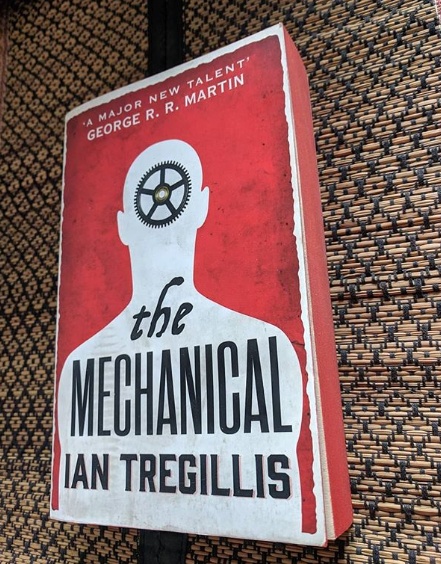
  • The Mechanical (The Alchemy Wars, #1)

    Ian Tregillis

    What a thriller! The blurb on the cover has the high priest of epic fantasy – George R R Martin – calling the author ‘a major new talent’. The book indeed delivers to the compliment, and if the first volume of the series is any indication, it promises to be an extremely interesting ride.

    I am not really sure what genre the book would fall into – speculative fiction seems to be the safe choice. Given that it seems to be set in the early 1900s, and the title, I had thought steampunk, but somewhere in the book, the author alludes to steam power not having caught on, and relegated to the pile of forgotten technologies.

    There is definitely robotics and artificial intelligence involved – “Clakkers” having been developed in the 1700s. One of the principal characters – Jax, a Clakker – reminded me a lot of R. Daneel Olivaw from the Foundation series.
    Alternate history it is, because the Dutch are the major super power – the Empire, thanks to a “monumental breakthrough” in technology by Christiaan Huygens. They are locked in a stalemate confrontation with the French, whose court is riddled with internal politics. The Dutch seem to have mastered a technology that combines clockwork with alchemy, while the French have focused on applied chemistry.

    A Protestant vs Catholic tussle is also quite evident, complete with ‘church police’ in the form of a special kind of Clakkers called Stemwinders.

    The mechanics of the plot are racy and intriguing by itself. But the author takes it up a notch with philosophy – what constitutes sentience, and free will? The ideologies of Descartes and Spinoza play a significant role, with the significance and influence of the latter being an instrumental part of the narrative.

    It is quite amazing how the author has done justice to all these themes by integrating them into the plot. I am definitely hooked!