
Month: October 2018

  • Daemon

    Daniel Suarez

    OMFG! That was one fantastic ride!

    An obituary of a genius gaming tycoon gets published, a program, or rather a complex logic tree system, is activated, and it begins its not-so-slow journey of taking over the world! The concept of a person infiltrating and controlling (and even micromanaging) people, events and corporations, after his death, doesn’t seem as far fetched once you get on this roller-coaster of a book.

    The immense tech knowledge that the author clearly possesses, meshes with a worldview that I definitely could relate to, and is nuanced with some very humane moments. It is as much a commentary of technology’s impact on society and individuals as it is an absolutely racy thriller that paces itself superbly. Pretty much an MMORPG set in the real world! What’s interesting is that at a certain point, it becomes very difficult to decide what the villain is – the Daemon or the government-military-industrial-corporation nexus that it seeks to destroy. The characters that fight for and against the Daemon are also an interesting bunch, with their own complex backstories, and sense of loyalty.
    I thought this would be classified as cyberpunk, but apparently there is a thing called post-cyberpunk. Whatever it is, I can’t wait to read the second part of this amazing story!

    P.S. Somewhere in between, the author also manages to explain the reason for evolution deciding on sex as a means of reproduction! Fantastic stuff there too!
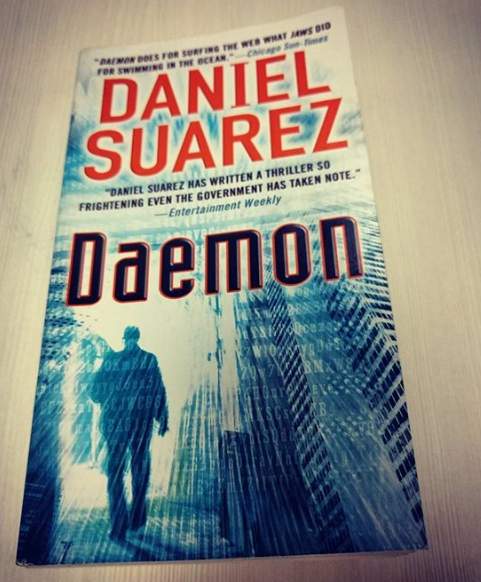
    Daemon

  • Finn, Tolstoy, and happy families

    “You’ve heard that line about all happy families being the same?”

    “War and Peace”, I said.

    “Anna Karenina, but that’s not the point. The point is, it’s untrue. No family, happy or unhappy, is quite like any other.”

    I read this in The Woman in the Window by A.J. Finn recently. I use the Anna Karenina principle quite a bit in many contexts and discussions. In fact, recently, while reading Guns, Germs & Steel, I realised he had used this framing too. To put it simply, there are x number of conditions that definitely need to be met for something to succeed. The ‘something’ could be anything from origin of life to economical supremacy, and the ‘x’ conditions would change with that context. But in a given context, only those who fulfill all the x conditions will succeed.

    Naturally, as a believer, I was miffed by Finn’s (character’s) statement. But, could he be right?

    As I write this, D and I are a day away from celebrating 21 years of being together, 15 of them in a married state. Speaking of state, Kerala in the late 90s and early noughties, much like other non-metros in India, wasn’t friendly to intimacy or dating. In fact, the reaction to our relationship was actually a combination of the two – intimidating! Especially since a couple of religions were involved. Anyhow, here we are, 21 years later – happy.

    The stage was set for a thought experiment. Are we happy in the same way other couples are? I’d think not. I don’t really have data, so I will use  a simple non social-media-posturing observation. There are a lot of happy families with kids.* We chose not to succumb to that genetic pressure. So we’re different from other happy families. Does that mean Finn is right, and Tolstoy was wrong?

    I think it just isn’t as binary as that. Tolstoy was right because if one figured out the conditions that need to be met for a happy marriage, I have a feeling the successful couples would be meeting them (children most likely will not feature in that list). Finn is right too, because the way in which the couples met them would be drastically different from each other.

    In any case, I don’t think we have found an objective framing of happiness to begin with!

    *There is interesting data (Google searches and experiments) to show how “kids bring happiness” is just belief transmission for evolution’s needs and not the truth it is portrayed to be. But people have their own narratives of what happiness is, so I’ll leave it at that.