
Month: September 2015

  • Onesta

    First published in Bangalore Mirror

    Under normal circumstances, 7.30PM is a safe time to walk into a restaurant without a reservation – experience suggests that it’s too early for the twenty-somethings to have started their Saturday nocturnal agenda. But then one comes across places like Onesta that completely defy this logic. Onesta is on the Ooty Chocolates road off 100 feet Road Koramangala. (map) Best of luck on the parking. We barely managed to get a table, and in the two hours we spent there, there was hardly a moment when a whippersnapper wasn’t waltzing in and asking for a table, seemingly oblivious of folks who were already waiting. Having landed a table right at the entrance, we were at the receiving end of a ton of evil eyes, all of which were questioning the legitimate amount of time one should be allowed to spend with pizzas. This is amazing for an outlet which has been around for only a month, and it immediately raised hopes of some fantastic food. But, according to the menu, you need to wait for 25 minutes before the food reaches you. So let me attempt to distract you with the ambiance. Imagine walking off a Koramangala road straight into a cobbled street in Europe, complete with a tiny fountain, white walls and shutter doors. In the first ten minutes, we even had a two-girl band crooning to lyrics sourced real time on a mobile phone! Music reminds me, there’s a heavy metal fan right next to the fountain, and while the idea (coolness in summer) is indeed sound, it does result in water sprays every five minutes if you’re seated anywhere near it. That notwithstanding, the yellow flower pots, red and black chairs, the quaint lampshades and glass bottles, and paneled wood tables all contribute to a bright yet chic elegance that’s warm and charming.
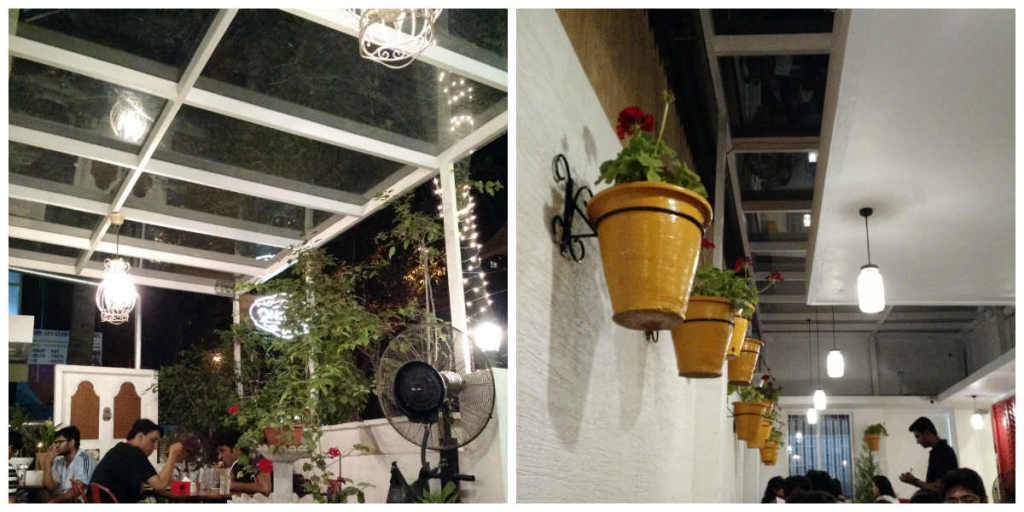
    collage1 (more…)

  • Re-framing employment

    For untold generations work was simply a matter of maintaining the status quo.

    Across the world, the debates on productivity, reduced work hours, 4 day work weeks, DND after work hours etc are intensifying. Add to this the narratives of “the end of employment” and the “gig economy”, (and therefore the case against full time employment) and the signs of an upheaval of our concept of work seems imminent. I can vouch for that from my own experience as well – expressed to a certain extent in earlier posts –  The Entrepreneur & the Professional, and Re-skill. My posts on AI and its impact on employment are also related to this in a “bigger picture” way.

    It is personal in a different way too, because it’s increasingly an application of a broader life framework and worldview. In fact, I was accusing myself of over thinking this, until I read this fantastic piece – How Not to Let Work Explode Your Life. That’s where the quote at the start has been taken from. It traces the origin of the clashes we are facing in our work-life environments now to trends that have been forming for centuries. Long, fascinating read, and a confirmation of many of my complicated thoughts! (more…)

  • The Lowland

    Jhumpa Lahiri

    The good part is that the usual characters are all present – Kolkata, Boston, melancholy, wistfulness. The better part is that Jhumpa Lahiri is in top form. I was a bit disappointed with the last book so I started this with a skeptical mindset, but am extremely glad to have been proved wrong.
    The story spans about four generations, beginning in the 1950s and ending in contemporary times. What is interesting is that, though at least a couple of the characters seem easy enough to slot into standard stereotypes – a Naxalite moved by his milieu into embracing a fiery ideology, and his brother who moves to the US and becomes the immigrant absorbed in scientific research building a new life in an alien country, the author takes them beyond that in the story arc, giving them depth and layers.

    One wonders whether it is the story of Udayan whose influence in the lives of the characters extend far beyond his death, or that of Subhash and the women in his life – a mother disappointed by his choice, a wife who never loved him as he wished she would, and a daughter whom he raised but is not his own. Or is it really the story of Gauri, and her journey which seems to be played out in a real as well as philosophical level? “Plato says that the purpose of philosophy is to teach us how to die.” Between these three, the author travels the spectrum of human nature – from its most benevolent to its most selfish. The Lowland is the stretch of land between two ponds – probably also symbolising the two brothers and Gauri. (more…)

  • Adaptability & Actualisation

    “It is not the strongest species that survive, nor the most intelligent, but the ones most responsive to change“, Darwin had said, in a more long-winded form. I have been in awe of evolution as a concept for a while now, and have rather prided myself on being adaptive, specially in my work context. In terms of hard skills, I still believe that’s the way to go. However, when dealing with people, both in personal and professional settings, I have realised that it is possible to go overboard on being adaptive.

    A meta prequel before I get to that. On hindsight, I am seeing an evolution in my thinking on this subject. Back in April of last year, I figured out that I am happier when I don’t judge myself.  Later, in October, I realised that there is a correlation, and probably even a causation, between my happiness and the way I treat others. I decided to fix my happiness as my compass. But when I read this post from a couple of months ago, it seems as though I had wandered off the track I had decided on.  (more…)