Month: July 2014

  • Linking learning & labour

    I’m a huge Asimov fan, and am constantly amazed at how he was able to have a perspective of the future on multiple fronts. I was reminded of two of those recently thanks to their application (of sorts) in contemporary scenarios.

    First, Hari Seldon‘s (pretty much the foundation of Asimov’s Foundation series) psychohistory, which was able to make general predictions on the future behaviour of large populations using history, sociology and statistics. The easy contemporary connection is big data and predictive analytics.

    Second, a short story written by him called ‘Profession‘, (do read) in which every person’s profession is based on an analysis of his/her brain, and no choice is given to the person in this matter! In India, we seem to be already there even without the analysis!

    Collectively, these two made me think of employment, and on a related note, education. The thought was that with so much of data available on education and employment, we should be able to create ‘tests’ to compute the interest and aptitude of individuals at a very early age. What this would aim to do is to eliminate the herd education that currently exists. Instead, children would learn things that help them in a profession for which they have the intent and interest, using say, a combination of traditional classrooms and MOOCs. Also, this would no longer be one part of a life cycle, but a continuous process – helping the individual thrive in a dynamic environment.

    If you remember, LinkedIn was my representative for ‘L’ in the ‘change imperative‘ deck. That was because I felt that it had the data and the vision to be the catalyst for this kind of a change. I was very happy when it underscored this faith with the fantastic ‘future self‘ experiment, in which they identified the future professional self (5 year time frame) of LinkedIn user Kurt Wagner – another user Mussarat Bata – using various data points!

    LinkedIn hasn’t really built this as a public tool, but just imagine the possibilities! A platform that shows people the possibilities which take them closer to their ‘purpose’. (remember ‘The Evolution of Work and the Workplace‘?) I sincerely hope to see this in my lifetime. 🙂

    until next time, live and learn
    Clipboard01

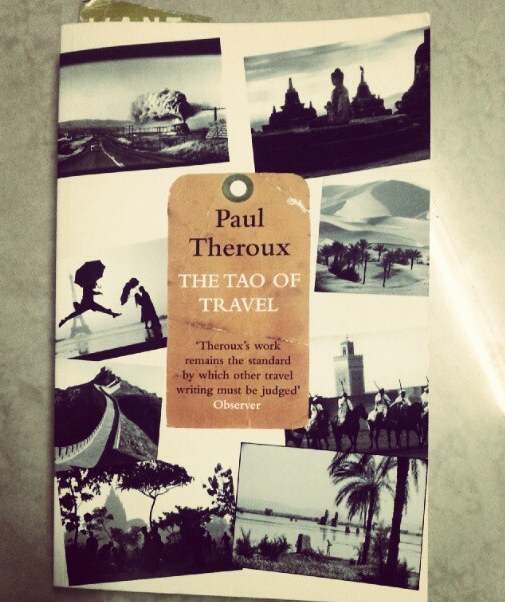
  • The Tao of Travel: Enlightenments from Lives on the Road

    Paul Theroux 

    Whenever I take a vacation, I arrive as a tourist and like to think that I leave at least partly converted into a traveler. I am forever envious of travelers, many of whose journeys serve as a purpose in itself. This book is an excellent little guide to what the author mentions in the preface – paraphrasing the Buddha – “You cannot travel the path before you become the path itself”, and how travel is also a way of living, and thinking.

    In addition to excerpts from various works by different travel writers and adventurers, classified by unique and amazing themes from Railways, time spent in travel to Murphy’s laws, to imaginary journeys, how places are different from what they sound like and so on, the book is peppered with Travel Wisdom from various authors.

    There are gems hidden in the pages – little quotes that somehow tell you that the spirit within each wanderer is essentially the same. The description of places and times by masters are splendid enough to transport you to locales across to world from Alaska to Africa and Russia to South America….And it’s not just the places, but the people who live there, the way they think, and one can sense the cord that invisibly connects humanity.

    In 275 pages, the author manages to indeed provide a Tao of Travel across time and space. Must read.

    Clipboard02

  • Social Nextworks

    The impending death of Orkut (2004-2014) made me think of the evolution of social networking and its transience. Orkut lived ‘only’ for 10.5 years, and this is despite being part of Google, though some would call that a disadvantage. Facebook  has been around for the same time, and the fact that it is a force to reckon with is a testament of its understanding of this transience. It also explains the acquisition of Instagram, Whatsapp and the attempt on Snapchat.

    However, I recently realised that I am probably more active on Whatsapp, Instagram and Pinterest than Facebook and Twitter. I am also reasonably active on Secret. That made me dig a bit deeper.

    Clipboard01

    (via)

    What is changing? From my observations, there are at least two factors that are driving the change.

    Perspectives on connectivity: The early era was fueled by the need to connect. Facebook is soaring well beyond a billion users, and its longevity is (also) because the need still exists. It continues to look for better ways to do this, manifested through front end and back end changes. But despite this, and my own curation of my newsfeed by sending signals to Facebook, I am regularly overwhelmed by the volume. This goes for Twitter too. Personally, I have treated these platforms as a means of self expression. I would also like to choose the people whose perspectives I want, and who are entitled to a judgment, if any. But that’s not so easily done on popular platforms.

    That’s when I start to look at the many ways to handle this – from social networks to messaging apps. I could go to where the crowds are relatively less and/or are more ‘focused’ – by domain or use cases, (LinkedIn, Pinterest, Instagram) I could interact with smaller groups, (WhatsApp) use ephemerality (Snapchat) or be anonymous (Secret) As I mentioned, at least three of these work for me. A wonderful nuance I caught in Mitch Joel ‘s prophetic ‘The Next Big Thing Online Could Well Be Anonymity‘, is that it may not just be ‘something to hide’ that makes some prefer anonymity, but it could also be so that ‘who they are will not become a focal point within that discussion’. Anonymity on the web is not new, but many of its enablers are.

    Devices: The networks of an earlier era (eg.Facebook) were made for desktop and had to adapt for mobile. On the other hand, Instagram, Whatsapp, Secret, Snapchat etc are mobile natives. Given the increasing ubiquity of smartphones, their growth is not surprising.

    What are the possible business models and what’s a brand to do? As more and more users flock to these new platforms, they would need to mature, with business models which could mean associations with brands – the journey from social network to social media.

    Instagram and Pinterest are already social media, making advertising at least one of their revenue sources. WhatsApp does not like advertising and already makes money on downloads. Its competitors like Line, KakaoTalk, WeChat etc, however, have found various other means – virtual items, (stickers, in app purchases in free video games) promotional messages, baby steps in electronic payment handling fees, and interesting tie-ups. Snapchat already has many marketers on it and is likely to offer promotion options too, probably tied to a time bound event.

    Secret has a lot of negativity surrounding it – s3x talk and startup malice and being just a fad – and there are comparisons to Formspring and its demise despite funding. But beyond advertising and in app puchases, maybe, there’s also potential for insights on a brand and its use cases? Things that cannot be found on indexed platforms. Also, Whisper already has a content deal with Buzzfeed.

    Analytics for such platforms haven’t even really begun yet, but it can’t be far away. But more importantly, all of these platforms are potential enablers for a brand to take forward its narrative and become relevant to its users. It continues to be about storytelling, and digital.

  • Mother Cluckers

    12th Main Indiranagar now rivals Koramangala in terms of cuisine diversity! Mother Cluckers belongs to the Plan B family and pretty much rules the roost in terms of popularity in the area. (map) I was told that finding a table among the dozen options available would be near impossible. But we were early cluckers and got a spot, near the ‘hippie entrance’. In about half an hour, the place was packed. Not surprising, since it’s not a really large space. In case you don’t get lucky, take your drink and spend some time in the smoking zone beside the entrance. They have made the most of the space – rustic brick walls adorned with plaques and posters that sum up the commitment to clucking good food. The glasses, tissues and even the menu show the lineage quite clearly – Plan B. The dim lighting (though they have done a fantastic job of ensuring tables are well lit) and a general informal ambiance and decor make it a perfect spot to unwind in the evening. That’s despite the mildly uncomfortable wooden park bench seating. The music went everywhere from ‘Walk of Life’ to ‘Summertime Sadness’, and the decibel levels don’t really encourage a lot of clucking.

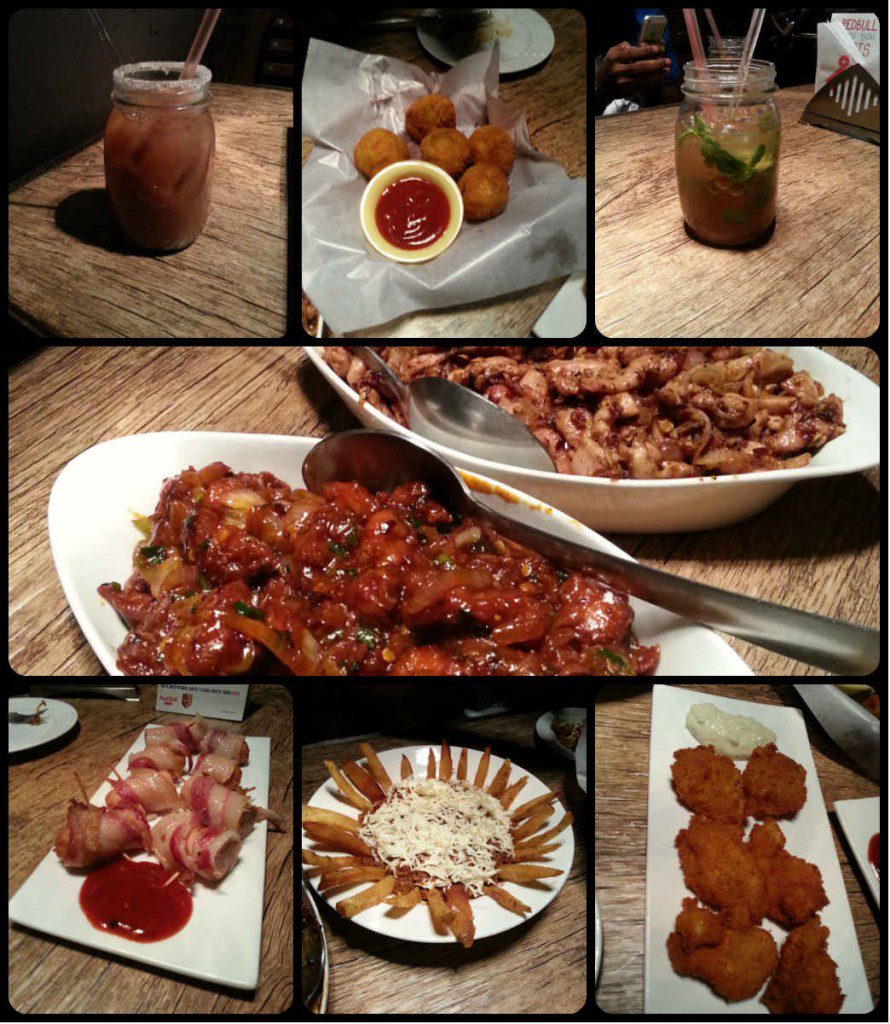
    One gigantic menu, one side of which is occupied by solids, and the other by liquids. The focus is clearly on bites that can go with drinks, which does make eminent sense given the place’ intent. We decided to test out the standard stuff before the specials. The Long Island, despite not skimping in alcohol, fell rather flat. The Caipirovska didn’t have as many illustrious ingredients, but was a much better drink – smooth and refreshing. The obvious choice for me, from the house specials, was Chutney Mary – a mix of vodka, guava juice, and spices. I suspect the ‘spices’ were chaat masala, but the drink is fantastic, if you’re the kind who doesn’t mind the drink being ‘hot’. Also, it does set the tone for the food. From “The Clucker’s Arsenal”, we asked for the Fiery Clucker, boneless chicken, grilled and marinated. Tasty enough, but surprisingly, despite the name, it turned out to be relatively less spicy than the other starters we tried. The Chilli Fried Pork, on the other hand, did live up to its name, and is only for those who can handle the heat! The Beef Chili Cheese Fries occupied the middle ground, with the cheese tempering the spiciness of the beef. The bacon with sausage, was exactly like all things that have bacon – great! The crunchy prawns were true to the name, and though the batter was bland, the mildly pungent dip made up for it. It was also a good respite from the spice assault! This is not really the best place for herbivores, but the Stuffed Mushrooms are totally worth a try, thanks to the delicious cheese and spinach stuffing.

    collage

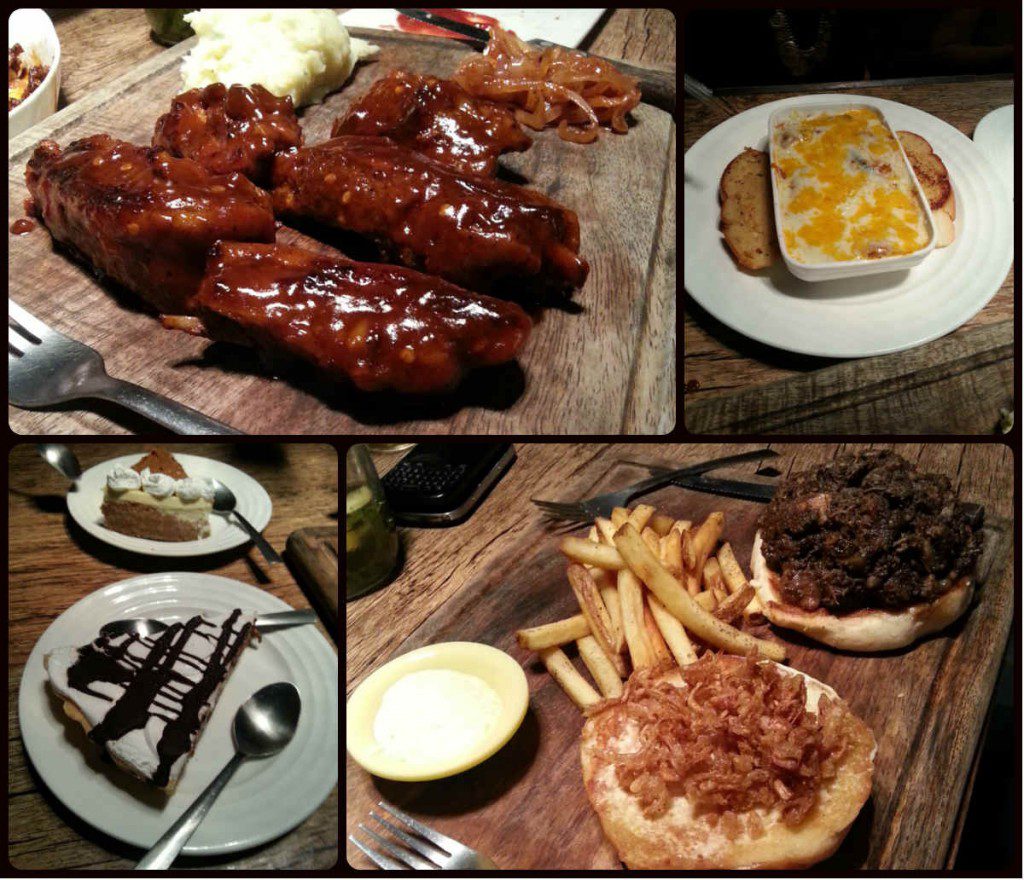
    The mains options consist of burgers and a reasonable selection of other dishes. We started with the Pandi Burger, probably the most unique one in the list. Instead of the patty, there’s spicy Coorg pork, with a zesty tang to it. They have a crab burger as well, in case you prefer a sea adventure. The Smoked Spare Ribs is another dish that stands out from among the spice crowd! The marinade is sweet and only mildly spicy, with well cooked meat. Yet again, there was a pleasant veg surprise, this time in the form of Baked Eggplant, with a healthy dose of cheese and a tasty sauce.

    The menu doesn’t display desserts, so we had given up hope, until one of us noticed the board outside with four options! We chose the Banoffee pie and a Chocolate cheesecake. It’s counterintuitive to go to a pub for desserts, but you’d be forgiven in this case. Spectacular stuff and a sweet mother clucking end to a meal!

    collage2

    A meal for two would cost around Rs.1500 (Inclusive of taxes and service charge) – a couple of cocktails, a non veg starter, a main course dish and a dessert. There are only two things that can bring tears to your eyes – your preference for veg dishes (if any), and the spice levels in pretty much all the dishes. If you’re fine with that, and a hoarse voice that comes from shouting over the music, you’ll completely enjoy the place. The place is built for carnivores who enjoy their drinks. The rest of the world would unfortunately have to go cluck itself.

    Mother Cluckers Bar, 957, 12th Main, HAL 2nd Stage, Indiranagar Ph: 9886092625

  • The legacy need

    The last two books I read had only a faint connection. One was historical fiction and the other was a memoir. The first – “A Spoke in the wheel” by Amita Kanekar – is a take on Buddha and his teachings by a monk three hundred years after the Buddha’s death when his teachings have begun their journey into religion, the emperor Asoka being the key catalyst. The second – “City of Djinns” By William Dalrymple is his discovery of Delhi – past and present – in a year that he spent in the city in the early 90s. The connection, as you might have guessed, is historical narrative.

    It is natural to think that there is a huge difference in a work of fiction and a more research and experience led memoir, but the point of the post is that with time, it is difficult to establish that. In the book on the Buddha, the monk chronicling his life and teachings is irritated by the supernatural abilities being attributed to him. But we do know that many people believe in it now and even consider him as one among the avatars of Vishnu. On a related note, William Dalrymple delivered a body blow to my notions of the Mahabharata era when his conversation with an archaeologist constituted a distinct possibility that the war was fought with sticks and stones and probably a bit of metal! (the proof being excavations around what is considered one of the earliest versions of Delhi – Indraprastha) I am a huge fan of Hindu mythology and it has fascinated me from as long as I can remember. I truly believed that they had happened in some form, but the archaeologist is clear that most descriptions in the epic would fall under ‘poetic license’!

    It made me wonder if there would be any difference between the two books say, a hundred years from now. It is possible they might exchange roles. It is also possible that they both are treated as fiction, or as factual pieces of work. I think all scenarios are possible because at the time of chronicling something, we believe that its factuality would be transmitted across time. And yet, we could debate the Mahabharata’s historical authenticity and Buddha’s superpowers both ways! So think about it, the same thing could happen to the information we store now as well. Thanks to digitisation, more data is being created in this world than ever before and (arguably) every point made has a counterpoint. There are no objective annotations because even the original construction is a product of biases, interpretations, perspectives and so on.

    That brings me to legacy, something a lot of us care about. From children to business empires to art to helping others, there are many avenues. However, I think that unless there is documentation, the chances of a legacy lasting beyond a few generations is questionable. For example, Dalrymple finds the last line of direct Mughal descendants and their knowledge of their ancestors is limited to a few generations before them. The futurist in me does fantasise about a global neural network and consciousness that connects all of humanity and has sufficient storage to instantly collect, catalog and annotate all ‘memories’  in as objective a state as possible for later generations to study them.

    But meanwhile, even as I dissect my baggage of the past, I am now forced to consider my need for leaving a legacy – something behind that will represent me when I’m gone.  After all of the above, how relevant is that need? Isn’t it just a demand made by the ego, a story we create for ourselves? Something to continue the narrative of our lives? We do talk a lot about letting go of the baggage of the past, but isn’t legacy also a baggage? A baggage of our future? If we let go of that, how different would our thoughts and deeds be? Understanding that is probably the key to living in the moment. I could easily twist my favourite cricketer-gentleman’s words for this context- He’s not concerned about his legacy, he’s concerned about what actually makes him come alive in the first place, which is that love of life, the desire to live completely.

    recite-15416-48543400-hiy6v5

    until next time, present participant