Month: May 2014

  • Agile @ Scale

    Prelude

    I think I used ‘dis-aggregated social network‘ on this blog for the first time in 2009, referring to Google’s basket of services that were connected relatively flimsily then. IMO, Google has always been that way, even including Google+. (read) I remembered it when I tweeted this about Facebook – around the time news of their Fan Audience Network started trickling in.

    It got me thinking (again) on ‘scale’, a recurring theme here. In a less complicated world, where the trends in the business landscape were significantly more linear, (growth, competition, consumption, economy) scale was a powerful weapon to wield. But it’s a different world now. Artificial Intelligence, 3D Printing, Internet of Things, Wearables  and a hundred other things might completely disrupt the status quo and the need an incumbent brand satisfies. These are the known ones, and then there are the conceptually invisible (at this point) ones. Surviving (let alone thriving) in this shifting scenario requires agility, and it is difficult (though not impossible) to see scale and agility together. I looked to Google and Facebook for an approach towards this because not only are they surviving, they seem to be thriving. Yes, we’ll get to Amazon in a while.

    What does it take to be agile at scale? I can think of four ingredients, the last three repurposed from the title of this post by JP Rangaswami.

    Purpose

    I remember talking about re-defining of scale at the Dachis Social Business Summit. The thrust of the presentation was that brands could engage consumers at scale only if they use currencies that create value for the user in the context of a shared purpose. I have elaborated it in this post at Medianama. Recently, I saw that Hugh MacLeod has brought it out beautifully here. Simply put
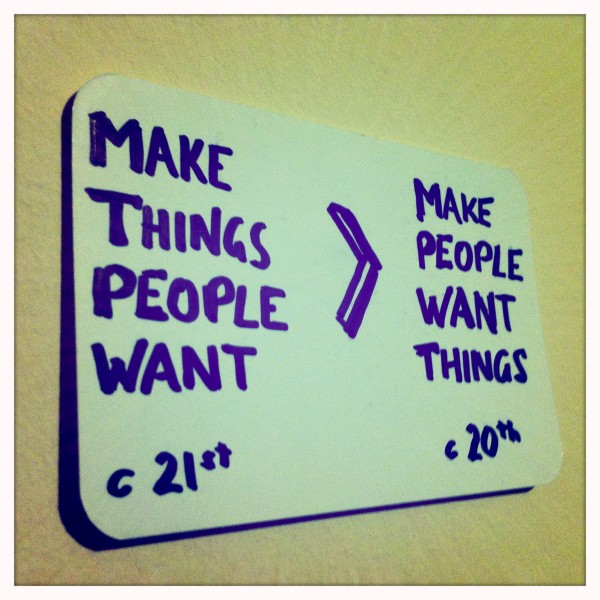
    Make-Things-People-Want-600x600

    (via)

    Possibilities

    The purpose need not have one constant rendition. As the landscape changes, a business will need to adapt it to suit changing circumstances. For that, a business needs to understand the possibilities. I saw a very good line in this post about being a maker – the more you work in the future, the less competition you will have. How much into the future a business needs to be working is subjective and depends on its dynamics, but if it doesn’t disrupt itself, someone else will gladly do it for them. (“The Jeff Bezos School of Long-Term Thinking” is a good read in this context)

    Platforms

    While purpose and possibilities are all good at high altitudes, a business also needs strong operational  platforms to back it up. As organisations scale, I have seen two things that affect agility. One, the processes that are introduced to create efficiency @ scale more often than not, become the goal instead of a means, slowing things down and taking away from actual goals. Two, as processes and manpower increase, silos are created. The good news is that it is easy to see technology platforms bringing more efficiency into processes as well as an iterative way of thinking in the near future. It is already happening in marketing. This, and many other factors are also dictating a consumer experience driven approach and are forcing organisations to break silos. As the entire brand/organisation becomes a platform (read) that regularly revisits its context and purpose in the life of a consumer, ‘everything becomes a node on the network

    People

    HuffPo had a post sometime back, citing Zappos, calling 2014 the year of workplace reinvention. It is interesting to note that parent company Amazon has apparently aped Zappos’ ‘pay to quit’ policy, even as more and more stories about working there being a ‘soul crushing experience‘ are coming out. Meanwhile, the two points it mentioned for this to happen are purpose and trust. These I’d say are the bedrock of culture. It’s intuitive that a workforce mindful of the organisation’s purpose and their role in it would keep an eye out for the business’ possibilities, be ready to work beyond silos towards a great consumer experience, and bring in others who would help the business scale. This, along with purpose, has to be the glue that holds it all together, enabling the organisation to move fast without cracking.

    While different sectors are at disparate distances from a radical shift necessitated by technological developments, it is, I think, inevitable. In this fantastic post titled ‘Knowledge is faster than mortar‘, which looks at scale through a different lens, the author makes the point that ‘the old mechanisms don’t fit the new social structure.Old mechanisms were built to scale stability, new ones will have to be built to scale despite instability. Anti-fragile, so to speak. Indeed, we will see many manifestations as existing structures try to adapt – internal mechanisms like Amazon’s 2 pizza rule, consumer facing disaggregation like Facebook that have a corresponding internal wiring, or brands tweaking their 4Ps even further for different contexts. But whatever paths businesses choose, this will hold true
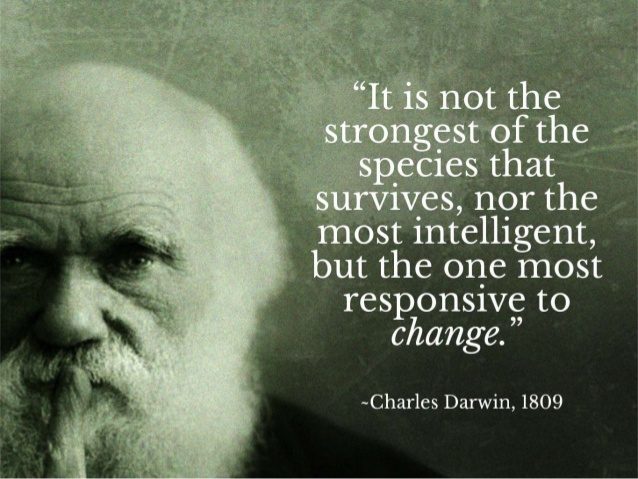
    responsive-to-change

    until next time, the fast and the curious
  • Infinitea, Indiranagar

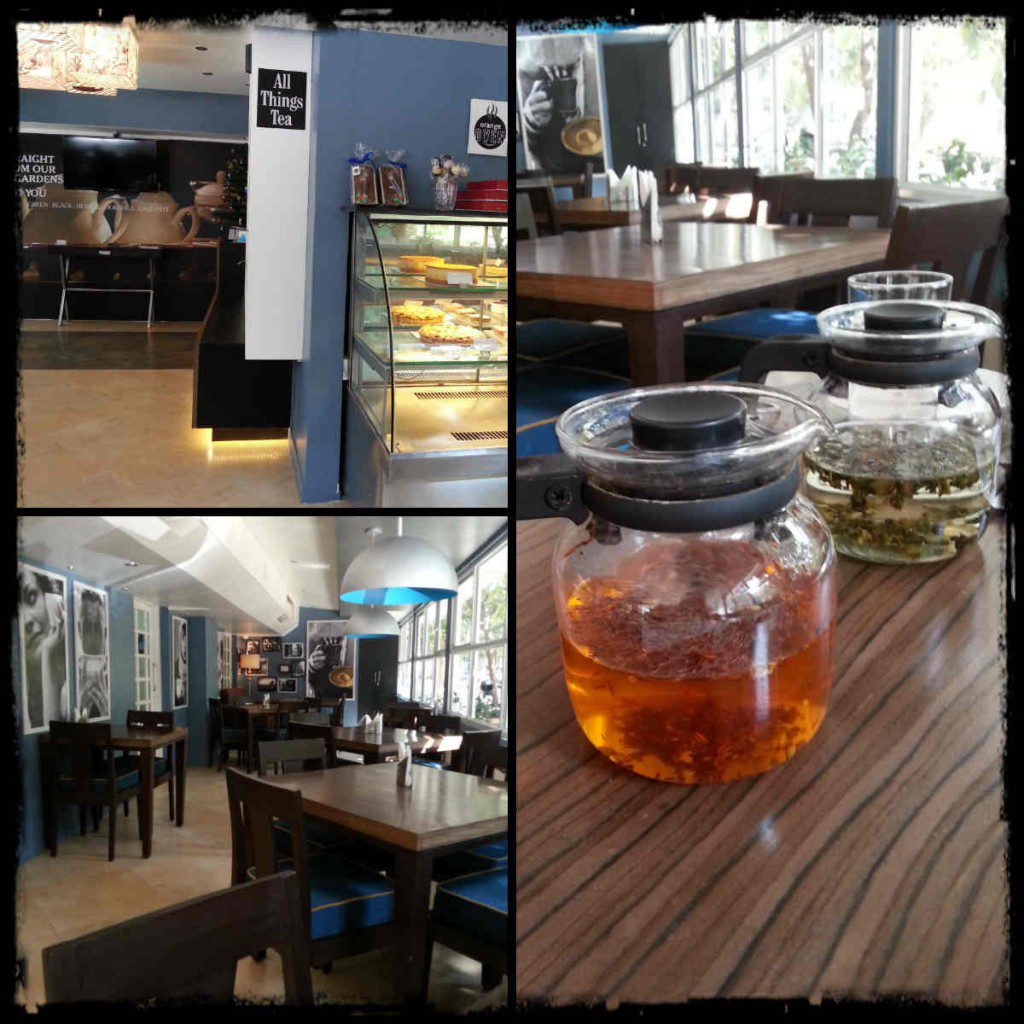
    I’ve been to the Cunningham Road version a couple of times, and am a bigger fan of its ambiance than the food served. D has not been there and such occurrences (me having visited places that she has not)  don’t sit well with her. Unfortunately, Cunningham Road is a little away from our part of the universe, so I have dillydallied. Sometime back, she triumphantly announced that she had seen an Indiranagar version and that left me with no excuses. So we landed there one Sunday noon. When going from Koramangala, take the left turn after the Domlur flyover, you’ll see the outlet on your right a bit before this road meets 12th Main. Enough lanes around to park peacefully.

    The space is considerably lesser than the Cunningham Road outlet, and limited to one floor, though there are alfresco and indoor seating options. The ambiance retains some of the quirkiness, though this is less of the elegant tea room than the other outlet. But they have done their best given the space constraints. The menu is the same, and we asked for pots of Choco Ginger and Vanilla Oolong. The first one had a chocolate aroma that proved that the way to man’s heart can also be through his nose. The taste though was skewed towards the ginger. The second one had really subtle flavours and D didn’t care for it much.

    collage1

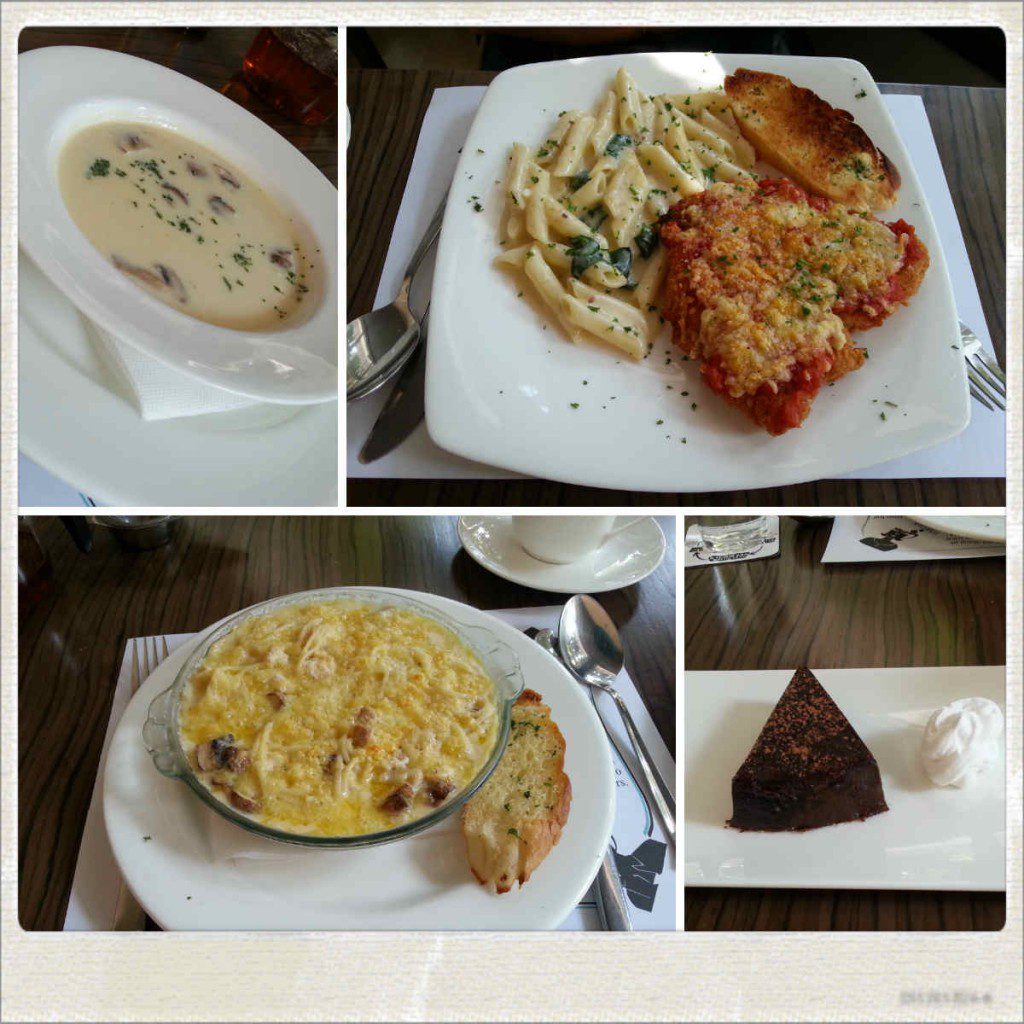
    We decided to skip starters and began with a Cream of Mushroom and Chicken soup. It was slightly thinner than we’d have liked, but it wasn’t stingy with the cream, and with a dash of pepper, we learned to like it. For the main course, we ordered a Chicken Tetrazzine and a Baked Fish Parmigiano. The Tetrazzine was a baked dish with spaghetti and a cream sauce. The cheese was strong with this one, but the sauce again felt a tad diluted and bland. The fish dish was relatively better, because there was some tang thanks to the red sauce and tomatoes. This one too was generous with the cheese, and left us with just enough space for a Crillon Cake. Dark, flourless chocolate cake with whipped cream which floored us. Fantastic end to an otherwise average meal.

    collage2

    The service was quite prompt, the ambiance is pleasant enough, and the meal left us lighter by only Rs.1470 including service tax and charge. That was quite reasonable, given the location.

    Infinitea, 26, ESI Hospital Road, HAL 2nd Stage, Indiranagar, Ph: 41265258

  • ASURA: Tale Of The Vanquished

    Anand Neelakantan

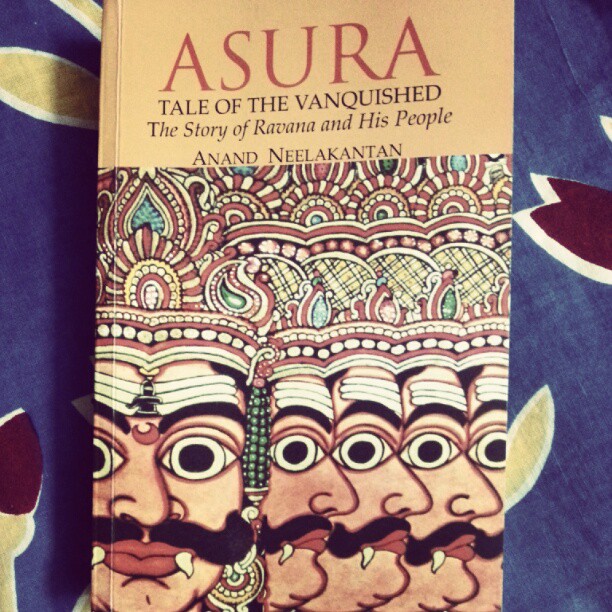
    Asura is partly a Ravana perspective on where his life intersects with that of Rama, (and thus Ramayana) and partly a social commentary of his life and times. (how society treats women, the caste system etc) The tale is narrated by Bhadra, an asura who fought under Mahabali and several others before becoming a recurring (and key) figure in Ravana’s life from the time he led a ragged army against Kubera. The narrative begins with Ravana’s last moments, as he lay dying on the battlefield.

    Predictably, the book shows Ravana in a good light, whose only fault was that he defied the prevalent societal norms and lived life on his own terms, as opposed to Rama, who was deified by the higher castes and made into an ideal image. For all we know, this is probably true, since history is after all, written by victors.

    While most of the story is essentially known, the author deserves credit for demystifying the myth – from the big picture details of which region was ruled by which king to smaller details like Pushpak as a flying machine prototype and Jatayu becoming a bird that got caught in its rotors. This does require that he has to gloss over some of the events, but that’s easily something we could forgive because the author largely keeps it true to the original tale. Varuna as a pirate, Kubera as the merchant king, Yama as the drug lord, various Indras, are all superb renditions of familiar mythological characters. There’s some intelligent use of Bhadra in the final events, and the author leaves ample clues for the reader to predict it. The author tries to show that in many ways, things have remained unchanged – the generation gap between Bali/Angada and Ravana/Meghanada is a classic example, and this is something that gives the narrative a lot of credibility. (+5 points for the Jabali mention)

    But I did feel that it could have been edited better. Bhadra’s character, though used well to show how the life of a common man changed, or remained unchanged as the ruling class switched, is prone to long winded discourses which slackens the pace. The working of Ravana’s mind too becomes preachy once in a while, but thankfully not too often. If I had to nitpick, I’d say that mistaking navel for naval while describing a woman’s anatomy is not a sign of good proofreading. (-5 points for not connecting Chandrahasa to Shiva and relegating it to a blacksmith origin)

    But in essence, it is a fresh take, and was good enough for me to visualise how it really must have been – as something that really happened, and not just a myth.

    asura

  • The IP Man

    Disambiguation: This is about the Infinitely Patient Man. For the original, see Ip Man.

    In the last post, and a few before that, (Brand &  the personal API, The path to Immortality) I’d written about our increasing ability to log and monitor our various activities (food consumption, exercise, sleep, location, to name a few) as well as apply them – for example, to measure and  course correct – manually, machine-led or using a combination. The idea of the quantified self, I’d think, is to make a better human being at least in the physiological sense to begin with.

    In another line of thought, I’d also explored whether, as we proceed along this evolution, we could also create a more mindful version of ourselves – what I called a qualified self. This surfaced again a few weeks ago, as I analysed my own behaviour in a certain situation. I have been trying to be non judgmental, but it’s not easy to let go of some baggage, especially deep rooted ones that have existed for a long time. As I became grumpier (also) thanks to my irritation at not resolving my battle with inner demons and the other person’s behaviour remaining unchanged, the person at the receiving end remained his calm self. As always, I had conflicting emotions later – on one hand, guilt, for treating him thus, and on the other, a justification based on many events past and present. I also tried to put myself in his shoes and imagine how he must have felt.

    That’s when I realised that the process of creating a qualified self is much more challenging because there is no objective measure of right and wrong. i.e. one can objectively quantify the input/burning of calories based on BMI, gender, age and other factors which are subjective, but on what objective scale does one decide whether one’s action/decision/thinking is right in a particular context?

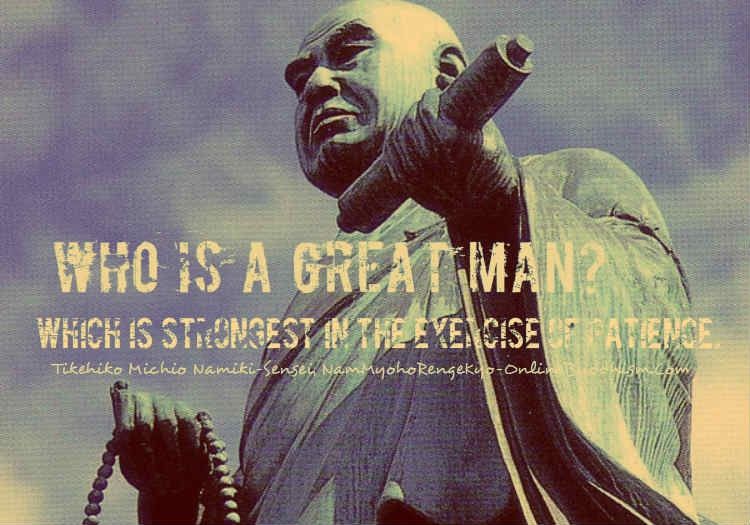
    What must have gone on in his head – did he face and win against the same struggles I had, or was he detached from it? Either way, it seemed to me that he was less anguished than I was. Is it his considerably larger experience of life that makes him so? It made me think – are such people, the infinitely patient ones, a key to cracking the qualified self? Is it even possible to monitor let alone apply their path? Or is it the kind of IP that refuses to bow to objectivity, and plays a part in making us what we are – human?

    until next time, intellectual propriety 🙂

    Bonus read: Achieving Apatheia

    patience

    (via)


  • Stomp

    First published in Bangalore Mirror, though I had no hand in that unintentionally hilarious USP! 

    I whined when I was asked to do this review, because it was in Whitefield! The Koramangala snobbery in me called it a 2D/1N package, specially thanks to traffic. But it was a good thing that I finally visited. A visit to Stomp manages to bring out both the meanings of the word. I can imagine people stomping their way (angrily) through Forum Value Mall (map) trying to find the place. They have hidden it well in a corner! But once they manage to get in, I can understand why they’d want to stomp – dance with a rhythmic stamping step.

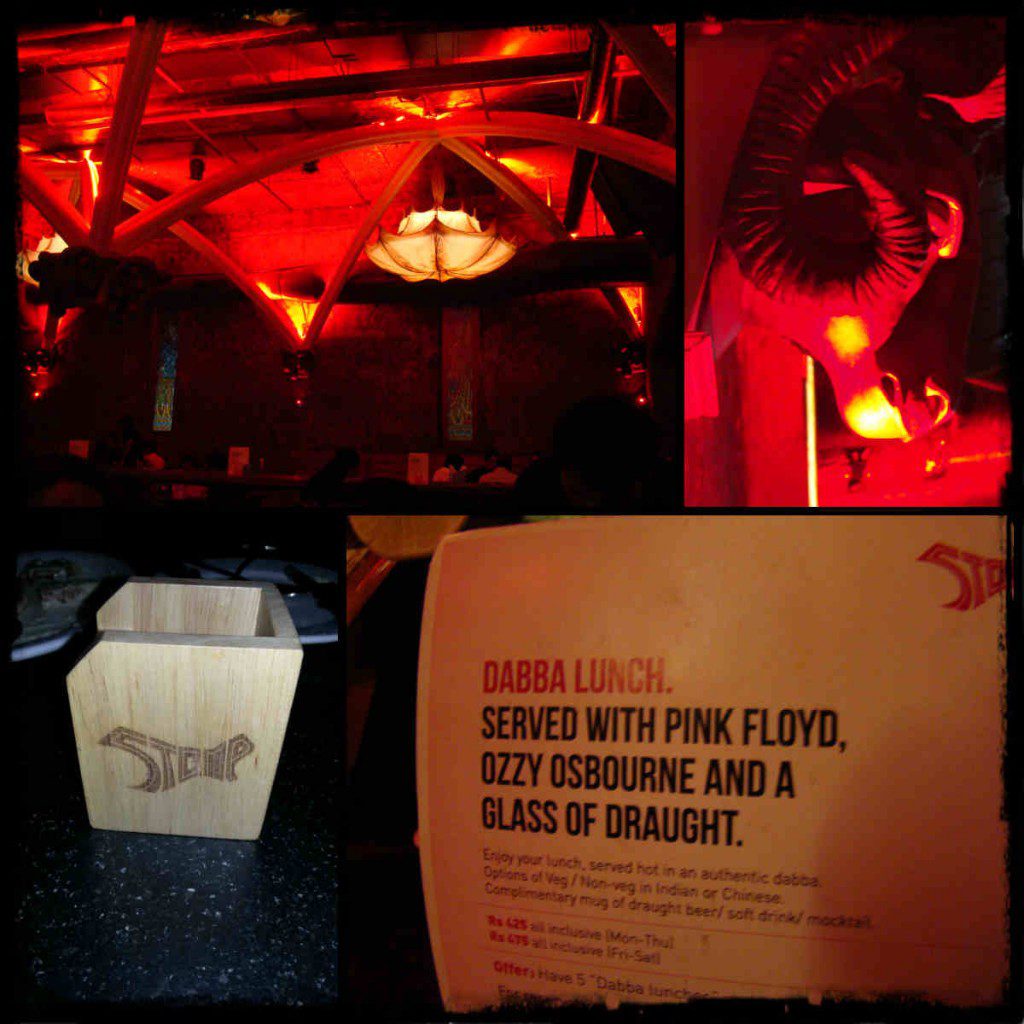
    There’s a small alfresco section, but the rest of the ambiance immediately reminded me of Richard O’Brien’s Crystal Maze – this would be the Medieval zone, with some ‘Industrial’ thanks to the large pipes. Add to this a Gothic touch, and the picture would be almost complete. Almost, because music is an integral part of the pub’s character as well. I loved the church-like stained glass ‘windows’ featuring Ozzy, Hendrix, Morrison and so on, and the quotes by famous artists that pop up at a few places. With all of that as the backdrop, we were mildly disappointed when we walked into a James Blunt song video playing on the giant screen. But that was quickly redeemed with a blast of Floyd, Dire Straits, Guns N’ Roses, The Police, Bon Jovi and videos we hadn’t seen in a long time! A hark back to the days of my youth, but as the night progressed, the playlist became younger. Avicii woke me up to the fact that I was older and Icona Pop reminded me that “You’re from the 70’s, but I’m a 90’s b***h”! The food proved to be a good distraction, and I let the non-veg mafia croon ‘Don’t you worry child’ in their own comforting way!

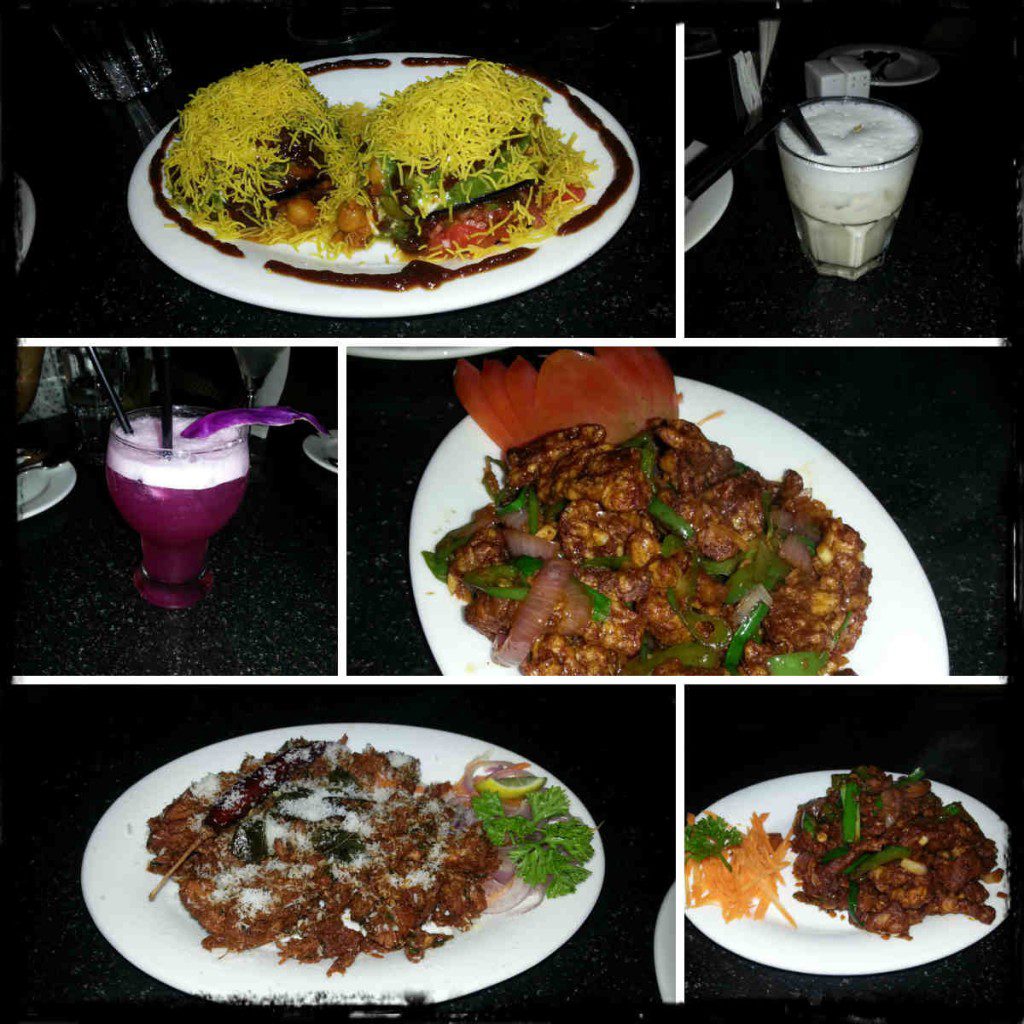
    collage1

    The menu is mostly Indian, and even when they do stray towards Continental and Mexican, there’s an Indian touch to it. The good news is that alcohol is relatively cheap and there are some interesting cocktail options. We tried the Purple Slurple, made from cabbage juice and white rum, and the strong and frothy Whisky Lass-y. The white wine Sangria was also different from the standard, apparently using a pulpy soft orange. The complimentary Guava Martini wasn’t bad either. Solid consumption began with the Beef Chilli Fry, which was quite tasty – well cooked meat and spicy. A house special – Ghaati Chicken Sukha was up next, and it reminded us of the coastal Sukka dishes. This was our favourite non veg starter with a mildly spicy masala and finely grated coconut for texture. Baingan Burani tha, in fact it was quite good and in appearance and flavour reminiscent of chaats. The Chilli Pork was the last of the starters to arrive, and except for the animal involved, was a replica of the beef dish we’d had earlier. But we had been  warned, so I wouldn’t really complain.

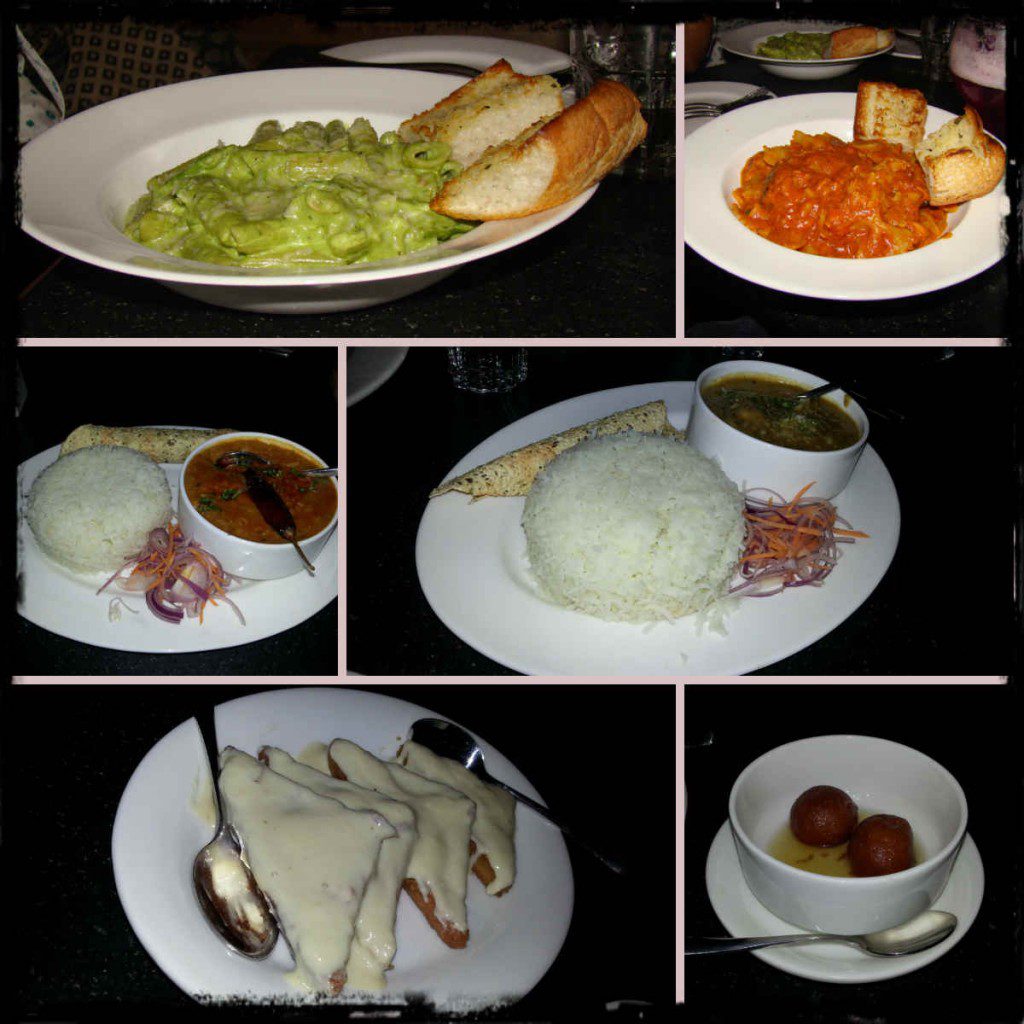
    collage2

    Understandably, the main course section has fewer options compared to the starters, but what was disappointing was that quite a few dishes were unavailable. All dishes are served with Indian bread/rice variations. We had to go with the Dal Gosht because the Dabba Gosht, Maamsam Koora and the Sri Lankan Beef Stir fry were not available. Unsurprisingly, this bland dish proved to be the least favourite. The Prawn Chilliajo made up for it with juicy, brilliantly cooked prawns in a delicious onion and pepper based thick gravy. The only vegetarian in the group tried to interest us in the Pesto Penne, which was quite good, though heavy, according to her, but we were preoccupied with the superb Chicken Farfalle in Makhanwala sauce – thick, flavourful and an example of a happy cuisine marriage.

    There are only four dessert options and the house special wasn’t available. The Gulab Jamun turned out to be quite good, though not extraordinary. The shocker was the Shahi Tukra. Though they weren’t stingy with the milk ‘sauce’, it wasn’t really rich, but the bread was the kind that could be successfully used for interrogations. You must pray that the tooth prevails!

    collage3

    For about Rs.1800, you could share a couple of cocktails, two non veg starters, a non veg main course dish and a dessert. (Inclusive of taxes and service charge) The service is friendly, but occasionally careless. They also need to be coached on dishes. I had to wonder how many people coming to Forum Value Mall would be interested in this kind of an offering. A pity because once you find your way in, the only thing that could piss you off is the lack of a toilet – you have to use the mall’s common facilities. Despite all that, I think the combination of good food, excellent ambiance, and different and interesting meal deals through the day will help this wonderful hangout establish a stomp of authority in Whitefield’s pub scene.

    Stomp, 12A, Ground Floor, Forum Value Mall, Whitefield, Ph: 080 49420000