Month: April 2014

  • Bricklane Grill

    Bricklane Grill has been a source of emotional attyachar from the time I went there for an office dinner in December 2012. (thanks, foursquare) Every time the restaurant pops up in a discussion, I get accusatory looks. “Tonight, we end this!”, said I, on a Saturday evening, when both D and I were sneezing in tandem. And that’s how we landed up at Bricklane Grill. (map)

    We had reserved, and though only one table was occupied when we got there, (early – 7.30) by around 8.30, the entire section was full. For some reason, they were only serving drinks and appetisers in the alfresco area. Anyway,  it was a windy evening and we were already have sneezing fits, so we sat inside. The decor is functional yet classy, and the place has a very pleasant ambiance, with sufficient space between tables, and by the end of the evening there was a fair amount of buzz. Just right. I remember sitting upstairs (technically, the 6th floor) the first time I was there. That floor had a room almost similar to the one we were in, and a small terrace, where we had sat.

    One of the service staff introduced himself and began offering recommendations from the menu. When he heard about our nasal troubles, he offered to make us a toddy based hot drink. Good touch, but though I asked for one and said we would order another if we liked it, we got two, and D didn’t even like it! 🙁 Should’ve sent one back! We also ordered a Cream of Mushroom  soup and a Bheja na Cutlets to begin with. A complimentary plate of bruschetta arrived on the table. Not spectacular, but not bad either.  The soup was not bad, though uni-dimensional in terms of flavour. The cutlets were really good – mutton brain with a crumbed and deep fried egg batter coating. As for the drink, it couldn’t hold a candle to the LTO. (at Like That Only)
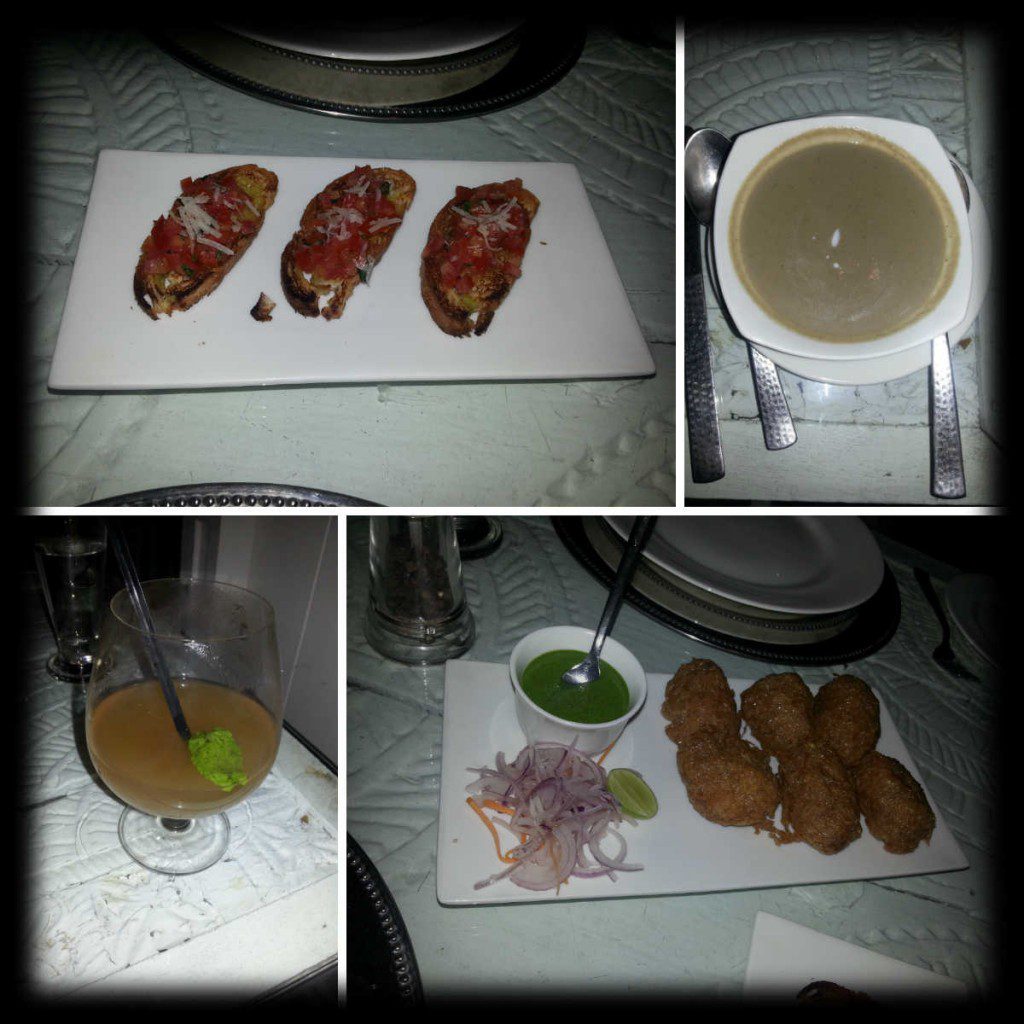
    collage1

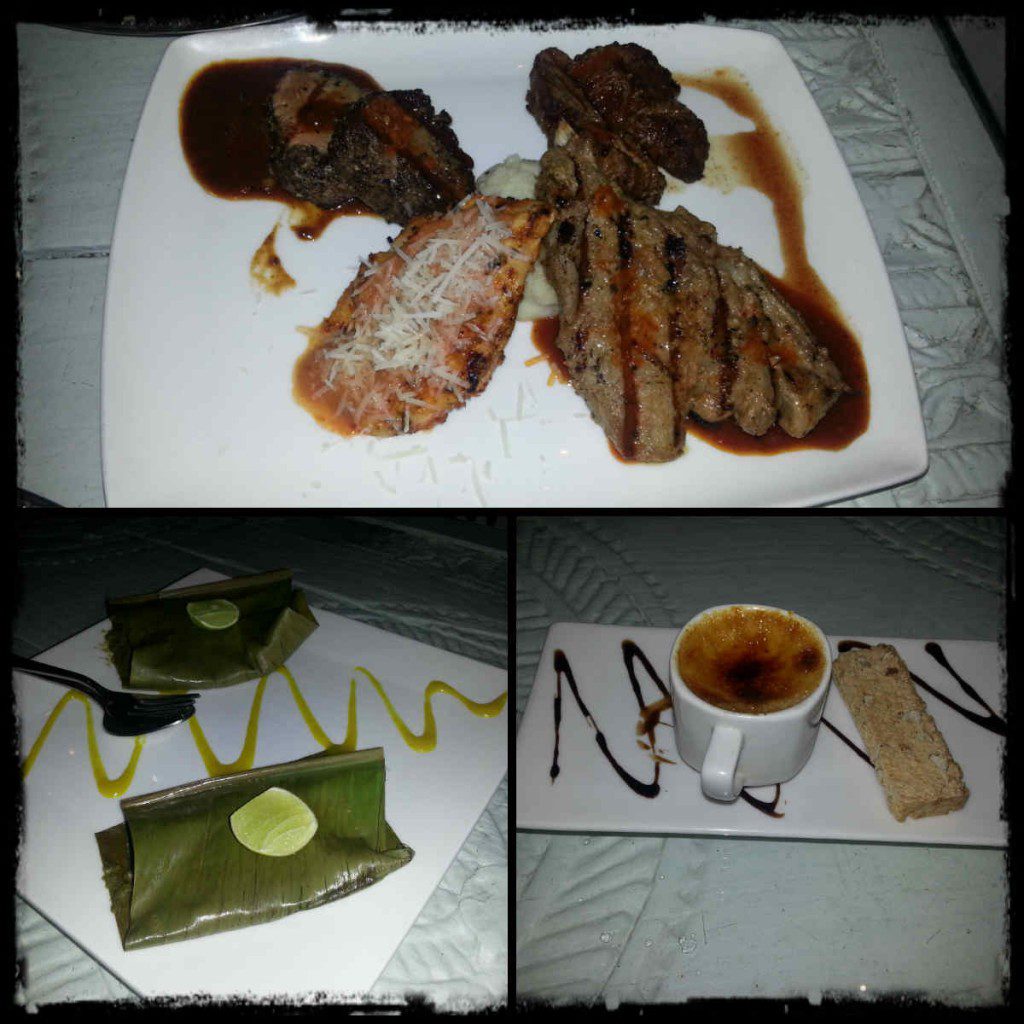
    We waited to see what appetite we had left before ordering the main course – Patra ni Machi and a Bricklane Mixed Grill. The mixed grill had beef of two kinds, chicken, and pork. The Merlot beef was my favourite, followed by the Jack Daniels pork. The garlic chicken was not bad though the Peppercorn beef was a bit of a disappointment. But in general, well cooked and succulent meat. The fish dish, came wrapped in banana leaf, as it’s supposed to be, with a mint and cilantro chutney. D found it too bland, though the dressing on the plate could actually change that! The best part was that we still had space for dessert – so we could have that South Indian Coffee Brule (sic) that we had been eyeing. That turned out to be excellent, with the filter coffee flavour coming through beautifully. It was served with an almond biscotti, whose texture added much to the dish.
    collage2

    The service was quite good, except for the drink fiasco. The bill came to just over Rs.3050, including charges and taxes, Rs.1000 of which was thanks to the two drinks! But we enjoyed the meal and the ambiance, so wouldn’t really complain much.

    Bricklane Grill, 5th Floor, Escape Hotel & Spa, 770, 100 Feet Road, HAL 2nd Stage, Indiranagar Ph: 080 42415505
  • An Internet of Things narrative

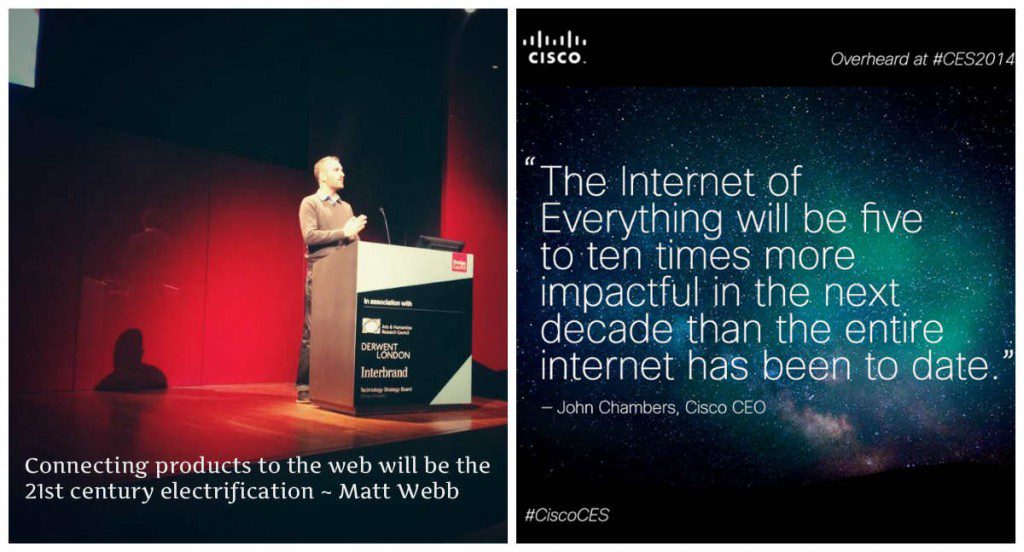
    Towards the end of last year, I’d written a post on the ‘social product‘. Its premise was that given social’s conversion to media, the opportunity for fulfilling social’s initial promise would fall on ‘product’ – using data, network effects, and relationships to connect consumers along a shared purpose. In the last few weeks, I have seen rapid acceleration happening on this front. I can see at least two narratives working in tandem, and I’m sure that at some point they will begin to augment each other really well. In this excellent post on technologies that are shaping the future of design, sensors occupy the top slot, and they are at the basis of both the narratives – one on humans, and one on things. The official classification, roughly, translates into Wearables and Internet Of Things respectively for the scope of discussions here.

    This post is about the second. So, what is the Internet of things? The wiki definition is simple, but effective –  “The Internet of Things (IoT) refers to uniquely identifiable objects and their virtual representations in an Internet-like structure.” The best primer I have come across would be this infographic, which has everything from a quick technology explanation, applications and challenges to market size, statistics, and interesting use cases. For a really solid perspective, look no further than this deck titled ‘The Internet of Everything‘.

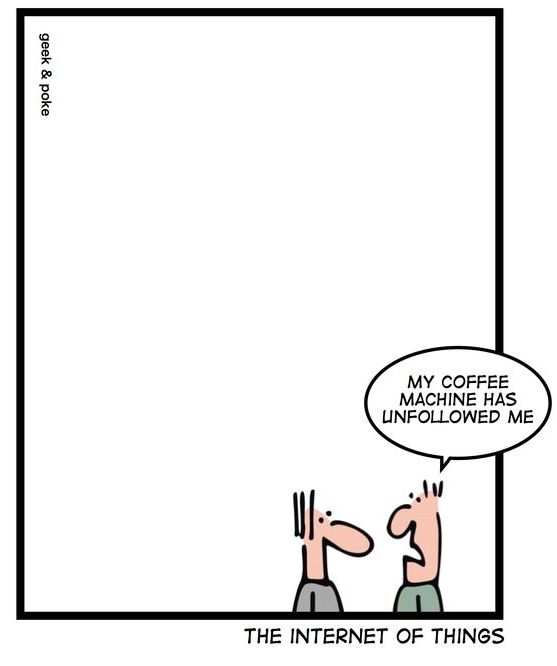
    How does it affect us? For now, it is about convenience. If you’re familiar with Android launchers, imagine an IoT version – it’s almost there, using iBeacon! There’s more – Piper, which works as an IFTTT for your home, the smart fridge that can order groceries from the online store, the smart TV that can learn preferences and help us discover content, the washing machine that can help order detergent, the egg tray that will let you know about the number of eggs it holds and their ‘state’, the automated coffee machine, Philips’ connected retail lighting system, Pixie Scientific’s Smart Diapers, the GE a/c that learns your preferences, the smart bulb that doubles up as a bluetooth speaker, (!) and so on. Some of the products are really useful and solve a need, while some others are more fads and probably not adding the value that reflects the potential of IoT. But that’s just the learning curve in progress, as the market starts separating needs and wants.

    All of this also means that consumption patterns will begin to change, as more purchases become automated, and more importantly data-driven. In my post on the driving forces of 2014, I had brought up technology as the biggest disruption that marketing has seen. This is most definitely one of the manifestations.

    Clipboard02

    What can brands do? For starters, get interested. Think about the tangible benefits that can be offered to consumers. What are the kind of data patterns that devices (or products) can surface to help the consumer make better consumption decisions? What kind of contexts can be relevant? Instead of force feeding advertising on traditional channels and fracking social platforms, can communication to consumers be made seamless using data, contexts and easy processes? While ‘device’ brands might have an initial advantage, ‘product’ brands need not be left behind at all. As the washing machine post (linked earlier) suggests, a Unilever or P&G might subsidise a machine, because it’s pre-sold with 500 washes worth of their detergent. It could even be real time, with SDK, API systems telling a partner brand to push a contextually relevant communication to a consumer. As things start storing and communicating data, privacy will be a major factor that decides whom consumers will share what with. Unlike media, trust cannot be ‘fracked’, it needs to be earned over a time frame.

    Where does it go from here? A common language/protocol/registry is a good start, as is a white label platform – both are trying to connect an assortment of devices and gadgets. While there is value in data at an individual level (more on that in the next narrative) one of the critical factors in the success of this phenomenon is the devices talking to each other – humans acting as middle men to pass on data may not be a smart way ahead!  Digital Tonto has an excellent nuanced perspective that differentiates IoT from the web of things. (WoT sounds cooler!) The difference is in connection and interoperability.

    collage

    Equally important is this phenomenon’s ability to solve human needs. (Internet of Caring Things)

    Collaborative consumption is fast becoming a consumer reality. As always, brands (generalising) are bound to be a few years behind, but the hope is that the web of things will force them to start collaborative creation and distribution and more importantly, focus on consumer needs.

    until next time, #WoTever

    P.S. In a corruption of Scott Adams’  idea, I think #WoT is paving the way for robot domination. 😉

    P.P.S. If the subject interests you, check out my Internet of Things Pinterest board.

  • Empires of the Indus: The Story of a River

    Alice Albinia 

    I am showing signs of travelogue addiction, and this is the kind of book that creates it! It’s not just the content of the book, which is marvelous and makes for a treasure trove of information, but the sheer tenacity and guts the author displays, that has made me a fan. Spanning four countries, this book is the story of the river Indus, from its source to its destination, though not in a linear way. What it succeeds in doing, like the best travelogues do, is to also allow us to travel through time, in this case, even to the time before man existed. From Hindu mythology to the Harappa civilisation to Partition and the Kargil conflict and China’s occupation of Tibet, the book is not just the story, but the history of a subcontinent (at least a part of it) and the civilisations that rose and fell.

    The preface gives us an idea of the expanse of the river through its various names, given across lands and by everyone from Greek soldiers to Sufi saints.

    There are nuggets everywhere right from the beginning – the comparison of the arrangements of the Quran and the Rig Veda, the integrity shown by a citizen in the early days of Pakistan’s formation, a modern day citizen blaming Jinnah for the country’s authoritarian culture, a nation’s search for identity, and the vision of its founder, who was only human. The first chapter ‘Ramzan in Karachi’ is a book in itself, and this can be said of all the chapters! ‘Conquering the classic river’ is a slice of the Company’s India exploits, ‘Ethiopia’s first fruit’ shows the amazing ‘presence’ of Africa in the subcontinent’s history and present, and the facets of their absorption into the mainstream. ‘River Saints’ is about Sufism and its modern day remnants who are not beyond politics, religious conflicts and feudalism.

    ‘Up the Khyber’ is about the exploits of Mahmud of Ghazni, the sexual preferences in the frontier province, and the beginning of the author’s more difficult challenges as she zigs and zags through Taliban and smuggler territory. ‘Buddha on the Silk Road’ is an awesome chapter on the meeting of 3 great religions – Hinduism, Islam and Buddhism and how they influence each other in the area, down to the destruction of the ancient Bamiyan statues more recently. In ‘Alexander at the outer ocean’, the author stubbornly walks, despite very serious hardships, the route that the Sikunder-e-azam took. ‘Indra’s Beverage’ takes us back to Rig Veda times, the Aryans and ancient Stonehenge like relics that survive to this day, along with the Kalash tribe, which follows a religion that goes back beyond Hinduism. Some areas, as the vivid prose describes them, seem to exist the same way they did in Rig Vedic times. The incredibly advanced Harappa civilisation is showcased in ‘Alluvial Cities’, though the reason for their fall is still contested. Kashmir’s archaeological treasures are the focus in ‘Huntress of the lithic’ and it’s interesting to see how the same ‘painting’ has been reinterpreted across time by various people to suit their needs. In the final chapter, the author captures the startling contrast of man’s attempts to conquer nature and at the other end of the scale, his ever decreasing ability to live in harmony. This chapter is also a testament to her commitment to the book, and the mentions of Kailash and the possibilities of Meru were extremely interesting to someone like me, who is interested in Hindu mythology. The book’s final words, which makes us wonder how long the river which spawned civilisations will be around, is a melancholic gaze into the future.

    At 300 odd pages, every page of this book is packed, and there is no respite. But it’s completely worth it!

  • I won’t be the judge of that!

    A few days ago, S wrote to me that she was going through my old posts and was delighted to find lower caps for ‘i’ , font change for each blog and heavy and careless use of ellipses after every three sentences. The background is that in my professional life I am a stickler for error-free content. Even until a few months ago, I’d have been irritated at myself for this and despite the painful process, would have gone ahead and corrected each post! In fact, as I told her, I had even considered this once. I occasionally refer to my own posts when I’m writing new ones and once, sometime last year, I happened to read one from 2008, with all of the things that S mentioned and more! That’s probably one of the first times that I implemented something I’d been wanting to for quite a while – stop being judgmental and to be comfortable with myself – past and present.

    There’s a back story to that as well. My judgmental nature had been on an ascendant for quite a while, and coupled with a temper and wit/sarcasm, I realised that I was hurting people. As is my wont, I analysed a bit and figured that at the base of it was the fact that I was extremely unforgiving of myself. Since I drove myself to those levels, I took a higher ground and berated others when they didn’t live by those standards, across various life situations. I also understood that the work had to begin internally before I could manifest it to/on others. It wasn’t easy to forgive myself in the beginning, but I got the hang of it gradually.

    KR

    (The Kite Runner)

    This was, and continues to be, a bit tricky. How does one maintain objectivity when being kind on oneself? When does it slide into laziness? The way I deal with it is to try and understand the relative importance of an incident in the larger scheme of things. Carrying it forward to other people was a much easier task, especially when I paused for a moment and made myself understand that behind every behaviour there is a story. The challenge here is to make sure others don’t take advantage of the new found benevolence! If you’ve gotten thus far, you’d be able to handle it.

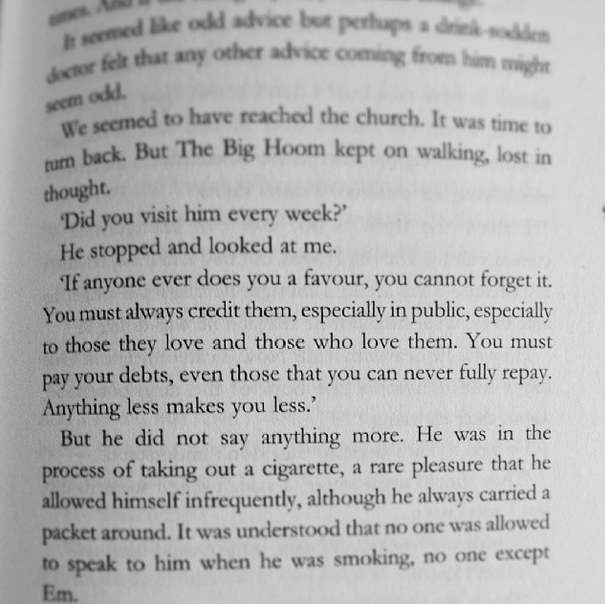
    During a recent offsite, my current boss said I was one of the most unflappable people he knew. Huge compliment, and one I totally cherished, not only because of my history in this context and therefore my progress, but also because I actually think he is one of the most composed people I’ve come across! This also allows me to bring up a related subject – praising others. One of the side effects of being harsh on myself was that I became stingy with praise. I think it was Surekha who first pointed this out to me. In Em and the Big Hoom, I saw some lovely words, and have tried to live by them.

    EATBH

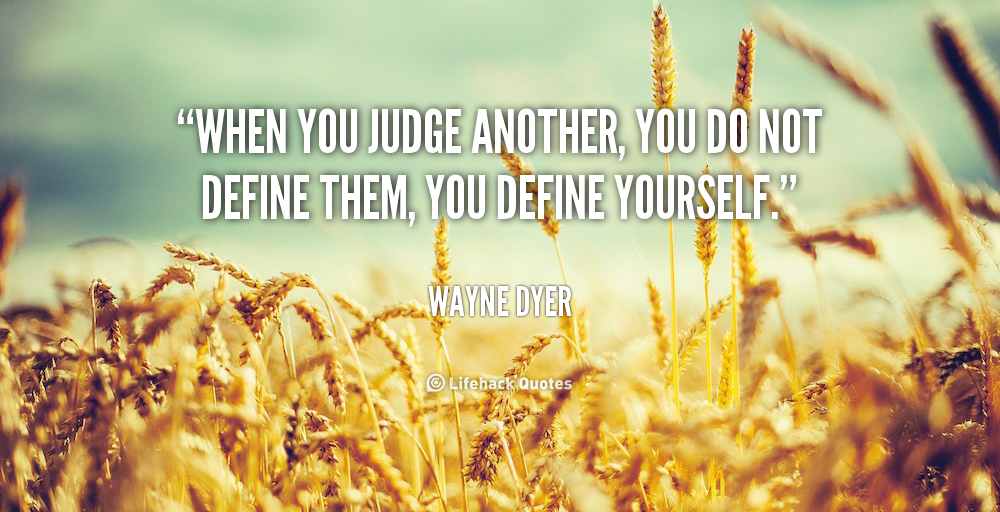
    Anything else makes you less.” That’s probably a judgment right there, but we’ll let it pass. These days, I try to praise – not for the sake of it, but by being a little more open to it. I also try not to judge. Even if I do, I keep it to myself, and make it as transient as possible. In the era of Twitter, this does become quite challenging! It is still a work in progress, and most likely will remain that way always, but I like to think that I have gained some ground. The mantra these days is

    quote-Wayne-Dyer-when-you-judge-another-you-do-not-42355

    until next time, judge dread!