Month: March 2014

  • The overhaul of currency

    Back in 2012, in my first post on institutional realignment, I’d written this – “…my biggest hope is that the current currency of our lives – money – will have a better successor, one that will be better connected with our unique identities, and weave in contexts better.” In the two years since, this movement has not only begun, but is also figuring out its own dynamics. I had expected, or wanted, a disruption of money, but it will most likely be a transition. At this stage, I see at least three broad areas to frame this movement -the democratisation of finance, alternate currencies and marketplaces for value exchange.

    Democratisation of finance: This is probably where it began, because the internet has a reputation for removing intermediaries who do not add value in this case, financial institutions. From projects in Kickstarter, Indiegogo, and GoFundMe to social investments like RangDe and Milaap, there are now many ways to mobilise funds for me and you from people like me and you, according to personal passions, interests and belief systems. I’ll add more to this in the ‘marketplace’ section.

    Alternate currencies: Arguably, money as an institution has built a network involving processes, dependencies and establishments keeping in mind the dynamics of an earlier era. A civilisation connected by the www may find these tedious and irrelevant, and thus it’s only natural that it builds its own institutions. Bitcoin (a good introductory guide) is the one that made this phenomenon (relatively) mainstream, to the point that it even has ATMs. Bitcoin may or may not survive, it is probably the Napster in its domain, it has changed the game irretrievably. While on the subject, do read this fantastic tongue-in-cheek take on how it’d be if the roles were reversed – a cash based mechanism replacing digital currency. Meanwhile, there are other currencies similar to Bitcoin, and then there are completely different thoughts – for example, Pay With a Tweet. Which leads us to the various payment mechanisms that are being built.

    Marketplaces & Value Exchange: While the other two are the dynamics, this is where the mechanics play a part as well. In the ‘democratisation’ section, I had referred to several platforms that aid both discovery and action. There are many more stories in this line – from AgreeIt, an app that allows crowdfunding from friends on Facebook to crowdsourcing for emotional advice, ideas and so on to selling one’s reservation at a restaurant/spot in a line through Shout to  a ‘new media company’ Ideapod that wants to “amplify the ideas that shape our world, create genuine and enduring dialogue around ideas and spread ideas that matter through new and traditional media channels.” to ordering food from neighbours, (Eatro in London and Imli – a startup I mentor at the Microsoft Accelerator- closer to home) there are various models of value exchange that are shaping themselves. In fact, the entire ‘social commerce via collaborative consumption‘ route is based on these marketplaces. (a few good perspectives and stats on its drivers here)

    But, irrespective of the currency, every transaction requires (another) key element – trust. The social web is also building its own mechanics for this – from relatively generic clout mechanisms (Klout, Kred and the likes) to more context specific ones like LinkedIn or GitHub or even Wiki and review mechanisms. (from Amazon to TripAdvisor to Foursquare to GoodReads to Zomato) We earn trust through our knowledge and actions in these mechanisms. We earn social currency. That brings me to the final portion – how does all of this impact brands and what would be their role?

    Brands & the trust economy: Across the ages, corporations have been built on competitive advantages pertinent to the economies they operated in. I found a fantastic illustration in this context here
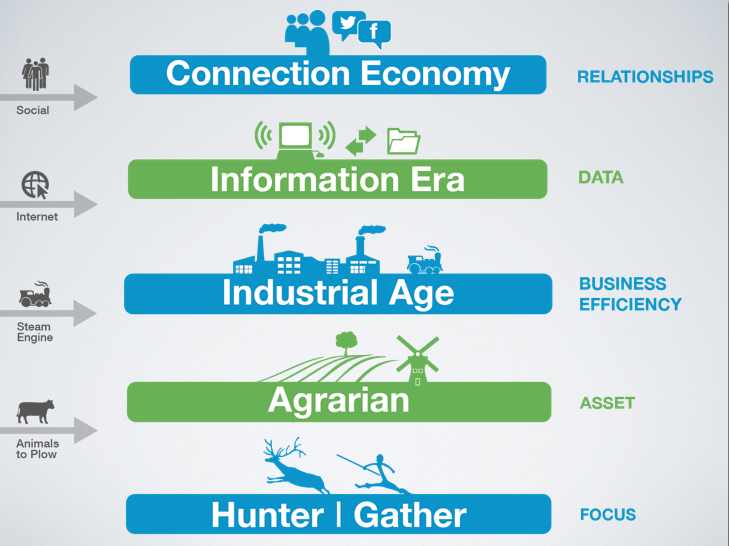
    Economies and competitive advantages

    I think relationships are indeed going to be the major competitive advantage in the future, and if so, the currency that would play a bigger role than money would be trust. As in many other developments prior to this, there are opportunities here for brands to weave themselves into the consumer’s narratives and go beyond transactional relationships, and to earn social currency. Many of them are already on it, finding ways to earn consumer trust and helping him/her develop and change perspectives about various currencies and relationships between them. Since we’re talking of finance, let’s use an example in that domain. Fidor bank helps its consumers discover crowd sourcing options, staying true a bank’s generic commitment of excellent wealth management. Yes, it’s still money, but it understands that it can be deployed beyond traditional options. In the process, it also helps the consumer to belong to a community.

    Brands actually have an option to join in wherever there is consumer spending. Nike+, as usual, did something back in 2012 – they allowed runners to trade in (running) mileage for Nike goods (I had shared the video in the institutional realignment post too) While this ties in beautifully with Nike’s business purpose, maybe some brands would have to lean a little more towards the consumer side and get into relatively unrelated narratives, and a relationship, before connecting it back to the business purpose. For example, airBaltic’s loyalty program Baltic Miles rewards frequent fliers who jog enough to burn off the same number of calories as miles they’ve flown. One of the aspects of agile marketing would be to enable identification of opportunities early. For example, imagine Coke getting into the act in Beijing’s first reverse vending machines that pay subway credits in exchange for returned containers.

    In what might seem like a ‘changing of goalposts’, just as brands are beginning to vaguely realise that their currencies of engagement with consumers need to change, the consumer’s relationship with the common currency of transaction – money – is also changing. The two are very related, and brands need to tackle both to have meaning and relevance in a consumer’s life, because if (as Godin says) “money is a story“, we’re probably nearing a plot twist.

    until next time, the end of money’s monopoly

    P.S. For another detailed look at the subject, you’d want to read Gauravonomics’ post on ‘The Future of Money‘.
  • No Full Stops in India

    Mark Tully

    No Full Stops in India was published in 1991, and so the best part about it is that it involves a fair amount of time travel. It’s a collection of 10 essays with an introduction and epilogue that could pass off as mini essays too! While all of the essays are commentaries, what adds that little flavour is the author’s own involvement in it, which he somehow manages to balance with a near objective view. The first essay, for instance, involves the marriage of his cook’s daughter, and his experience at the village. But it also is about how communities in villages have been solving their own problems even better than the land’s relatively new legal system. It thus serves as an example of how we, the ‘educated elite’ make a clamour for egalitarianism without understanding the positives of the caste system.

    Cultural imperialism is the theme of the next essay and is brought out through the carvings at Mahabalipuram, and the interaction and friction between British artists (sculptors) and their Indian counterparts, whom they rate slightly lesser- as craftsmen. The essay also touches upon Dalit Christians and how they are discriminated against even within the Church.

    The Kumbh Mela is what the third essay is about and is a vivid telling of the massive festival. The author spends time with VP Singh’s brother, and meets the various people who ply their trade in this enormous festival – the pandas and later, the akharas who look to recruit people or get donations. In this, there is a note of sarcasm that creeps in occasionally, but Tully still manages to capture the faith driven fervour superbly. He has also correctly predicted the potential rise of communal parties towards the end of the essay.

    One of the most interesting essays in No Full Stops in India is the fourth one, especially for my generation which grew up watching Ramanand Sagar’s Ramayan! The author reminded me of the impact of this mega serial long before we had reality TV and TRPs – taxi drivers who knocked on the author’s door asking for permission to watch it in his house, cabinet swearing in postponed so everyone could watch it, and so on. He spends 2 days with the Sagars while they’re shooting the Uttararamayan section (owing to public demand) and there Ramanand Sagar tells him how he has handled feminists and also the story of his own life. There is an amusing part about the filming of a scene – Lakshman having biscuits between takes, reusing marigolds for extra takes, and so on.

    Operation Black Thunder is a more serious essay which involves covering the whole event live. This was an era before live TV and omnipresent crews and the author tries to delve deeper into how a section of the Sikhs and the Central and State governments reached this point, with interviews of civil servants and military, police personnel.

    Colonialism in Calcutta is probably my favourite essay as Tully takes us through the city where Marxism, industries and religion co-exist side by side amidst bare remnants of an earlier era. In between are interesting anecdotes like the Oberoi Hotel’s origins. This happens to be the author’s birthplace and the affection does really come through.

    The next one was a surprise since it dealt with a modern day case of Sati and it has never been proved whether it was suicide or murder. The author gets the varying perspectives of the villagers, politicians, civil servants, activists, the extended family, and it does bring out how laws at the end of day, should be made understanding the minds of the people they are made for.

    Typhoon in Ahmedabad also surprised me but apparently that’s the name they use for riots! This is an era before Narendra Modi left his indelible mark and does show that riots existed long before him. The poor – both Hindu and Muslim, seem the most affected in the politically motivated result of a nexus between politicians and the underworld. SEWA’s activities also get some space as does Ahmedabad as a city.

    A journey into Madhya Pradesh in what was the national vehicle of the time – the Ambassador, makes up the next essay. The destination is the village of an artist who has made it (relatively) big in Bhopal with the help of a government program. Jabalpur, the inconspicuous geographical centre of India, represents eminently the feel of a tier 3 city in the mid-late 80s. This essay also covers ground on tribals, their belief systems and I also found what could be the precursor to Arundhati Roy’s essays about the Narmada.

    The last essay is about Digvijay Narain Singh, the politician from Bihar who also happens to be the author’s close friend. He belongs to an era when politicians had a conscience, and while you could say that the author is biased, much of the perspective is reportage – opinions from others. The politician’s relationships with Nehru, Indira Gandhi are well chronicled and throws light on the kind of politician who took the responsibility of being a public servant seriously.

    The epilogue is a note on Rajiv Gandhi, and through this, the state of India as a nation. It ends with the news of Rajiv’s death and the author’s perspective on what this means for a nation.

    In essence, No Full Stops in India is a wonderful read that gave me insights about a time when I was too young to dwell on things happening around me and events that ultimately affected the present I live in.

  • The world we create

    A while ago, I had written about the narratives of our lives, a look at various narratives across time – from religions and nations to popular culture and brands to the internet – that have (arguably) tried to fulfill our sense of belonging. All the narratives I had considered were external in nature, though they might be dictated by our choices and preferences.

    An excellent comment on the post by The Lit Room made me consider ‘the narrative of individual imagination’. As I answered, it is probably the most important one, as it takes all sorts of external stimuli, and converts it into a unique stream of consciousness. Just when I began thinking of writing a follow up post by including that aspect, I was reintroduced, thanks to Devdutt Pattanaik’s Sita, to the concept of ‘aham brahmasmi‘ – “every human creates his own imagined version of the world, and of himself. Every human is therefore Brahma, creator of his own aham“. I think it is impossible to crack everything that goes into the making of one’s own consciousness, which is probably what led to

    Clipboard01

    (image via)

    But there are at least a couple of perspectives that the book provides in terms of how one can create an ideal ‘world’ for oneself. It says, “stay true to the idea of dharma. Be the best you can be, in the worst of circumstances, even when no one is watching.” I thought a bit about what actually drives our actions, and realised that at the bottom of it is fear. (debatable) Not just one fear, but many, many fears driven by our contexts – some we acknowledge, some we don’t. George Lucas probably figured it out earlier, (see) though we might travel paths different from what Yoda has suggested. The book also states that – Fear is a constant, and faith is a choice. Fear comes from karma, from faith arises dharma. Faith in what, was the next thing I pondered over. In oneself, and a moral code that one adheres to? Or a higher power/cosmic law that governs all that happens? Or is it just a mechanical process with the fittest surviving? There are more options as well, probably, but I like to go with the first, because in the world that I create, my actions can ensure I do not have to fear.

    Meanwhile, also from the book – Shiva chooses the path of asceticism and self control to control the aham, and the world it creates. Vishnu chose to live amidst materialism and yet find a way to break free – a middle path. (now I can see why Buddha is assumed to be a form of Vishnu) I think there are several degrees to choose from, and there lies the challenge. I also realise that it if each of us are creating our own worlds, we cannot really answer the questions of the world at large – a universal answer – because it is an aggregate of each of our worlds, which are different from each other and have unique rules. We can only find the answers to our own world, and through our individual paths, find our own version of the answer to the purpose of life.

    until next time, muddled path

  • The Mirage

    First appeared in Bangalore Mirror

    I came upon The Mirage quite by chance on the web, and for a few moments, when I was hunting for its precise location in Koramangala, I did wonder about the name of the restaurant and whether it was literally that! Situated on the fourth floor of a building, it’s pretty easy to miss unless you’re specifically looking for it. At an eye level, look for the new Corner House. (map – though it has shifted to the other side of the same road) Parking on the street. When we visited, the place was relatively unknown because it’d been less than a month since it opened, and they hadn’t done much in terms of publicity. That probably explains why we were the only group there. Thankfully, the cliché of the service staff attacking as a swarm did not happen. In fact they actually seemed a little intimidated, especially when we ordered wine – they had difficulty finding it, and seemed confused on how to serve it! For now they are serving only wines, (though they plan to make it a full fledged alcohol menu soon) so it might be a good idea to train the staff on it. But once the initial fear of strangers passed, they turned out to be quite helpful and attentive! The décor is functional aiming towards lounge and there’s lots of ‘greenery’ – in the form of lighting, graphics and cushion covers. Marilyn Monroe seems to be quite an influence, appearing in various avatars, the most interesting of which is her quote “I don’t want to make money. I just want to be wonderful.

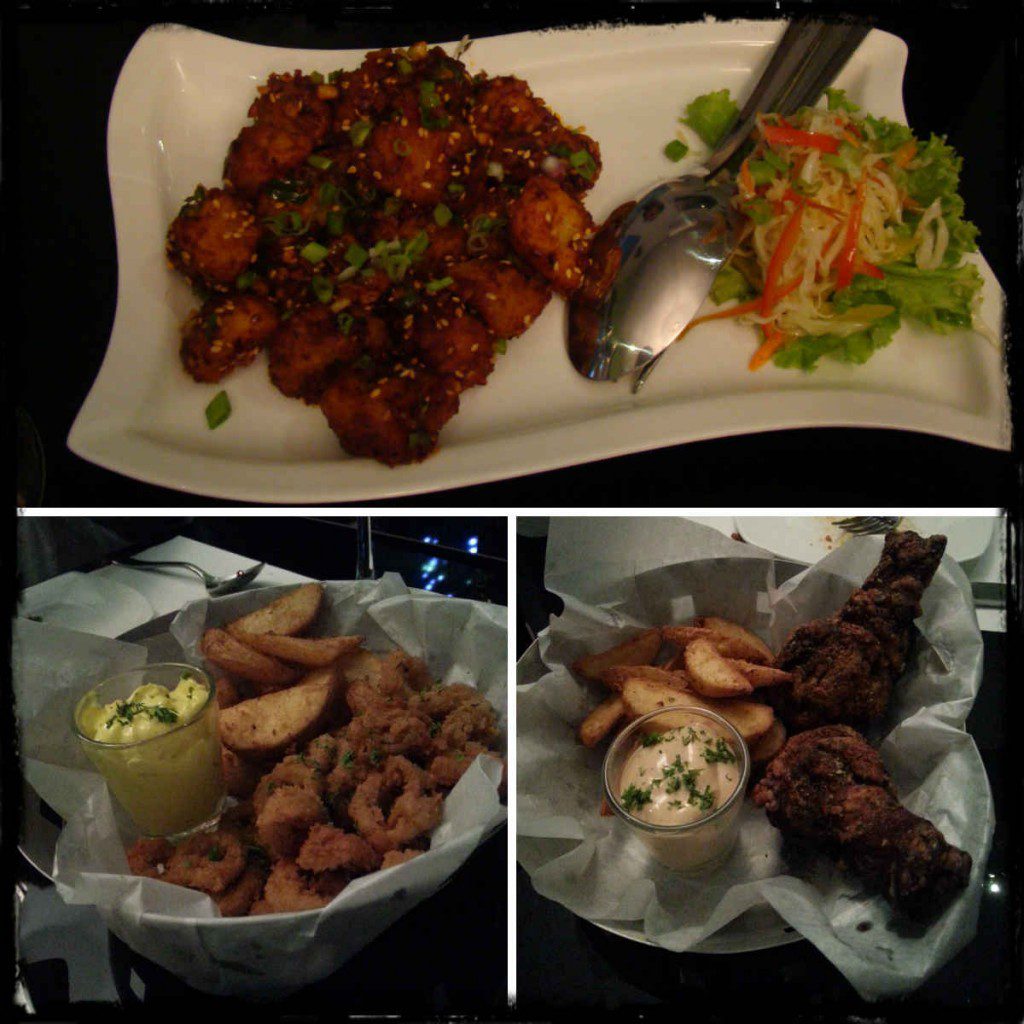
    The menu is a mix of many cuisines – Thai, Chinese, Mexican, Italian and even a smattering of Vietnamese. From the more than a dozen options available, we began with a Sesame Potato Bites in Chili Sauce. On hindsight, we needn’t have ordered this since everything else came with potatoes anyway! There was something funny about the oil in this dish, and it wasn’t the kind that would make you look forward to the rest of the meal. The Fried Calamari served with Garlic Aioli and chips was up next. The squid was well cooked, the dip complemented it well and if you can ignore the general greasiness, it’s not a bad dish. The Highnoons Special Fried Chicken was the last to arrive, and was served with the mandatory chips and a ‘Mayo-Tard’ sauce. The chicken itself was decent, except for a couple of undercooked bits, but the sauce, which was already a cause of much mirth thanks to our juvenile vowel movement jokes, actually had a funny taste, most likely thanks to a mustard overdose.

     collage1

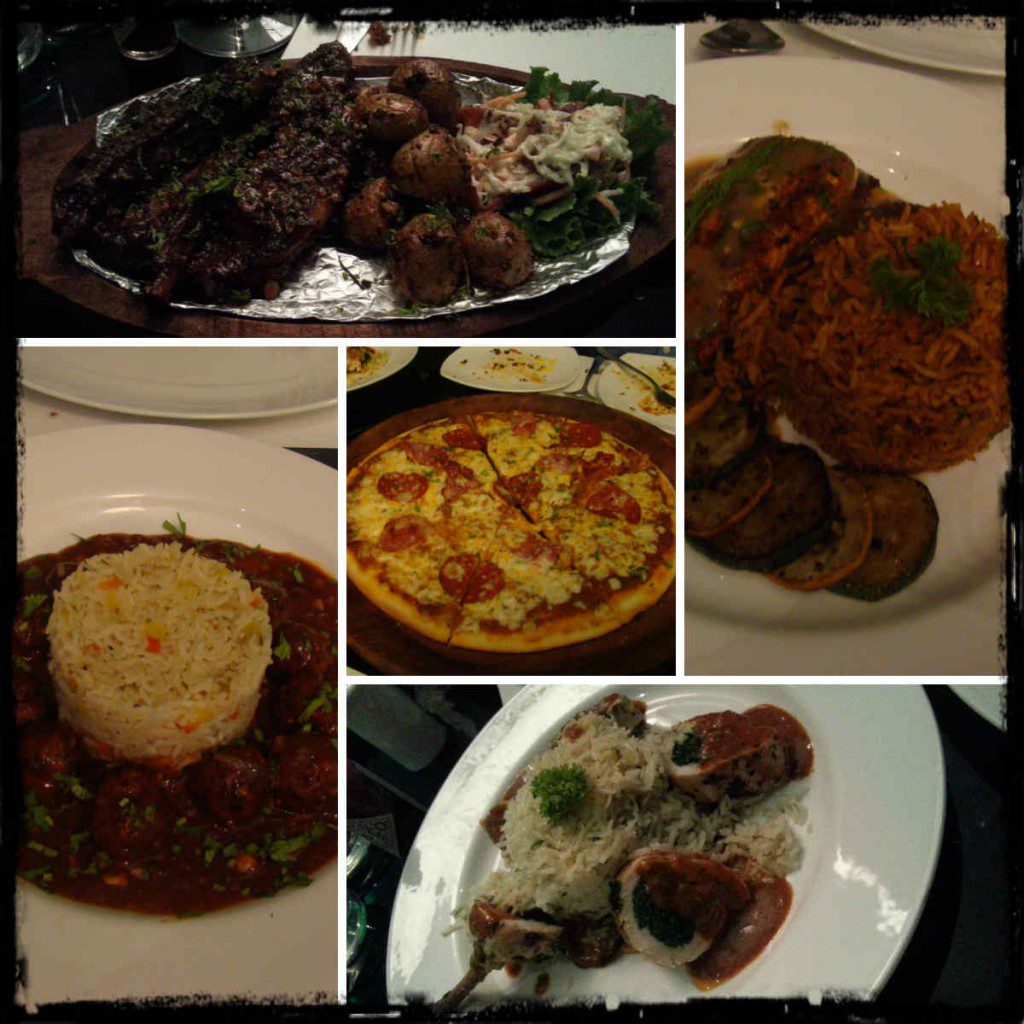
    In addition to the standard menu, there’s also a ‘daily specials’ display. Since the idea was to pig out, we decided to try the BBQ Pork from this set. It came with.. Ok, this is getting boring, so imagine potatoes as bodyguards and that no dish arrives on the table without them accompanying it in some form! But the pork dish actually turned out to be the first of the fantastic dishes – a superb mix of spice, tang and splendidly cooked meat. To even out things a bit, we then tried the Veg Dumplings in Hot & Sour Gravy which was served with Butter Rice. This was not in the league of the earlier dish, but the hot and sour flavours were complemented well by the mildly flavoured rice. The Cajun Spiced Grilled Fish with Dill Butter Sauce was up next. The fish was cooked well enough, but it was probably our least favourite, mostly thanks to a strange pungency. The Chicken Roulade turned out to be the dish of the day, with an awesome spinach filling, a mildly spicy herb sauce and butter rice to complete the package. From the half a dozen pizza options, we chose the Pepperoni & Bacon. They weren’t stingy with the meat and the caramelised shallots added a nice touch to the thin crust pizza.

    collage2

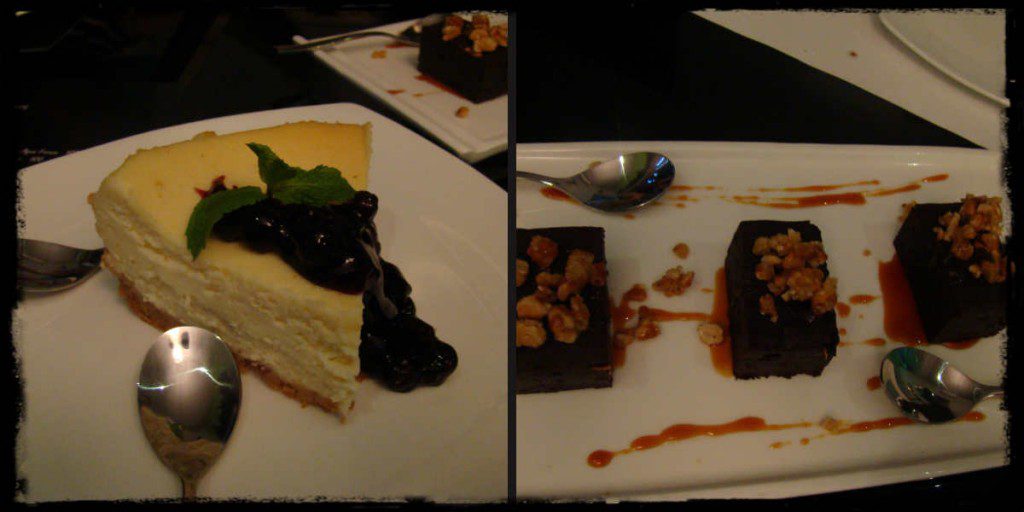
    There were plenty of interesting options but we were pointed to the Brownie Caramel Fudge and the New York Style Blueberry Cheesecake, and thus we had a new benchmark of how meals should end! The brownie was just the right texture and consistency – neither too dry nor moist- and had some wonderful dark chocolate! Good chocolate dishes are always a tough act to follow, and the fact that the baked cheesecake almost beat it is testament to its quality. I wondered whether we should have started with desserts!

    collage3

    For about Rs.1350, you could share a couple of non veg starters, two  non veg main course dishes and a dessert. (Inclusive of taxes and service charge) The Mirage actually lives up to its name in the sense that the restaurant’s appearance doesn’t do full justice to the quality of some of the dishes. Considering the Koramangala location, it manages to deliver value for money as well. A little more attention to the overall packaging, including some good music (instead of piping Radio Indigo) and it could be wonderful and make money!

    The Mirage, #61, 4th Floor, Above Corner House, 7th Block, Koramangala, Ph: 080 65333533/633