Month: February 2014

  • Brand, Journalism, Marketing

    A few months ago, in The Future Of Owned Media and Can media become social enough?, I’d written about a marketplace model that would connect journalists and ‘buyers’. More recently, I saw an article about Contently raising a round of funding to work on its stated objective – connect freelance journalists and writers with nontraditional publishers, such as brands, agencies, nonprofits, and new media companies. These organizations use Contently’s technology to commission projects, such as sponsored articles, infographics, and blog posts.

    Like I’ve tweeted before, journalism is definitely in need of a business model. Media (with advertising) is arguably not the best bet now, because of various reasons. Digital has allowed brands to create their own media platforms (blogs, websites) and social has enabled them to (at least) broadcast it themselves, without a dependency on traditional media. Frank Strong, in a post titled ‘Why Content Marketing is the new Branding‘, rightly states that content is currency. It not only builds perception, but enables us to transact with consumers, keep a conversation going, and at some point, achieve a certain business outcome.

    However, except for campaigns, marketing collateral etc, brands have never really required/produced ‘content’ on a regular basis, and thus they are not wired for it. But content marketing obviously requires sustainable quality content, and that’s where brand journalism can play a part. I’d come across the term ‘brand journalism’ first on this post in early 2013 – ‘The Role of Brand Journalism in Content Marketing‘ – where it is defined as “research, storytelling and reporting for a non-media company, in that company’s line of business, with the goal of thought leadership.” (Erica Swallow) There’s a media vs non-media debate in the post, but my little tiff with the definition is that ‘thought leadership’ is rather limiting. There might be other business objectives/outcomes. Unless we’re talking of a leadership among the consumer’s thoughts. (share of mind)

    Meanwhile, in addition to a structured way like Contently, I can see brands already doing other forms of brand journalism. (used loosely) I’d classify blogger outreach, guest Twitterers, all under this, because the brand is using a content creator’s contextual reputation to enhance its own standing. The latest example I saw was quite fantastic – teen retailer Wet Seal ‘handing over’ its Snapchat account to MissMeghanMakeup (aged 16) who has quite a social following on various platforms. (via) To note that this is not Miss Meghan’s only client!

    I can paint a rather utopian win-win-win picture with this – brands with a purpose that has a social-societal perspective, journalists, who have created trust and a reputation of their own, who can identify with the brand’s purpose and who can write honestly (with disclosure) and consumers, who get to know more about the brands they align with through superb narratives created by these journalists. (among other storytellers) But I’d be surprised if it pans out this way anytime soon.

    It will have its challenges, but most of it is when we try to fit this method into the ‘containers of the past’. Its potential to succeed is because it offers much for all stakeholders. Journalists will have the option to be authentic in their writing, and give full disclosure because they’re not tied to the (traditional) media aspect. (newspapers/channels with their own business interests) Brands can be transparent about who has been commissioned to produce their content, and can use paid, owned media to promote it. Consumers get an interesting mix of narrators. It is a shift because the players (Brand, PR, journalists, media platforms) and/or their roles (production, distribution) will transform, but I do think brand journalism (a type of content) + marketing stands a chance.

    Clipboard01

    until next time, to better brand stories
  • The Betelnut Killers

    Manisha Lakhe

    The story of a typical mild mannered Gujarati businessman in Oregon – henpecked, confused about how his two children were growing up in America and focused on growing his business, only distracted by the thought of his first love whom he had to give up. Chimanbhai Shah’s life turns nasty when his business plans are dealt almost a death blow by Supriya, who opens a shop very near to his and lures his customers away. The rest of the book is about the plan that Chimanbhai, along with his wife Radhika, and children Maya and Suraj, hatches to get rid of Supriya. They are also helped by Neeraj, a distant relative.

    An ad for ‘betel nut workers’ (supari) backfires when the Employment office gives them a duo – Dean and Elmore, whose only skills are small time crimes. They decide to call in a supari killer from Mumbai – Osmanbhai, to literally finish off the competition. Osmanbhai’s activities to get a US visa at any cost is a sub plot.

    It’s dark humour all the way, and the plot is tight enough to hold your attention, though you do know how it’s all going to end, because the narrative is in flashback mode. The book won’t change your life, but the author manages to capture the existential crises of a Gujarati family in the US well. It’s a breezy, light read, probably just right for a flight.

  • A measure of helplessness

    A while back, I’d seen a Malayalam movie titled Pigman. Not really a typical movie by any standards, and that explains the poor performance at the box office. It is the story of a young man whose life pretty much becomes an abyss. (spoiler) The movie starts with him pursuing a doctorate in linguistics but failing to get it because of his research guide, who is miffed at him rejecting her advances. He sees no point in continuing and thanks to his family’s dire financial circumstances, is forced to take a job. He gets a clerical job at a pig farm courtesy a friend. A series of altercations with the corrupt management gets him demoted to the lowest job in the system – that of a pigman. He continues his protestations and the movie ends with him losing his mental faculties after being given electric shocks.

    It is a depressing story, and one can really feel his helplessness as his life spirals downwards degree by degree. In fact, the entire theme of the movie is failures in life, and it is as though, the intent is to drive home the point that some lives are meant to be lived in a continued state of helplessness.

    I think we have all felt helpless at some points in time, in varying degrees. Helpless in traffic (probably tactical helplessness, for the lack of a better word) at one end to probably the other extreme of watching a loved one die and not being able to do anything to prevent it or alleviate the suffering. I couldn’t help but compare it against what I’d call (again for the lack of a better word) chronic helplessness -a life consistently going down in quality (defined in this context as standard of living) – like the life of Pigman’s protagonist. In turn, I also couldn’t help but compare this to someone who has never had a decent standard of life. I wondered whether, among the last two, the last was better – if one hadn’t really experienced a higher standard of living, one wouldn’t know what one was missing, and therefore the suffering would be lesser than someone who had experienced it earlier, but could no longer do so because of circumstances.

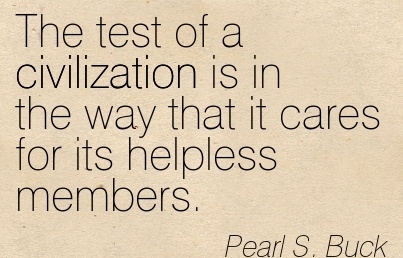
    And that is the really enigmatic thing about this business of living – there is no objective measure of mental anguish. If there were, probably we’d be better at helping those less fortunate than us. That would at least be a step up from feeling helpless at the injustice of it all. Help more, to feel less helpless. Sounds like a plan?

    until next time,

    Clipboard02

  • Lan Thai

    Lan Thai has been widely regarded as a sort of hidden gem, and for some reason, had been appearing on my various timelines for a while now. It had been a long while since we’d been to Brigade Road – there actually aren’t many reasons for us to do so – but since I had books to sell at Blossoms and since D and I don’t need a lot of encouragement to make trips for the soul (yes, by design) purpose of eating, we decided to drop in at the 5th Avenue mall, where this little place is located. It’s in what can be called the atrium space of the mall – open – and shares its premises with a juice shop. The seating is functional, and we managed to find a little corner.

    We had to rebuff the advances of the juice shop guys and wait a while before we got the menu. There’s also an extra seafood menu, but we had already more or less figured out what we wanted to eat from the main menu and didn’t think there would be any space left! We ordered everything together because a) we would then have to eat it even if we were reasonably stuffed (we’re strange like that) and b) some main course items seemed suspiciously similar to starters!

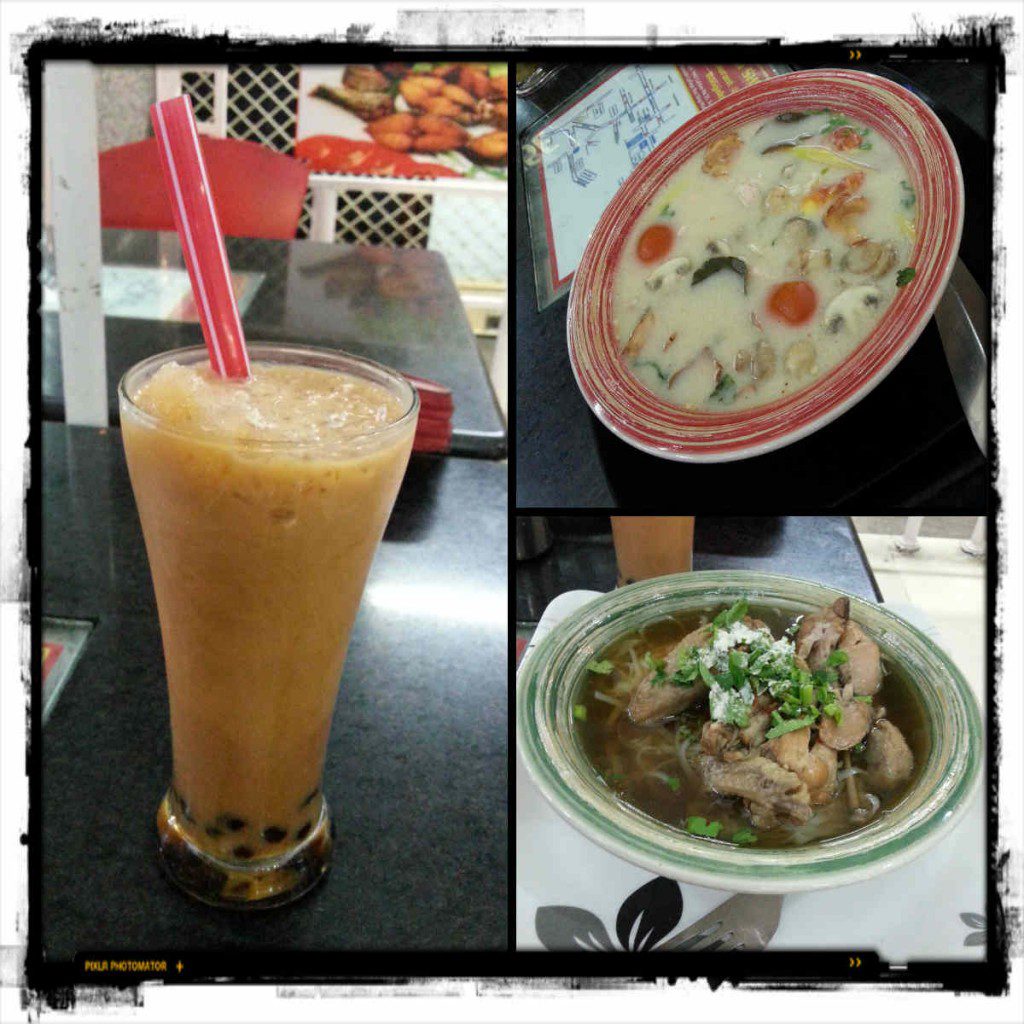
    The bubble milk tea arrived first, ice blended and a tad less sweeter than we expected, but still good enough. It reminded us of the Cendol we had during our Bali visit, but that is probably an unfair comparison because it had coconut milk and palm sugar and was in a class by itself! The Chicken in Coconut Milk and Galangal came next and though on the thinner side was fantastic in terms of flavours! No stinginess in terms of ingredients and reasonably spicy as well. The other soup we tried – noodle with chicken – is probably the only dish we’d avoid. It had a vaguely cloying (though mild) sweetness and not many other flavours. We took the help of all the sauces available on the table to modify its taste! Those bowls are big, by the way, and almost a meal in themselves!

    collage1

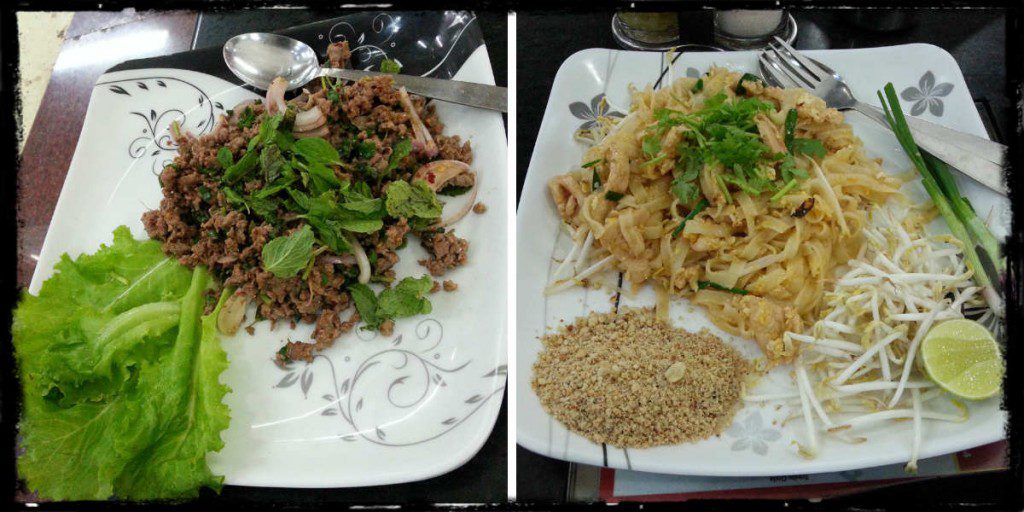
    The Spicy Minced Beef Salad had chilli flakes in it but wasn’t really spicy. (probably by our standards) That, of course, does not mean that it wasn’t tasty, and the meat was well cooked except for a couple of pieces that I got. The Pad Thai was the last to arrive, and despite what I thought was a mild overdose of bean sprouts, was absolutely awesome. We really didn’t have the space, but asked for desserts anyway. Unfortunately, there weren’t any! 🙁

    collage2

    All of the above cost us Rs,1200. I don’t think they accept credit cards though. The service is friendly though they do take a while to get to you. Thankfully the delivery of the food is really prompt. We probably will drop in again when we have a Thai food craving.

    Lan Thai, 5th Avenue Mall, Ground Floor, Brigade Road

  • @ #WIN14

    BlogAdda and I go a long way back, practically to around the time they were born, and when I was asked to be a speaker at #WIN14, there really was no question of not going. The icing on the cake was being a part of this excellent list of speakers!

    My favourite talk of the day was delivered by one Kavi Arasu, who, first virtually and then really, has become a very good friend. As I tweeted

    Meanwhile, I was part of a session whose subject was ‘Influence of Blogging’ and my fellow speakers were Lakshmipathy Bhat and Anaggh! The areas I tried to cover in 15 minutes were the changing nature of influence, its effect on brands, how blogs can help in that context and how bloggers can create a market for themselves.  (does that explain the breathlessness? 😀 ) Do take a look and let me know your feedback.

    Shekhar Kapur made his presence felt in the second half by being his usual articulate self. His analogy of crests and troughs, and tsunamis, to explain media cycles, time, and social was just fantastic. He had the audience spellbound, and deservedly so.

    It was wonderful to meet people,  some of whom I knew online, but had never met – Anaggh, Maneesh, Kalyan, Ankita, Rakesh, and others whom I got acquainted with at the event   – Ravi Subramaniam, Ashwin Mushran, (what a fantastic compering role he played!) Anuradha Goyal, Amit Agarwal, Sampath Iyengar and Anil P.

    A big thanks to BlogAdda for putting together a great event (photos) and having me over, and to Courtyard by Marriott, who were great hosts!