
Year: 2013

  • Social v2.0.1.3

    I really avoid writing “trends for 20xx”, but towards the end of last year, I jotted down a few things for an article. Same thoughts, but I expanded a bit.

    Barring a game changing phenomenon that further complicates the already shifting landscape, these are the 3 areas where I see the needle shifting more than others, in 2013.

    1. Content is (also) Advertising: Branded content will continue to rise as the worlds of publishing and commerce collide. Brands will invest (talent, money, time) more in content creation and curation. Also, paid media (traditional and social) will be used to promote owned media (blogs/twitter/FB page content etc) and we’ll continue to wonder how much was earned by publishers in supposedly earned media! By ‘advertising’, I don’t just mean the traditional marketing communication kind, but one that brings out more of the character of the brand/organisation itself. Hopefully this will be the first step towards a larger culture of authenticity, values, and transparency. Something like McDonald’s “Our food. Your questions” would fit the bill.

    2. Social Orientation: Social is media, social is CRM, social is enterprise collaboration, and many other things which we haven’t even begun to explore. Silo based approaches for social will evolve into socializing business strategy itself – a horizontal approach (and team) that looks at business objectives more clearly, and encompasses everything from CRM to ORM and beyond. These teams will also be equipped to handle everything from new social platforms to how social integrates/manifests on more advanced devices to technologies from AR to Big Data. Not all of this would happen in a jiffy, and there would be challenges aplenty – right from setting objectives to harnessing various skill sets to getting buy-ins from various verticals that social would interact with and affect. Social Business is most likely this year’s gamification in terms of buzz and random usage, but while that sorts itself, businesses would at least need to start seeing social as a strategy, one that can actually provide competitive advantage.

    3. Brand Voice: Speaking of competitive advantage, brands will figure out that they need to craft a voice and tonality that can resonate on social platforms as well. Many of the large brands we see now have grown up on media that never talked back, and hence adopt a  traditional media approach to communication on social as well – swinging between being apathetic and being servile. An identity and voice that can withstand the rigours of increasing conversations across platforms needs to start getting built. There might be multiple renditions of the voice as well – adapted to contexts, audiences, intent and so on, and brands will thus need to learn cohesion in narratives. A new approach to storytelling that spans media, understands popular culture and involves consumers better is the brand imperative.

    Update: Very heartening when people I respect – Dina, Gautam Ghosh, Prem think all of this makes sense! Mighty pleased and grinning away! 🙂

    until next time, #makeittrend 😉
  • Stated Obsession

    A defining purpose, or rather, the lack of it, is something that has been gnawing at me for a while now. One can go about the daily motions of life without defining a purpose, and it need not affect professional objectives or progress. In fact life must, and will go on without a purpose, but once the gnawing begins, it is difficult to rid of. It might be the result of something that I am often accused of – extra doses of analysis – self and otherwise. 🙂

    A friend-in-law (coined to refer to the spouse of a friend :D) recently got probably one of the biggest highs possible in his domain – a result, I am sure, of the hard work he put in, and his unwavering belief in the self. The hard earned outcome of a well stated purpose and well directed passion. May he have many more.

    One of my favourite Malayalam movies in recent times (actually in the all-time list as well) is Ustad Hotel, about a young man and his choices – two paths and their implications symbolised by his father and grandfather respectively. The game changer in the movie is inspired by Narayanan Krishnan. (do read if you are not familiar with the name) In real life, Narayanan Krishnan has defined his purpose, and bravely soldiers on, helping those who have no one else to help them.

    Completely different scenarios, with completely different motivations, but linked by the presence of a purpose. I can cite excuses – primarily the business of living and an interest in way too many things to devote myself completely to one – but I know those are just excuses. I am still searching for the reason – the inability to find something that defines me or the inability to devote myself to pursuing it, or just sheer lack of guts. My only hope is that I have some time left, but the clock is ticking.

    until next time, a gnawing tick

  • The Pregnant King

    Devdutt Pattanaik

    ‘The Pregnant King’ is Devdutt Pattanaik’s first work of fiction, in which he takes the story of Yuvanashva and distorts the timeframes to juxtapose it with characters in the Mahabharata, whereas in reality, the tale of Yuvanashva is recounted twice in the epic, as one predating it by many generations.

    Yuvanashva’s tale is special in at least two ways – it involves his mother Shilavati who possesses all the qualities to be a king, but cannot, only because she is a woman and Yuvanashva himself, king of Vallabhi, who accidentally drinks a potion meant for his queens (for them to become pregnant) and gives birth to a son. Is he the child’s father or mother, that is the answer Yuvanshva seeks. By bringing in various characters like Shikhandi, born a girl, but who uses a Yaksha’s masculinity to become a man, Somvat, who becomes Somvati during the course of a night by exchanging his gender with the yaksha, Arjuna, who lives for a year as a woman courtesy Urvashi’s curse, Ileshwara/i whose gender changes with the moon’s cycles and Adi-natha himself, seen as a hermit and a nymph, the author manages to not just show the nature of gender roles but also gives profound perspectives on dharma – its rigidity and fluidity, the dynamic nature of matter and the static nature of the soul, its various symbolism, and ‘the imperfection of the human condition’.

    This is an amazing read, and that’s not just because I am really interested in mythology. Ancient in origin, and contemporary in narration, the questions it raises belong to a different era and yet manifest themselves now in another form.

  • Clubd

    Clubd rewards you for frequenting your favourite hangouts in town. In conversation with founder Ishwar Sundararaman.

    [scribd id=120021160 key=key-jlk649y8grtue9399od mode=scroll]

  • Of trending on twitter and media fragmentation…

    A couple of weeks back, I’d written about the increasing broadcast tendencies on social platforms. Some events last week reminded me of something I’d tweeted a while back –

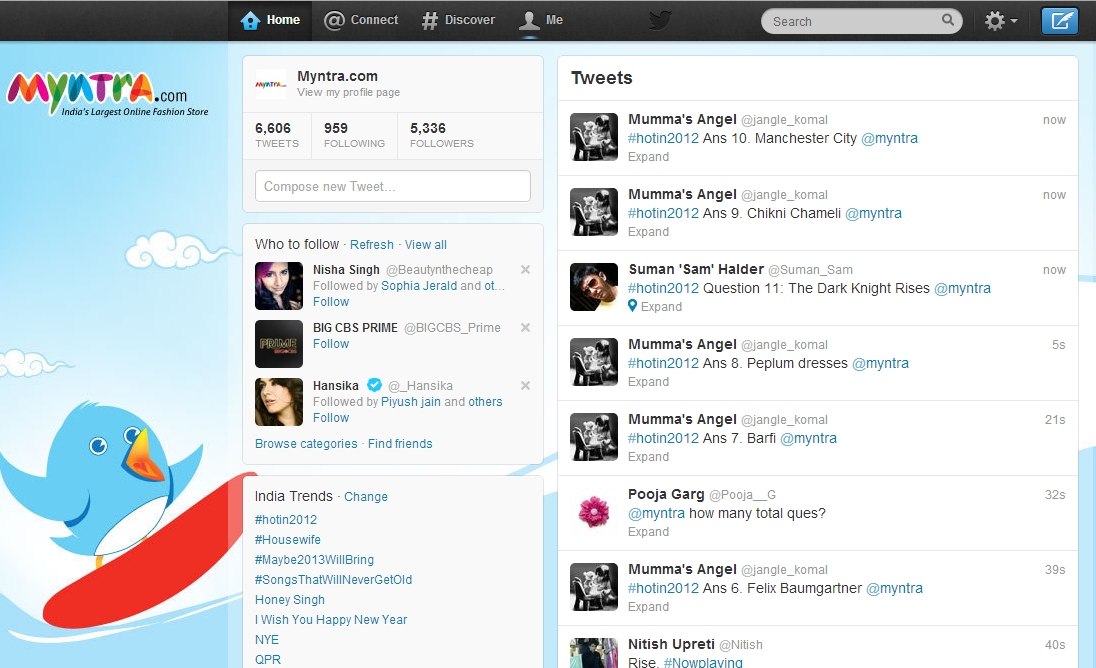
    It is, for better or worse, an item in the social marketer’s checklist. So unless it’s a day on which we’re outraging on multiple issues, you can easily see ‘branded’ trending topics. At Myntra.com, we’ve been playing with hashtags for quite a while now – #bachpanstyle was one such experiment. As we practiced more, the patterns started becoming more evident. Late last month, we started the #hotindecember hashtag in response to a business objective – creating more awareness about the similarly titled promotion at Myntra.com – and had constructed it around the promo TVC. It resulted in the hashtag trending on twitter. Just to check the lessons learned, we ran a #hotin2012 hashtag on 31st Dec, and ended the year as the #1 trending topic in India.

    Considering that there was a much more serious issue taking up everyone’s attention, this should be surprising, but it’s not, and that’s what we have learned of Twitter’s trending algorithm.

    That was about a brand using social as media. Like I mentioned earlier, the first hashtag was based on the TVC, something that had gotten us positive feedback on Twitter. After the Delhi incident however, the ad was considered by a few as ‘projecting women in poor light’. (worthwhile mentioning that Lisa Haydon, who starred in the TVC, had tweeted about the TVC being a lot of fun) Users, who also utilise social as media, are bound to have their opinions and will air them. The interesting part was that all this (hashtags and criticism) was happening in the same timeframe – 27-31st December.

    Why do I find it interesting? Let’s take a step back. It was only when TV stations started competing with the rabbit population that we started contemplating the fragmentation of media as we then knew it. Add to that the increasing web (+mobile) penetration and things became more complicated as time progressed. Brands (in general) still haven’t figured how to handle this, so fragmentation within a social media channel and its impact is small fry, except this is probably an indication of the future.

    This time, we chose not to react to the criticism – given the circumstances, it would have probably led to a nasty debate. Thankfully it died down. But what if a few twitter heavyweights had gotten into the act and made it trend for all the wrong reasons? We’d not have had the luxury. We’d have to refer to Crisis Management 101. In a worst-case scenario, we’d probably have to consider taking the TVC off air.

    In essence, when an interactive medium is added to the mix, fragmentation takes on a completely different meaning. It no longer means isolated compartments which don’t talk to each other, the events on one affect another. As a media buyer, a brand can choose not to be present on some media, but when a channel talks back, the brand’s choices suddenly dwindle. I think this will manifest itself much more in 2013, the learning curve is going to be very steep!

    until next time, user generated brand virals!

    Disclaimer: The perspectives above are personal, and does not reflect the thoughts or actions of the organisation mentioned.