The review was first published in Bangalore Mirror.
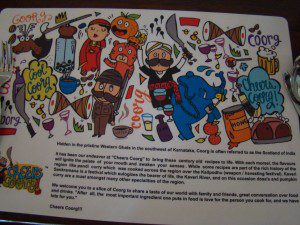
I knew that Shillong is called the Scotland of the East, but Coorg is apparently called the Scotland of India. However, what amazed me more is that in terms of my culinary mapping, I associate both of these places with pork, and that is something that Scottish Highlanders have an aversion to! Thankfully Cheers Coorg’s menu doesn’t have Scots in mind as the target audience. But long before the menu, the ambiance does a good job of conveying the restaurant’s character. From the funky tablemat that gives you an introduction to Coorg, its heritage, culture and cuisine to the various décor elements that line the wall – including photographs, sketches and even a couple of guns, Coorg is all over the place. Meanwhile, to get to the place, you can follow the map here.
The menu, presented in the form of a compact clipboard, also tries to give a sense of character. For instance, there is a “Real men ask for their drinks” line in place of a bar menu, but unfortunately the spirit is limited to words as the license is still a couple of weeks away. This proved to be a recurring theme.
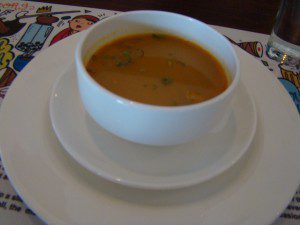
 We began well with both versions of the Nalla Malu Kanni soups – chicken and mutton, and a Mutton Bones soup. The Mushroom Coconut soup we wanted to try was not available. The Mutton Bones soup was spicy, with the pepper making its presence clearly felt, but though it was a fine soup, the Nalla Malu Kanni soup, with its mix of a mild sweetness and a peppery kick delivered slightly later stole the show.
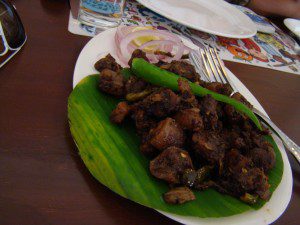
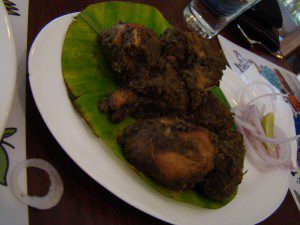
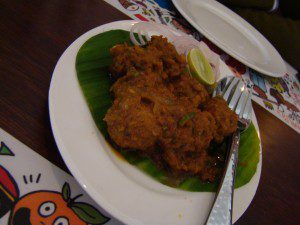
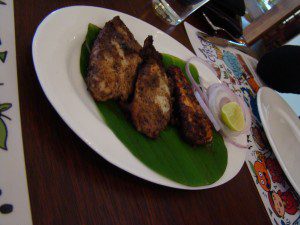
The menu is skewed majorly towards appetisers, so it was a difficult task to choose the representatives from each kind of meat. The Chilkana Pandi triumphed over its peers and turned out to be an excellent choice. The pork was well cooked and the onion and green chillies based masala also had a touch of sourness courtesy the vinegar. The Chicken Fry in Green Masala had tender chicken in a spicy masala made of green chillies, coriander and a hint of mint. Mutton was represented by Khaima Unde, minced mutton balls. The meat was bordering on tough, but not a complete disaster. Aquatic life made it to the table in the form of the Kachampuli Fish fry, though the tamarind was a name only presence, and the only discernible flavour was that of the pepper.
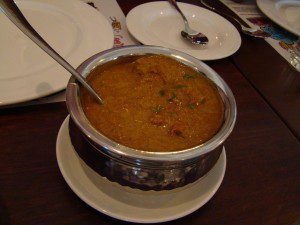
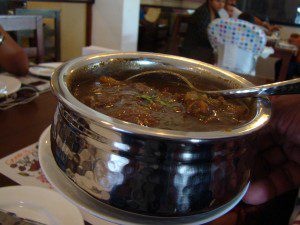
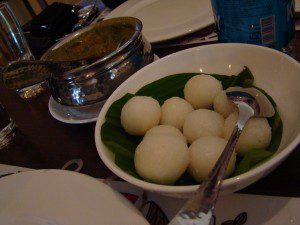
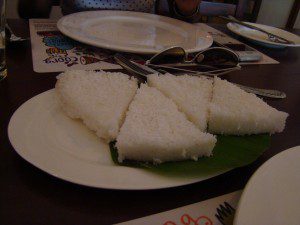
The alfresco area on the first floor was nearly full by the time we were ready for the rest of the meal, and that meant the main course took a while to get to the table. The Pandi Curry was a mandatory choice but failed to deliver, with a poorly diluted gravy that was rather insipid. The only consolation was that the pork was well cooked. The Chicken Curry also did not impress with its coconut based gravy. Most of the vegetarian gravies were unavailable, and from the options we asked for a Kumbala (pumpkin) Curry. Mildly sweet, it was just about average. We tried out most of the ‘accompaniments’ – Kadambuttu, Noolputtu, Paaputtu, Akki Otti, Sannas and Neyi Koolu (Ghee Rice). The Kadambuttu and the ghee rice were the pick of the lot. The former had an excellent consistency and the ghee rice was different from the standard fare with a mild sweetness to it. The Paaputtu was a tad crumbly, and the Akki Otti was an XS version!
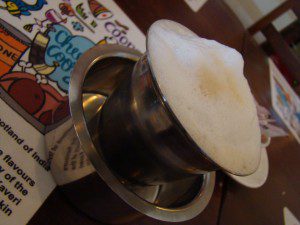
When we asked for the Dessert of the Day, the only option other than the Ice Cream, we were told that it was Caramel Custard, not really the Coorgi dish we had expected. So we decided to end the meal with juices and coffee. The Passion fruit juice and the Filter Coffee were not bad but the Kaipuli (bitter orange) juice was the clear winner.
For about Rs.1200, you could share a soup, a non veg starter, a non veg main course dish and a couple of staples, and a dessert. (Inclusive of taxes and service charge)
Cheers Coorg has nailed the ambiance, and features a unique cuisine, but they do have some way to go in terms of the quality of food, before we can truly say cheers!
Cheers Coorg, #29, 80 feet Road, Indiranagar , Ph: 080 41219555