Year: 2013

  • Live Empty

    old tree and new tree stories

    (via)

    Such is the pace of life now that I can easily identify with the opening paragraph here. As I read on, I completely loved the part about the graveyard being the most valuable land in the world, “because with all of those people are buried unfulfilled dreams, unwritten novels, masterpieces not created, businesses not started, relationships not reconciled.” The rest of the article is about dying empty – to complete every task, thought, action, to leave nothing unspoken, uncreated, unwritten. 

    Later, I read on Brain Picking, “Henry Miller on Creative Death“, in which Henry Miller, defining art, says, “Strange as it may seem today to say, the aim of life is to live, and to live means to be aware joyously, drunkenly, serenely, divinely aware. In this state of god-like awareness one sings; in this realm the world exists as poem. No why or wherefore, no direction, no goal, no striving, no evolving…. This is the sublime, the a-moral state of the artist, he who lives only in the moment, the visionary moment of utter, far-seeing lucidity…. in the sense that any moment, every moment, may be the all; for the artist there is nothing but the present, the eternal here and now, the expanding infinite moment which is flame and song.” And later in the article “On the contrary, his zest for life is so powerful, so voracious that it forces him to kill himself over and over. He dies many times in order to live innumerable lives.

    I read a pattern in these. Of dying every day and being reborn the next day. A new life. I faintly understand and relate to this, but within me is another side that plans, that likes stability, and saves for a rainy day. I am unsure of how these two can co-exist. And I can’t help but be drawn to the lines at the beginning of the Miller post ““One aspect of our nature cannot be exalted above another, except and the expense of one or the other.” 

    If so, I already know the winner, and as the first post points out, that would create an angst, or a perpetual state of discontent. It would seem as though the opposite of ‘die empty’ can only be ‘live empty’. There can be no middle path, and that’s scary and sad.

    until next time, empty vessels and a lot of noise
  • Fortune’s Favorites (Masters of Rome #3)

    Colleen McCullough 

    The third book in Colleen McCullough’s “Masters of Rome” series, after “The First Man in Rome” and “The Grass Crown”, begins just a few years after the latter. Sulla gets back to Rome, the beauty of his early days giving way to a toothless self with a hideous wig and an addiction to wine, and true to character, wreaks terrible vengeance on his enemies – Young Marius, Cinna and Carbo- and becomes Dictator of Rome.

    The seeds of Rome’s Republic days were probably sown that early as Sulla changes laws that had persisted for years. But what he also aids is the rise of the two other “Fortune’s Favourites”. He gave enough room to Gnaeus Pompeius, who, very early in life gave himself the title Magnus and sought to play down the other moniker Kid Butcher, and was the wealthy provincial whose military machinations and continuous search for military glory finally made him senior consul without being a member of the Senate. Though not easily, Sulla also helps free Gaius Julius Caesar from the position of flamen Dialis, the yoke that a bitter Gaius Marius had hung on his neck before he died. And then, true to his promise, Sulla makes an exit, on his own terms.

    In this book, through the later years of Sulla, and the early years of Caesar and Pompey, the author brings to life the character of Rome and its citizens. The presence of other familiar characters like Cicero, Spartacus and Mithridates add to the excitement. With a few eventful campaigns, the author also gets to pace the book well, allowing the characters to build slowly. Pompey’s supreme confidence in his own abilities, his showiness, the ignominy he suffers at the hands of Sertorius, and his tantrums when things don’t work his way all give us a glimpse of his character, a stark contrast to the confident yet subtle-when-required Caesar, whose diplomatic and military coups at an early age showed that he was destined for greatness. The brilliance of Caesar’s mind is on display as he brings a truce between Crassus and Pompey, uses his aunt’s death to show Romans that he is indeed Gaius Marius’ true successor and explains how time was his greatest ally all point to him indeed being the “greatest prime mover of them all”

  • A new brand narrative

    Dove’s immensely viewed ‘Real Beauty’ video has sparked a parody and many debates including how the content would (or would not) help sales. But what it actually reminded me of was a quote attributed to Marty Neumeier (via)

    Brand isn’t what you say about your product, it’s what other people say about your product.

    A little reminder that the marketer’s best attempts at defining the user’s perceptions have a chance of failing, especially in the era when everyone is a publisher. Sometime back, I’d read a post on Smashing Magazine which argued that the traditional way of brand building – repetition and consistency – applicable in a time when media options were limited, needs to give way to a playful, adaptive brand that is flexible while keeping intact the core principles. (Oreo is one of the better examples here) It defines the brand as an ecosystem of interactions that embraces different platforms, co-creation with customers and proposes a very interesting method to achieve this – apply the concept of ‘minimum viable product‘ to brand design.

    On another front, it was heartening to read that at least some feel that venture capital needs to get serious about brand thinking. Though not in so many words, this post is also in alignment with the concept of brand as an ecosystem and gives several good examples of brands earning the trust of users as well as going beyond their products and services in the positioning. This post uses the phrase ‘Clean Slate Brands‘ to describe new, unknown brands who are using better products/services, radical transparency and ‘open operations’ to compete with, and beat more ‘revered’ brands. (follow the link for examples)

    But what happens to established brands? How do they redefine themselves to be relevant in this changing scenario? This led me to think about Maslow and his hierarchy of needs. Do you think that the traditional form of brand building and communication focused on the bottom 2 sections – Physiological, Safety? As products and services become more efficient courtesy technological advances, and functionality becomes a given as opposed to a value proposition, should brand design as a science (and brands that have thus far used the traditional method) realign to focus on the top 3 sections – Love/Belonging, Esteem, and Self Actualisation? Think about the cola giants – from thirst to happiness (Coke) and Empathy (Pepsi Refresh) is that what they have been doing?

    until next time, a brand’s new story 🙂

  • Trader Vic’s

    Our visits to Phoenix Market City are biannual, since the End of Season Sale is the only time we can buy most of the stuff that gets sold there! This time, in addition to the wardrobe makeover, we were also looking forward to visiting Trader Vic’s. While the food court at the mall was not bad, and we specially loved the chocolate momos, meals there were getting a bit monotonous. The restaurant is on the same floor as the food court, right next to Rajdhani.

    There are about three seating options – the bar itself, a lounge, and a terrace – though that faces the parking lot. We sat in the lounge, and though we ended up right next to the stage – where a band began to perform later – we didn’t really mind, because the music was good. I quite liked the ambiance as well – a reflection of the restaurant’s overall Polynesian theme – check out the various carvings around.

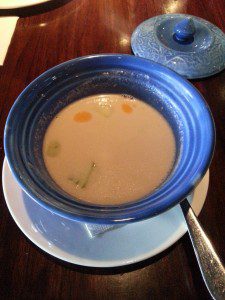
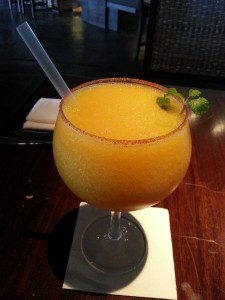
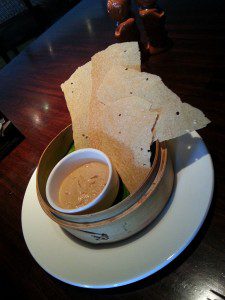
    Though they had a very appealing Sunday brunch priced at Rs.1500 + taxes, we chose to go à la carte. You can take a look at the drinks menu on Zomato and a more detailed food menu at Burrp. The Mai Tai is said to be invented by the restaurant chain’s owner, something that is heavily contested by one other party as well. Since we didn’t want to take sides, we decided to share a Mango Taj, despite the Mai Tai temptation. Even if it wasn’t fresh mango, we really couldn’t spot the difference in this concoction of orange juice, vodka, gold rum and a dash of spices. Superb drink. They also gave us a complimentary nibble, which turned out to be really good. Polynesian papad, you could call it, with an excellent dip that complemented it superbly. If the Tom Kha is on the menu, it’d be a rare occasion when we didn’t order it. This one turned out to be slightly less thick that we liked, but made up for it with the flavours. Didn’t have the standard lemongrass and galangal though.
      

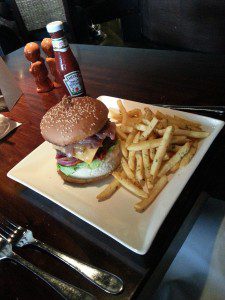
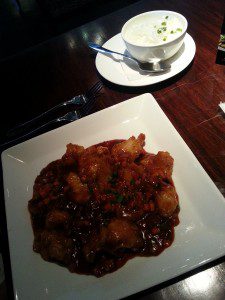
    For the main course, I resisted the Thai curries and asked for a Wood Fired Trader Vic’s burger, and D chose a Spicy Chilli Fish. The burger patty was superb, and the peppered bacon and caramelised onion played their parts well too. Massive amounts of french fries as well! The Chilli fish was actually quite spicy, but since it was paired with jasmine rice, it ended up quite a good dish. The only snag was that we were too stuffed for desserts!


    The service was reasonably prompt, the music was really good, and so we didn’t really mind the Rs.1800+ bill (including taxes and service charges) I really want to try that Sunday brunch at some point, but it requires skipping many meals to ensure the Rs.1500+taxes is well spent! 😀

    Trader Vic’s, 2nd Floor, Phoenix Market City,  Mahadevapura Ph: 67266237/8

  • Often, these days…

    10b

    From a shared computer at office in 2003 and posts written over the weekend, to a shared computer at home and posts written over the weekend and scheduled for days far ahead in 2013,  it’s been one awesome journey. Thank you for reading.  🙂

    until next time, tenacious