Month: November 2013

  • Red Fork

    For some strange reason, these days we’re more inclined to Sunday breakfast-outs than Saturday dine-outs. Though a beer brunch has been the standard, we decided to give that a break one weekend and try out Red Fork, for more healthy options – bacon and such. 😉

    Red Fork is in the same premises as (the new) Daddy’s Deli – here’s a map to help you. Park in one of the many side lanes that spread out of 12th Main, and walk up. Helps build appetite! At noon, we just about managed to find a table from the indoor and outdoor options. The menu is on blackboard(s) and is usually a marginally different version of this. The ambiance is pleasant and peppy, and the owner (I’m guessing) is extremely helpful. The decor is functional, includes a lot of quotable quotes, and reminded me of an elegant home – especially the shelf units.

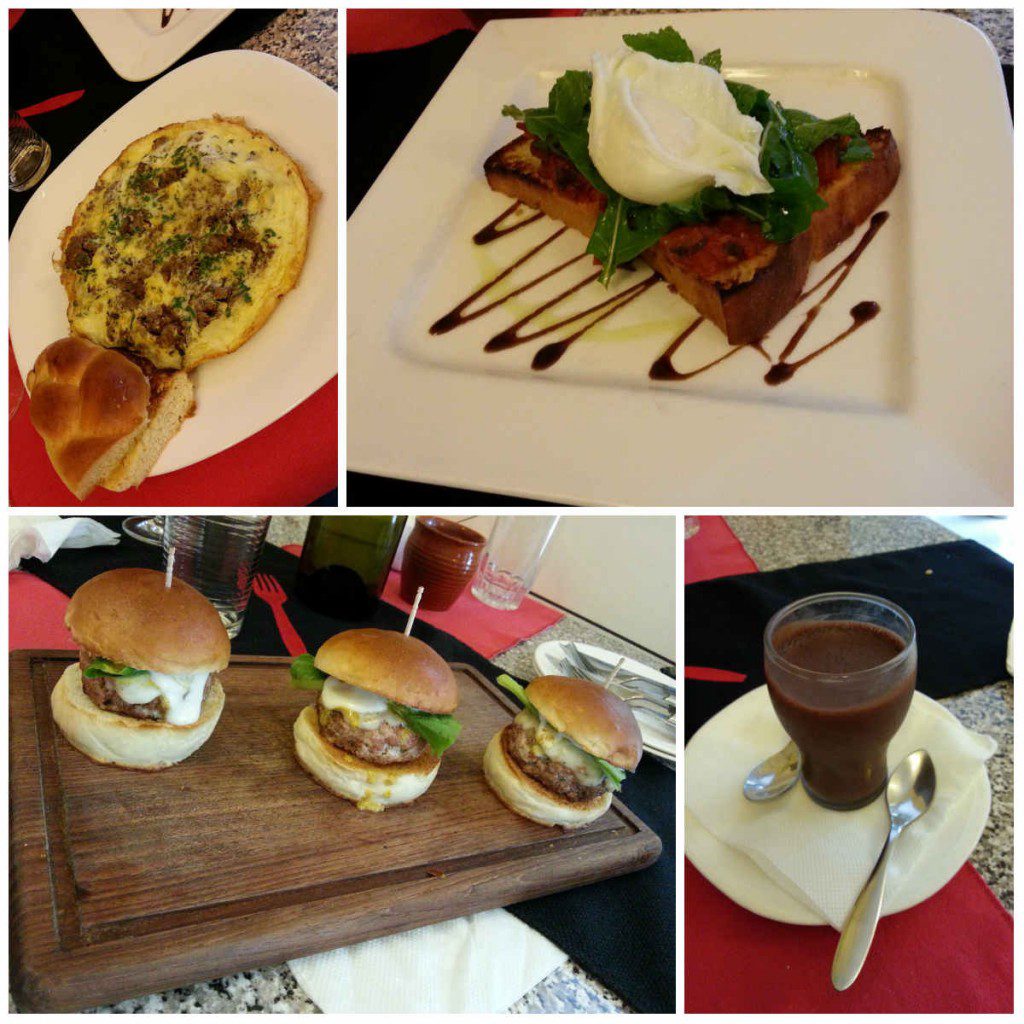
    From the beverages menu, I asked for a Kahlua Coffee and D ordered an ‘Indian’ tea. The coffee came in a wine glass and drew suspicious glances from the tables nearby, especially when I added the sugar! 🙂 D’s Indian tea had a cardamom flavour and was in a kullad. Pretty much two ends of the spectrum.

    collage1

    We oscillated between the ‘Big Breakfast’ and the Breakfast Pizza and finally, the latter won. The other dish we decided to check out was the  Eggs on Kheema. We had chosen the soft bread option for the ‘Pizza’,  which had bacon, a tomato based sauce and a poached egg! Quite tasty, though the soft bread obviously began getting soggy pretty fast. I loved the flavourful eggs on kheema – in terms of looks, this was closer to a pizza than the other dish. Since we had some additional space, even after considering desserts, we decided to try out the Mini Lamb burgers. Good choice, I thought, with excellent patties, cheese and a tinge of mustard. A good time to note that the Big Breakfast, which were being consumed all around was quite a looker – especially that mini frying pan, that seemed straight out of a kid’s kitchen set! For dessert, we asked for a chocolate mousse, and it was quite good, the quantity just right for two people who have hogged reasonably well!

    collage2

    The bill came to around Rs.1350, and that seems reasonable enough for the location and quality of food.

    Red Fork, #59, 12th Main, HAL 2nd Stage, Indiranagar, Ph: 41154372/5/6

  • The Social Product

    A few days ago, I read this post that cited studies on consumer sentiment (US, UK) about brands being present on social media. There are plenty of interesting perspectives and nuanced insights but one key takeaway is that consumers feel there is a glut of companies on social media, though it seems the younger age group feel that presence on social media adds to trust. Around the same time, I also came across the theory of peak advertising which begins with the decreasing effectiveness of online advertising and moves through various stages to suggest alternatives to the current business models that sustain the internet.  Collectively, it would seem as though the (generic) advantage of just being present on social is plateauing, or probably even going down. There are obviously brands that are using these platforms effectively, but increasingly, social is being used as media and this is easily replicated by other brands. At a larger level, the advertising barrage on social is also reducing effectiveness. That led me to think – before the utopia of social business, what opportunities does social have beyond the traditional marketing, advertising media based approach, enterprise collaboration, and social CRM?

    In the second Myntra post, I’d written about how I felt that ‘product’ was best placed to deliver sustainable business advantage. Though it was related to the website/features in that context, I’m now considering if this is applicable across the board – to physical products as well. Also, the more I see social evolving on customer care, marketing, advertising and sales, the more I think these are becoming hygiene. I have omitted marketing because I think there is scope to build a unique brand and thus some business advantage in the long run. However, I also think that this marketing will have to significantly integrated with ‘product’.

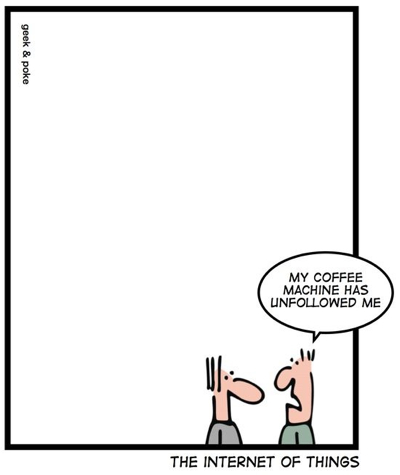
    In this context, I found this Forrester post titled “There is no Internet of Things” extremely interesting. Though we’re in the early stages of this phenomenon, I think it’s a good time for her to have raised the point of fragmentation and apps/brands working in silos. There are some excellent examples and scenarios in that post that make it a must-read. The conceptual answer to this is in the title of this HBR post – “The Age of Social Products“, and it makes a great point on ‘shared purpose’. “In an age of social products, competitive advantage comes not from product features but from network effects.” (though at this stage, I do think it’s both and not an either/or) Nike, as mentioned in the post, (and as usual) continues to be on the cutting edge. The common theme in their case is that the product + community (user+developer) offering only uses popular social platforms to augment, and is not dependent on them.

    The current approach to social (media) is either to use $ or influence. I’m not sure there’s enough importance given to the network and the effect that’s created over a period of time. As this superb post states on the subject of disruption and diffusion states, “It’s not the nodes, it’s the network” In that light, I feel social products might be able to do more justice to the promise of ‘social’ than its current avatars, especially social media. I did think the same way about social platforms earlier, but we live in hope!

    IoT

    (via)

    until next time, objectifying social 🙂

    P.S. I was reminded of a term coined much earlier – social objects. In that context, it was anything that could be a conversation starter, and the focus was more on its ability to connect people around a subject of common interest. Social products have the ability to take that connection and give it a platform where even people who are not in the same time and place can be part of the conversation. This is beyond its ‘utility’ not just as a product but also as a device that talks to other devices and makes itself more useful. I’m actually thinking of that ‘bottle of memories’ I mentioned in an earlier post, probably in a smarter avatar – like this or this – but also ‘tagged’ (say, using an augmented reality app) with the people who are part of the stories associated with it. Now, at some point, when I see the bottle, and get particularly nostalgic, I could use the same app to see what those people are up to, and quickly ping them to start a conversation about the good old times. In the collaborative and sharing economy, think of the possibilities! (If you’re interested in this sort of thing, you should like this post) When I think about it, what we probably need to accelerate this is a browser (what it does for the web) equivalent.


  • The Non Fiction Collection: Twenty Years Of Penguin India

    Celebrating Penguin’s twenty years in India, this book has a collection of 46 non-fiction works, (chapters from published works) and since there’s no specific theme that links every one of them, I’ll just list my favourites. Devdutt Pattanaik’s Myth = Mithya is probably the best way to begin the book with its premise of creation (as per Hindu mythology) and its take on the complementary forces at play in the universe. Gita Piramal’s “the old fox” gives us the ringside view of the Ambani – Goenka war that played out in the eighties. Humra Quraishi’s “from Kashmir” offers us a glimpse of today’s Kashmir, and the life of the people there, a far cry from the times when Kashmir was described as heaven on earth. Vikram Seth’s “From Heaven Lake”, in addition to its vivid description of travel in China, shows in its last page a snapshot of the human condition that remains unchanged across the globe. Amrita Shah’s “Launching Into Space” is one of those reads that take across time, and space, with its chronicling of the early days of India’s space research programme. Khushwant Singh’s “Village in the Desert” is a very personal recollection of the author’s own childhood in a village that now stands in Pakistan, and shows how people across the line really can go beyond the lines drawn on a map. Sanjay Suri’s “Near Mrs.” (that title is a good example of the humour involved) is a brilliantly funny respite from the serious content in the rest of the book, involving a bride-search in London.

    Roopa Swaminathan’s “Extras” is a poignant piece of writing on the life of extras who come to Mumbai/Chennai with the hopes of becoming the next star, but who find that their life has passed them by even as they clung on to hope. Giles Tillotson’s Jaipur Nama has an account of the East India Company’s activities in the context of Rajasthan. Even as Mark Tully’s “No Full Stops in India” gives an excellent perspective on ‘development’ in India, Pavan K Varma’s “Being Indian” has a fantastic take on how India’s own way of getting things done still survives. Abraham Verghese’ “My Own Country”, while set in the US, touches upon, among other things, the idea of a home.

    Pinki Virani’s “Home as hell” informs us about sickening cases of child abuse in India. John Wright’s “Indian Summers” gives us a behind-the-scenes look as well as a non-Indian’s perspective on the game that unites India, even as S. Hussain Zaidi’s “Black Friday” shows how communal forces and the merchants of terrorism try to break this unity.

    There are also very interesting pieces like the Veerappan based “Face to Face” by Sunaad Raghuram, former PM Narasimha’s Rao’s version of what happened at Ayodhya in 1992.

    The book also had quite a few excerpts from works that are already my favouries – Mishi Saran’s “Chasing the Monk’s Shadow”, Shashi Tharoor’s “India: from Midnight to the Millennium” and Arundhati Roy’s “The Algebra of Infinite Justice”.

    The book is a few years old, and some of the works, even more so, but they are in some ways, timeless pieces too. I read them because they not only give me clues on interesting books to read, but also offer me a glimpse of worlds that I probably might not travel to in the course of my normal reading journey.