
Month: July 2013

  • Arbor Brewing Company

    Ever since Arbor opened, and I saw them on twitter, I’d been pestering them on when they’d open the microbrewery. On my birthday, we’d wanted to visit Windmills Craftworks, but they had an event and were booked out. I casually looked up Arbor’s menu on Zomato and found that the microbrewery had finally opened!

    We went there once more later, and on both occasions, we realised that having a reservation really helped, though the first time we had asked for a table outside, but had to make do with one inside. I missed the passive smoking! 😉 Follow the map to get there, and make use of their valet parking.  I loved the way the building encapsulates Bangalore – Nalli Silks, a restaurant named 4 States, (not sure if it’s open yet, can’t find it on the web) and then Arbor, a microbrewery. The place is quite huge, with various kinds of seating options spread across its space. The music is rather loud, but I liked the playlists, so won’t complain!

    Over two visits, we tried the Brasserie Blonde, Bangalore Bliss, Big Ben and the Cold War. I loved the theme of the last one, but the coffee flavour was a little too strong and the drink too bitter for my taste. The Blonde was my favourite, and Bangalore Bliss a close second. D preferred the latter though. Big Ben was not bad either. I liked the way they have explained the drinks with trivia, notes and food pairing.

    The Flaming Chicken was our favourite starter – chilli sauce and an assortment of flavours like lemon, pepper etc. Quite spicy and extremely tasty. The Chilli Fish was also reasonably good – the sauce being quite spicy again. We didn’t care much for the Drunken Chicken or the Bourbon barbeque sauce it featured.
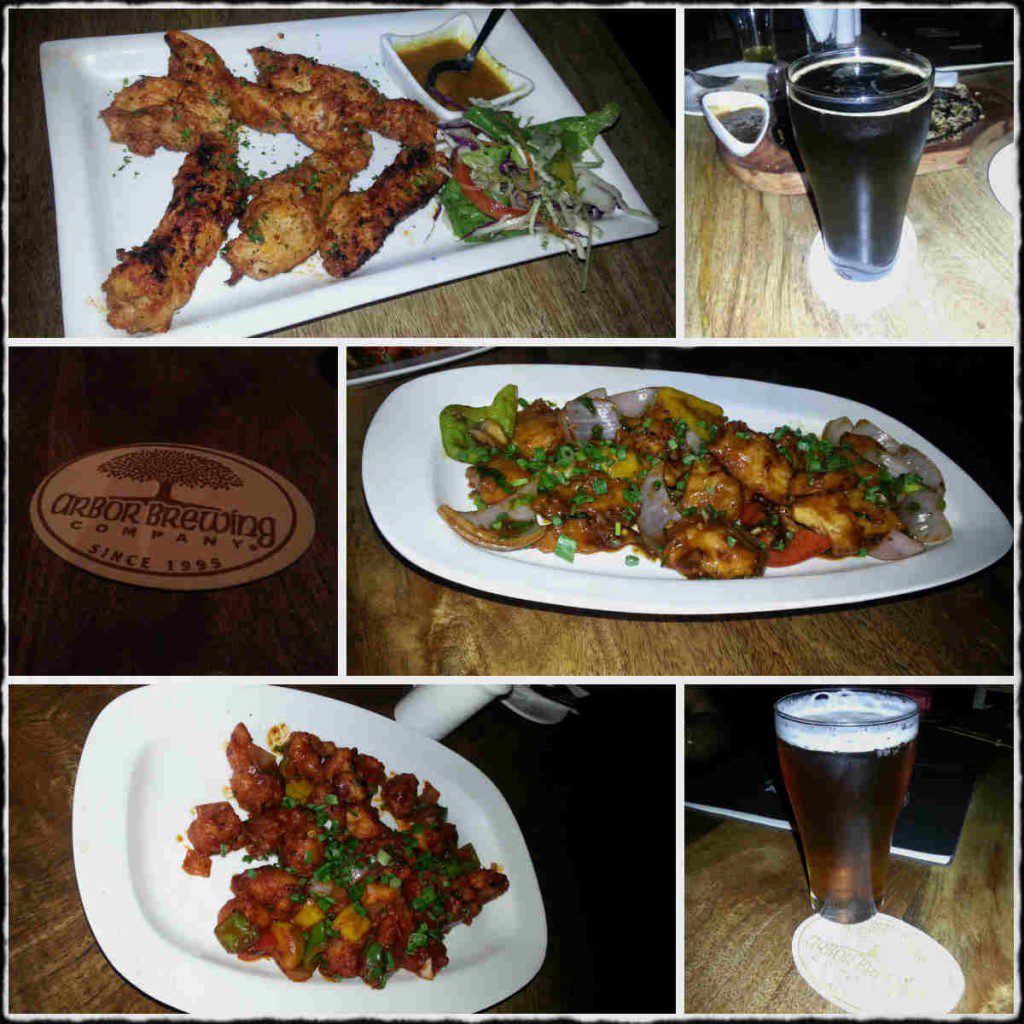
    In the main course, we tried a couple of pizzas – ‘I Like to Party’ and ‘Buffalo Soldier’. The former featured superstars like bacon, pepperoni, sausage, ham and cheese, but it was the latter’s fiery buffalo sauce that won us over. We also tried The Fleetwood – chicken sausage fried rice with garlic pepper sauce and a fried egg on top. This was just about ok. The dish we really liked was the Fiery Chicken Alfredo – creamy sauce and spicy red chilli paste came together very well indeed. But the star, as on most occasions, was a dessert – the gigantic Long Lasting Vertigo. Three layers of chocolate sponge cake with chocolate mousse oozing through! So awesome that we didn’t bother to try another dessert on our second visit!

    Our bill on both occasions came to around Rs.2500 – for a couple of beers, a starter, a main course dish, a pizza, and a dessert. Reasonable, I’d think. There’s a distinct buzz about the place, and I think it has a character that will develop well over a period of time.

    Arbor Brewing Company, 8, 3rd Floor, Allied Grande Plaza, Opposite Home Stop, Magrath Road. Ph: 080 67 921222
  • Future Tensed

    Thanks to Neal Stephenson’s The Confusion, (Vol 2 of The Baroque Cycle) I’ve had to do something that I haven’t done since I started reading – read two books in parallel. Every 200 pages of The Confusion, I take a break and read a volume of The Hunger Games. Neal Stephenson, to me, is genius, and I’ve been a fan since I first read Snowcrash. I could speed read The Confusion, but I really want to pay attention and understand the nuances, the humour, the larger thought and so on. I cannot do that for 800 odd pages, hence this shift.

    I only understood the ‘connection’ after I started reading The Hunger Games. The Baroque Cycle is set in late 17th-early 18th centuries, and uses an excellent mix of historical and fictional characters to cover a whole variety of themes. In some ways, it uses the past to understand the present. The Hunger Games, on the other hand, is set in a dystopian future, and shows a potential fate of humanity. It uses cues from the present to predict the future. The connection ends there, almost. Though at massively different levels, both require imagination, the former at a much more larger scale.

    That’s what led me to think about imagination in the present. We’re in the midst of probably the biggest upheavals in the history of humanity – new technologies emerging at a rapid pace, institutional realignment, socio-cultural changes, behaviour alteration and so on. All of this means, that collectively, we’re having to run really fast just to cope. Where does that leave time for imagination? In fact, such is the assault on senses that I wonder if anything really disruptive is being written in the science fiction genre these days (I hope to be proven wrong and pointed in the right direction) because except for things like teleportation and time travel, pretty much everything that was science fiction is getting played out now, and so busy are we – trying to keep abreast – that science fiction is merely extrapolating the present (read) or giving alternate versions.

    There is a term in psychology called Functional Fixedness, wiki-defined as “a cognitive bias that limits a person to using an object only in the way it is traditionally used.” With my limited knowledge, I wonder if that’s the dystopian future of the human imagination.

    until next time, the end of collective imagination

  • Caesar’s Women (Masters of Rome, #4)

    Colleen McCullough

    The fourth in the ‘Masters of Rome’ series, covering 10 years from 68-58 BC, chronicling the rise of Gaius Julius Caesar, with most of the narrative set in Rome itself. Despite being part of the book’s name, the first half of the book does not really focus on Caesar himself. Much of it is spent on building up the rest of the cast who would play an important role in Caesar’s life during this period – from his allies like Pompey the Great and Marcus Crassus to enemies like Cato and Bibulus, and even those who, in modern terminology could be called frenemies like Cicero and Clodius. However, the author remains true to the title by delving into the minds and lives of the various women who essay a key role in Caesar’s life – his mother Aurelia, his lover Servilia, his daughter Julia and even the non-influencer – his wife Pompeia, whom he later divorces – though to a minimal extent.

    Cicero, in this book, is shown in poor light, and the author does say in her notes that his peers didn’t think too much of him, as per the documentation available from that era. The other important character who makes an extended appearance is Brutus, originally betrothed to Caesar’s daughter Julia.

    It then follows Caesar’s political career covering his curule aedileship, his election as Pontifex Maximus, governorship of Further Spain and his first consulship. The book also highlights possibly the only chink in Caesar’s otherwise impenetrable armour – an indifference towards money – though he manages to learn his lessons in that respect towards the end of the book.

    The book not only chronicles how Caesar uses various tools, even marriage (his own as well as his daughter’s), to out-manoeuver his enemies and further his rise to prominence, but also manages to give a good idea of how Roman society functioned, in terms of culture, belief systems and hierarchy. It minimally shows Caesar’s military genius but quite elaborately showcases his political and legal brilliance, aided in no small measure by his mother Aurelia, and which culminates in the formation of the triumvirate with Marcus Licinius Crassus and Gnaeus Pompeius Magnus.

    The book sets quite a lively pace though it does require concentration to follow the various alliances that are made and broken at regular intervals. As in the previous books, and probably more so because of the new characters, the large secondary cast is not easy to follow. The final pages of the book point to a change in Caesar after his year as consul and sets the stage for the next book.

  • Can media become social enough?

    A few days back, it was reported that Facebook now had a million active advertisers, and that LinkedIn has 3 million company pages. I’ll let that sink in, in case you hadn’t heard. Despite all the social-ness, I realised it’s impossible not to call it media. The wiki definition for media is “tools used to store and deliver information or data” That, for me, is a smartphone now! I also wondered how many media behemoths could boast of a million active advertisers. And that’s when it really struck me how much the traditional media we were used to have been sidelined – yes, they still get advertising revenue, but from a sheer reach perspective. Google, Facebook, YouTube and many more platforms get anywhere between a few million to a few hundred million visitors every day.  To put it all in perspective, TOI – the world’s largest English daily has a readership of over 7 million.

    Media and advertising have had a very intertwined life, unless of course the publication/channel has been on solely a subscription based model. I think the magic of Facebook (and Google, before it) and those that followed is that they have democratised advertising by not just making it something any small business could spend on according to their means, but also giving them the ability to advertise according to contexts – intent, interest, social etc.  Though Google, Facebook etc are still intermediaries, they never flashed their powers, though the latter has begun to, recently. As brands move away from a one-size-fits-all mode of advertising, these platforms give them more options of form and function, and changing the face of advertising. (Google’s exploits are known, here’s a pertinent read on Facebook)

    In such a scenario, what really does a traditional media channel have to offer to its consumers and clients? I’m not saying that they’re all going bankrupt next Sunday, but it’s clear which way the wind is blowing. One way, of course, is to use their brand value, and replicate (and grow) their audience on devices and platforms which better serve advertising interests. They can hone their value offerings by offering various contexts and their combinations – local, social, interests, and so on, and build business models for each. The early movers are already making big deals. But that is the red ocean that everyone is fighting for. How really can a player differentiate?

    Biz_Is_The_ArtI had a vague thought. Media’s original strength was its relationship with users and the trust involved. In the social media era, how can that be leveraged? Flipboard has already allowed users to become curators and create their own magazines. Is that the future, along with shared revenue on advertising? What if users can also curate the advertising their ‘subscribers’ can see? After all advertising is also news/information and has a certain value depending on the source. Traditionally, media  has been the middle man between advertisers and users, but what happens when everyone is media? Can media start aggregating influencers in every domain, including niches, provide them the material for curation, negotiate on their behalf to relevant advertisers, and share the revenue? Perhaps the next  disruption will be the platform that can handle the complexities involved. What do you think?

    until next time, mediator