Month: July 2013

  • The questions in Big Data

    In my last post that touched upon Big Data, I had mentioned how the seeming intent of Big Data is to synthesise actionable insights from processed and unprocessed information at touch points related or unrelated to the enterprise, and then use it to target consumers better. While this is probably true for the short-medium term, I read a wonderful perspective at GigaOm by Beau Cronin on its true potential – the path to building the equivalent of global-scale nervous systems. As I tweeted after I read it, it reminded me of something I’d written a couple of years back before I’d heard of #BigData – if we could actually use data to go beyond that to answer life’s profound questions. Before we go into the subject, here’s a nice video by OgilvyOne titled “Big Data for smarter customer experiences” (via) though it’s skewed more towards the experience rather than the data.

    Beau Cronin has mentioned several possibilities this would give rise to, and the post made me think if something like the hive mind concept would mesh into it as well – a sort of hybrid neural network. He has also pointed out the hurdles we would face while we get there – gathering, processing and conversion into actionable insights, and how phenomena such as priming,expectations, and framing matter so much in how we perceive our physical and social environments. In essence, a fascinating read.

    I was particularly intrigued by framing, and began thinking about it in the context of the unstructured data – tweets, posts, mails, videos – that is a major component of Big Data. The fundamental question being – is it unstructured because we’re framing it ‘wrong’? Based on the enterprise’ intent and not the users’? Ironically, I couldn’t frame the questions right until I met the ever-brilliant S, who has always maintained that the answer is easy to find once the question has been framed right. He has developed (Tulpa -to build or construct in Tibetan – is the concept he enlightened me on while we were discussing semantics) something that at a rough level mashes the MECE principle with Frame Semantics and the entity-relationship model. There’s IPR involved, so no more beans shall be spilled, but as always, I learned much from the conversation.

    In essence, structure can definitely be derived from what we currently call unstructured data, provided we frame the queries right. I can intuitively begin to understand that in the era of data abundance, the only way we can make sense of all of it is by focusing on an intent that is derived from a common purpose, so that the sources of data (users) will be more open to help solve the challenges of data collection. The processing and inferences that follow would yield the best results when the right questions are asked. I have a feeling that the questions asked by a business in an earlier era might not cut it.

    until next time, role models
  • Windmills Craftworks

    We’ve been hearing good things about Windmills Craftworks for a while now – that though we might be considered tourists given the distance between Koramangala and Whitefield, it was worth dropping in. We had tried once earlier, but they had an event and all the seats were taken. This time, though, we agreed to meet, and an OlaCabs booking was promptly made! That was a massive risk, given that they had left us high and dry only the previous night, but I persisted. When I didn’t get the cab details half an hour prior to the planned departure, I called up OlaCabs and they said I’d get the details in 5 minutes. True to word, I did get a call in 5 minutes, to tell me that there had been a mistake, and I would not be getting a cab! An auto, a Volvo and another auto later, we managed to reach on time! This accurate map really helped!

    The ground floor itself is business-like, and has nothing to offer in terms of directions. Your first task is to find the lift, then all will be clear. The floor which houses the establishment is a better representative of Total Environment Hospitality though. Once inside, there are bookshelves and comfortable seating options indoors and a smaller space outside from where you can see the IT parks that surround the building. Despite all that concrete, the latter is still a wonderful setting, and we chose to sit there.

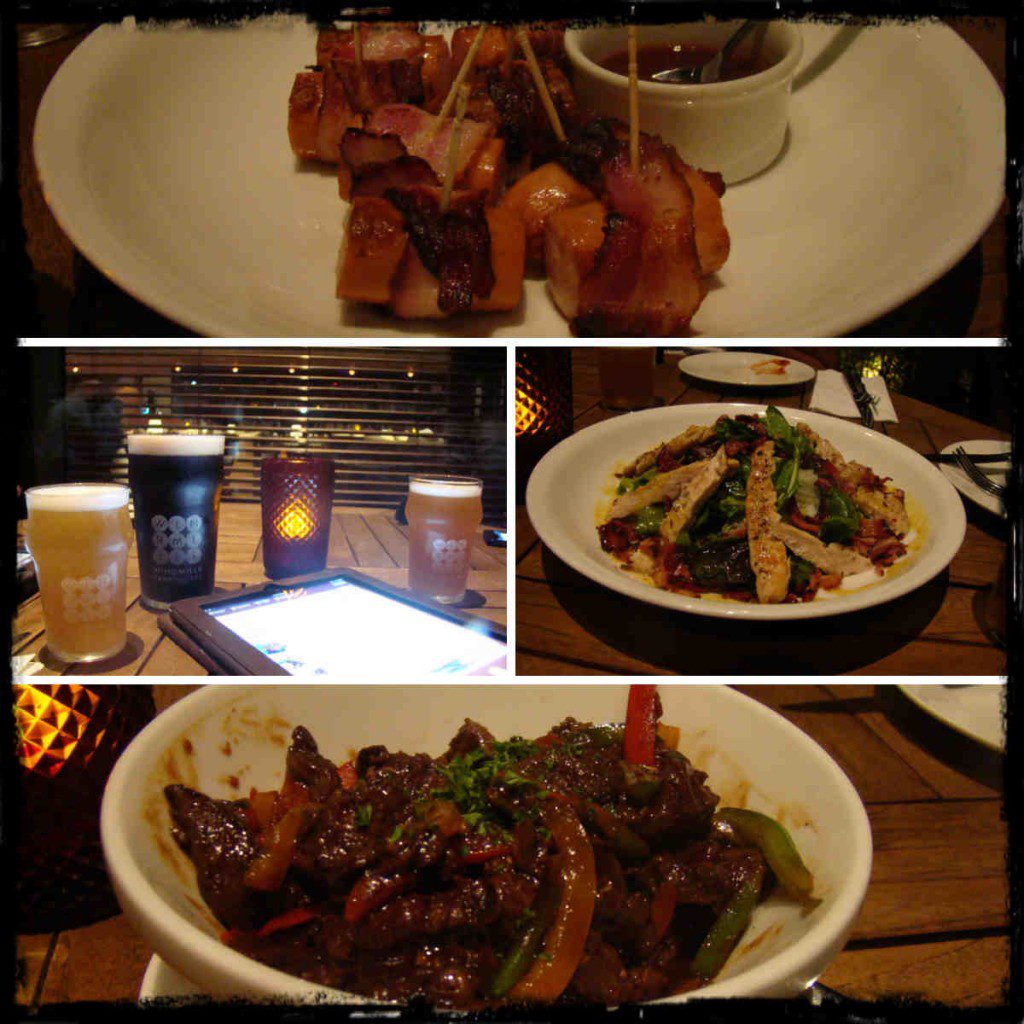
    The menu is available on an interactive tablet that gives more scope for the appealing food visuals and you can order on it as well. The staff will also confirm the order with you. Though I was tempted to try the samplers, we went ahead with half pints (Rs.195) of Golden Ale, Hefeweizen, a pint (Rs.295) of Dunkelweizen and later a half pint (Rs.225) of the India Pale Ale as well. The Hefe, with its low bitterness, was the most popular, though I liked its darker cousin Dunkel too! The Golden Ale, which is probably the lightest around, was also quite good, and the Pale Ale, true to its name, paled in neglect at our table. Chicken in Pigs Blanket was our first starter, and though in itself it was quite good and not stingy on the bacon either, they could’ve given us a better dip. We then tried the Chicken and Smoked Bacon salad, which had some amazing flavours on the veg leaves that I otherwise ignore! But the pick of the starters was the Beef Picante, which will give any of my favourite Kerala preparations a run for its money. Superbly hot and sweet with very well cooked meat, highly recommended!

    This was about the time that we decided to skip the main course, since we couldn’t have done justice to it. So D decided to test out an Indian starter – Dill Chicken Kebab. It wasn’t bad, but by then the beef had set the bar really high! Given the dessert options, we jumped right in and asked for a Chocolate Pudding, Shahi Tukda, and an Orange Bread and Butter Pudding. The Chocolate was really dark and a little too bitter, though the strawberry helped a bit. The other pudding was fantastic, as was the Shahi Tukda.

    The service was prompt and helpful, and all of the above cost us, including charges and taxes, over Rs.3800. (3 people) Costly? Yes, but then the experience is quite worth it. Like a friend said, you probably can’t go there regularly, but for special occasions or to try the place out once, most definitely.

    Windmills Craftworks, #331, Road No:5B, EPIP Zone, Whitefield. Ph: 26592012

  • Awesomeness is homemade

    Three weekends and three Malayalam movies – different genres, different directorial approaches and a largely non-overlapping cast. But all of them underlying that this is indeed becoming a glorious age for Malayalam cinema! New stories, novel thoughts, fresh perspectives – this is a wonderful time to be a viewer. I decided to write this post, because as I’d mentioned earlier while on the subject, movies are a representation of an era, and years later, I’d like to read this and remember what a great time we had!

    On the first weekend, we saw ABCD, (trailer) starring Dulquer Salmaan, who with each outing impresses further, seems destined to be an actor and a star, and might not have to wait for years like his father (Mammootty) to attain either. Our decision to see it in the theatre was also heavily influenced by the presence of Jacob Gregory, whom we were fans of thanks to Akkara Kazchakal. The movie was not meant for intellectual stimulation and delivered its promise of entertainment quite easily. What it also did was look at contemporary issues in a non-preachy way. Despite a few niggles – the editing could have been better, Gregory’s accent could’ve been worked on and he could have been better utilised in the first half – Martin Prakkat has ensured that his success continues after his debut film Best Actor. Extra points for not trying to force fit a love story that could have spoiled the superb essaying of a script-backed character by Aparna Gopinath, the very anti-thesis of a traditional Malayalam movie heroine.

    The second weekend saw us in PVR for 5 Sundarikal – an anthology with stories of 5 different women in various life stages. 5 directors, with one of them making a debut. My favourite was Aashiq Abu’s Gowri, (despite not being a fan of Kavya Madhavan) thanks to the really sensitive story of a couple whose life goes through a drastic change after a seemingly casual remark by a visiting friend. Kullante Bharya was an equally strong contender, and quite unchacteristic of Amal Neerad, I might add. I place it second only because the story is an adaptation. Dulquer takes on the narrator role with ease and does a splendid job of making sure the nuances are caught just right. Shyju Khalid’s Sethulakshmi, based on a story by M Mukundan, is poignant and very disturbing! Fantastic treatment of the story in terms of catching expressions, and portraying scenarios. Anwar Rasheed’s Aami does not fail only because of the superb portrayal of the protagonist by Fahadh Fasil, who captures the flitting gray shade nuances of his character with ease, and the riddle based flow of the story. Sameer Thahir’s Eesha, starring Isha Sharvani and Nivin Pauly reminded me of a short story (not sure if it’s Archer) and was probably the only one which only worked marginally for me. But in all, it was an excellent compilation.

    The best was saved for the last – Murali Gopy teaming up with Arun Kumar Aravind after Ee Adutha Kaalathu – Left Right Left. The title of this post is inspired by its tagline – revolution is homemade. Fantastic casting, with Hareesh Peradi, (what was he doing in Red Chillies?!)  Murali Gopy and Indrajith making each character easily believable. So strong is the script that you feel the angst and pain that each of them have within – and that even goes for the ruthless character played by Hareesh Peradi. The political overtones are more than obvious, but yet manage not to take over the film. There is an immense amount of realism in the movie, and that is not because one could easily associate it with real life personalities, but because even the secondary characters have a clear DNA – why they are the way they are, what drives them, what is their rationale for doing the things they do. It is really difficult to choose between the three protagonists and that’s because of the strong script as well as the brilliant portrayals. Like I mentioned in a tweet, it was awesome to see the sons of gifted actors – Murali Gopi, Indrajith Sukumaran, Sudhir Karamana, and Vijayaraghavan in a single movie! If that isn’t new generation Malayalam movies, what is? 🙂 A powerful, hard hitting movie, and kudos to the director for delivering the script just right! For now, watch the back story of the characters in the movie’s potent anthem

    until next time, malayalam cinema #ftw

  • Revolution 2020: Love, Corruption, Ambition

    Chetan Bhagat 

    As usual, Chetan Bhagat sucks the reader into the story from the first page. The narrator speaking to CB has become quite the signature prologue now, though he played it slightly differently in the last book.

    The overall concept of the book reminded me of several books/movies, and the one that came specifically to mind when I read the ‘summary’ on the jacket was Hazaaron Khwaishein Aisi. That actually made me think of the author’s themes across his books. For me, the first three were unique because the story itself was new. (though FPS could be seen as a rendition of “poor hero – rich heroine – evil father” set in an IIT. But there was something refreshing enough in it for it to spawn a cottage industry) The last book seemed to be inspired by the author’s own life (it’s probably marketing) and to me, seemed like a nadir in the author’s imagination and storytelling capability. This one is a clawing back, and though the theme itself is jaded, CB manages to bring life into it with the storytelling. At least, it didn’t annoy me like 2 States.

    Gopal Mishra is a protagonist who you can easily root for, even as his ‘grey shades’ continue to darken as the book progresses. Despite being quite stereotypical, it’s probably this that holds the book together, as all the other characters are quite cardboard. The climax itself is quite predictable, especially if you’ve watched a typical love triangle in 80s/90s Bollywood. But the pace is relentless, and despite the predictability, the narrative was reasonably interesting to hold my attention.

    The mentions of CCD in every tenth page made me wonder if this is part of the author’s ‘special friend’ deal with the coffee chain. And that also made me wonder about the Taj and Ramada hotels as well. But hey, the book costs all of Rs.140 (maybe a hat tip to Twitter), I think that makes it all fair, even if the conjecture is true.

  • Revisiting Social Commerce

    It’s been more than 2 years since I wrote about social commerce on afaqs, and since then, there have been massive changes right from the definitions to the operations of social commerce. Karthik’s recent post on the subject led me to think about it again.

    I’ve always felt that most of the popular definitions of social commerce have constrained its actual scope. Back in 2011, facebook stores accounted for most of the social commerce discussions. These days, it is mostly referral traffic and sales from social, and that too, in terms of last-touch attribution, as the Ecommerce quarterly (that Karthik cites) would suggest. While I’d not contest EQ’s methodology or assessment, I think it’s only fair to point out that there have been a great number of exceptions. (read; Disclosure: that list includes Myntra where I work) I’m not a fan of how Facebook has throttled what we used to call organic reach, but if you want to read about how Facebook helps target users at different levels of the funnel, Zappos serves as a good example. Facebook’s Custom Audiences and FB Exchange products allow different ways of targeting consumers. Twitter is a bit late to the party, but their products also have excellent potential from what I’ve seen, and they’re moving quickly! (already into retargeting)  YouTube is already a big bet for advertisers, and Pinterest is already being used by scores of Etsy users! (read) From small experiments, I also suspect that Google+ is a potential top rung player. Even if you’d like to leave the $ out and consider (for example) only organic (eg. Open Graph actions) there are case studies evolving. (example)

    tumblr_lteusu0d0K1r54seio1_500

    So, can commerce be driven through social channels – advertising as well as organic? An emphatic yes would be my answer. Yes, it might score low if one considers only last-touch attribution, but hey, many of Facebook’s strategic PMDs are getting a handle on multi-touch attribution. (Kenshoo is an example) One should also consider that other traffic channels like search, affiliates etc have been around for longer and have tried and tested models. The point is rather simple – if we judge social’s contribution on the basis of models created for an earlier version of the web, it would not measure up. We’re at a stage where both technology and tools are still evolving to help measure social on terms that balance its uniqueness with the needs of the business. The good news is that the little that I have seen of Facebook’s strategic PMDs has been inspiring!

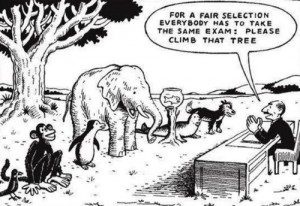
    (Image via)

    But I think using social channels as sources of traffic/revenue for commerce is still not capturing ‘social commerce’ in its entirety. Though arguable and reducing in favour, I’d still label many group buying options as social commerce. (example) But to me, the elephant in the room is  p2p commerce. Though the collaborative economy is more vast in scope, I’d put it in the same bucket in this context. (do read Jeremiah Owyang on the subject) From Airbnb to RelayRides to Loosecubes to TaskRabbit to even KickStarter, commerce is now happening between individuals with everyone playing creator, buyer and seller as per context. While the $ is inevitable, trust and one’s network itself are becoming currencies. Yes, these also use social platforms for extended reach, but this is inherently more social than the pure commerce play of brands.

    It is interesting to see social platforms working on these lines as well. Facebook’s Marketplace was probably a bit ahead of its time, but nothing stops them from bringing it back. I read recently that Google is planning to release Mine – a service integrated with G+ that allows users to keep track of “belongings” and then share those with friends in different circles. (via) Yes, there will obviously an Android App. It’s not just these platforms, I’d think that Amazon is slowly approaching it from a different direction as well. (read)

    To sum it up, commerce has always been social, it’s only the dynamics that keep changing.

    until next time, commercial breaks