Month: June 2013

  • The Black Pearl

    Pirated from Bangalore Mirror

    There’s something very ironic about ‘borrowing’ a ship’s name from The Pirates of the Caribbean franchise, and using it to run a restaurant with a pirate theme! Even more ironic when it’s located right next to an establishment called Empire! (map) But that’s exactly what The Black Pearl has done, and they have obviously invested a lot of effort into doing justice to the theme. Across three floors – the top floor akin to an upper deck with open sky above – there are décor elements that accentuate this – anchors, cannons, mannequins, chains and ropes, skeletons, swords. There is a tinge of tackiness too, like the huge bones that became the butt of many jokes, and it was a little funny to have pirate-costumed service staff valet parking and speaking in Hindi. But ambiance is only part of the tale – the service, and the food had a role to play too, and that’s where the seas got rough! In the end, keeping with the theme, looting did happen, in the form of a bill.

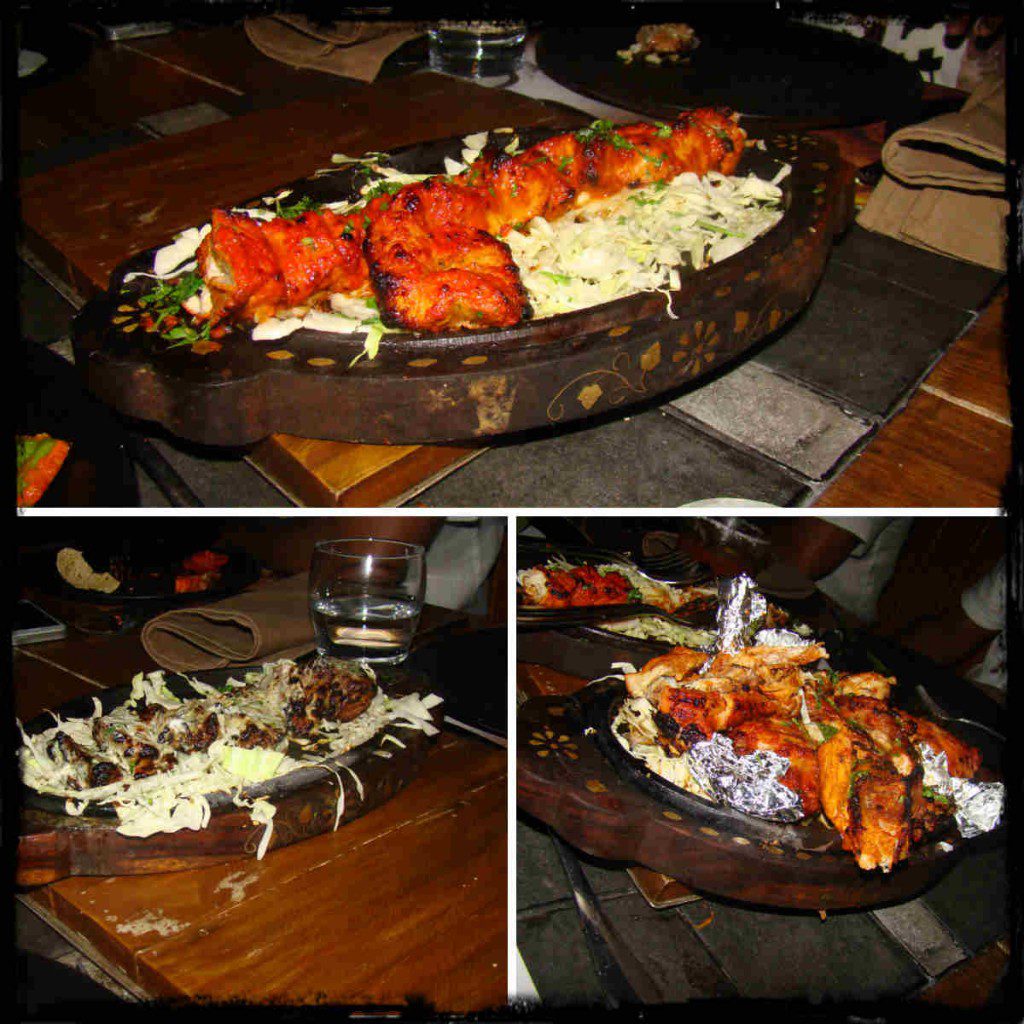
    Except for some pirate lingo, there was hardly anything on the menu (though the one we got was quite different) that went with the theme. When we began ordering the starters, we realised it was pointless to navigate the Continental and Chinese sections since they weren’t available. That went for some of the more interesting (sounding) drinks as well! From the Indian menu, we asked for a Til aur Paneer ka Tikka, an Afghani Mutton Boti Kabab, Aatishi Murgh and a Pirate Special Macchi Tikka. The veg representation was superficially spicy, though the paneer itself seemed quite fresh. We were served what was claimed to be the chicken, but easily sensed that it wasn’t. For a while, we pondered the various possibilities, until we were told that it was just the mutton dish. A little too bland. The Aatishi Murgh made an effort to live up to its name in terms of spiciness, and was quite a favourite. The Macchi Tikka was mildly spicy and quite tasty. In addition to some standard fare, we had ordered a Masala Cola. That turned out to be a Hajmola cola in disguise, with an overdose of masala! Exactly the opposite happened with the Pomegranate ‘N’ Tamarind Martini – it had no trace of a tamarind flavour. In the meanwhile, the ship was under aural attack – a singer was methodically gunning down favourite numbers!
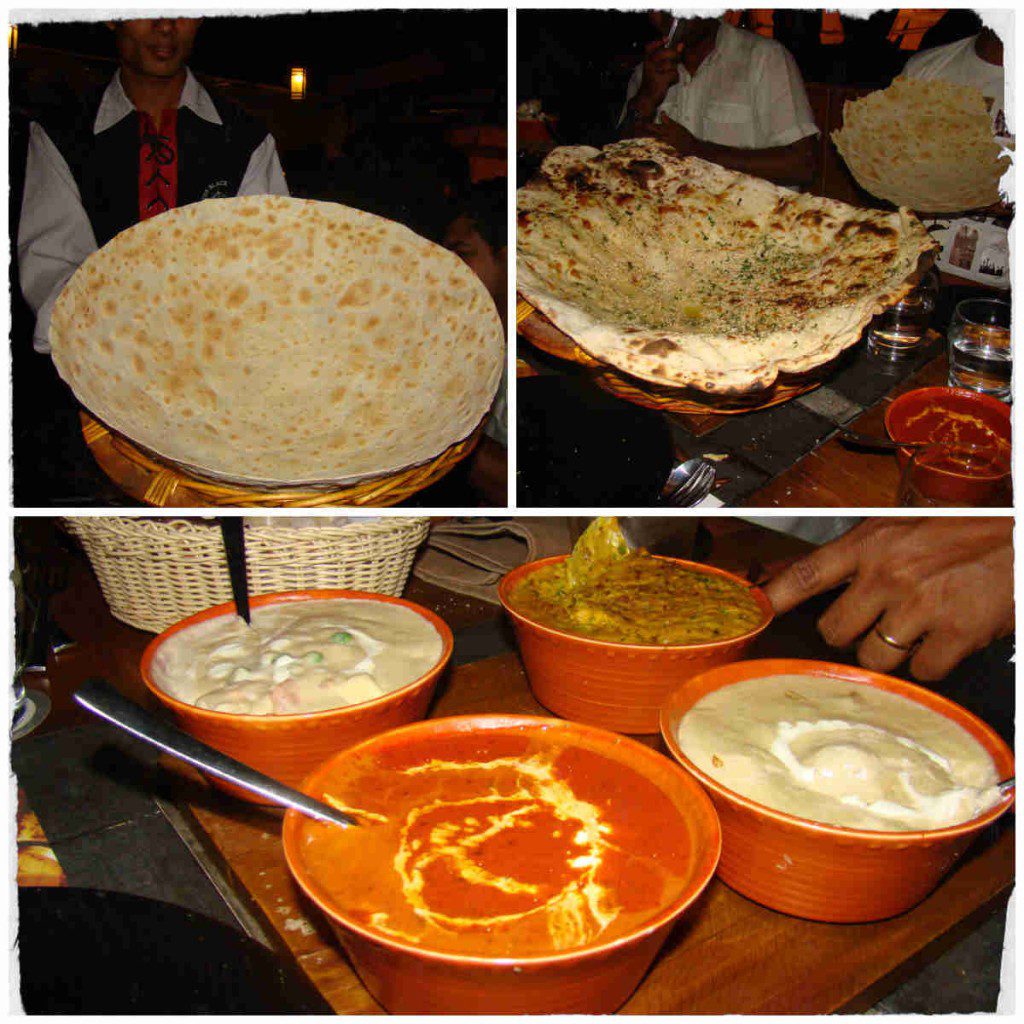
    It took so long for the main course to arrive that we joked that it had to be brought from the mainland! The Dal Peshawari was watery and had none of the butter and cream that was promised! We unanimously agreed that the Navaratna Korma deserved a spot in the desserts section! The Malai Gosht turned out to be its near-cousin, the only consolation was that the meat was well cooked. The Murgh Matka suffered from a methi overdose, though the boneless chicken was tender. The Ulte Tawa ka Paratha was mentioned in the menu as a must-try, but was nothing special. Ditto for the Afghani Kulcha, which had a few dry fruits slivers tossed into it for the name’s sake! The excitement was delivered as Crispy Roomali Roti – another ‘must try, but deservedly so. It was huge and we thought this was the Family Naan we’d ordered! When we realised it wasn’t, we had a sinking feeling, soon justified when we saw the size of the actual Family Naan! Gigantic and they obviously had the Indian joint family in mind! Thankfully, it was quite good.
    Meanwhile, penance was happening in the form of bottled water, which was being served for free! The singer, as though understanding his limitations, was now crooning ‘Please Forgive Me’

    From about ten dessert options on the menu, only four were available, and that included ice cream! Considering the experience thus far, we decided to play safe and try just the Gulab Jamun. That was surprisingly not bad! By this time, the singer had reached ‘Take me home’, and we heartily agreed.

    For about Rs.1800, you could share a cocktail, a non veg starter, a couple of main course dishes, rotis and a dessert. (Inclusive of taxes and service charge) But ‘Arrgo’ would be a pithy way to describe our predicament – six of us held hostage in a pirate-themed restaurant serving not-so-great food. Such is the restaurant scene in Koramangala that a new place needs to run a tight ship just to keep its head above the water. Shape up or ship out, as the saying goes, and it’s mercilessly enforced. There would be first visits courtesy the theme, and the place was full while we were there, but unless there’s a sea change in the service, food and pricing, The Black Pearl could soon be in Davy Jones’ Locker!

    Black Pearl, Vikas Tech Park, 2nd & 3rd Floor, #105 1 A Cross Road, Koramangala Industrial Layout, Jyoti Niwas College Road, 5th Block, Koramangala, Ph: 080-64333111
  • Humachines and the role reversal

    In his post ‘Virtual People‘, Scott Adams writes that his generation would be the last of the ‘pure humans’  raised with no personal technology. Someday historians will mark the smartphone era as the beginning of the Cyborg Age. From this day on, most kids in developed countries will be part human and part machine. As technology improves, we will keep adding it to our bodies.

    Singularity has appeared on this blog in various forms, and in at least a couple of posts, I have written about the augmented human, and like the proverbial frog in the slowly-boiling water, we wouldn’t know when it happened. (check this post for a fantastic short film on the subject) In fact, medical applications of 3D Printing are already accepted and on the rise. Not just ‘accessories like hearing aids or dental braces, we have moved on to a lower jaw, (previous link) 75% of the skullan ear, and yes, ‘cyborg flesh‘! It’s obvious that the applications are improving the lives of many. My question though remains – as we replace more and more of ourselves, possibly the brain itself within my lifetime, what happens to the essence of us that makes us human – the feelings, the emotions, the zillion unique reactions to various physical and mental stimuli?

    In this wonderful post titled “How not to be alone“, in which the author writes about how we have begun to prefer (diminished) technological substitutes to face-to-face communication, (I couldn’t help but remember this)  he quotes Simone Weil, “Attention is the rarest and purest form of generosity.” And from that statement I realised how the the narrative might come full circle – I remembered this post I had read a few months back. It mentions bots that have passed the Turing test (“test of a machine’s ability to exhibit intelligent behaviour equivalent to, or indistinguishable from, that of an actual human”) and has a compelling argument that while we’re singular entities with a complex design, we’re still just blueprints –  with many similarities. This also  entails that we’re building machines that can mimic, and evoke, our emotions. Thus, he writes, the era of artificial emotional intelligence is not far.

    Perhaps, in the future we will outsource our humanity and reverse roles – half-machine former humans who deal with each other in mechanical ways and go back home to a humanoid bot that will give it all the empathy and emotional anchoring needed. Or would it need it at all? 🙂

    until next time, be human, comment 😀

  • Once Upon A Time In Aparanta

    Sudeep Chakravarti

    I picked up this book because I liked Sudeep Chakravarti’s earlier work – Tin Fish. In both cases, the author sets up the story in very familiar and much ‘abused’ settings, but manages to give it a completely different and memorable treatment using his unique characters and narrative.

    In this case it is Goa – Aparanta – the Land at the Horizon. The characters are well defined and to some extent even familiar – Winston Almeida the power hungry thug and land-grabber, Fernandes the corrupt cop, Sergei the Russian drug lord, the politicians who abet them so long as they get their stake, Antonio the innkeeper who is concerned more about his marriage and is content to sit on the sidelines as the thug-politician-drug lord nexus pillages Goa, Dino Dantas the crusader who refuses to give up, and so on. Even Princess, a Brazilian transsexual who lends the eccentric touch to the mix, is made to blend in naturally. Small detours in the narrative provide context and colour to the secondary characters – Ida, Anastasia, the Professor etc.

    The reason it works is because like many good books, it adds the place as a character. Goa spills out of the pages – colorful people, unparalleled natural beauty, language which oozes flavours, the colonial hangover, the regular tourists who consider themselves locals, and their temporary versions who consider Goa’s pleasures a temporary answer to all their woes. The other reason is the prose – flexible enough to accommodate descriptions of Goa’s bountiful beauty as well as the satire that makes the brutality bearable.

    I was a bit disappointed with the ending, especially considering the chapters that preceded it. It felt like a compromise, very accommodating, and in stark contrast to the rest of the book which pulled no punches. However, it still remains a must read for anyone who loves Goa and has seen it change over the years. For others, it could be the story of a land and its citizens, the choices they make and the price they pay for ‘development’.

  • Brands and the Personal API

    Lifestreaming and I go way back, at least 5 years. 2008 was when I wrote about it first, though the experiments had started earlier. Most of the services I’ve mentioned in the post are now defunct, but my interest in the subject never waned. From the perspectives of memories mentioned in that post to speciation to brands using their lifestreams to build communities around it, I have had several thoughts on the subject. That’s why I found this post at GigaOm, which was about Foursquare co-founder Naveen Selvadurai sharing data logs from his life (weight, sleep, activities) and hoping developers would hack his ‘personal API‘, very very interesting. There have been stories about people and the tons of lifestreaming data they have amassed, but I had never heard of an API, and therefore consider it pioneering work.

    Pioneering, less because of the novelty, and more because I think it has the potential to become mainstream, and even, the default paradigm of creation and consumption. Since the engagement @ scale framework refuses to let go of me, I immediately thought of the personal API in that context. With technological advances, I think it’ll become easier to create one’s own APIs and you can see several companies mentioned in the GigaOm post that are working on it. So I’d hope that its evolution is as fast as (or faster than) that of self publishing (on the web) which about a decade back was a relatively complex thing to do. So, in essence, we’re talking about huge amounts of data that are being generated and captured by individual users, and this is only going to be accelerated thanks to phenomena like wearable technology.

    The current way of looking at Big Data is to synthesise actionable insights from processed and unprocessed information from touch points related or unrelated to the enterprise. As I’d mentioned in my presentation (on engagement @ scale) this is then used to target users better or drive more efficiencies.  They don’t really operate at the higher levels of community/meaning/purpose. Now think of the personal API and the data it holds. What if we looked at this individual streams of ‘Big Data’ not from the enterprise’ perspective but from the user perspective? What if brands created platforms that  would allow people to upload data that they choose to so that the brands could solve their needs better? Like I wrote in my ‘maker’ post, with massive technology leaps happening in areas like 3 D printing, there are tremendous opportunities for co-creation. Brands could even aggregate data from these individual streams to find need gaps and package that for a larger market. In fact, I’d say that this is probably what Nike+ is doing already.

    But the real story is that these personal APIs could give great insights into the individual’s purpose in life, his priorities – in short, his life’s narrative. It gives brands the window to latch on to the narrative that they can identify with, and create value and meaning in the individual’s life. I think that’s what brands originally strove to do!

    Update: Thanks MJ, for pointing me to the Nike+ Accelerator!

    until next time, AP”I”

    PS: Over at Soylent, they’re creating the nutritional equivalent of water, an ubiquitous ‘meal’ that is customised for body types. Funding? Kickstarter of course! 🙂

  • Bak Bak Bar

    the bak bak appeared on Bangalore Mirror first

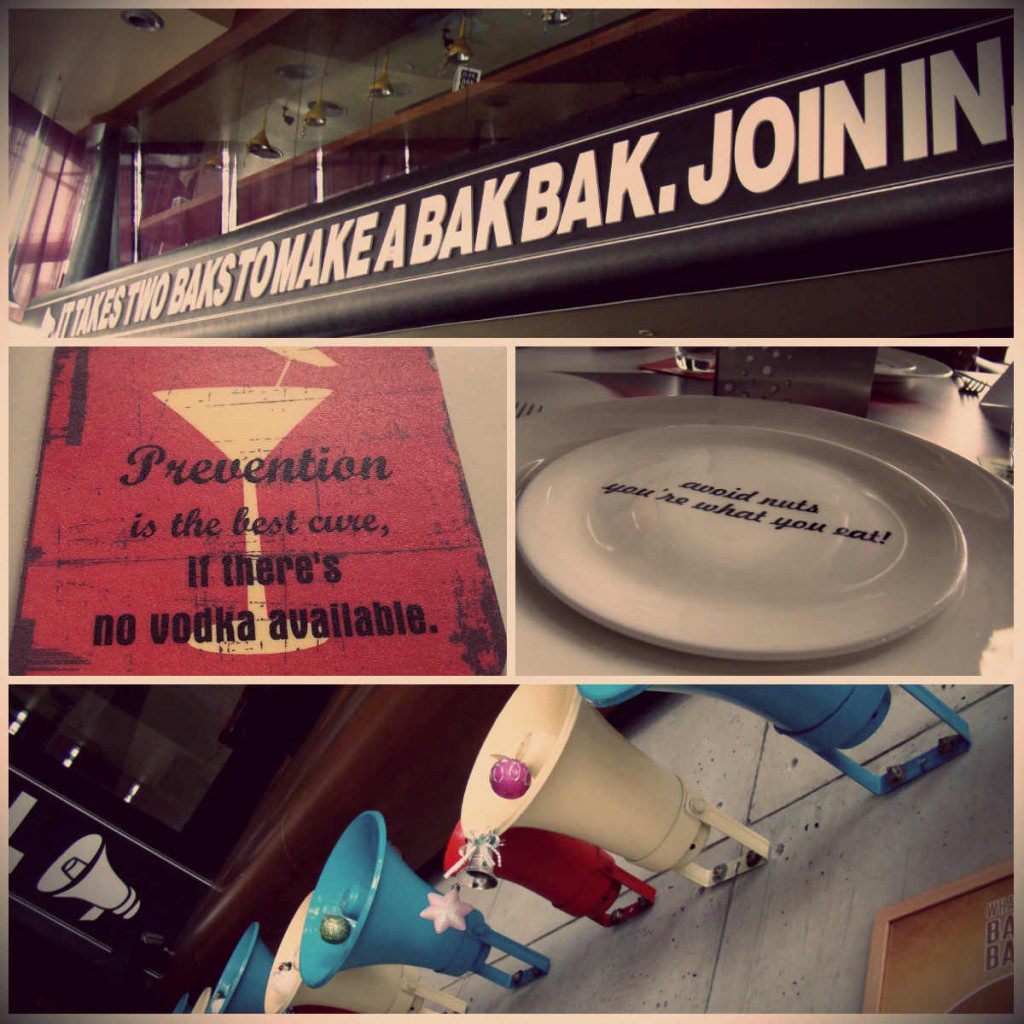
    The place has a bakstory – the Manchester United Restaurant and Bar. But after its game ended, the buck was passed on to Bak Bak Bar on Children’s Day in 2011. (map and menu at Zomato) It belongs to the same group as Bakasur, and even if you miss the mention at the door, you might find an odd stirrer or two that have the Bakasur motif. But there ends the connection. The theme stays true to the name, sometimes in the form of good advice – “Don’t walk into a bar. Use the door instead” (though the poster is inside) – and sometimes as great conversation starters – “Avoid nuts. You are what you eat.” Coasters, posters, plates, bak bak is all over the place. A special mention needs to be made of the music – from Modern Talking to Peter Andre to Coldplay, it seemed to be a soundtrack of an average 30 year old’s life! The volume level is generally toned down to allow bak bak, but Saturdays are a loud exception! But enough bak bak, and on to the bar and the rest.

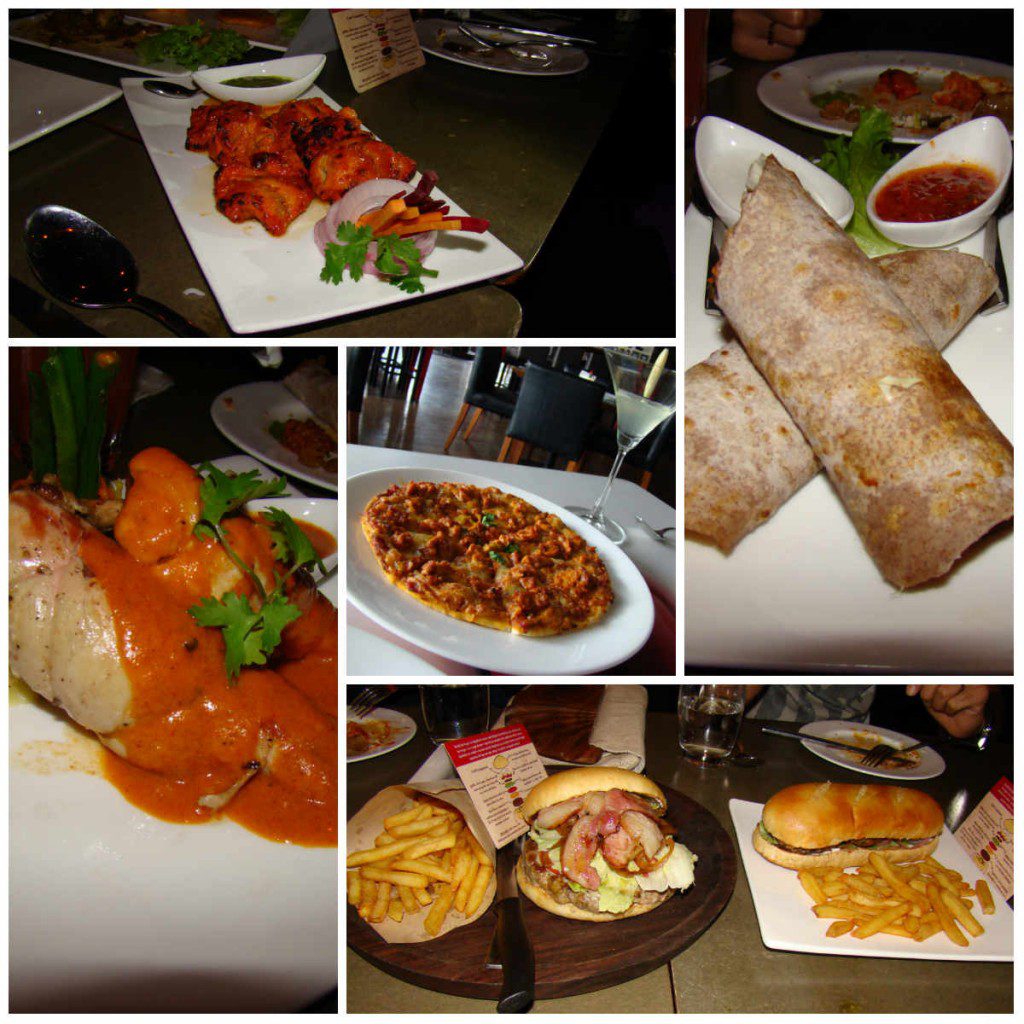
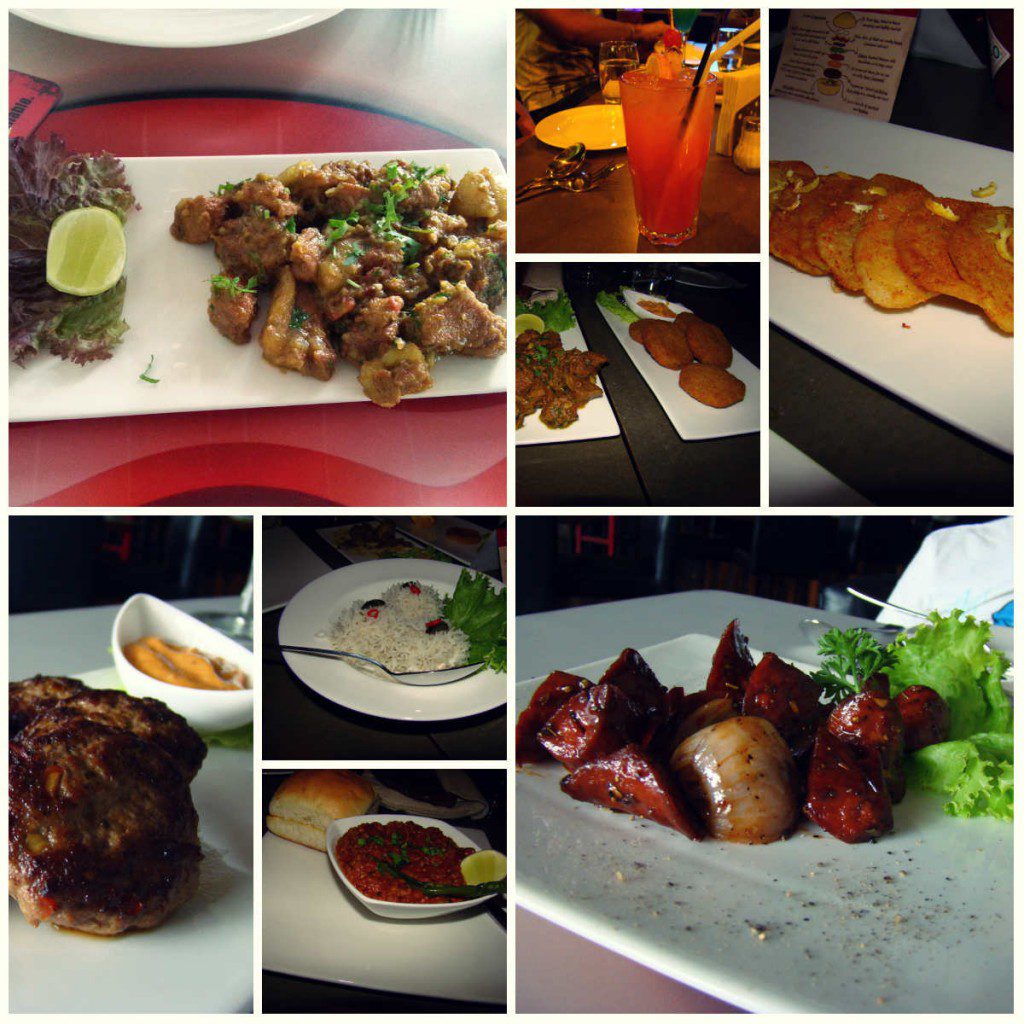
    It’s difficult to slot the menu into the regular starters, main course silos, so we’ll just proceed in the order of consumption and move to the next section at half time! The drinks have amazing names – mostly popular culture characters! It was difficult to believe that Captain Jack Sparrow was a mocktail, but even then it was more entertaining than Mary Poppins. We also tried Princess Leia. Yes, that does sound wrong given that she’s an (ahem) icon among males, and unfortunately, we found her lack of taste disturbing! Since the idea was to pig out, we began with ‘Porkalicious. Though the meat was well cooked, it was a bit bland given that it was supposed to have a green chilli presence. The Beef Kheema Pav made up for it though and was probably the best of the starters. In close contention was the Prawn Pesto cutlet, though we felt that the signature gunpowder mayonnaise that came with it did not live up to gunpowder standards. We’d also tried the Spiced Beef Baklet earlier, and it wasn’t bad either. The PCP (Perfect Citrus Potatoes) had an excellent masala coating, but (thankfully) was not as addictive as its more famous acronym. The Lemongrass Fish steamed riceballs were really strong on flavours, and if you find that too overpowering, its dip is a real help. The Chicken Sausage Kalimirch is usually a safe bet, but during this visit, was lacking in spice.

    The Monk-Flamed Chicken provided some flambé entertainment, but was more or less a flame out. The Mushroom Tikki ‘bakwich’ was also very mediocre and it was only the Beef Burger (with the bacon contributing generously) which brought some respite. The patty scored well on texture and flavour, though it was a task to ignore the over-excited lettuce leaves which was forever trying to get in the way! The Lamb Seekh ‘Bak Wrap’ failed to evoke any extreme reaction and played a decent supporting role. The star though was the Chicken Roulade with Makhni sauce. The cheese filling was subtle and allowed the Makhni sauce to shine. The only tiny chink was the strong mustard flavour in the mashed potato. We had tried the Butter Chicken pizza (yes, you heard that right!) the first time we dropped in, and it was awesome, but the second time, it was a huge disappointment thanks to its unavailability!

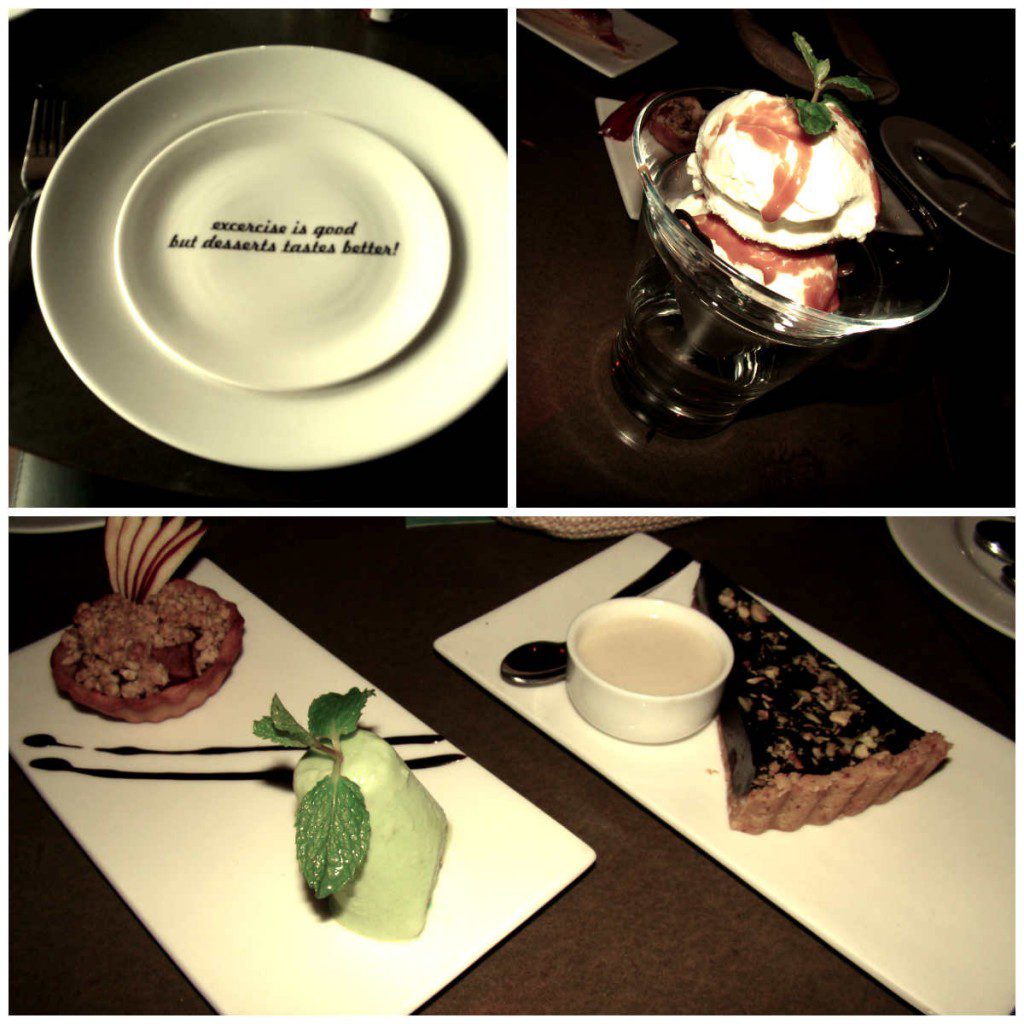
    The writing was on the wall (actually a plate, but you get the message) “Exercise is good, but desserts taste better” So we tried everything that was available. The chocolate easily won – Ganache Tart with Badam Milk sauce, though the latter was ignored. The second half of Apple Pie with Pista Kulfi was a favourite as well, and if they had been less stingy with the Caramel Rum Sauce, the vanilla ice cream would have left us in high spirits as well! The Apricot Meetha Pastry couldn’t really match up to the other performances.

    In terms of price, for about Rs.2000, you could share a cocktail, a couple of non veg starters and main course dishes each dishes and a dessert. (Inclusive of taxes and service charge) But beyond that, Bak Bak Bar serves oodles of character – from the liberally strewn fun messages to the yellow cycle. The food they served was not stellar, but it doesn’t make you go ‘What the bak’ either. There’s a definite buzz about the place, and courtesy that, and the Bak Bak meter (a bill holder) that thankfully doesn’t do a one-and-a-half, an extra point.

    Bak Bak Bar & Restaurant, #1, Kira Layout, Hosur Main Road, Ph: 8792000390/1