Year: 2012

  • Zheng

    Despite being in the ‘right’ place – close to our regular haunts – we’ve always ignored Zheng, and I still haven’t figured out why. It’s been around for a couple of years at least, and is part of the BluPetal Hotel, (map) which also has Sultans of Spice on the first floor. I often recommend the latter because we’ve been there quite a few times and have never been disappointed. But Zheng, despite its promise of Mongolian, was always classified in my mind as a Chinese alternative and with options like China Pearl around, it always lost out. Until…

    I checked in on Foursquare and the tip shown to me was that I shouldn’t be disheartened at finding the restaurant empty. That’s exactly how it turned out to be and the situation only changed towards the end of our meal when another group walked in. I wonder if it’s because people don’t know about the place or they know something I don’t! There is something tranquil about the ambiance, and is reinforced by the music played. Red dominates, as it does in China and in restaurants which offer its cuisine.

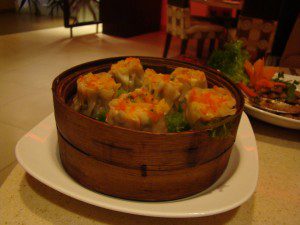
    The menu is fairly elaborate and when it’s only two of us, choices are difficult to make. The Chicken Ginger Coconut Broth lost out to momos -the Chicken Pepper Suimai – and the Mongolian Lamb. The flower shaped momos were quite different in terms of flavour and fragrance from the ones we usually have and is definitely worth a shot. But the Mongolian Lamb easily won the battle of the starters – succulent shredded lamb in a spicy sauce. Highly recommended.
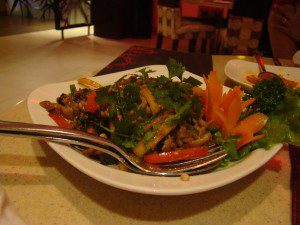
     

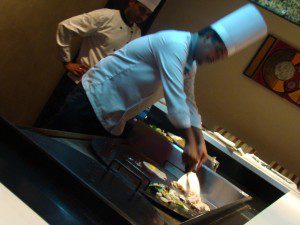
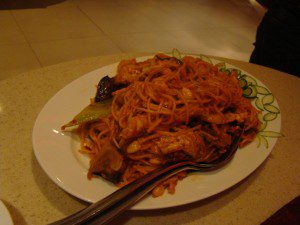
    The only time we’ve tried a Mongolian Barbecue was at HongKong Hustle, and that was a long time back. So we didn’t think twice before ignoring the Chinese dishes, though it was ironic that we had to ask the person who took our order to get us the Barbecue menu, since he only bought us the liquor and the main food menus. Maybe no one asks for it? I had a nagging feeling while we ordered a Thai Chilli pot and a Dragon’s Breath Bowl. As we watched the chef prepare it, I understood why! We usually only order one rice/noodles, and this time we had ordered two. And they were massive portions!

    The Dragon’s Breath Bowl, which I had ordered, with chicken and hakka noodles, came first. Mildly spicy dragon sauce with shiitake mushrooms, pak choi, peppers and green onions. By the time we had a few spoons each, the Thai Chilli pot arrived. D had asked for Udon noodles and chicken with the pak choi, green onions, pad thai sauce, bird’s eye chili etc. This was more subtle than the Dragon’s Breath, but we immensely enjoyed both. So much, that it also became the next day’s lunch. (thanks to the quantity!)
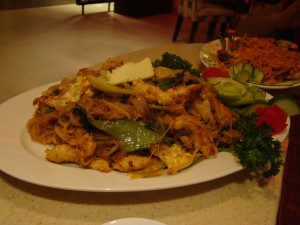
     

    We had no space for desserts, and neither the Juice Junction mango juice nor the Gelato ice creams could tempt us as we walked to pick up the Activa. The service was friendly and prompt, though they could’ve warned us about the quantity. All of the above, including service charges and taxes cost us just over Rs.1650. For the quantity and the quality, I thought it was just fine, and will definitely drop in again.

    Zheng, Jyoti Nivas College Rd, Koramangala Industrial Layout, Koramangala. Ph: 4343 1888

  • The Things that FB Connect Us

    Facebook’s ad film, released last week, reminds me of its redesigns – I hear it getting dissed across the web, starting with the place I saw it first. (check the comments) In case you really haven’t seen it yet, here it is

    The film is titled “The Things That Connect Us”, it uses real world objects – chairs, bridges, doorbells, dance floors, nations and so on – as analogies of how Facebook connects us, and suggests in the end that perhaps we make these things to remind us that we are not alone.

    I have read perspectives on how some of the ‘metaphors’ are not universal enough, and that this ‘connect’ idea has been used by several brands already. At 1 billion monthly active users, I wonder if Facebook really needs a positioning statement and if this film was supposed to be that. It is different things to different people but at its base, it connects us. The film is not meant to acquire users, or retain them. There are other things that Facebook does that will achieve these ends more efficiently and effectively. It’s when marketers see it through the prism of a campaign or advertising that it seems a #fail.

    So why did I like the ad? A couple of lines from the AdAge article (linked to earlier) are pointers – “Great brands don’t talk about themselves, they talk about what they really love.“, attributed to David Kennedy, and “The best marketing that we have is people coming to Facebook every day connecting with their friends, families, local business, but every once in a while we’re going to want to define for ourselves who we are and share our values…” from Facebook’s own consumer marketing head.

    The first statement is about a purpose that the organisation has found for itself – the things it loves to do as an organisation. (A few quotes here would give a sense of what Zuck’s aspirations are) Call me naive, but it’s a compelling purpose that has the potential to go beyond business and profits and one that many people would love to work on because they can identify with it. That defines brand Facebook, and purpose is what the best of brands strive for. The second sheds light on the audience it is intended for – themselves primarily, and then users who can share their values.

    So then, why not show it in their internal network, you might ask. Probably because they’re Facebook, sharing is in their DNA, like it or not. 🙂

    until next time, share a like (or a dislike)

    PS: In case you didn’t like it, you might like this parody 🙂

  • What remains…

    Kathavasheshan means ‘The Deceased’, and it’s one of my favourite Malayalam movies. In my mind though, I split it in a different way (inaccurately) – what remains of him after the story. I watched it on TV after a long time. Meanwhile, such was the magic of Devdutt Pattanaik’s Jaya that I used the ad breaks to continue my reading. Though I consider myself fairly well versed with the epic, the book was an eye opener at many levels – new interpretations and back stories, philosophy, and the narration that immensely adds to the tale’s relevance.

    After the Mahabharata, as Yudhishtira is conducting the Ashwamedha and is called upon to settle a dispute, Krishna asks him to postpone his decision by 3 months as the situation would undergo a sea change, because 3 months later, the Ashwamedha will conclude and the Kali Yuga will begin. Only a quarter of the values instituted by Prithu at the dawn of civilisation will survive. Man will live for pleasure, children will abandon responsibility, woman will be like men, men like women. Humans will copulate like beasts. Power will be respected, justice abandoned, sacrifice forgotten and love ridiculed. The wise will argue for the law of the jungle. Every victim will, given a chance, turn a victimiser. Values. Dharma. As the epic explains, dharma is not about winning. It is about empathy and growth. Dharma is work in progress, and cannot be seen in the isolation of one life.

    (movie spoiler) Kathavasheshan‘s protagonist is a sensitive person who has empathy for everyone around him. The story begins with his suicide and his fiancee’s search for the reason. The story progresses through the perspectives of various people whose lives he has touched and his effect on them. It finally turns out that it is this very empathy and his inability to live in a society that allows the Gujarat atrocities to happen that is the reason for his suicide. (there is a personal connection for him too)

    It led me to wonder if the manifestations of the Kali Yuga were such that they could not be fought within the ‘constraints’ of dharma, and escapism was the only way.  It is only a movie and a character, but I’d like to think that he remains – in the minds of the people he touched – and continues his growth and the pursuit of dharma in his next life.

    until next time, the post continues.. 🙂

  • Maria’s Room

    Shreekumar Varma

    I’m still not sure whether I could ever describe Goa as languid, despite siestas and feni, but this book did make me consider that possibility, and for that, Shreekumar Varma’s way with words can take credit.

    The protagonist, Raja Prasad, an author from Chennai, reaches a Goa that seems to echo his own ‘broken down’ self. The sun takes an extended break as rains lash Goa, and the narrative alternates between the introspective author, willing himself to break from his past and his concerned/nagging father, and work on his new book, and his observations of life, people and places. Its in these initial sections that we see a Goa that’s rarely captured – heavy rains instead of sun and sand, decrepit hotels replacing swanky resorts and a local life relatively less centered around tourists.

    We then seem Raja get acquainted with another guest in the resort – Fritz, and later shifting to “Maria’s Guesthouse”, where he falls in love with Lorna, and gets interested in the story of Maria, the girl’s aunt, after whom the guesthouse is named. As Raja’s romance progresses and he follows the mystery of Maria’s life, and death, it seems as though the two stories are just different in rendition.

    What didn’t work for me was the inconsistent pace of the plot and a narrative in which we’re forced to follow the extended wanderings of the protagonist without facts that would indicate a plot in progression. There’s a limit to what descriptive prose can do to stretch curiosity.

    However, the book itself is a bit like Goa in pace, if you can get adjusted to it, you will perhaps begin to like it. Even the deluge of ‘loop closing’ in the end is a bit like you’ve been idling and suddenly realised that there are some places to see and things to be done before you bid Goa goodbye.

    I got the feeling that the author enjoyed giving Raja Prasad the freedom to carry the plot at his own pace and create his own subtext that some readers would enjoy.

  • Sunohre Technologies

    Imagine hiring a sales guy and paying only incentives and not salary; that is Sunohre. In conversation with founder Praveen M…

    [scribd id=109103162 key=key-248he5sti6vhpr5kvhj mode=scroll]