Year: 2012

  • Under the Dome: A Novel

    Stephen King

    (ex) Captain Dale Barbara is about to leave town when a gigantic, transparent dome envelops the town of Chester’s Mill. He could consider himself lucky since he survived the arrival of the dome. Several animals and people didn’t, as they crashed into the indestructible, impenetrable dome.

    The dome gave an electric shock when a person first touched it, but saved its disastrous results for those with pacemakers and hearing aids. The first victim on that count was the police chief Howard “Duke” Perkins, and that gave the town’s First Selectman ‘Big Jim’ Rennie to assert his superiority with First Selectman Andy Sanders serving as a willing puppet.

    He soon appoints his man as the new police chief and begins machinations to seize complete control. He pays special attention to Barbara, whose reason for leaving town was an altercation with Rennie’s son Junior, and his friends. The only people who can see through Rennie’s game are notably Barbara, Julia – the editor of the local newspaper, ‘Rusty’ – a physician’s assistant, and Howard’s widow Brenda.

    Even as the military reaches the town’s borders to address the ‘situation’, and the media update a stunned nation, Big Jim manipulates the town’s people into believing what he wants them to believe, despite television channels broadcasting his nefarious schemes for making money. The town and its people meanwhile, remain trapped under the unrelenting dome, like ‘ants under a magnifying glass’

    With a huge supporting list of characters, and spanning close to 900 pages, the author has tried to highlight a multitude of things – from human transactional relationships to environmental hazards. Unfortunately, the book didn’t really work for me, it was just too long to hold my attention, especially towards the end. The character snippets, the descriptions of town life and the jarring differences of climate inside and outside the dome, all gets repetitive after a point, and even the vast array of characters, interesting though some of them are, become too tiresome, despite the messages they seem to be carrying for the author.
  • HireRabbit

    HireRabbit helps companies boost their existing recruitment strategy with social-media. In conversation with co-founder Prafull Sharma

    [scribd id=113574291 key=key-16y50vfjlos6nxyvesnc mode=scroll]

  • Create and curate

    Yay! Instagram launched web profiles, and mine, as you can see, is dominated by food! Which meant that I was completely blown by what Zomato did with the Instagram API at Zomato.xxx. If you haven’t seen it yet, now would be a good time. Try to have a full meal before you take a look. One of the bugs in this version is that it makes people hungry. I don’t see them fixing that bug soon! 😉

    It’s not really an original thought, since I’ve seen at least one fashion brand use hashtags on  Instagram and Twitter to generate photos, but that doesn’t really take away anything, since the execution is extremely good.

    I wrote about the reemergence of branded content last week. One way is to create your own content, the scalability of which is debatable, unless that is one of the organisation’s core competency and priority. The other way is curation. Like I have mentioned on the blog before, curation is a great way for brands to engage with content producers and at the same time, provide  great content to those who consume it. It’s not really creation vs curation, but more of their respective share in the strategy.

    On the execution front, crowdsourcing works best if you make it as easy as possible for the for the content producer. In Zomato’s case, adding a #zomato to the food snaps I load on Instagram is hardly a task. The simpler the task is, and the more it is an add-on behaviour than a new one, the lesser the need for incentive. The cooler it is, the more people would want to be a part of it. It distributes itself.

    In a traditional media dominated era, more money was spent on distribution than creation. Now content is marketing and with owned platforms, and earned and ‘sponsored’ media on social platforms, the costs of distribution have fallen. There’s a lot being written about content strategy for brands from a creation perspective, but the costs of distribution fall even further in curation because content creators would want to show off their work. The hope is that brands will spend at least a part of the money they’re saving, into creating platforms, processes, tools etc that make it easy for the user to create and share ‘branded’ content.

    until next time, co-curation is for later 🙂

  • City Zen

    Sometime back, in a post, I quoted Paul Theroux “My own feeling is that city dwellers invent the cities they dwell in. The great cities are just too big to be comprehended as a whole, so they are invisible, or imaginary, existing mainly in the mind.” 

    The other day, during a cleaning exercise, I came upon an ‘old’ Bangalore map we had taped together from printouts. (I remember the site had separate maps for north, south, east and west 🙂 ) Back in 2003 and thereabouts, this used to be our reference when we had to travel to places unknown. Unknown at that point included Malleswaram, Cantonment, Jayanagar and such. 🙂 The city that we had created in our mind included Koramangala, Indiranagar and MG Road. Yes, just about that much. 🙂 But the outdoor media selection that my brand job entailed ensured that I soon became familiar with many parts of Bangalore. In an earlier job, my office was at VV Puram and those not familiar with the place would say that it was far. Actually, my travel time from Koramangala was quite less.

    A few weeks back, we decided to check out Haralur Road as part of the Realty Check endeavour. Despite the advanced features of Google Maps, and its time estimates, we thought it would take a while to get there from Koramangala. Not only did it turn to be near, we got back much earlier than expected. I’m sure the area will be unrecognisable 5 years down the line. Just like say, HSR has evolved. 🙂

    As Bangalore creates its own little self sustaining bubbles, it’s not just the city that will be created in the mind, it’s probably the distances too.

    until next time, cityscape

  • Spaghetti Kitchen (Koramangala)

    Though we asked for an EMI option at the Indiranagar version, we picked up the courage to try out the Koramangala version, thanks to Poshvine. Mostly for the awesome view of Hosur Road while we dined. Located right at the Forum junction, above Punjab Grill, there’s valet parking. There’s also a coffee shop in the same premises.

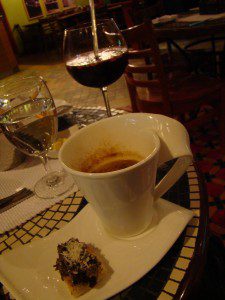
    The ambiance, which is bright and cheerful in daylight, gets an additional classiness at night, and suckers that we are for road facing views, this one was just awesome. We had a fair idea of what we wanted, courtesy the menu at Zomato, but added a Sangria for two to that list.

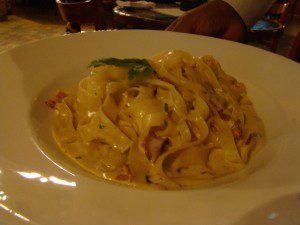
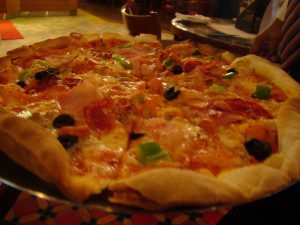
    The complimentary bread basket was excellent, and the bread was indeed fresh. We started with the Cappuccino of Four Mushroom soup (/2) and it turned out pretty and tasty, though I’d have liked a dash of pepper. Thankfully that’s available on the table easily. For the main course, we asked for a Fettuccine with Cream & Cheese and a Tutto Carne thin crust (Rs.50 extra) pizza. The all meat pizza arrived first and though we couldn’t complain about the meat presence – ham, lamb…, the crust was burnt a bit too much. Basically, pay Rs.50 extra for a burnt crust. The pasta though, was awesome. Don’t judge it by its skimpy appearance, it’s quite heavy and there’s no stinginess on the cream and the parmesan – pecorino sauce was just amazing.


    The wallet felt lighter by about Rs.2350, after the Poshvine discount. Pricey, and probably the place to go to when you’re in the mood for celebrations. The lunch buffet on weekdays (<500 after tax) is something I’d very highly recommend though.

    Spaghetti Kitchen, 1, SJR Primus, 1st Floor, Adjacent To Raheja Arcade, Koramangala. Ph: 41160500