Year: 2012

  • Building Brand Frameworks

    It was an interesting coincidence that a couple of weeks back, around the time I posted on brand building and the effects of instant gratification (largely in the context of social media), I also got into a minor debate with a colleague on brand communication – tonality, voice etc. This is a topic I constantly think about – brand building in the social era- and on this blog, that is manifested in the form of posts from ‘flawsome‘ to ‘consistency and cohesion‘ to larger canvasses like brand identity and the definition of ‘brand’.

    Thanks to an ever changing social landscape, the questions and the answers are extremely dynamic. Different brands face different challenges as per their category, (pricing, demographic, ‘conscious’ly purchased or not) how long they have been around, their internal processes, structures and culture, and so on. But the earlier eras also had challenges and yet, we managed to define certain basic frameworks of brand building, which could be adapted across product categories, geographic locations and so on.

    Social has indeed disrupted everything because unlike say, television, which probably took over from print, it fundamentally changed the linear narrative by making ‘media’ a two way street, with side lanes opened up by consumers. It is probably because of this, that (for example) a Leo Burnett’s Human Brands concept (this post, for context) goes beyond adapting current frameworks and into the purpose of the brand itself.

    Brands that have built themselves in the ‘traditional media’ era are trying to adapt themselves, and that brings its own set of challenges. But what about brands being built now? Ignore the tech brands for now please – Facebook, Google, Twitter etc, what would your framework be if you had to build a brand starting now, in this age of massively fragmented media and user presence? Would you design the brand identity and adapt it to different media platforms or would you go with a bare minimum checklist and allow it to evolve with consumers adding context across various touch points – real and virtual? I’d really love to hear some perspectives!

    until next time, frames per second…
  • ‘Algebra’ & Twitter

    My favourite story in Paul Theroux’ ‘The Collected Stories’ is Algebra, a simplistic tale of a clerk easing his way into London’s literary crowd through one chance meeting and several arranged ones thence.

    Friendship is like algebra, but there are operations most people are too impatient or selfish to perform. Any number is possible!…. But one can be unselfish…. in giving everything and expecting nothing but agreeable company. ‘Giving everything’, I say, but so little is actually required – a good-natured remark, a little flattery, a drink.

    Last week, I completed 5 years on Twitter, and while I haven’t broken into literary circles nor started drinking, I have made friends. In the self conscious, real time and usually selfish world of twitter, where snap judgments are the order of the day, it is not easy to give at all, let alone expect much in return. And yet, many a time, I have been at the receiving end of acts of kindness. On most of these occasions, they are unaware of what they’ve done and the difference they have made. I’d like to think that I have passed it on. But meanwhile, they reside in my favourite list on twitter.

    until next time, follow through 🙂

  • The Servants of Twilight

    Dean Koontz

    Refreshing to see a ‘Twilight’ book without teen vampires. But though its not a damsel, a woman in distress is one of the main characters, this time with a child, who is the cause of all the trouble. The Twilight cult, led by Mother Grace, believes that single mother Christine Scavello’s son Joey is the Anti Christ.

    A relatively harmless parking lot incident turns into a full blown chase, with Christine trying to protect her son from the cult. She is helped by Charlie Harrison, a detective, who quite predictably falls in love with Christine. Most of the book is an elaborate and vividly described chase sequence, which I found quite boring after a while.

    I’m quite a fan of the author’s later works, when he explores new concepts and then weaves in a thriller narrative. But this was quite a Terminator meets religion style mash-up, which failed to engage me after a point. I kept waiting for the Koontz touch, which, though promised to appear towards the end, turned out to be just a mirage.

    Quite an avoidable book, especially since there are many other works from the same author like False Memory or From the Corner of his Eye, to name a few.

  • Gene-rational

    Sometime back, there was a debate on Samadooram, a talk show on Mazhavil Manorama. The topic was the changing nature of colleges in Kerala, specifically the waning influence of arts and creativity in general. Panelists included a student politician, a regular student, a college professor, a socio-cultural commentator, a literary figure, among others. Among the various sub-topics discussed were the rapid increase in number of colleges, the pressure on students, the internet revolution, the effects of changing societal and familial conditions, with several aggressive comments on how the earlier generation should give way to the new, rebutted well by the older panelists. All the panelists, and many in the audience gave varying perspectives on the subject and it became a very interesting albeit noisy debate, which brought out several moments of generational difference.

    When the Roadies spoof became a rage and a discussion topic, I remembered tuning out after Season 1 because I just couldn’t understand the entire exercise. I also understood that for some reason, it meant a lot for a section of the 18-25 audience, and that it was a big deal.

    It made me think of what has changed, beyond the passage of time  and why. I realised that the entire ‘intent’ of various phases in our lives had changed. The innocence of childhood, the new found freedom and the process of evolving a world view during college have all given way to a single point agenda for the child from the time it is born. The intent is to mould a creature that can survive the peer competition and whatever else the world can throw at it. The changes in education and the college atmosphere are IMO, by-products of this.

    The paradox is that thanks to the internet, this is probably the best time for an individual to explore and make the most of his interests in life. It gives you the freedom and the tools to be the person you want to be. Unfortunately, it is quite possible that at a young age, they don’t have the confidence (or even the clarity of thought) to choose a path. They are guided by society’s norms, norms which have a benchmark of ‘success’ that rarely accommodates the individuality perspective. The ones who break these shackles get to live a life.

    until next time, grown down

  • The Biere Club

    Having been thwarted once on a ‘table for 2 after 7pm on Saturday’ at TOIT, we decided to try another tack at The Biere Club and reserved a table via Poshvine for Sunday noon. Here’s a map for those who aren’t sure where it’s located. Parking would really depend on when you’re dropping in. One option is to park at UB City and walk. We sat on the ground floor, with a view of Lavelle Road as well as the microbrewery. There are two more floors – the smoking sections, I think. Lots of graphics on the walls, reminded me a bit of Mario Miranda. Looks like a peaceful place, without the buzz that TOIT seems to have, but that was probably because of the time we were there at.

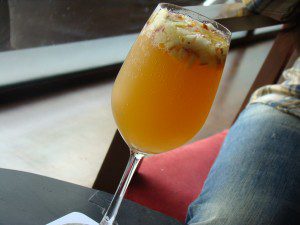
    From the huge selection of beverages and meatables, (don’t worry, there are veg options  in plenty too) we decided to go for a wheat beer (you get a 500 ml for the price of 330 ml as part of a breakfast combo) and a glass of Biere Sangria. We also ordered a Moroccan Chicken to go with it. The wheat beer was fine, and perfect for the non-regular beeraholics, but on my taste buds scale I prefer the Basmati Blonde at TOIT and the one at Punjabi by Nature, in that order. The stout beer is pretty good, if we go by the 4sq tips. Maybe some other time, when I’m not riding back. 🙂 The Sangria was much better, and chances are that you’ll really like it – especially the little zing that the lager adds.


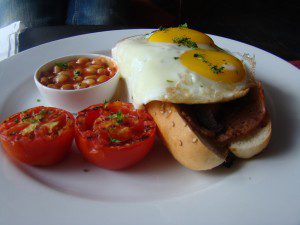
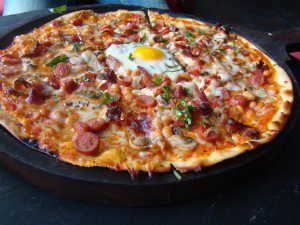
    The Breakfastwich arrived first – a sub with ham, bacon, a couple of fried eggs and a token cheese presence. While the bacon and baked beans were just fine, the entire thing proved a bit unwieldy, and didn’t really impress much. The Breakfast pizza arrived a bit later, and it was then that we realised that they had forgotten to tell the kitchen about the Moroccan chicken. But one look at the pizza was enough to convince us that it was a fortunate mistake. The thin crust pizza had bacon, sausages, mushrooms and a fried egg at the centre of it all. Sliced just right, it was quite awesome with a tomato tang, mild spice and a good load of cheese. Great combo with the beer. 🙂 We really had no space for desserts.

    The service was reasonably good, barring the Moroccan chicken incident that proved advantageous for us. All of the above cost us less than Rs.1200, thanks to the Poshvine deal. Definitely worth a visit, especially considering that it’s Bangalore’s first microbrewery. 🙂

    The Biere Club, 20/2, Vittal Mallya Road-Lavelle Road junction Ph: 42124383/4/6