Year: 2012

  • Naming exercise

    The alarm rang, as it did, usually. He snoozed, stretching his sleep time a bit. But he knew he would have to get up soon. He was already late for his other kind of stretching. That’s when he figured the alternate reason for the name of the new concept they had come up with – Yogalates!

    PS: Yes yes, pronunciation, I know!

  • A Silence of Desire

    Kamala Markandaya

    ‘A Silence of Desire’ is seemingly about the turmoils in the life of a government clerk, after his routine is shattered one day when he finds his wife missing when he returns home from work. Furthermore, he also realises later that the reason she had given for her absence was not the truth. He suspects his wife of infidelity. Much flustered, and not helped by the discussions happening in his office on the social mores of womenfolk, he follows her and finds out something, which to him becomes a more painful thing to bear than what he had initially suspected his wife of. His structured life then goes through a turbulence, as his personal problems begins to affect his work, and even his character undergoes a change.

    What makes the book interesting is how the author uses the family to show the upheaval that happened in Indian society after the British left. The spirituality and faith of the traditional Indian housewife collides with the scientific and rational mindset of her British trained husband. The father is disturbed that his teenaged daughter would go to the ‘milk bar’ with a male friend, even if its in a group. There is even some reference to the conflict between north and south indian civil servants because of their varying approach to problems and fellow workers.

    Even as the author manages to create a microcosm of the changes that were sweeping Indian society, her narrative and prose manage to bring out the human aspect in a very convincing manner.

  • The Yellow Cycle

    Ever wanted to gift something totally out of the ordinary to a loved one? Then you must check out The Yellow Cycle. In conversation with co-founder Neha Arora

    [scribd id=102709947 key=key-lkmwoxmxt4fbohf3ir2 mode=list]

  • Data: Growing up

    The Facebook story might be facing rough weather, but that hasn’t stopped the social network from pushing out new and interesting things. It launched “Page Post Targeting Enhanced” – features that make it a media platform offering sharper slices to marketers (easily) by allowing filters based on gender, interests, relationship status etc. It has also rolled out Facebook Stories that highlights “people using Facebook in extraordinary ways”. Venture Beat has a very smart take on how this can be the future of news by intersecting two of the most interesting contexts – location and interest. As a media platform, one can imagine the advertising potential.

    Twitter already has local (city specific) trends, though, from experience, many people seem to think that they’re viewing national trends when Twitter is actually showing them local trends. Twitter already has Promoted Tweets and is enhancing features that allow better targeting.

    Media buying in the age of traditional media consisted of a plan being prepared (and negotiated) after evaluating the reach, cost and other parameters of various options across platforms – print, OOH, TV, Radio etc. The (reach) data has always been contested, and the (post) measurement is more of a myth than reality. New media platforms, on the other hand, are significantly better in terms of transparency and in addition, have better native and 3rd party tools for self publishing, distributing and measuring. The data is one click away from the marketer. After a certain tipping point of reach that these media achieve, traditional media would be forced to provide this level of accessibility, and then, IMO, the value provided by media agencies would be reduced significantly, as tools would make it easier for the marketer to plan real time and measure too, across platforms.

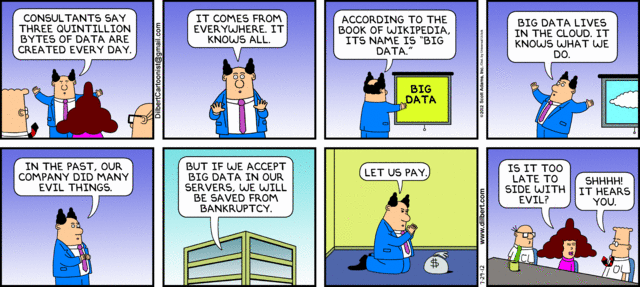
    In essence, data that the marketer needs, to make informed choices on the why/what/how/when of platforms, is easily becoming available.  The data that really needs to be converted into information is now flowing in the reverse direction – from the consumer and his actions across platforms to ______. And this data is not just for marketing, its use is across the board and affects product, customer care, operations, technology and so on. It is Big Data, the players are evolving, and the next stage in this ever changing game has begun.

    until next time, don’t worry, it’s already a buzzword. 😉

  • Legacy, Mastery, Success

    At Brain Pickings, that treasure trove of awesomeness, I found this quote attributed to Ray Bradbury on legacy, through a character in Fahrenheit 451:

    Everyone must leave something behind when he dies, my grandfather said. A child or a book or a painting or a house or a wall built or a pair of shoes made. Or a garden planted. Something your hand touched some way so your soul has somewhere to go when you die, and when people look at that tree or that flower you planted, you’re there.

    The subject of legacy keeps popping up here, and my understanding, especially since the last post has been that it is not something that one works towards, but happens as a (side) result of doing something that you love to do. In that sense, I would read between the lines above and add that ‘doing what you love to do’ as a prequel to the quote.

    One of the best posts I have recently read was Hugh MacLeod’s ‘On Mastery‘. I immediately riffed on it over at the other blog. It articulated things that I know for certain were muddled up somewhere in me, wanting to be told but finding words missing. He starts with trying to define success “Suc­cess”. What does it take to be suc­cess­ful, pros­perous, happy, have a sense of pur­pose etc?, separates it from the by products like fame and money and arrives at “It’s something that truly belongs to you”. For the master (as someone commented on the post) it’s more about the process than the product. Low key, known by a few, but masters in their chosen domain. “It’s something that truly belongs to you, always.”

    In the ever hyper world of real time media, micro-celebrities and experts, fame and money are many times the definitions of ‘success’, and though I do know at least a few people who have bucked that trend, it was heartening to read posts that told me that such thoughts weren’t really alien.

    There is an interesting article I read on the subject on HBR titled “You Are Not a Failure” which had an intriguing classification of  types of creativity — “conceptual” (in which a young person has a clear vision and executes it early, a la Picasso or Zuckerberg) and “experimental” (think Cezanne or Virginia Woolf, practicing and refining their craft over time and winning late-in-life success).

    Thanks to the deluge of information and opinions, it is ridiculously easy to give up on yourself and lose confidence. As Godin writes in “Do we have to pander?“, it is also easy to compromise, and then defend.   I think this is not just for greatness (people or things), but also holds true for personal belief systems and mores. And probably, at the very end, the perseverance really doesn’t achieve anything other than the satisfaction of setting one’s own definition of success and spending time and energy on it. But I have a feeling it’s worth it. A legacy in itself.

    until next time, this happens to be post #1000 here 🙂