Year: 2012

  • The Catcher In The Rye

    JD Salinger

    Its perhaps a book that I should’ve read a decade and a half back, only because I could’ve related more then to the angst that permeates it. The timeframe and the narrative style would make the work seem small in scope – the book is set in about three days (not counting the recollections) and is told from the point of view of a teenage boy, who has just been expelled from his school (not for the first time) and instead of going home, spends the next few nights in a seedy hotel.
    But what makes this book unique is Holden Caulfield’s (the protagonist and narrator) way of distilling the thoughts and emotions of a teenager and making you feel for him. Indeed, there are many moments in the book that made me feel infinitely sad, though the ending seems to indicate that this is only a phase in life.
    The title is based on Holden’s mishearing of a poem by Robert Burns – Comin’ Through The Rye. Holden creates a fantasy on it – with himself being the guardian of kids who are playing in a rye field on the edge of a cliff, entrusted with the task of saving them if they are in danger of falling off.
    His attitude towards children – his sister Phoebe in specific, and adults would seem to indicate that he understands that at some point, kids will lose the qualities he likes them for (which are missing in adults) and he wants to be the heroic figure to prevent this from happening. A turning point in this role is his conversation with an English teacher of his – Mr.Antolini, who says that the mark of the mature man is that he wants to live humbly for a cause while an immature man would die nobly for it. Later Holden gives Phoebe his hunting hat, probably the symbol of his catcher identity.
    Its probably a book you need to be patient with (though its only about 190 pages) since (I felt) its only towards the end that Holden really manages to suck you into the idea of the book.

  • Until the customer is king..

    Instagram just released v3.0. One of the biggest changes in this version is the introduction of Photo Maps, which quite obviously, plots your photos on a map. The default is opt-in, not opt-out, though they’ve done their bit to give the user control over data.  I updated despite reading this Wired article on the privacy implications and the bug that briefly exposed private photos!

    I’d written my first post that referred to Big Data recently, and the day after that, I read this very interesting post that talked about various applications including an algorithm that can identify cities based on their unique architectural elements and other distinguising characteristics. But a few weeks earlier, WSJ had an interesting post that talked of how large corporations see big data as a means to get personal with customers using information gathered by placing tracking files in people’s browsers and smartphone apps without their knowledge—so they can be stalked wherever they go, with their “experiences” on commercial websites “personalized” for them. The post describes not just its real world analogies but practices as well, and predicts a future where the user will declare your own policies, preferences and terms of engagement—and do it in ways that can be automated both for you and the companies you engage. An entire ecosystem across apps and corporations built in a consumer centric fashion.

    But as the post itself admits, the move toward individual empowerment is a long, gradual revolution. Until then, we need to define our own limits of sharing, fully understanding that it is a give and take. Not just what and where, but whom too – since all it takes a RT or a ‘Share – Public’ for something shared in a close circle to go public. How much of privacy would I give up to open myself to opportunities, or get an experience that is tailored to my needs and convenience. On the other side, a modern corporation needs to understand the choice the consumer is making and use the information to not just provide genuine value, but also make it easier for both entities to adapt to the rapidly changing landscape.

    until next time, kingmakers

  • The masks we wear

    In TDKR, there is an interesting conversation between John Blake and Bruce Wayne, during which the former says that he knows Bruce is the Batman. He then talks of how he does not remember his mother’s death, but remembers his father’s murder well, and that the anger stayed with him. People understand, he says, but they don’t really know. They understand for a while, and they expected him to move on, to let go of the anger.  But he couldn’t do it, and when people realised that, he was sent to therapy and foster homes.

    He realised in time that for people to accept him, he would need to wear a mask that would hide his anger. He reveals that when Bruce visited the boys’ home he lived at years back, he immediately recognised that Bruce was Batman, because he himself wore a mask.

    Thanks to various experiences, I think all of us wear masks. Some of them are not because of experience, but for acceptance among others. Either ways, it works as a coping mechanism, and depending on our skills, at various levels of invisibility to those around us. Sometimes we are conscious of the mask and try to reach a place where we can live without them, by becoming strong enough to either face the past or deal with ‘acceptance’ on our own terms. Yet, despite those efforts, many a time, circumstances are such that the mask becomes the man, consciously or unconsciously. Whether or not that is a good thing is completely context dependent.

    But sometimes we are able to move on, just as Bruce was, embracing aspects of the Batman mask into his own personality. Or maybe it’s the other way – Bruce being a mask that the ‘true’ Batman personality wore. 🙂

    until next time, masker aid

  • Chianti

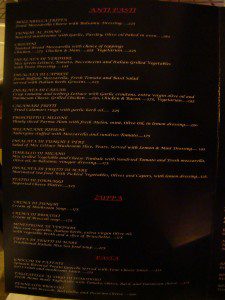
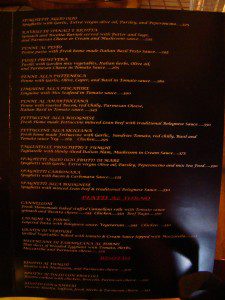
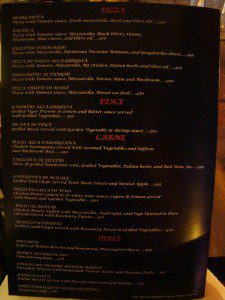
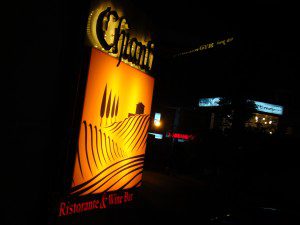
    D’s organisational duties and my laziness conspired to make sure that we had a ‘home’ match. Thanks to Zomato, we came to know about Chianti. It’s on the road that goes from Sukh Sagar on 100 feet Road in Koramangala towards Jyoti Nivas. (map) You can’t miss the orange sign on the left. This, I thought, is probably how Nepal feels like – India  (Sukh Sagar) towards its south and China to the north (Beijing Bites, Mainland China) They have valet parking and two-wheelers can go underground.

    You can either watch the world go by or enjoy air conditioning. We chose the former, though the brick wall and the chandeliers inside looked very inviting. We were given a DIY Bruschetta (no, it’s not Mallu) on arrival, even as we checked the menu. In that order, we rubbed (on the bread) garlic, basil, (fold first) tomatoes, and then added salt and pepper and the olive oil, but they won’t chuck you out if you tried any other order. 🙂


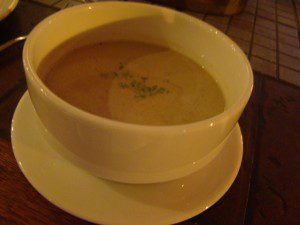
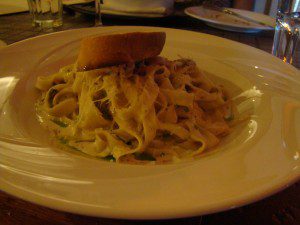
    On the paid part, we started with a Crema di Funghi and D used puppy eyes on the person who took the order, and asked for chicken to be added.  He seemed familiar, and it turned out that we had seen him at Fiorano. Same owner, apparently. Though we were told that the chicken would be added, the chicken didn’t get the memo. But the soup was thick and creamy and quite a good dish otherwise. A complimentary bread basket arrived too, and I quite liked the dip that they provided with it. For the main course, I tried to nudge D towards a thin crust pizza but she refused to bite. So we ended up with D’s Cannelloni (Beef Ragu version) and my Tagliatelle Prosciutto e Funghi. I ordered it partly because it reminded me of the Tattaglia family in The Godfather, who make attempts on Don Corleone’s life because he wouldn’t partner them in the heroin business, nor allow them to trade in it (hint hint) and partly because it had a creamy sauce and ham! D’s dish turned out to be a bit too tangy for her liking though she did like the Ricotta cheese and the overall taste. The other dish was heavy and a bit salty, though I loved the ham in it. We also had a Red Wine Sangria which we quite liked.


    The service is friendly, but are a bit over eager in asking for our opinions. (not the person who took our order) The meal cost us Rs. 1548 inclusive of charges and tax. Considering the location and the cuisine, I’d say it’s fair. It’s not the place you go to if you’re in a hurry. Sit back, enjoy the food and the wine, and watch the world go by.

    Chianti Ristorante & Wine Bar, #12, 5th A Block, Koramangala, Ph: 41132021/4

  • The path to mediocrity

    Seth Godin wrote a post on the masses vs great design, and how the brands we love refuse to become democracies. Yet, on an everyday basis, and across product offerings – from web design to entertainment, I see brands clearly pandering to the ‘masses’. And they’re not going to disappear in at least the medium term, because they spend resources in wooing and keeping consumers, though these consumers are hardly ‘loyal’. The undemocratic approach that Godin mentions is for the rare breed of confident, gritty, focused brands which have answered their why, what, how and when very well.

    On HBR Blogs, I found an article by Bill Taylor – “Bad Service can be good business” a very interesting read. It showed two different scenarios where the headline is applicable -companies who try to keep the costs down to the barest minimum and charge a premium for anything but the basic (the author quotes Ryanair as an example) and companies whose offerings are so compelling, and whose reach is so vast, that making the investments required to deliver high-touch service would be making a big strategic mistake. He cites new media companies like Facebook, Twitter etc as examples.

    Most of the companies I was referring to in the first paragraph are trying to be one of the above. But they play an in-between game, starting at some point and thinking that they’ll figure out a way to get to their destination. But IMO, it can’t happen that way, because once you set expectations, you fall into the ‘trap’ of fulfilling them, without really figuring what your brand stands for. You’re forced to play the reactive game, watching your competitive landscape and fencing with them. As you progress, you’re drawn further away from the active game of pursuing a goal with focus. The trap, hence, is mediocrity, and it is surprising to see it these days because the web and social platforms specifically are a great way to find that slice of audience which will give the brand a chance to deliver that focused product/service. I’m not talking of superficiality here, but the DNA of the brand, and the organisation, the strand around which everything is built. I’m also not saying that all mass brands are mediocre. In the purpose that they have defined for their brand, Ryanair is anything but mediocre. Despite the seeming difference in the two scenarios from earlier, they are bound by a commonality – clarity of thought, which inspires clarity in everything that the brand does.

    until next time, clear blue ocean