Year: 2012

  • Heera

    The review first shone in Bangalore Mirror

    A stationery store named Staples on the ground floor, to a restaurant named Heera on the 4th, where time is purported to have stayed stationary – the capsule lift journey that takes you to the restaurant could seem like some layered Mughal intrigue. But time capsule it isn’t, and you realise that when you’re faced with a white door that makes you wonder whether you’ve gotten off on the wrong floor. But before all that, this is on Bannerghatta Road opposite Shoppers Stop, (map) and there’s valet parking.
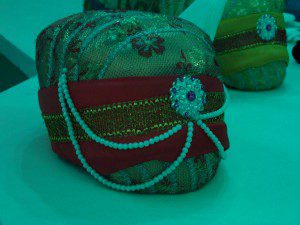
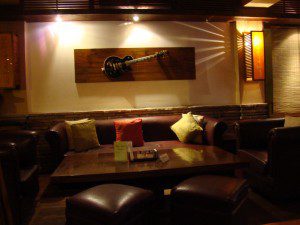
    If you remember Heera Panna on Church Street, you can skip straight to the next paragraph. For those who don’t, the Mughal theme is brought out reasonably well – there are alcoves separated from the main hall with bead curtains and multihued chandeliers from high ceilings which bring the theme to life. (video) You even get to wear turbans and cloaks, and if you’re so inclined, you can play with wooden swords too. If you happen to be sitting in the main hall, Rekha is likely to dance for you on the gigantic screen to In aankhon ki masti (Umrao Jaan) In case you aren’t floored by this, there is a good chance that one of those loose floorboards will do it for you!

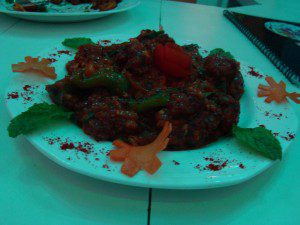
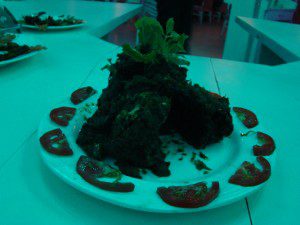
    One thing that’s to be said for the menu is that you’ll be spoiled for choice. We started with the Macchi Tikka whose red chili paste and subtle ajwain flavours made an excellent combination. The Paneer Kurkure was up next, and the crispy covering served as a perfect foil for the cottage cheese. Figuring out a clear favourite from among these two was difficult. I was expecting much from the Lal Mirch ka Murgh, but it really didn’t deliver on the spice factor and seemed to be a dish that wasn’t sure of its identity and aspired to be a Manchurian. The Mutton Chops Masala Nasheeli Champein had no idea that it had been classified under ‘boneless’ and though its masala was quite good and had a fair share of spices, the lamb pieces themselves – whatever we could judge from the miniscule meat presence –  were not really the best we’ve had. We also tried a couple of mocktails – the Red Devil did a good job with the watermelon, apple, and orange combination but the mint leaves were a bit like moss on Kerala backwaters, quite spoiling the drink. The White Orchid – lychee based, didn’t turn out a lot better.
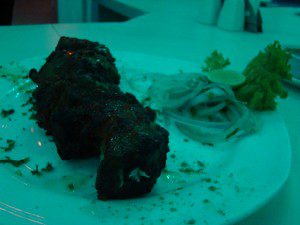
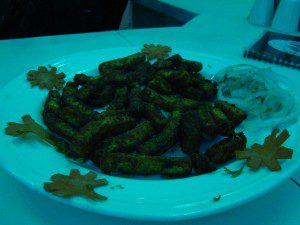


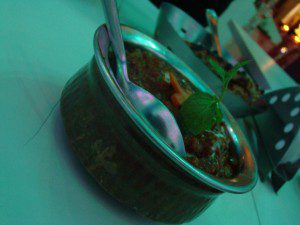
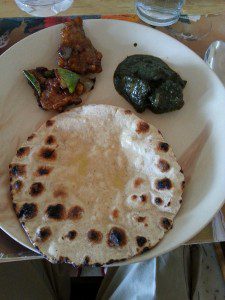
    The plethora of choice continues in the main course too. And though the Mutton Kofta curry we wanted to try out wasn’t available, it turned out to be a blessing. The Gosht Nehari that was suggested to us instead turned out to be the best of the main course dishes with a silken rich gravy and well cooked meat. The Dum Aloo can be summed up with the fact that everyone approved of it until I smirked and told them that it was a Dum Aloo. Then everyone agreed that this wasn’t the way it was supposed to taste. Cheap thrills. The Murg Masala was mildly spicy and not a bad dish, but for a ‘special dish’, it wasn’t exceptional. There are some interesting options in the roti/naan section. The Baluchistan Kulcha with a kheema stuffing is definitely recommended as is the Harimirch ka Paratha, but you would want to stay away from the Channa Pudina ki Roti. The Gosht Dum Biryani was excellent – flavourful, non sticky rice and well cooked meat complemented by a reasonably good raita.
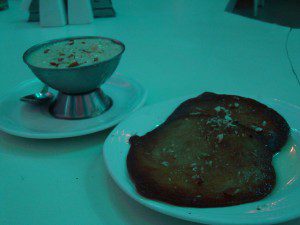
    The Rabdi Malpua was easily the best among the three desserts we tried, since both components did their jobs well and worked as a combination too. The Kulfi wasn’t bad but not really stellar either, especially on a relative note. The disappointment was the Flambéed Gulab Jamun, which had such an overdose of rum that we felt that it should have been in the liquor menu.

    For about Rs.1500, you could share a mocktail, a non veg starter, a couple of rotis, a biryani and a non veg gravy, and end with a dessert.  (Inclusive of  taxes) All things considered, the food really wasn’t bad at all, though it is priced on the higher side. The service was a tad too enthusiastic and we had to finally tell them that we would help ourselves. But what really takes away from the place, despite its relatively unique theme, is its condition of disrepair. It’s a bit sad to see it fraying, and not just at the edges, like a Mughal monument that no one seems to care about.

    Heera, #17, 4th Floor (Opp Shoppers Stop, above Staples), Bannerghatta Road, Ph: 9972305871, 9972934777
  • Shillonging Day 2 – To Cherrapunjee

    Continued from Day 1

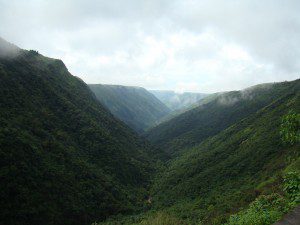
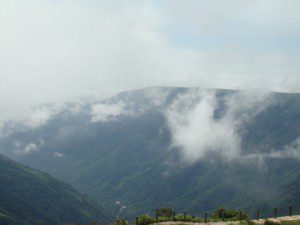
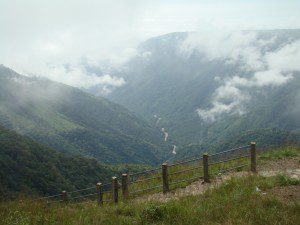
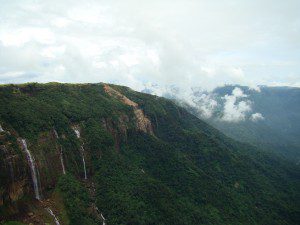
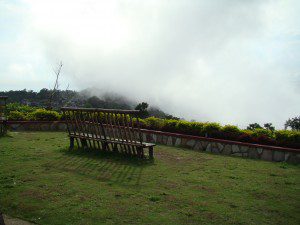
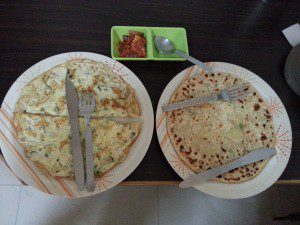
    Day 2 was slightly kinder as we got up at 7.30 and had plans to start off for Cherrapunjee by about 8.30. Breakfast was paratha and omelette, served at 8. We were slightly delayed though, but set out just before 9. The journey took us through some extremely picturesque landscapes and we stifled the urge to tell Ajmal to stop the car so we could take snaps. We were secretly afraid that he might continue without us. We stopped at Duwan Sing Syiem on the way to Sohra, and then at Nohsngithiang falls before continuing to Cherrapunjee. Soon, it was easy to understand why Meghalaya is called the Scotland of the East. It has to be those endless meadows.


    It was immediately after that, soon as we passed the Mawsmai caves, that Ajmal got it into his head that we had to see the Indo-Bangladesh border. Of course he had no idea where it was. So he just vaguely drove around for a few hours, despite several suggestions from us that we turn back. I have a feeling that his ancestors must have come from Bangladesh, that is the only plausible explanation for his extra bout of madness. It passed at about 11.45 and we got back to the caves. That was another bizarre experience as we splashed into the cave with another large set of tourists. Slippery as hell, the only way out was to just keep plodding ahead, amidst shrieks from kids and their parents alike. Ignoring Ajmal’s suggestions to eat at a restaurant there, we decided to proceed to our hotel, following spirited little yellow signboards along the twisty, curvy way that had some amazing views.

    The Cherrapunjee Holiday Resort, about 15 kms away from the main road, is an establishment that’s totally unique. We reached just in time for for a late lunch – Pork Chilly, Chicken  Neiiong and Butter Tawa Rotis. There is something very homely about the place – the people, the large hall with the computer, common television, and photographs and handicraft items on the wall. We rested for a while in our clean and functional room. A musty smell was mostly solved by the freshener that the staff sprayed just before we got in. 🙂 There are  costlier Executive rooms too, but we had an awesome view from our room. D went out to take snaps while I napped. Around tea time, we were given a little file on local legends, and the treks we could go for. THE thing we wanted to see was the famous double decker root bridge, unique to this part of the world. But that was for the next day.

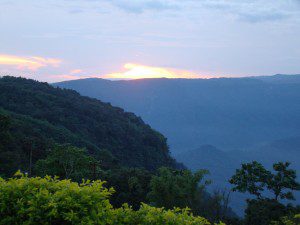
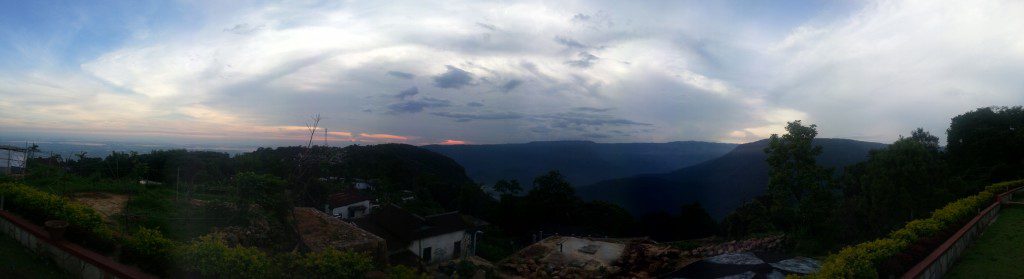
    Sipping tea, watching the sunset and a view that’s one of the best I’ve ever seen, we chatted about the resort itself. The main building had a bungalow feel to it and we wondered if it was government owned. I had become a fan of the place – the little yellow signs on the approach road, the way the staff interacted with us, the copious documentation available on various aspects about Cherrapunjee, their efforts on sustainable and inclusive tourism etc- and told D that I sensed a smart and creative mind behind this. As we strolled, an oldish gentleman stopped to chat with us. We gathered that he was in charge, and wondered if he was probably a government employee, a very amiable one at that! 🙂 Probably an IAS officer who had chosen to skip the bureaucratic rat race? It was only a few hours later that Google pointed me to the amazing love story of Denis P Rayen, who owns the place. The love in this case for not just his Khasi wife, but for Cherrapunjee itself. 🙂 Suddenly, everything we were seeing around us, had an explanation. I kicked myself for not recognising him from the photo in the little office room and having a longer chat, which would undoubtedly have been an interesting one! Several times on this blog, I have written about the purpose of life, I think this guy has at least gotten close to nailing it.

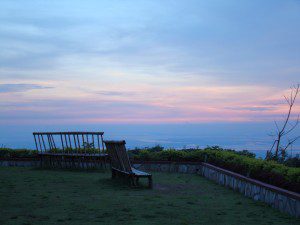
    Meanwhile, the view progressed further on a scale of awesomeness, and even the two noisy couples (and their noisier children) couldn’t take away from our experience. It wasn’t just the view – mountains and plains and the tiny town on the hill nearby, or the lights far away slowly flickering on as the sun set, it was the entire ambiance, the spells of silence…. It was magical, and by far the best part of our trip.


    (more pics)

    Dinner consisted of Pork Dohkhleh (highly recommended) and a Jadoh Stem Chicken, which seemed like a regional variation of the Biryani. We also made elaborate plans for the trek the next day – a guide, packed lunch – and were guided perfectly by the staff. Sometime during the night, I was awakened by a loud noise. It was a thunderclap, Cherrapunjee had just said hello. But that’s a story for the next day.

  • Differentiate or die?

    I’m close to finishing “A Clash of Kings” – Book 2 of George R.R. Martin’s “A Song of Ice and Fire”. Pages 879-913 has lists of houses and characters. The lists will continue to expand in the next book, I’m reasonably sure, and I will probably have to spend Rs.200+ and buy this app. Many fantasy superstars have existed before GoT – Potter, LOTR, but this is the first time I have been immersed in one. Generally speaking, works of fiction are unique, and yet, such is the abundance and the related scarcity of time that there are choices to be made. So why GoT? Mostly courtesy the huge buzz the TV series generated on my various timelines. Let me now shift the story to brands, where abundance and time scarcity takes an even worse toll.

    The title of this post comes from an article in FT. Without getting into the author’s bias/(vested) interest, I think he has a point when he says that the increasing focus on efficiency is stifling innovation and on the other side making consumers ‘number and dumber’.  On the business side, why bother with niche audiences when access to large sets of consumers through databases and mass media (now social media too) is much easier. On the consumer side, larger tribes are easier to find in the search for belonging. Of course these are generalisations, and I’ll be the first to admit that there are exceptions.

    In the case of mass brands solving mass needs/wants, functional benefits are increasingly becoming a commodity. In an earlier age of information scarcity and relatively unfragmented media, differentiation could be as simple as just being visible. The story is different now, though the recent turn of social towards media would indicate that only the channels have changed. But IMO, there is a high chance that this trend will prove to be shorter than the reign of mass media, and true differentiation will evolve from a user perspective after everything from product to design to communication to experience has become a commodity. Arguable. 🙂

    Increasingly, brands are using social media to target better, and that’s how platforms are selling their users too. I wonder if/how many brands at this stage are attempting to make their stories personal to the user. Different social platforms offer different contexts – in the way they are designed, in how users consume them, in terms of the need they satisfy, in terms of devices they are best suited for etc. Think of how Facebook, LinkedIn, 4sq, Twitter, Pinterest, Instagram, Path and the other services you use fit into your lives. Yet how many brands are trying to fit themselves into these contexts? Yes, we’re still in the early days of Big Data, but how much of investments are brands making in this as opposed to say, better FB targeting? What do you think – is it a scalable form of differentiation? Is it because of the pull towards familiar forms and templates of communication (read targeted mass advertising) that brands are loathe to walk this long path?

    until next time, differentiation by integration?

    Bonus Read: The Future of Storytelling

  • Shillonging Day 1 – 4 states

    To protest against people being unwillingly sent back to the north east, we decided to willingly go there. Actually, we had booked the tickets quite a while back. 🙂 It had been a while since “Gang talk” happened, and since D seemed to be acquiring the taste from Zingron, we thought now was as good a time as any to go Shillonging!

    Early we woke – 3.45ish – to catch the cab at 4.15 and reach the airport in time for the 6.40 AM flight to Kolkata. 6E is known to be punctual to a fault and we had no intention of taking any risks. We arrived early enough and true to form, the flight took off right on time. Kolkata airport was exactly as we remembered it, but then 2 years is hardly time enough for that phenomenon to change! We thankfully didn’t have long to wait since the connecting flight to Guwahati was just a couple of hours away. Breakfast was at Subway! Kolkata is not the kind of airport that gives you a wide array of choices, so you can probably stop smirking now!

    We had been informed by the tour operators that a person would be at the Guwahati airport to collect the balance amount, and with him we would find our driver, Ajmal. We saw a person carrying a placard with D’s name. In just 5 minutes, we were able to establish, with the help of a passerby, that D was indeed the D he was waiting for, and in turn, he was reasonably sure he was Ajmal! Introductions done, we started our journey towards Shillong. From the massive bovine presence on the road, we figured out how Cowhati got its name! Lots of greenery dotted with brick kilns and markets. We seemed to have arrived just in time for one of their celebrations, which involved people trying to spit on moving vehicles, including our own. White cars were given preference – probably more points.

    The person who was supposed to meet us for the payment finally met us outside town, and wished us a pleasant journey after he counted the money. We stopped to fill petrol at a station that had its own complex patterns of how differently sized vehicles should exit. Just to spice it up a bit, they also used a larger board for smaller vehicles. But Ajmal was smarter by a league, and used the entry path to exit. Ha!   In fact he was so good that we didn’t even know that we had already crossed into Meghalaya. 4 states in about 6 hours. 2x Chetan. We stopped soon at the L.C Woodland Dhaba and dug into rotis and Chicken Butter Masala, which actually turned out to be quite tasty. My friend from previous travels – the splitting headache  -announced itself immediately after. Ajmal celebrated by playing Silsila. (Hindi, not Malayalam)

    We slept most of the way to Shillong, though we did wake up in time to catch the amazing scenery as we climbed. Though the journey is a 3 hr one, we took double that. Part of it was the last mile traffic jams in Shillong. That’s a story in itself! Once we crossed that hurdle, it was time for Ajmal to do his bit. Having no idea of where our hotel White Orchid was, he promptly took us to Orchid, parts of which were white in color. It was also the home of the village idiot who proclaimed that he had been living in Shillong since 1979 and there was no place named White Orchid. He played the same sentence in a loop until I said I could pay him to shut up. While he considered that, we called up the hotel. They were very helpful and gave Ajmal directions to get there. But Ajmal, whose IQ cannot be measured by petty human standards, rebelled against directions, and stopping near a petrol pump gave that as the landmark to the hotel people. The hotel staff said they would be there in a couple of minutes. In subsequent calls, he also created a fantasy world nearby which had a hospital and a bridge. I used Google Maps and urged Ajmal, but he silenced me with a glare that would have made internet watchdogs proud! Finally I made him move in the direction that Google gave me and voila, there was another petrol pump. Ajmal complained about what the world was coming to when a town could have two petrol pumps.

    White Orchid was a tiny guesthouse but we were given a warm welcome by Chetan Kumar (aka Chintu bhaiyya) who would prove to be a godsend many a time in the next few days. We skipped dining there and asked for directions to one of the many places on our list – Sesame in Laitumkhrah, just over a km away. We used the most common transit form – the Rs.10/head taxi, but just couldn’t find the place. We finally settled for Cafe Shillong.

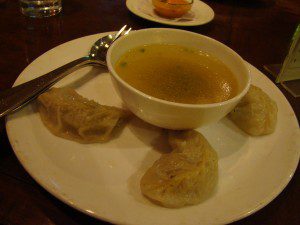
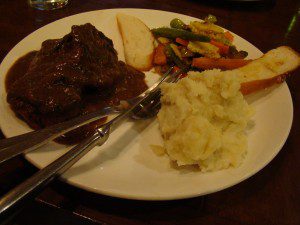
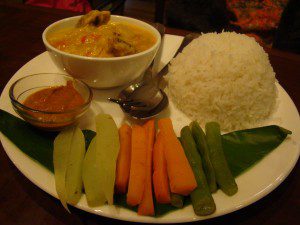
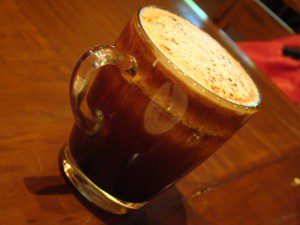
    A cosy little cafe on the first floor, a few buildings after the famous Jadoh. We were the only customers though the only big table had a ‘Reserved’ sign. Tiny tables on the balcony gives you a good view of the street. From the not-so-elaborate menu, we asked for a Pork Momos with soup, and for the main course, a Shillong beef steak with mashed potato and a Chicken Bastenga. The soup was thin but flavorful and the momos, tasty, though not a match for the Delicacy ones in Bangalore. 🙂 The Shillong beef steak was well, a beef steak in Shillong, with a tangy sauce and well cooked meat. The local rice wasn’t available for the Bastenga, so they used white rice instead. It had a spicy chutney and a very strong bamboo+other shoots flavour and smell. To wash it down, we asked for a Hot Chocolate, a reasonable drink. The bill came to about Rs.700.


    We took the taxi back to Malki Point, home to White Orchid, and slept in a spartan room after watching Kung Fu Panda for a while. 🙂

  • Indian Summer

    Pratima Mitchell

    I must admit that in the beginning, this book reminded me a lot of Kiran Desai’s The Inheritance of Loss’. It was probably the Himalayan setting, grandparents, a young girl living among mostly older people and the presence of the ‘Liberation Front’ in the background. But its just a coincidence, as ‘Indian Summer’ veers away soon enough.

    Fourteen year old Sarla finds herself in the town of Daroga, with her grandparents, after her vacation plans go awry when her mother is pulled away on account of work. Though Sarla’s last trip was six years back, which ended with between her mother and grandparents, she adjusts soon enough and even manages to befriend Bina, the 15-year-old granddaughter of her grandparents’ household help.

    The author makes a smart move by bringing in both girls as narrators of the book and we’re able to juxtapose the similarities and differences between the two girls. They’re both lonely souls in their own ways, and yearning for a more ‘normal’ childhood, they both have a not-so-regular relationships with their respective mothers, but the sheer class difference makes each others’ lives almost incomprehensible. Their friendship however, helps Sarla understand more about Bina’s life and that of Bina’s mother, Shobharani, Bandit queen of the hills.

    Though the book covers some ground on the condition of the poor in villages, women’s rights, class differences, it takes backstage when the plot moves on. Despite an attempt at a twist in the tail, the predictability of the plot and the stereotype secondary characters – despite their potential, takes a bit away from this book. But I liked it for its simple telling and the vivid description of life in a hill town. The kind of book that goes with cold nights and hot chocolate.