Knowing all about the new guy’s ‘secretary’ fantasies, (browser history checks during his smoke breaks) she cockily walked in, and sat on his desk. Ignoring her perfect figure, he replaced the hourglass, checked his daily engagements, and showed her the finger. Wedding ring. To the persistent caller, he answered “Yes, I’ll return the laptop soon”
Month: June 2012
-
No God in Sight
Altaf Tyrewala
Somewhere in between a relay race and ‘six degrees of separation’ lies the narrative style of this excellent novel. And just like the city it showcases, it sets a scorching pace. But its not just a microcosm of the city, its also a take on social issues – from religion to class differences to a clash of the old and new. And somewhere in between is a subtext of man’s search for where he came from and where he is going, and the series of connected lives and the sheer weariness that prevents them from being able to think beyond their immediate existence, somehow points towards the title – ‘no god in sight’.
From the millions that make up the phenomenon that’s Bombay, and gives it a ‘spirit’, the author manages to create a few characters that give us a glimpse of the individual lives. He begins with a seemingly nonchalant treatment of what might be considered a moral issue – abortion, and thus captures the pulse of a city and the thought process and credo of a new generation. But amazingly, there is a universal nature to it too, and more often than not, the author manages to walk this line with balance, despite the majority of characters being Muslim. Featuring the famous local trains, the cop who expounds the logic of his sense of justice, the men who share a name with a terrorist, the book is quintessentially Mumbai, and yet, from another perspective, they’re just human stories. If we juxtapose the allusions to ‘my mumbai’ and ‘your mumbai’ in the corporate executive’s story and the ‘to be comfortable with discomfort, one must banish all contact with ease’ in the butcher’s story, we see two sets of people figuring out their own ways to cope with what the city and life throws at them. Sometimes, they can’t, and all they want to do is escape, like Amin Bhai.
In just about 170 pages, Altaf Tyrewala creates not just the characters who make Mumbai, but even manages to represent, even if its just through a few examples, how they got there. Can’t even complain about the lack of character development because the snapshots almostd efine the characters. Another great rendition of Mumbai, and a must read!
-
Master Class
Last week, I read a profoundly insightful post at Gaping Void, titled ‘On Mastery‘. The post seeks to answer (in Hugh’s own words) ““Success”. What does it take to be successful, prosperous, happy, have a sense of purpose etc? What does THAT actually look like?” The answer, according to his post, is mastery. (do read his post for examples) When I shared this post on Twitter, Asmita related it to Chandni Chowk food vendors. Bingo. Around my own city – Bangalore- I can see examples of that. I can also see examples of when some of them have tried to scale and have fallen apart.
Fame, popularity and money are by-products, but the master is not really dependent on that. In fact, he might even see it as undesirable side effects. As someone commented on Hugh’s post, it’s not even about the product, it’s the process. In Hugh’s own words “It’s something that truly belongs to you” and perhaps that’s why it’s so much more better, because there’s no dependency, unlike the by-products.
It’s more of a personal learning for me, and it struck a chord as soon as I read it, as though I had the thought in my subconscious but lacked the cognizance to express it, even it to myself. In fact, I’d go on now to slightly disagree with Hugh MacLeod and say that for many people, mastery is success.
Meanwhile, how does all this apply to business and brands? If I look at it through the prism of how things work now, I might be inclined to say that mastery cannot really scale, and I’d go back to my ‘Institutional Realignment‘ post and say that we’ll eventually get back to making mastery, a smaller ‘audience’, and a lesser scale the norm. But in some ways, I can see examples of brands having mastered a culture and found a way to scale it – the much abused example – Zappos.
However, if I had to look at it another way, I’d say that the web has made discovery much easier. Not in the traditional media way of ‘push the message to a mass and the interested ones will find you’ kind of a way, but the exact opposite. To use the data that people are sharing and through that, to find the right audience. The kind of audience who will appreciate the brand’s mastery, and who will then create good old fashioned community and word of mouth. The web offers tremendous opportunities to focus, but unfortunately we’re still in the early days of organised marketing and CRM data and most brands are busy losing focus and spamming themselves into oblivion, courtesy the lure of scale and its trappings.
Of course, a part of me believes that mastery should have nothing to do with business, but as with many other things, the web might just change my perspective.
until next time, Master of Business Administration 😉
-
Mythistory
Centuries apart, but both in The Wonder Eras and Irascible, I had written about the documentation of incidents that we now call mythology and history. (respectively) In the former, I had mentioned the feeling when I saw the place where Sita had been temporarily imprisoned in Lanka, and in the latter, a fictionalised version of an event that happened in 1919. Both a bit intangible – the first only because of the centuries that have passed and it was still difficult to believe that myth was just history but more ancient, and the second because I am not sure if it actually happened.
Sometime back, I read William Dalrymple’s ‘The Last Mughal’, that uses Bahadur Shah Zafar as a ‘device’ to write about the events of 1857. The book is based on actual documents. As I wrote in my review (will share soon) what remains with me long after I have read the book, and something I went back to, almost every time I picked up the book to continue, is the photo of Zafar, lying with his face to the camera – the face of a broken old man who through his life saw the dominion of his ancestors taken away from him until all he had was his city and an empty title, who had just been made to undergo a trial and many humiliations before it, eyes expressing melancholy, and resigned to his destiny.
Suddenly, the images that I remember from history textbooks were transformed into a real person, and history was somehow tangible, as was his plight. It was almost as though that if I could take a few steps more, I could somehow feel the same about our myths. Have you ever felt that when reading/seeing anything?
Perhaps it is that way in every age, when some things that were history move into legend and then on to a myth status. I am still debating in my mind whether the layering that happens, adds or subtracts.
until next time, history repeats?
-
TOIT
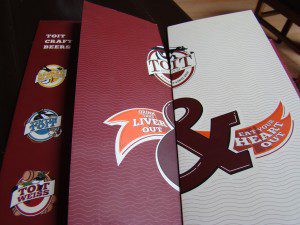 Finally, we used the same tactic at TOIT as The Biere Club – Sunday lunch, much more easy to accomplish than the 2 seater Saturday dinner. For those not in the know about TOIT, this should tell you the story so far, as well as help you get there. Though I’d been here before on a couple of occasions, D was a first timer. They have a valet parking and for two wheelers, there’s the pavement, though it’s not always easy!
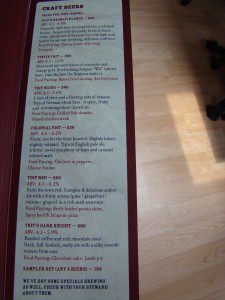
 The microbrewery has 3 floors, and we sat in the non smoking section on the 3rd floor. The smoking section has a great view of the Metro, though you need to be a large group to get a table there. At lunch hour on Sunday, it’s quite a peaceful place, but the buzz during evenings is quite something! Over to the food and booze. You can take a look at the menu here. In addition to this, there are the different kinds of house beer too.
I wanted the Weiss, but that was not available, so I ordered the Dark Knight. D asked for the Basmati Blonde. The Dark Knight was not as bitter as I expected, though this does change towards the bottom. The Basmati Blonde is quite light, with just a faint malt touch. This is usually the one I have, and I only tried the other to test it out. 🙂 I would’ve liked the beer colder though. [I happened to try the Weiss on a later visit, and now I don’t mind cheating on the blonde) 🙂
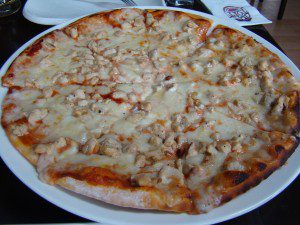
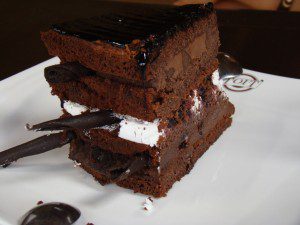
We ordered a TOIT Sunavachik for starters, strips of chicken with a dip and which can be made mild, spicy or very spicy as per your choice. We asked for very spicy, but it really wasn’t all that spicy. The dip complemented it well and it made for a good combo with the beer too. [Again, during another visit, we ordered ‘spicy’, and boy it was!] I think the menu has changed a bit though, since I couldn’t find the special TOIT pork dish I was looking for and the dish we had ordered was not something that was in the menu earlier. Hmm.For the main course, we ordered a Cream Cheese Chicken pizza – a thin crust pizza with marinated chicken and buckets of cheese. I would have liked it to be a bit more spicy – even the chili flakes on the table didn’t help. Despite being reasonably ‘toit’, we asked for the TOIT special dessert – a layered chocolate cake, which I didn’t feel was flambeed though. But it’s chocolate, and there was lots of it, so I really can’t complain. 🙂
All of the above cost us just over Rs.1450 including service tax and charges. TOIT is a place I haven’t heard a negative opinion about, and the packed atmosphere, even on weekday nights, is a testament to its popularity. Yep, it means you must visit. 🙂
TOIT, 298, 100 feet Road, Metro Pillar 62, Indiranagar
 The microbrewery has 3 floors, and we sat in the non smoking section on the 3rd floor. The smoking section has a great view of the Metro, though you need to be a large group to get a table there. At lunch hour on Sunday, it’s quite a peaceful place, but the buzz during evenings is quite something! Over to the food and booze. You can take a look at the menu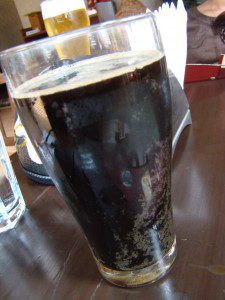

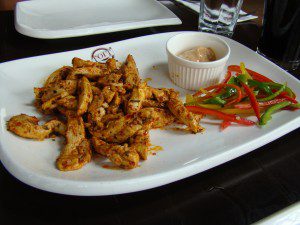 We ordered a TOIT Sunavachik for starters, strips of chicken with a dip and which can be made mild, spicy or very spicy as per your choice. We asked for very spicy, but it really wasn’t all that spicy. The dip complemented it well and it made for a good combo with the beer too. [Again, during another visit, we ordered ‘spicy’, and boy it was!] I think the menu has changed a bit though, since I couldn’t find the special TOIT pork dish I was looking for and the dish we had ordered was not something that was in the menu earlier. Hmm.