Month: May 2012

  • The Rozabal Line

    Ashwin Sanghi

    I have quite a bit of interest in Hindu mythology, so I had a bias going in. It would be fair to say that it also gave me the patience to sit through the back stories that constantly intersperse the narrative.

    The thing I admire most about this book is the painstaking research that the author seems to have done. (all references have been diligently acknowledged) I’ve read books that require research and mix fact and fiction (eg.Michener), but in this case, the research is across cultures and religions in one plane, and across time, in another. When you combine that with the requirement of having a story that should flow in concert, is when you realise the work that has gone in.

    The other thing I could identify with was the author’s love of anagrams and wordplay. He has put it to excellent use, when dealing with the names of gods and drawing connections between cultures.

    Though the primary plot of the book revolves around what happened to Jesus after crucifixion, his bloodline and the modern repercussions including religious terrorism, it is also about the parallel themes and recurring phenomena in modern religions. (The part of Jesus-like characters in earlier religions is fascinating)

    Its a superlative read, the only possible drawback being the heaviness of the content, not just in terms of historical trackbacks and comparative religion – conversations, but the twists and turns in the contemporary story itself.
  • Agility and Scale

    One of the things I'm trying to understand is how a rapidly growing organisation achieves scale and retains (or develops) agility simultaneously. When there's not much money in the bank/ revenue being generated, the organisation is forced to focus, and even if it does scale, it would do so in a particular domain in a given time frame, before moving on to another.

    But what happens when there's no dearth of financial resources and/or the organisation is in a business environment that demands scale for survival? One way I've seen organisations do it is to go on a hiring spree and get as many people on the floor as possible. But I've also seen it being counter productive, as either people lose clarity (of their role) in the medium term and quit or they get frustrated with organisational will getting in the way.

    To elaborate, in the first case, the organisation is not able to define roles, let alone c

    areer paths beyond basics, because the business domain/environment is still nascent. The employee may not be able to cope with it after a while. Also, rampant hiring many a time leads to massive role overlapping. In the second case, the number of decision makers and dependency across the system increases so much with scale that things do not move as fast as the employee would desire.

    To me, a good senior management team that is able to articulate the changing dynamics, lay out rules on what decisions should involve whom,  and align middle management and further so everyone pulls with the same end goal (need not be in the same direction, but that's a different debate 🙂 ) in mind is probably what can help help achieve/retain agility with scale. In all of this, communication is key, but that's easier said than done.

    Anything you'd like to share from your experiences?

    until next time, weighing scales

    zp8497586rq
  • Living over legacy

    Sometimes, when the topic of purpose comes up on this blog (and it has many many times),  I try to connect it with legacy. When I saw Michael Schumacher come back for another round, and in general, when I see people whom I have admired for their craft, continue plying it even though they have fallen below the insanely high benchmarks they themselves have set, I wonder what makes them go on.

    In the post that I’ve linked to earlier, I even wondered whether it’s the lack of a purpose in one’s life that drives one to look for a legacy – things that will last long after they’re gone. I also found it difficult to “consider that life, in whatever way it is lived, is its own purpose.”

    But recently, I read a statement (via this excellent post, if you follow cricket, even passively) from Dravid, (quoting Ian Thorpe) “I can sacrifice my legacy for the love of the sport.” He continues, “Sometimes we get too caught up in legacy; what are we going to leave? Sometimes it’s not about that, it’s about the player actually playing at that point in time. He’s not concerned about his legacy, he’s concerned about what actually made him play the game in the first place, which is that love of the game, the desire to compete and play.”

    At that point in time. Living in the moment. Where have I heard that before? In probably every book that talks of a higher state of consciousness. 🙂

    Focusing on leaving a legacy is probably looking at purpose from the wrong end. If I can find that something that gives me joy just by doing it – the act of doing it being a reward in itself – the result and even the implications would probably not matter. The legacy would be something that also managed to happen.

    until next time, legacy issues

  • Pizzeria Romano

    Despite us practically visiting every other restaurant on the road – Oye Amritsar, China Pearl, Cafe Malabari, Yana Sizzlers, Vicky’s la terrazza etc this is the one that got away, thus far. But as with all things food, we knew we would get to it someday. And we did. 🙂 If you still haven’t figured out the road, here’s a map. The building is right next to Oye Amritsar. I’m reasonably sure they have valet parking, but in any case, there are enough side roads nearby.

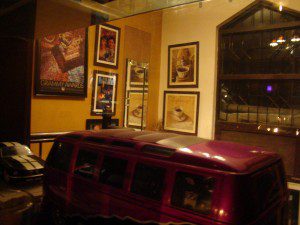
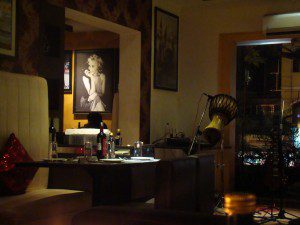
    The ambiance is quite awesome, and music and movies are the theme. The stairway that takes you to the dining area have some cool posters. They have a live music act on weekend nights, and when we arrived, things were being set up. It’s probably a good idea to reserve a table. We saw quite a few guests being turned away while we were having our meal.


    The menu – both liquor and food – is quite extensive. You can take a look here. D tried the Cobra Venom (tequila and cranberry based) , being used to me by now :D, and I was so lost in the choices that I ended up with a breezer.

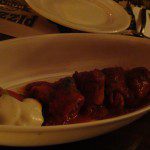
    From the starters section, we chose the Stuffed BBQ Chicken, bell peppers in slices of chicken breast with a faint flavor of wine from the marinade, and a BBQ sauce that was mildly sweet and quite spicy. This one is highly recommended. From the really huge number of choices  in pizzas, pasta, sizzlers and steaks, we sniffed out the Pattaya option from the special street pizzas, mostly thanks to the promise of coconut flavours. 🙂 We also asked for a Chicken Parmesan. The former turned out to be excellent though there was only a whiff of coconut, but there was enough chicken on a stone oven made crust  to keep us happy. The Parmesan came with a red sauce and pasta, and was another good dish. The only snag was that we ran out of space for desserts.

    All of the above cost us close to Rs. 2100. Costly? Yes, but thanks to some groovy music, decent service and awesome food, we had a great time, and will definitely make a few more visits to check out more things from that huge menu.

    Pizzeria Romano, 55, 5th Cross, Above Fulki, 6th Block, Koramangala Ph: 40953751/2

    PS: Review #150 🙂

  • Sin-A-Mon

    Home baked goodies for everyone, and basic and advanced workshops for those interested – that’s what Sin-A-Mon is about. In conversation with founder Monika Manchanda.

    [scribd id=93227705 key=key-2lzxsb3dfbsj1sscaee8 mode=list]