
My fandom relationship with the Pepsi Refresh Project has resulted in a few interesting conversations on this blog, this CSR one being the pick. As Surekha's comment says, this is the longest disagreement we've had. 🙂 That being said, I do agree with Surekha's point of sustainability, but my conundrum remains on another front. Aligning social responsibility with existing strategy/processes will make it sustainable and give it context, but would it create a perception that is not fair to its (assumed) good intent?
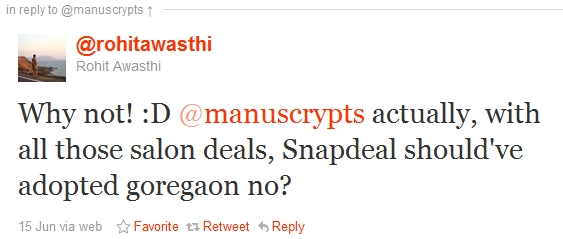 I was reminded of this last week when the news of Snapdeal's adoption of a village hit Twitter. Snapdeal was trending for 2 days of twitter on account of it. None of the comments on my timeline were flattering. I am guilty of contributing a couple myself, one of which was gamely retweeted by Rohith Awasthi, Head – User & Communities at Snapdeal.com. (as I have said on Twitter on an earlier occasion, the intelligence and maturity he displays when dealing with 'crowds' is something I respect)
Snapdeal has also written about their intent behind this exercise on their blog, and it is heartening indeed to see that it also happens to be the village that one of their employees belong to, and that the entire idea started there. I also have to wonder why that never made it to the PR machinery. Meanwhile, as their blog says, their commitment is something that time will show. Ef
ficacy is another thing about which time will have an opinion.
I thought about this from the perspective of the earlier post – sustainability, alignment with strategy etc. Even if this were a marketing gimmick, I'm fine because the village gains. As Snapdeal says, maybe other companies will follow suit too. Now, if good intent is the only thing at work here, how is it measured with regards to their strategic objectives? As I've repeatedly said, it's the deal that drives my relationship with the brand, anything else is of little consequence, including this effort.
On the other hand, what if Snapdeal had tied up their CSR with their deals? It could have happened in many ways – a bottom up approach, polling people on what they should do as CSR and taking the story further, or perhaps a commitment based on the number/value of deals sold, or promising a certain part of the revenue towards a CSR initiative (both of which can use a wiki like meter to show transparency), or a matching grant scheme for a cause (you pay Rs.x, we put in an equal amount). All arguably aligned to strategy, helps build community, and can be counted as CSR. But as a user, I wonder if I would then have said they are doing it to increase their deal counter. Note that even for a seemingly unrelated deed like adopting the village, some of the reactions were pretty nasty.
So, dead if you do, killed if you don't, and that's my conundrum. Am I missing something here? If not, perhaps the only way is to organically grow a community that supports you, communicate clearly with them and show them through actions over time – not just in terms of CSR, but overall strategy as well, that in the commitment to a larger cause, you mean business. In a future era, when social business hopefully becomes more mainstream, and people see brands whose purpose ties in with the larger context of their lives, this won't be as difficult as it seems now.
until next time, cause tick or Groupgaon? 😉