Year: 2010

  • O! Ustaad

    This review was first published in Bangalore Mirror. This is a much modified account.

    Thanks to the Gateway Hotel, you could end your gastronomic journey on Residency Road with ‘Arre huzoor, wah Taj boliye’. But in case you were wondering how to begin, you now have hope, in the form of O! Ustaad, at the other end. This is right after the St.Marks Road/Residency Road junction and placed under a certain Purple Haze, literally. Here’s a map. (the arrow mark is the right location) Parking should not be too difficult, since you have Hayes Road/ Convent Road also nearby.

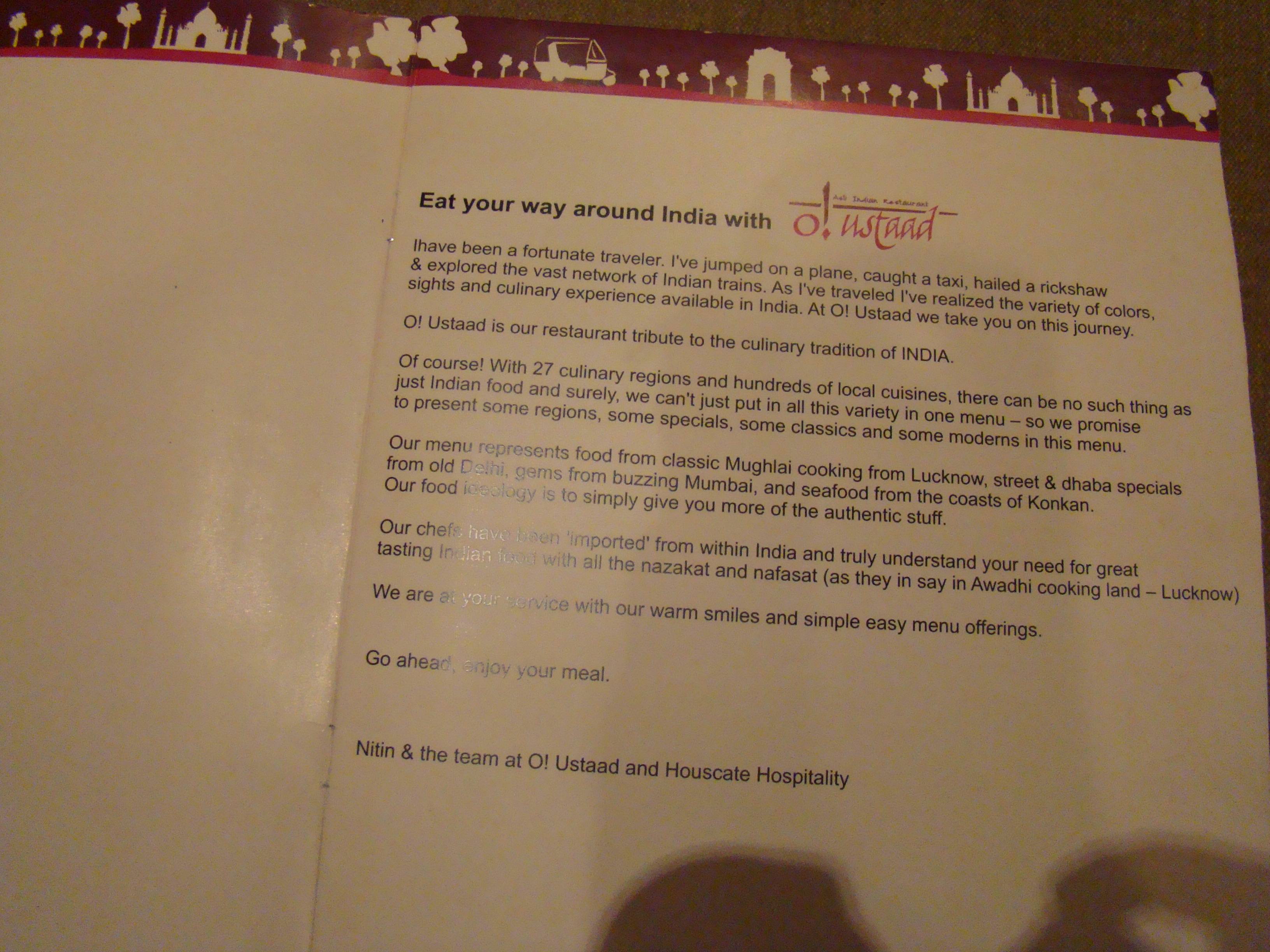
    O! Ustaad claims to be an ‘asli Indian restaurant’, serving you the best fare from Lucknow to Mumbai and Delhi to Konkan with nazakat and nafasat, but we journeyed from the delight of Wah! Ustaad to the despair of Waah! Ustaad.

    This is one of the places where you shouldn’t go by outside appearances, because though the frontage might seem a tad dingy, the interior is bright and peppy. O! Ustaad definitely serves up an attitude and has a penchant for wordplay, judging from ‘Facebhook’ and ‘LaLoo’. The photographs of street food, and an eclectic mix of music from Junoon to classic rock, all add up to a unique character. So much for the mahaaul, now for the real haul.

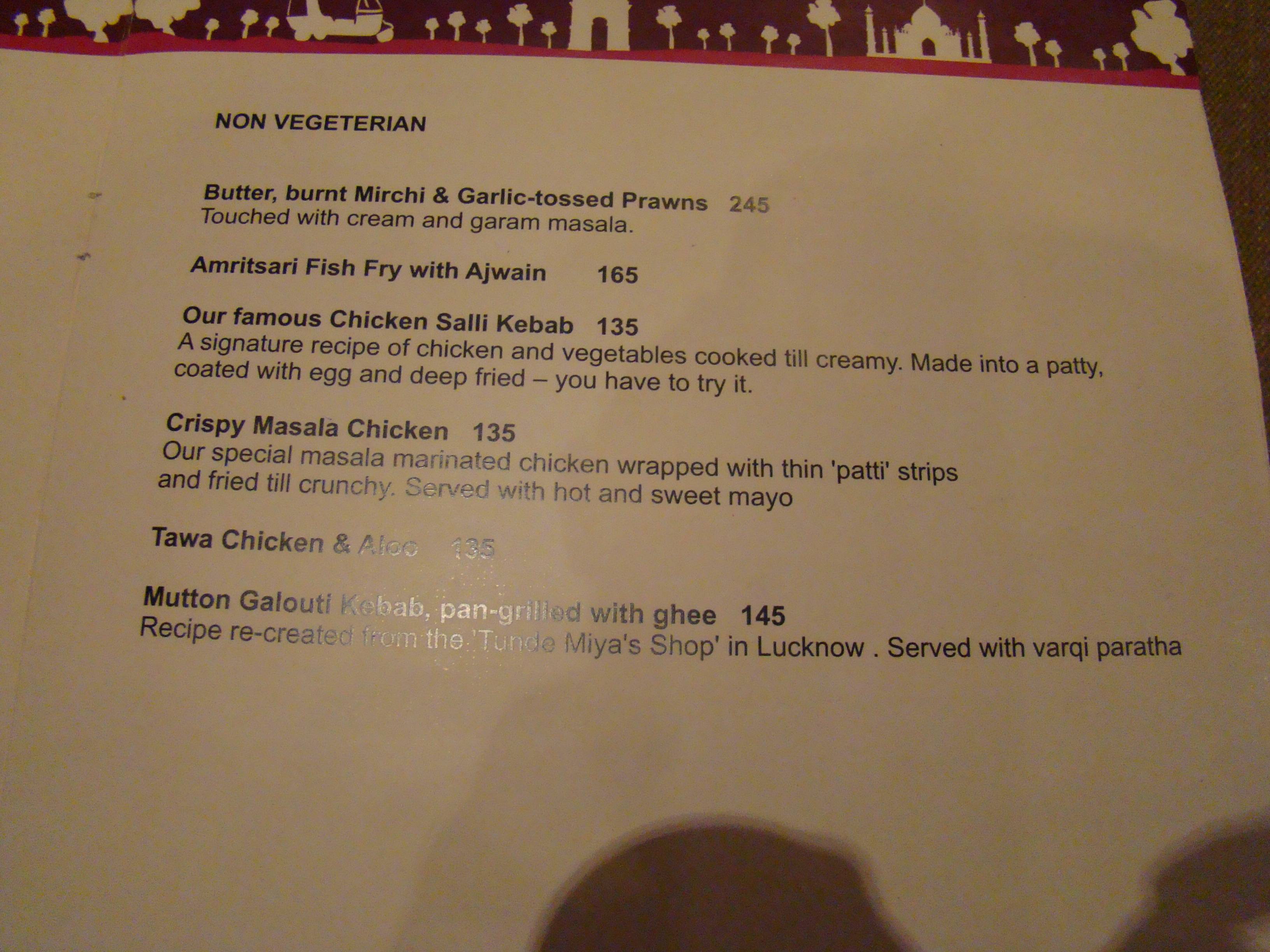
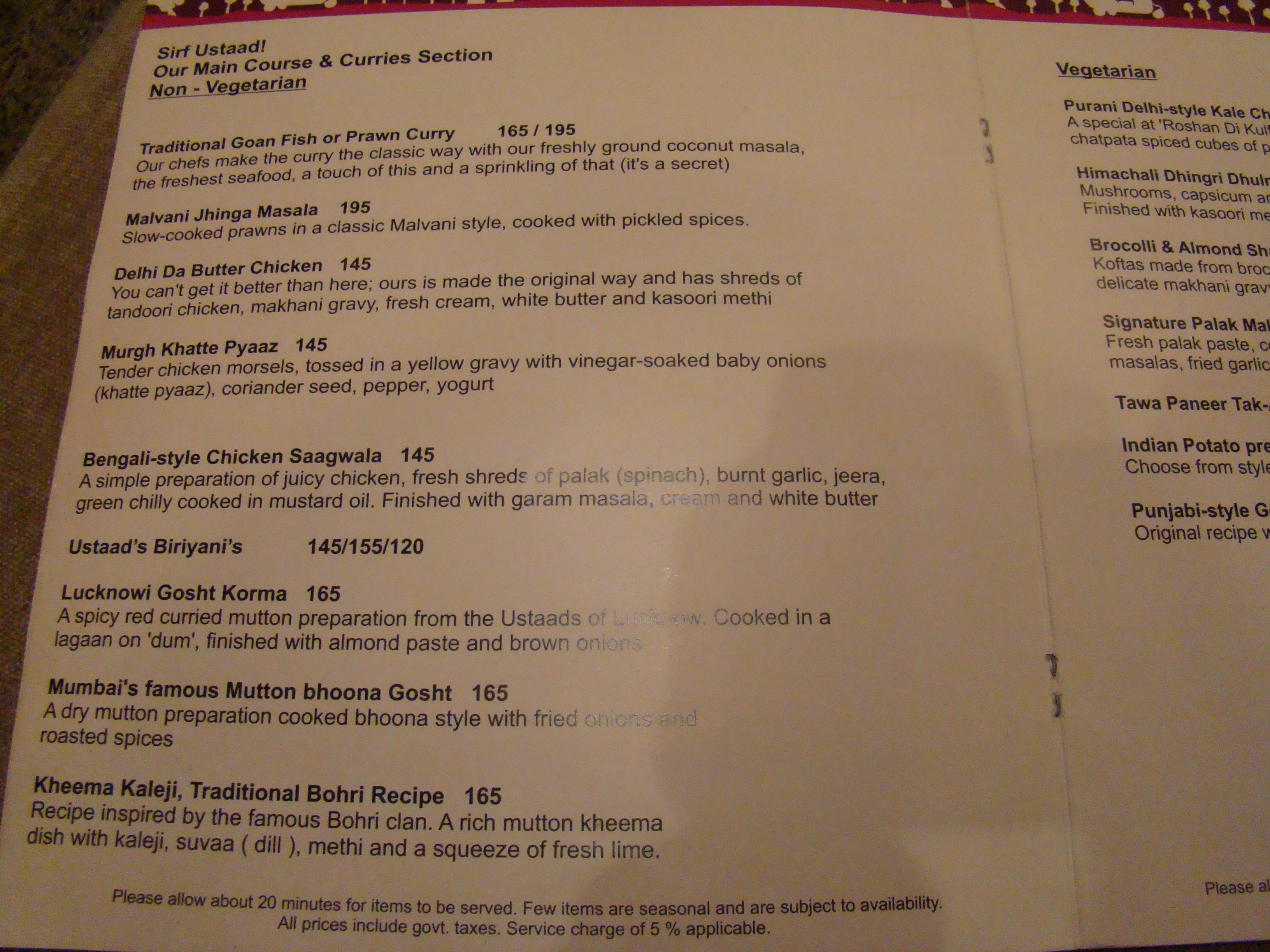
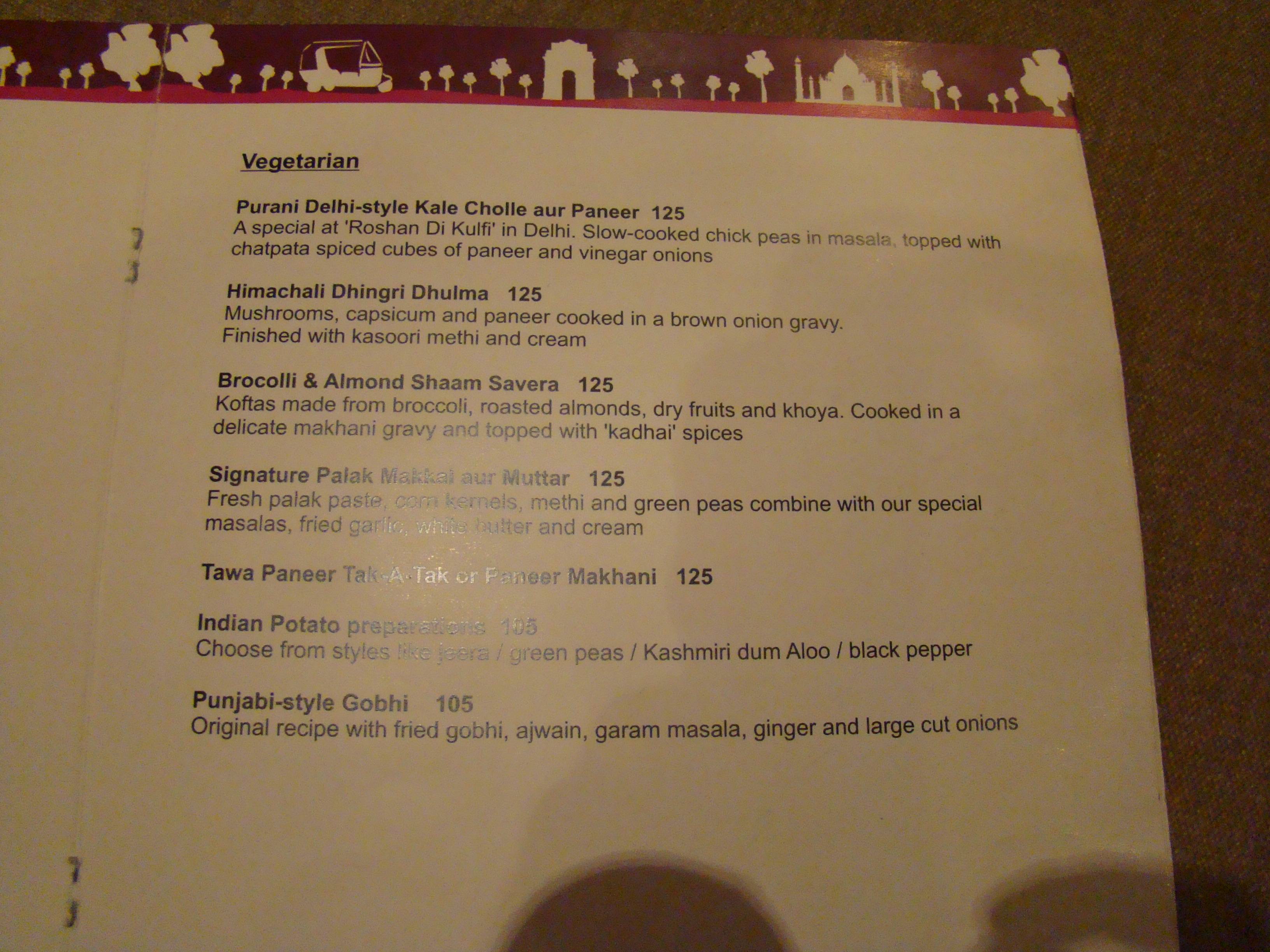
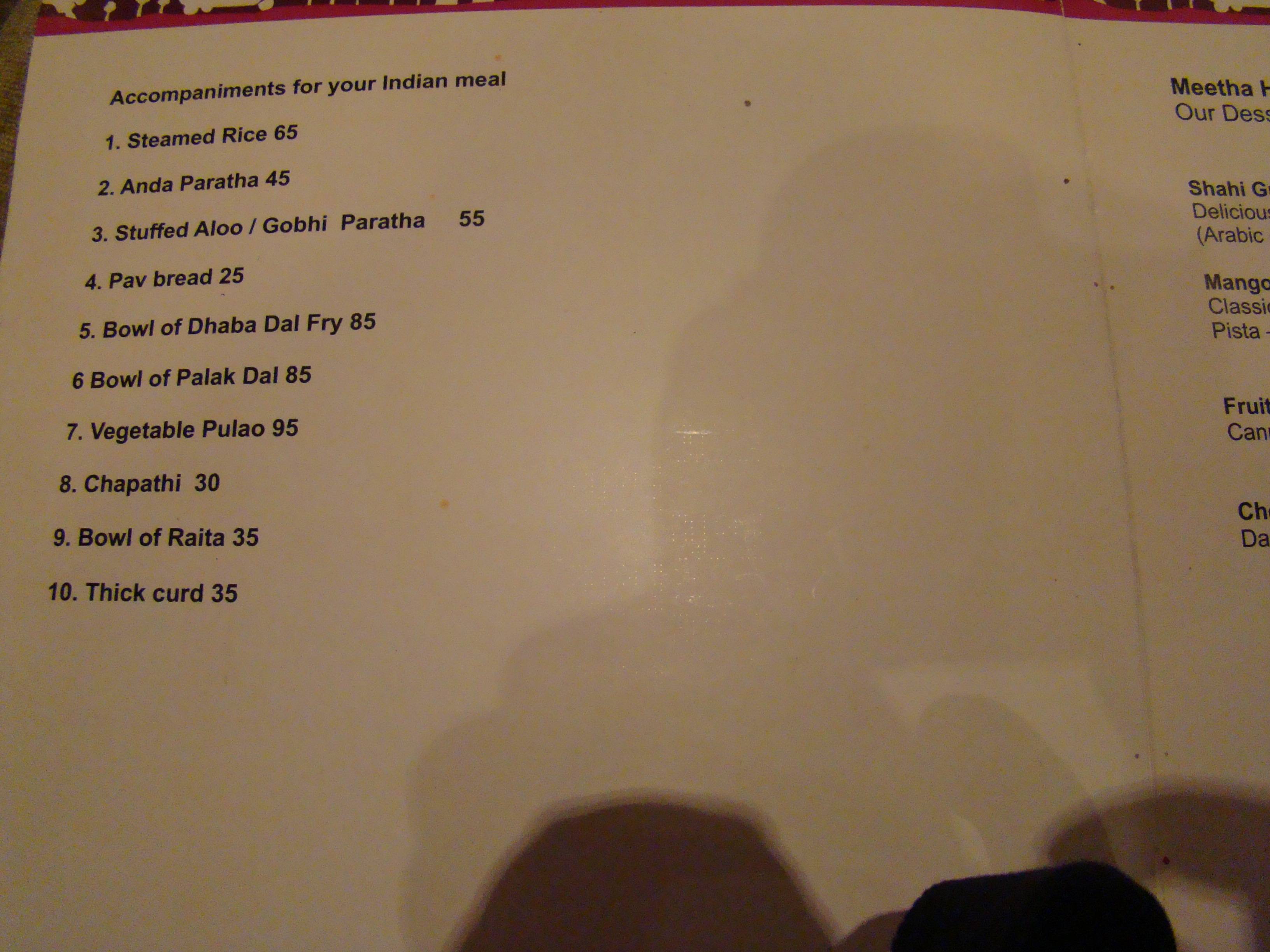
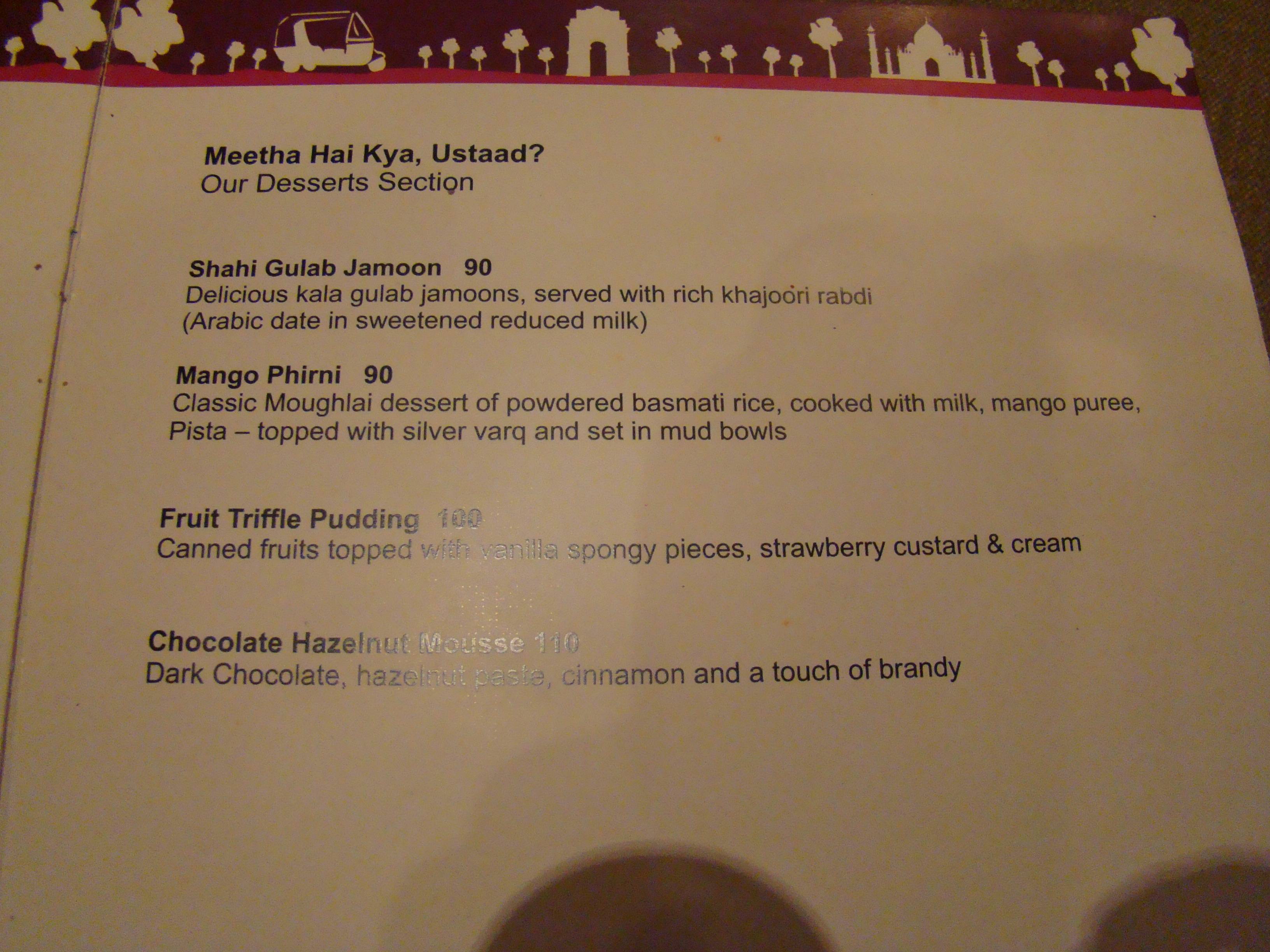
    The menu may not be spread over a lot of pages, but it covers much ground in terms of geography. Kebabs from Lucknow, fish dishes from Goa and Bengal, vegetarian fare from Himachal and Punjab, and Old Delhi specialities, together ensure that both vegetarians and meat eaters are kept happy. Add to this the uniqueness of many of the items and the day’s special dishes and you’ll find that there’s no dearth of choice. Take a look. (click for larger image)
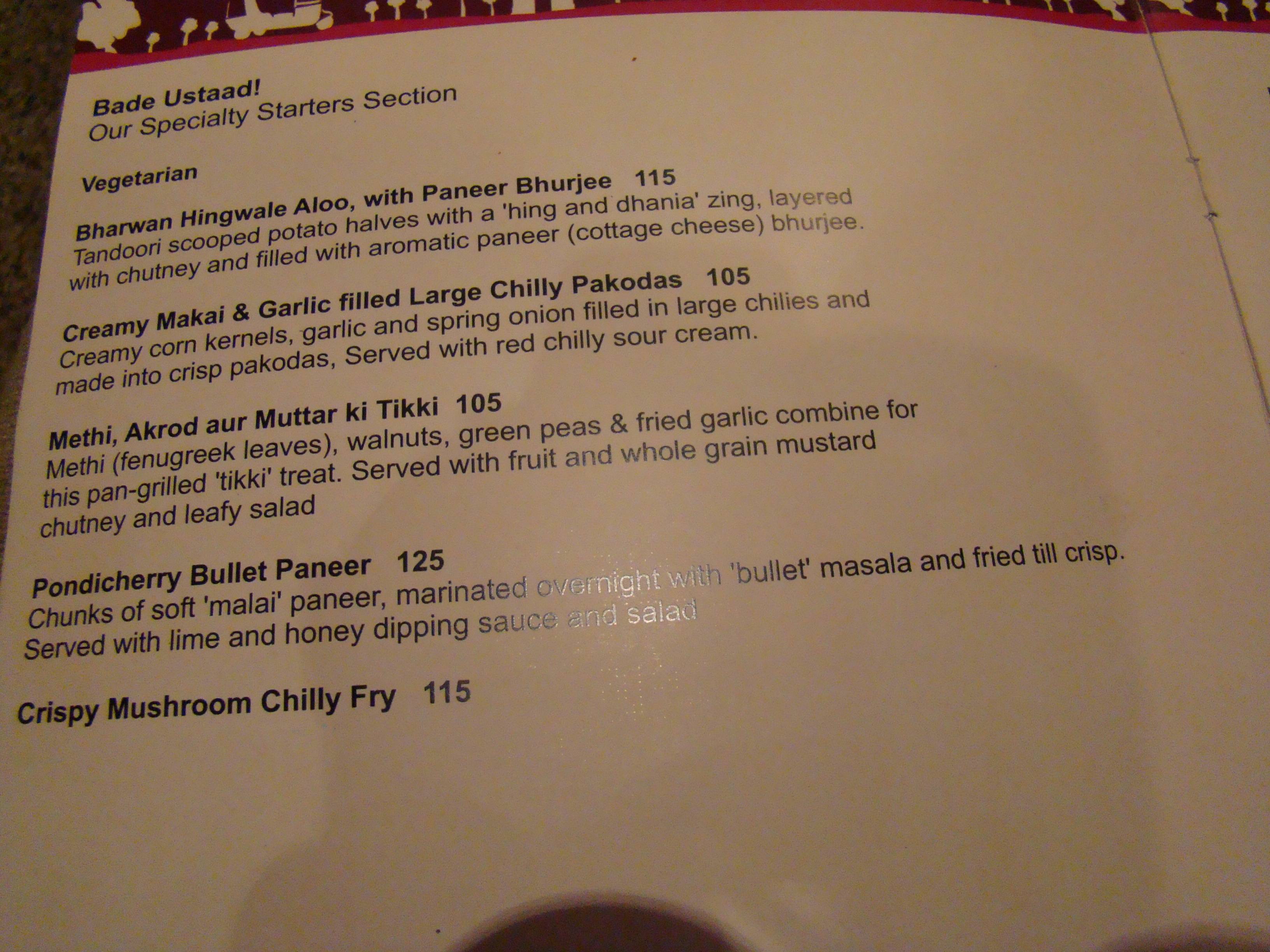
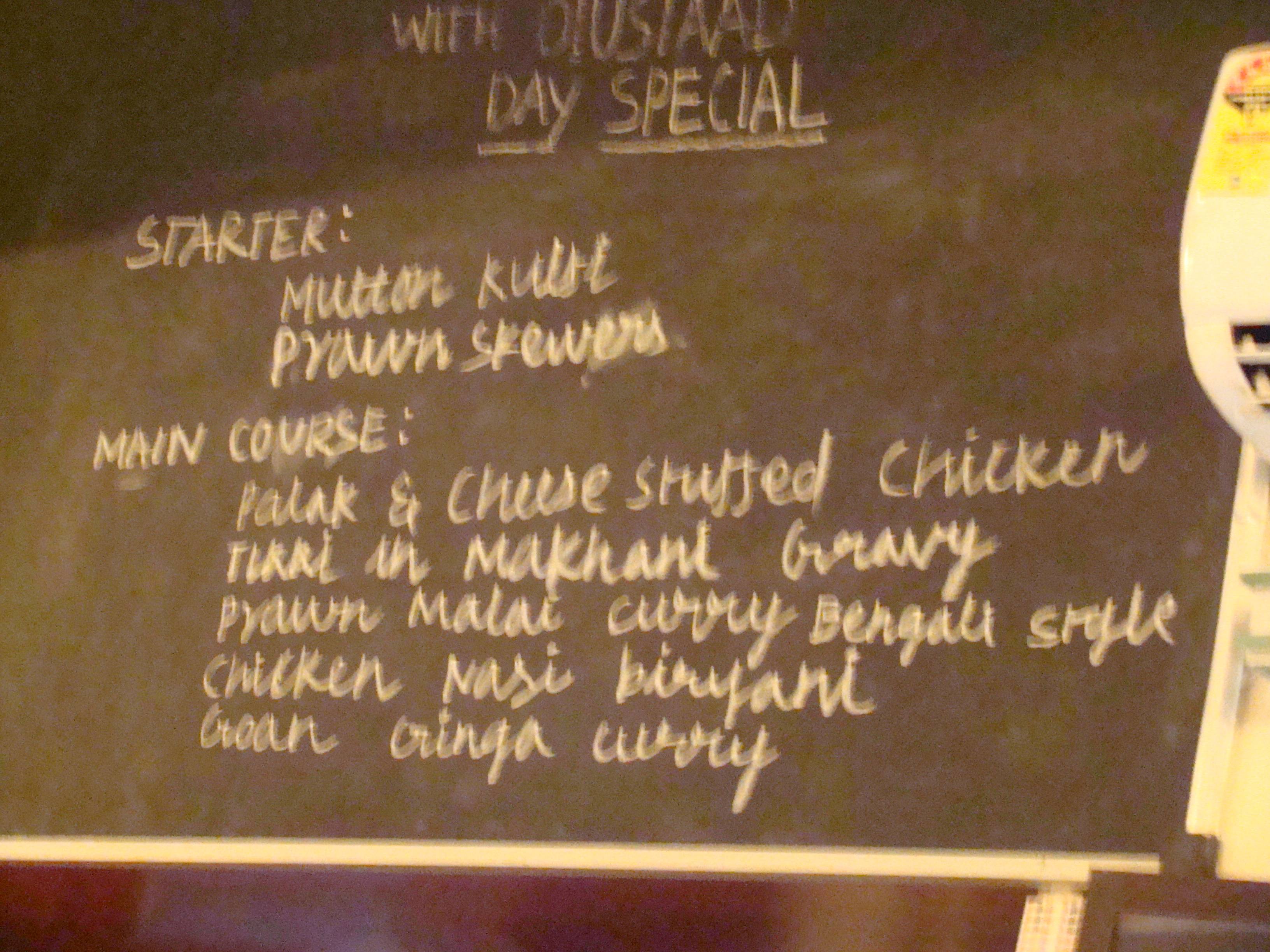
    From the 3 starters we tried, the Mutton Kulfi (one of the Day’s specials) was easily the best. The combination of melt-in-the-mouth mutton and a green chilly laden coating made it a unanimous favourite. The two starters we ordered from the regular menu were disappointing. The Pondicherry Bullet Paneer had no proof about the bullet or Pondicherry, and one of my friends had to be pacified as she felt she’d been conned into buying a Paneer Pakoda! The accompanying honey-lime dip didn’t make a good combination either. The ‘famous’ Chicken Salli Kebab was more potato than chicken.
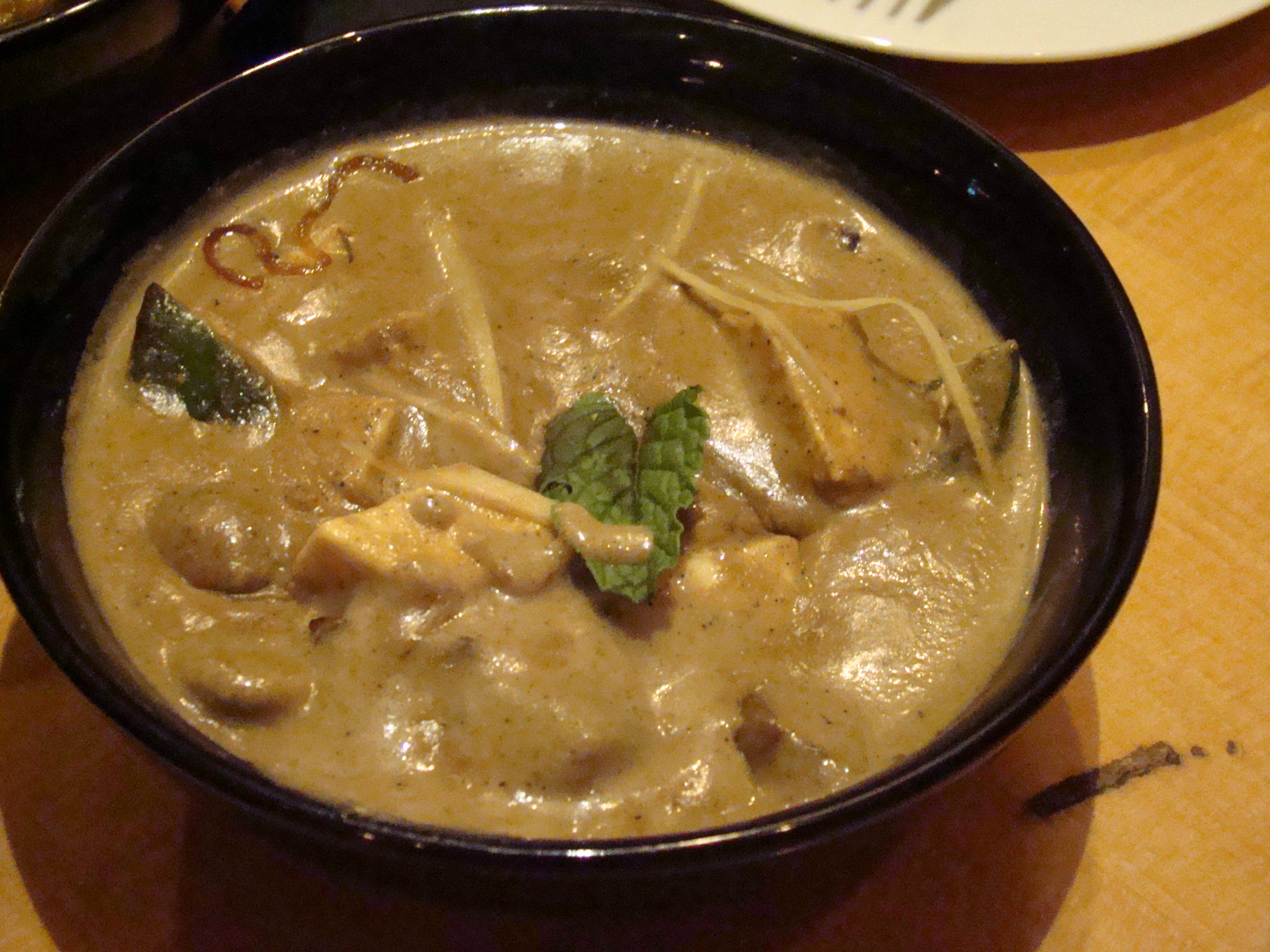
    Himachali Dhingri Dhulma Lucknowi Gosht Korma Prawn Malai curry Bengali style Anda Paratha

    In the main course, the ones that impressed were the Murgh Khatte Pyaaz, with its unique gravy of vinegar soaked onions, pepper and yogurt, and the Himachali Dhingri Dhulma, with mushroom, capsicum and paneer in a slightly spicy gravy. The Lucknowi Gosht Korma, though decent, was lost in the bargain. The Anda Paratha is definitely worth a try too, and though the Gobi Paratha had an extra helping of chillies, it was still reasonably good, as was the Aloo Paratha. The Prawn Malai curry Bengali style had an excellent creamy gravy which was ruined by the overcooked, rubbery prawns. The Chicken Nasi biriyani, which was another Day’s special, was, as one of my friends put it, Tomato rice with chicken. Somewhere in the kitchen, a cooking oil well has been discovered, judging by the liberal usage. Though the menu lists 4 desserts, which we were eager to try, we were told that they weren’t available. The apple and chocolate pies we were offered instead were both quite avoidable.

    The service was quite prompt, and Jitesh, who looks after the Bangalore outlet, did a good job of helping us choose the dishes, especially since the day’s specials didn’t have explanations. O!Ustaad is worth a visit when you’re in that part of town.  A meal for two would cost about Rs.800. Though some of the dishes fell short of expectations, the uniqueness of the menu and a cheerful ambiance should make up for the shortfall. They also have lunch buffets which seemed reasonably priced.

    O! Ustaad, Below Purple Haze, 17/1, Residency Road, Bangalore – 560025 Ph: 080 41518147

  • Place and Time

    After Facebook announced its plans to use its social graph to become the mayor of Location (via Places API, deals) and also become the ubiquitous sign in on the mobile platform, Mahendra, Arjun Ram and I had an interesting discussion on Twitter. It started because Arjun and I were wondering when Facebook Places would come to India, but also moved on to the impact of these announcements on Foursquare and even Google.

    Now in terms of world domination plans, Google is hardly a sitting duck and has been trying to gain a foothold in ‘social’ for a while now, with little success to report so far. But Android has been making huge strides and that should be some consolation. In our twitter discussion, I mentioned that what Facebook had done with this horizontal approach to the mobile platform (OS/hardware independent and just dependent on you being online) is a parallel to what Google did with Android, except this is a way more compelling move.

    Towards the end of our chat, I wondered whether, a couple of years later, we’ll be speaking the same way about Facebook as we are about Google now. Its difficult to imagine how, especially when Facebook’s strategy is about adding a social element to every online activity. Like I said, i have no clue on what the frontier might be, but then again, at one point, I did think, perhaps naively that Google had world domination all sorted out.  That was until Facebook started its march.

    Sometime back I’d written about whether every era has an organisation which best captures the culture that would enable success in the era. The time between eras is fast shrinking – IBM, Microsoft, Google, Facebook (?) (no, i haven’t forgotten Apple, just ignoring it) and I eagerly await the next breakout star. But I’m also trying to see if there’s something that connects the dominant forces – something that is not unique and not dependent on the time they were the gold standard in.

    Two posts I read recently gave me some understanding of why Facebook seems to be advancing faster. “Google’s real problem – GTD?” (Getting Things Done) at GigaOm and “Facebook and Google” at Piaw’s blog. Both pointed to cultural differences and the way the organisations deal with human resources. And so I wonder, is it inevitable that culture changes with scale, and how much can it change before things go downhill? Is there a way to stem that ‘rot’? I read a post about Amazon recently, that shows how Amazon deals with the various companies it acquires. More on ‘culture’ next week.

    until next time, search..social..surprise 🙂

  • Food notes

    For the last few weeks, I’ve been hooked on to MasterChef Australia. (the show’s site reveals the winner, this is the wiki entry) For those unfamiliar with it, its a cooking competition-show that airs on Star World.

    I’ve always liked the idea of food – more the consumption than the creation, of course, as you probably know. While I’ve begun to appreciate nuances these days, instead of focusing on solely gobbling up the food, cooking is still far away. My most famous exploit (and that’s only reheating) thus far has been the aluminum-foil-packed-food-inside-the-pressure-cooker-incident. I have a restraining order from D – I am not allowed to handle steel vessels and the microwave, when they exist in close proximity. D, as you probably know, has to show a lot of restraint anyway.

    But we digress. The show has interested me even beyond the awesome cooking that happens on it daily. I’ve never really been a fan of the music and dance reality shows, and after I began watching this show, I wondered about it.

    I enjoy music, but have always flipped, channels that is, when i watched those shows. Maybe its the one-upmanship games of the judges, or the showboating, or the SMS driven degradation of a god given gift, but they have never worked for me, though i have noticed some supremely talented performers.

    There is a passion in the cooking contestants, all of them – maybe they’ve managed to capture it well – a will to win, and they work hard for it. We can see the efforts, and the judges’ appreciation and backing – a sense of fairness. Perhaps I haven’t watched enough of the song and dance shows to notice any of this.

    Though both require honing, music (vocal) is perhaps a talent and cooking, a skill, to which creativity adds layers. So the latter, I thought, would require more of an interest, and more hard work. Does that mean the passion for it would be more than that for a talent, which might be ignored, because it has been given without asking. I guess either would be okay, if you had the passion and perseverance  to get it to its logical conclusion. Interest without talent, and talent without interest, both are sad states to be in.

    until next time, fortune cookie 🙂

  • Oye Happy

    [scribd id=51587862 key=key-14c9q39lppvv1buuuonh mode=list]

  • A Contention

    Ever since Facebook released the new groups, I have been wondering whether, in one sweep, they have started on a path to make the communities (vs) social networks dichotomy redundant. Yes, there is a difference. Of course, they would exist separately, but the dichotomy may cease to be a hugely relevant thing. Yes, I could list out an entire set of things that need to be fixed before they get there, but its still a very good start, when you compare it to its own groups, or groups on other networks like Orkut/LinkedIn.

    There’s a reason I thought so. One of the very interesting services that I don’t use (much) is Quora. Quora is a huge knowledge resource. It does this by allowing users to follow their areas of  interest, ask questions, which are answered by the community. Users can also follow specific questions and even follow people who they think will add value. Imagine the best in the field answering your questions, that’s usually what happens there. Its not just technology. I just saw that Ashton Kutcher had answered a question on Hollywood. And I still can’t make Quora a habit, though I’m trying to. But then I thought, what if this ‘interest’ was a (new) group on Facebook. Facebook is anyway one of my default tabs and an established destination site, and there’d be a much better chance of me participating if interesting QnA and people were a given.

    Back then to networks and communities. I was also looking at it through the prism of Gautam’s content-community social model, and wondering if this potential shift in the nature of networks and communities means that content is becoming a titular king, and distribution the real power. Content would obviously matter since conversations happen around it, and I’m not talking about the 140 character/ FB status message here. But in a social perspective, would good content be able to deliver value for its owner (in this case, I am referring to brands and media outlets) only if it exists in a network like Facebook or is able to deliver as much social functionality in its own network as say, a Facebook does, or has a huge distribution network on say, Twitter?

    Yes, yes, the strategists will say that Facebook, Twitter are just tools, and they’re right, but think about it. My hope is that in the next step of the web’s evolution, we’ll be able to see niche networks in perspective.  🙂

    until next time, contentious?