Year: 2010

  • Backlash

    “Ooh, seventh anniversary coming up”, says I, my eyes straying over the dates.
    No response.
    “Seven year itch..”, I remind her.
    “For now, you scratch my back and I, yours”
    “Isn’t it more to do with affairs behind your back?”
    “Easily solved if I scratch your eyes out first. I’ll promise to watch your back”

    until next time, start from scratch?

    PS. Back in a fortnight 🙂

  • Rolls United

    No, its not a post on my stomach, and the consolidated er, six pack. Rolls United is a restaurant in Koramangala 1st block. You can find the map here. (its actually at the corner where the road takes a natural right, when coming from the 1st Block junction). Parking shouldn’t be too difficult since there are many side lanes nearby. Note that its on the same road as Cafe Thulp, so don’t look to the left. Distraction would be easy, as our friend Eveline would agree. 🙂

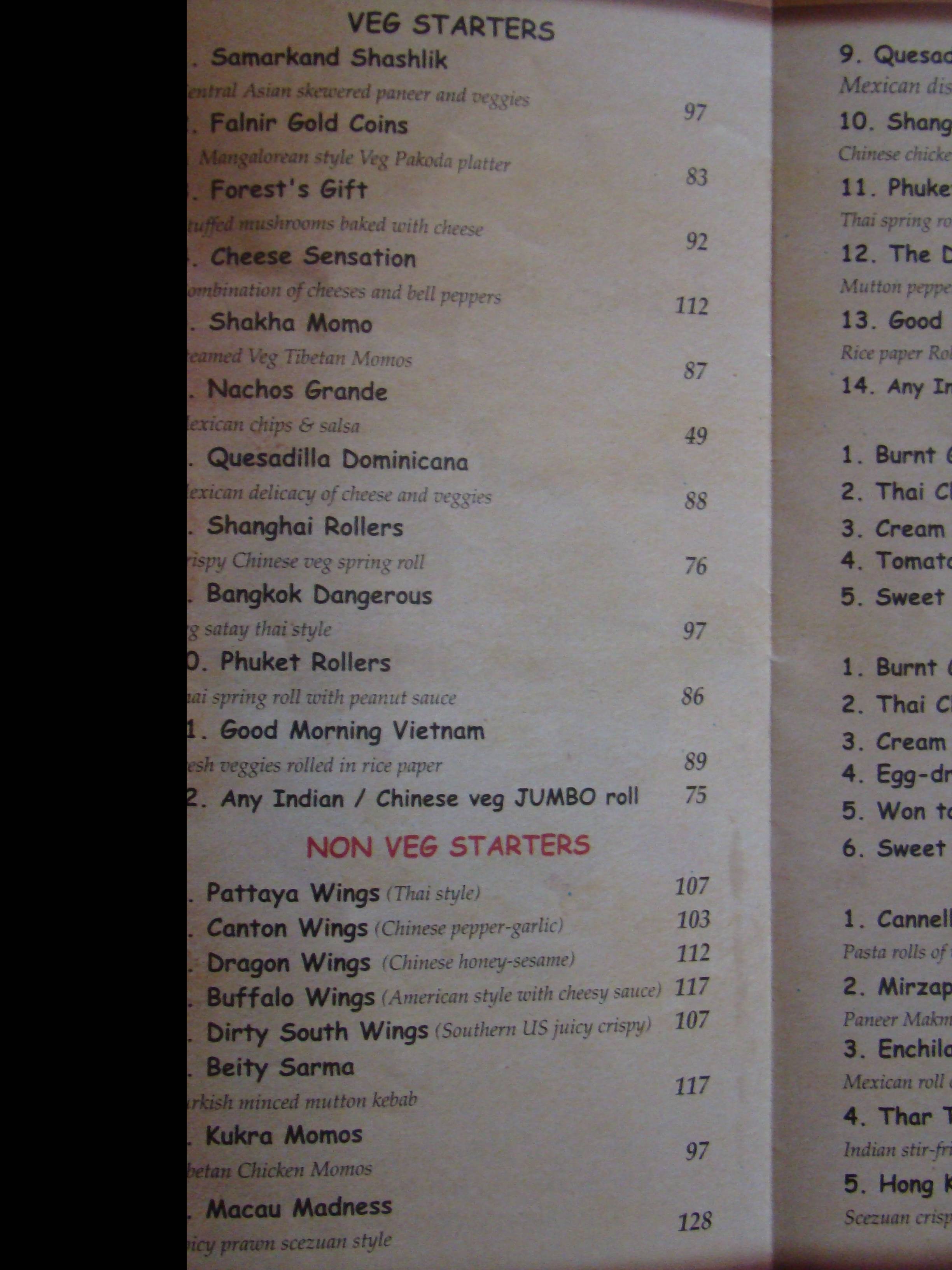
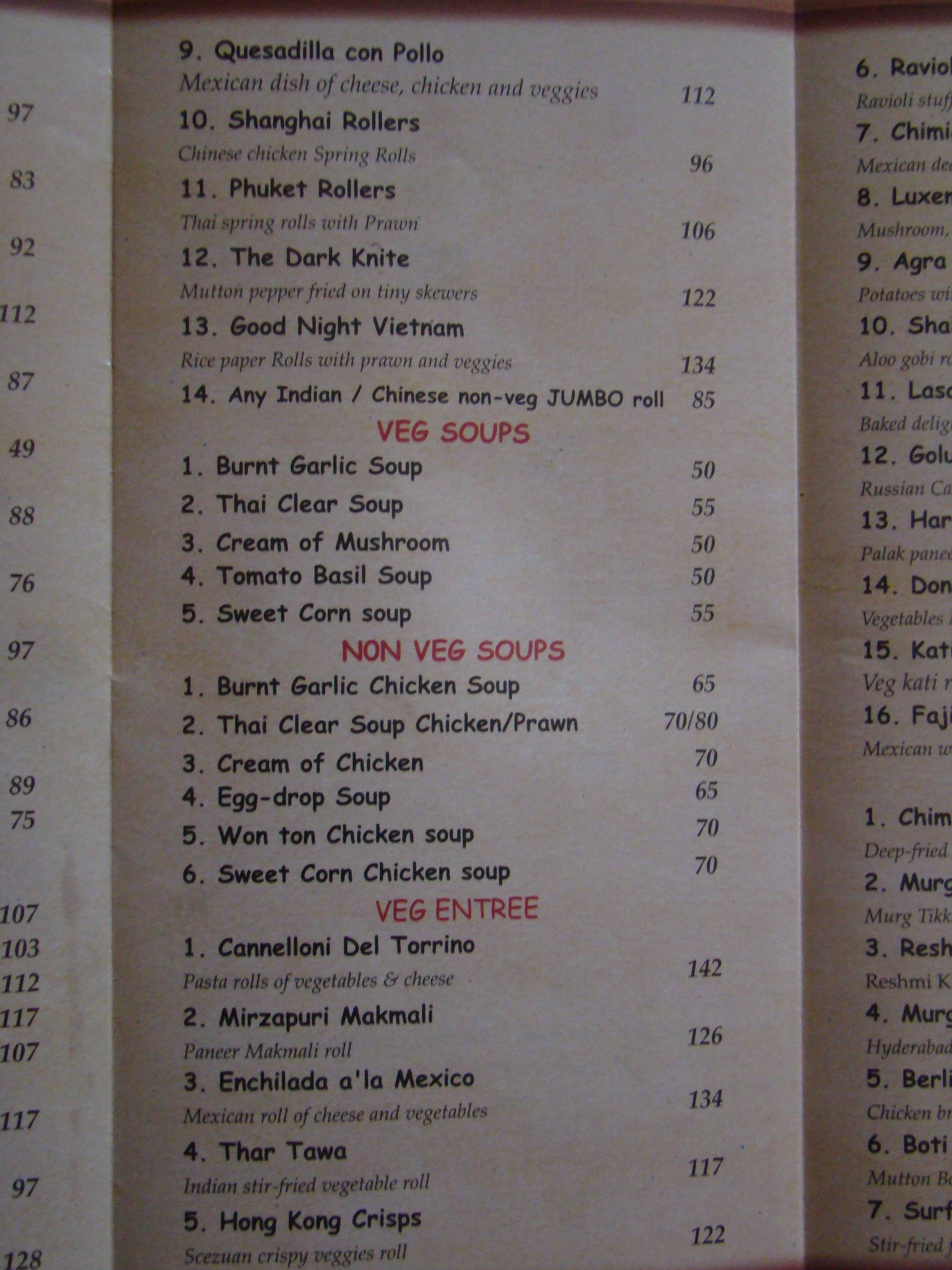
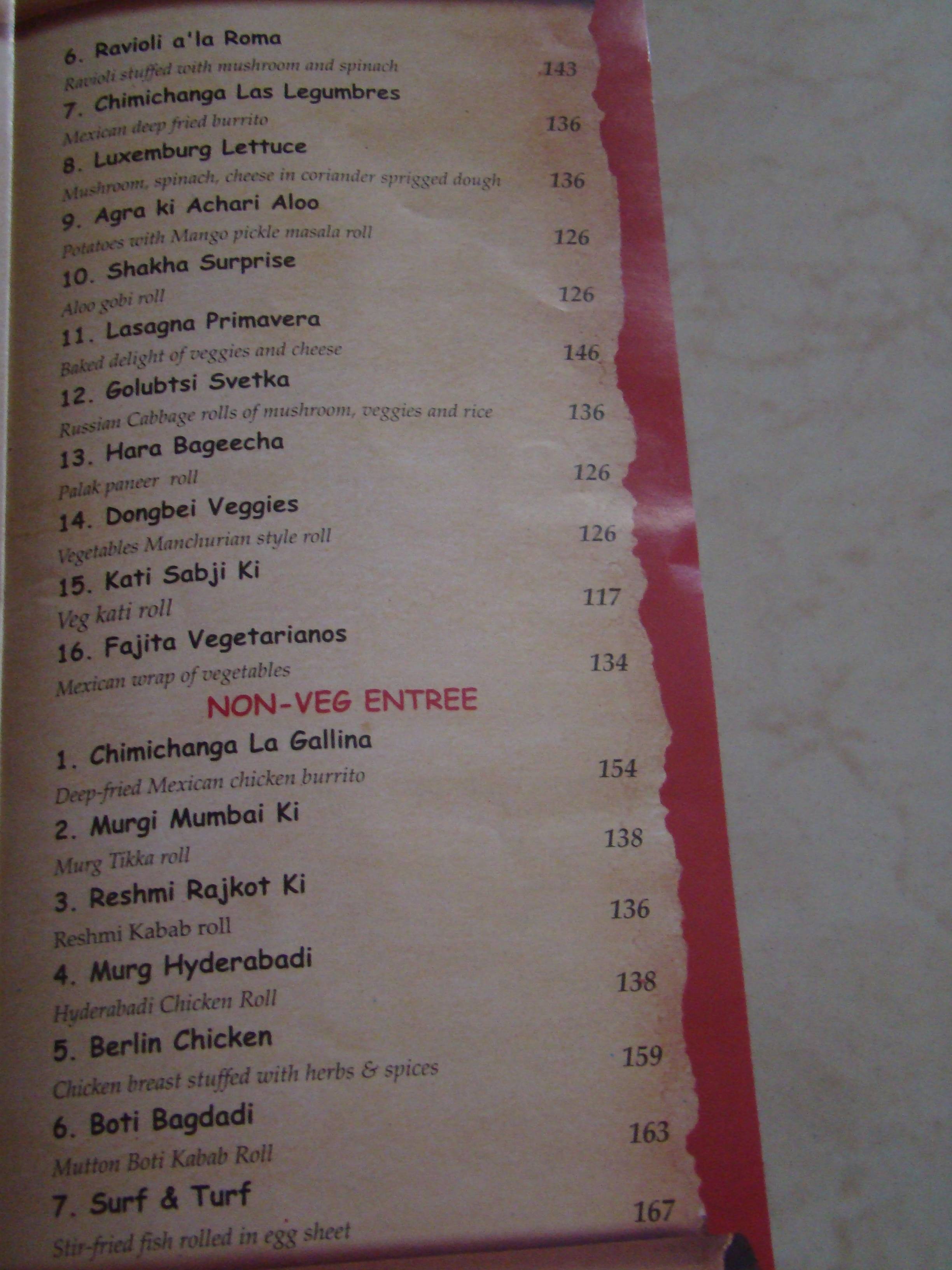
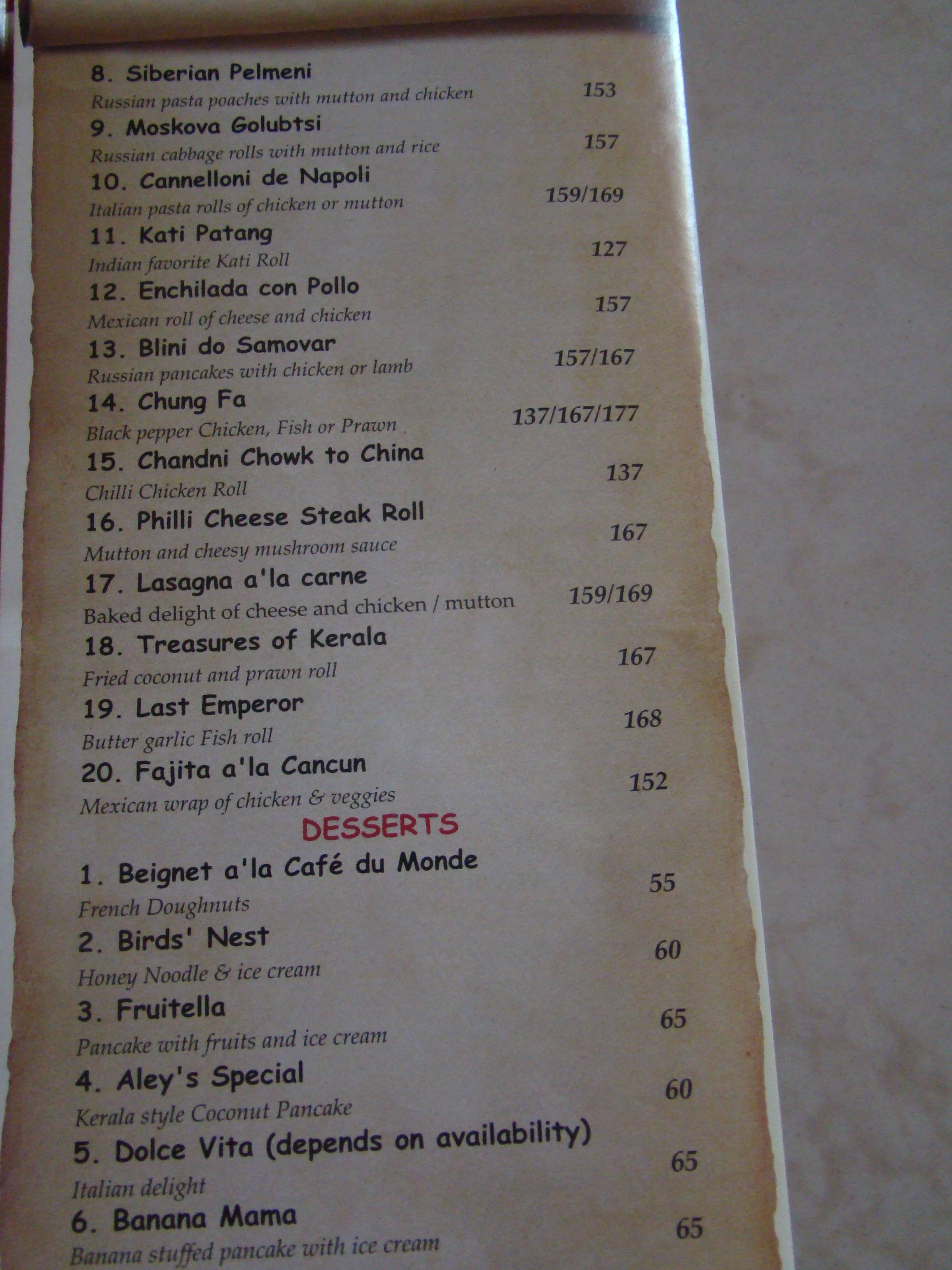
    The ambiance is pleasant and unpretentious, and somehow conveys a homely warmth. Of course, I am a bit biased because in the roll of honour (‘rolls united’ in various languages), there’s a separate panel added at the end for Malayalam. 😀 I must admit that I always thought the place was only about rolls, until I read a few Burrp reviews. It is a lot about rolls, but as the menu (below) would suggest, there are other things that play a role too. This is the home delivery menu (below – click for larger image), and in addition to this, they also have quite a collection of mocktails. (You can find that here  – page 7 onwards)

    1 2

    3 4

    Though the reviews at Burrp had mentioned large portions, the soups and starters were too tempting for us to ignore either. We started with a Cream of Chicken soup, which was so good that I think it worked on the soul too, as some book titles would suggest. It was very creamy, with a sweet tinge to it (coconut cream/milk?) and loads of chicken chunks and mushrooms. I think its the best we’ve had in a long time. Up next was the ‘Quesadilla con Pollo’, which is ‘baked cheese dish with chicken and bell pepper, served with sour cream and salsa’. Another good choice, though 1 slice (out of 4) had a goeey base. The sour cream complements the taste, though I felt it could’ve been more spicy. The salsa didn’t help on that front either, but the dish is good enough to still warrant a try.

    For the main course, we ordered a Siberian Pelmeni, “Russian favourite pasta poaches with the mixture of mutton and chicken that melts in your mouth together with the spicy paprika sauce and original Russian salad” and a Surf & Turf, “stir fried fish rolled in an egg sheet”. The former seemed to be the Russian version of momos, and while it did indeed melt in the mouth, it was a bit too bland for my taste. The sauce served was definitely not paprika. The fish dish was much better, mildly spicy, and was served with french fries and vegetables. The fries weren’t that great though. I have a feeling that we chose perhaps the wrong dishes. All of the above cost us a little less than Rs.500.

    I’d still ask you to give it a shot. The soup was excellent, the starter was good too, and there are enough choices in the menu for you to experiment with. The service is very good, maybe you could ask them for a bit of help in selecting the right stuff. They also have executive lunch combos, which, on paper, looked like great value for money.

    Rolls United, #15, 1st Main Road, 1st Block, Koramangala. Ph: 41314847

    Menu at Zomato

  • In duress

    A few days back, when I met Balu and Conall, we happened to talk about the lifecycles of services (Twitter and Foursquare was the context) and then discuss whether product lifecycles were being compressed too. It is interesting because let’s say an organisation has invested in a new technology and brought out a product. If they price it high, adoption will be slow, and it may never become mainstream. If they subsidise and price it low, they may lose out if a better technology arrives before they  break even. Mobile phones (feature compatibility and obsolescence), content storage devices (VHS to Blu-Ray) were some of the examples discussed.

    Dina wrote a couple of good posts (Part One, Two) recently on durability,and whether it is losing its power as a consumer driver. The plethora of brands advertising in the youth category would seem to agree (best expressed in Fastrack’s ‘Move On’ campaign), but as pointed out by Goutam Jain in the post, in many cases it would be intrinsic to the brand’s value. The rise of ‘good enough’ in the real time era is not helping the durability cause either. We could go from fidelity in devices to that in human relationships and the cause/effects in consumption, but maybe we should get Dina to do it later. 🙂

    The second post is also a great read and is based on the comments on the first, and introduces some excellent dimensions to the original thought.  Convenience + cost of exit, opportunity cost of not entering the next ‘upgrade’ are things that I’d like to add to that.

    Brand equity is something that falls naturally into the scope of this discussion. But what i was more interested in its impact on the content that brands create, including their communication. Look at say, print ads, whose physical durability is perhaps one day (equity created might probably last longer), or radio jingles and television commercials., with a slightly larger shelf life. On the internet, it can exist ‘forever’. But there are costs involved in all of these, and in terms of durability, they might not really deliver in this era of content abundance, fleeting attention spans, and the constant search for the next ‘wow’. Also, on a smaller scale, what happens when you design say, applications for a particular platform/device like a Facebook/ iPad, and it doesn’t prove to be durable? It is many ways, a gamble.

    So, when I read Clay Shirky’s amazing post ‘The collapse of complex business models‘, I sensed a tangential connection. To broadly summarise, the post uses Joseph Tainter’s ‘The Collapse of Complex Societies’, in the context of TV content producers’ inability to cut expenses below revenues, and explains how at some point, the level of complexity added to a system fails to add to the output, and becomes just a cost, because the different levels extract more value than the total output. Also, by this time, the system is too large and too interlocked for it to adapt quickly and change. Then ‘collapse is simply the last remaining method of simplification.’

    The post throws light on what is most likely the ‘tripping point’ for contemporary media. With increased connectivity between individuals thanks to various platforms, more ideas are being formed and honed. As new products and services arise, consumption patterns change, new needs are discovered and a disruption (which is perhaps another way of  describing simplification) always seems around the corner. I see this as a message to brands, many of whom have evolved their organisations, products and services on the basis of older ways of communication. How much has durability of products been a factor in the design and structure of communication and organisational processes? Or was it a result?  As durability ceases to be a major factor, is the new imperative flexibility?

    until next time, we still call it consumer durables 🙂

  • This connect…..

    Perspectives. The ones that will only make sense to yourself. I experience a lot of that – both ways. Cryptic ‘humour’ that I come up with, a book that I read. Maybe one has to be ready to receive that perspective. I used to wonder what the drawings at gapingvoid was all about until recently. One change in my own outlook of life and it all started making sense.

    Sometimes I think I might get it, but it slithers away. Like Road, Movie. I did enjoy the ride, but I don’t think I got the perspective the maker had. But it perhaps doesn’t matter,  because I may attribute something to it and derive a value that the maker had never thought of. Maybe that’s why many artists become popular years after they go hmm, underground, or up in smoke. Maybe others gain that understanding required for the perspective, or maybe the artist is no longer around to dispute the understanding 😉

    Perhaps that’s all what the search is about. The one kindred soul who can just feel the same way about the particular experience as we do. A smile, a tear, a look, a hug, a connection. But of course, then the greed sets in, expectations abound, permanence is sought, and heartburn happens, for after all, not all of us are lucky enough to lose baggage in transit. 🙂

    I’ve been really stuck to the eklektic station on live365. And I like the playlist so much that I felt I could perhaps get away from collecting music if I had access to it all the while. It seemed vaguely analogical to the idea of having no baggage when one is connected to a higher consciousness that provides bliss all the while. 🙂

    Its one of the things that makes Twitter work for me. A stream of collective consciousness. Somewhere in that huge crowd i can be invisible enough to continue sending and receiving perspectives and wonder exactly how the other person’s perspective was arrived at, all this even without a conversation. I can also stop myself from seeking validation. No baggage… technically, if I don’t count the RTs 🙂

    Oh, all that I know,
    There’s nothing here to run from,
    And there, everybody here’s got somebody to lean on.

    until next time, sole searching for a read that didn’t make sense? 😉

    PS: Like with most things web, shared perspectives too have an extreme dark side. Read about the Chinese Cyberposse, who track down and punish people who they think have committed a wrong.

  • Of Social Media Baubles

    I read Umair Haque’s post – The Social Media Bubble, through the prism of  ‘interesting’ vs ‘popular‘, the subject of my last post. In the post, Haque’s biggest gripe with social media, the way it is now, is the low quality of ties between the people who are connected. Thin relationships, he calls them and he has five supporting arguments – the disproportionate rise in the average number of ‘friends’ vs trust, the creation of more intermediaries rather than removal of old ones, hate (and I keep ranting about this on the other blog – trigger happiness), exclusion (again, something from the other blog – the clique friendly web), and lack of intrinsic value (and therefore the need to monetise, perhaps by ‘extractive, ethically questionable ways’). He also sees three major casualties because of this – inefficient attention allocation, investment in low quality content, and the weakening of the Internet as a force for good.

    Now, the archives of posts here and on the other blog would show that I am sometimes frustrated and disappointed with a lot of activities on the social web, its usage, and therefore the direction in which it is going. But then again, I still have faith in the social web, and believe what we’re going through is the phase of transition, a time between fundamental shifts in the way we interact, and I’d be naive to expect it to be smooth. Also, unlike the earlier forms of media and communication, the web (and mobile) seem to have a much smaller gestation time between disruptions. I now tend to believe that this IS the way its going to be for quite a long time, because we’ve only started exploring avenues and possibilities. So, extrapolating current usage patterns to the future in a disruptive scenario looks flawed to me. But yes, like any other ardent faithful, I too am looking for signs.. and thoughts.

    So while I did agree a lot with what was written in the post, and considered it a very good read, I was even more happy to read two replies to that post – “Rethinking Thin: Social Relationships in Social Media“, by Adrian Chan, and “Umair Haque is another new spatialist” by Stowe Boyd.

    Adrian Chan does a great job in deconstructing Haque’s post. He first argues that the logic and analytic of social network analysis cannot be based on the attributes and qualities of human relationships and social organization. He maintains that in the former, the tie (and its not the same as a relationship) is more significant than the node. (person) The (sometimes) asynchronous and unequal communication facilitated by the medium is also a point well made. The semantics of “social”, when explored through the meanings of ties, interactions, communication and relationships is something I found very enlightening. On the whole, I agree that these tools are modes and means of producing communication, and offer us means to form ties, interact, possibly communicate and then over a period of time, even establish a relationship. But the ties can be just that, and remain to be re-used in other contexts and at other times too, by people I may not have a relationship with, until then. Its a post you really must read, and I must confess that I’m still (re) reading it to truly grasp all the arguments.

    Stowe Boyd argues that Haque is ‘undervaluing the utility of weak ties’ and then brings in three of his own thoughts – ‘social has not gone far enough’, whatever is there has been ‘commoditized by the corporate types’, and a worry about the governance of the social web. The common thread that I sensed (with the paragraph above) was how the dynamics of broadcast media have been brought into play in blogging and microblogging. (attributes of one system forced on another). The other wrong attribution, with respect to Haque’s post, is perhaps looking at it through just an economic framework. The New Urbanism and New Spatialism notes are really fascinating, and that’s an understatement.

    Very honestly, and it most probably is because of my levels of understanding, the two ‘rebuttals’ and the thoughts therein, are quantum leaps that are required, which will take time. In the short-medium term, I think it will be an evolution (as opposed to a revolution). We might end up with better social media structures and frameworks of understanding or we could become a set of gated communities within a world wild web with controlled experiences suited to our likes and dislikes. The latter is not something I’d like since we’ll just be trading one set of walls and gatekeepers for another. In either case, I hope the medium term will see better tools for managing our ties and relationships, and will help us streamline our creation, and consumption. A good note on that curation by Robert Scoble.

    Meanwhile, I’m also thinking of the implication for brands. The no-brainer is an approach that goes beyond tools and looks at basic changes required within and without. The other part is setting the expectations right on metrics and ROI, when using the social web?

    until next time, echosystems, I hope not..