Year: 2010

  • A different kind of social

    Despite a healthy skepticism for all things Google attempts with social, Wave and Buzz not having helped very much, I was quite excited after I saw the presentation below by Google’s Paul Adams. (the link which I had shared last week) It meant that Google Me was worth keeping a watch on. No, not the movie, the service.

    [Read Mahendra’s excellent key takeaways+thoughts post if you need a quick snapshot without having to read 216 pages.]

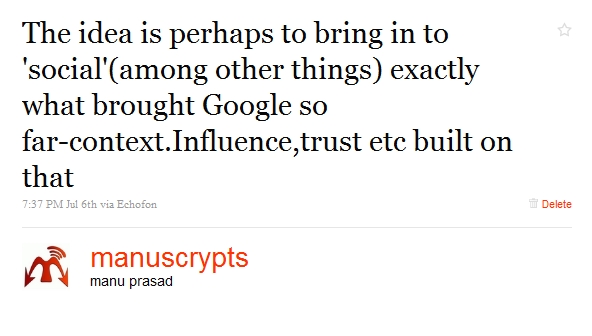
    I was quite impressed with the scope of the presentation – from looking at people’s motivations behind their ‘social’ actions to the insights that have been gleaned. I must admit that i was a bit surprised that Google, or at least its employees took social this seriously. Good to know that Facebook and Zuckerberg’s stated aim of 1 billion users in the near future is finally pushing Google to do something other than killing of services (Jaiku, Dodgeball…) or making a mockery of itself in front of its competitors with half baked products. And that they’re doing research too. My first thought, after I finished reading the document was
    Clipboard02

    Its ironic that Google faces a ‘What Would Google Do’ on itself. The good news is that there is enough scope for developing a network for context based social relationships and transactions. Like I said in my last post, the tools available still donโ€™t allow me the freedom to aggregate and disaggregate connections and content at will in different contexts. It is possible to build a social network around many contexts – enterprise/professional use, location, family, interests and so on. I even saw an interesting app built for ‘proximity based networking’ – it syncs your existing networks – Facebook, LinkedIn, MySpace with location and thereby does a twist on location based networking, with seemingly good privacy controls.

    The bad news is that Mark Zuckerberg won’t take too kindly to encroachments in his space. As if ‘friends’ weren’t universal enough (at least inside the FB universe – including Connect), ‘Like’ is even more universal, and Facebook’s recent play is aimed at pipping Google’s (relative) ability to deliver the most relevant content to the user. It doesn’t help that social doesn’t seem to be what Google’s comfortable with.

    But assuming Google Me is a social platform of some sort, what I’m wondering is that how many users would use Facebook lesser for a service which allows context to be brought into the picture. There’s something really simple about the ‘sharing’ on Facebook. For a service that used to be labeled ‘complex’ in the Orkut era, it has come far. Users have adapted. Also, how difficult is it for Facebook, which already has a massive userbase to introduce features that allow a user to create sub identities to splice and dice friends (already has lists) and content and choose what to use outside the network? It already has filters to control the kind of information I want to see on my newsfeed, these can be improved too.

    The other thing is how/where Google would build this – a separate service/ something around or integrated with iGoogle/Buzz (brrr)/Chrome (browser or OS)/ Search itself ? A lot of the design would be based on this. And how can it balance the simplicity of Facebook sharing with the more complex needs of context and privacy?

    A larger perspective is that we’re nowhere close to the end game as far as our (probably seamless in the future) network of digital and real activities go. Its having a larger impact than what we sometimes credit it for. In fact, we are only discovering how the web is changing our behaviour and even perhaps motivations. A few of us have yet to decide whether we want to sync our multiple online identities. And that means that though Facebook is probably the most accepted solution now, its by no means the perfect one, even for our current understanding. Facebook, Google and the ones we haven’t even heard about are all Work In Progress, but boy, what interesting work it is! No monopoly, lots of chance and multiple community chests ๐Ÿ™‚

    until next time, google yourself ๐Ÿ™‚

  • Storied

    The best thing about buying second hand books is that they might contain stories. No, I haven’t completely lost it, I meant additional stories. Messages, notes on the side, bookmarks from previous owners – they’re all stories. Stories that give you a tiny glimpse of the person who wrote it, or the person it was meant for. The last one I saw – in Pico Iyer’s ‘Abandon’, was very interesting. It said

    Dearest A****,

    Though this seems, and is the last day at C-72, I promise that its the first day and a nev be start to the best days of our life together.

    Yours

    S*******

    30/Aug/03

    I thought there was an amazing sense of romance in that little note. A story from almost seven years back. I wonder why A sold the book. Did they break up? Maybe she didn’t like this genre? Maybe they shifted, and there was no way to carry this. It was an empty page, A could’ve torn it off, she didn’t. Maybe she didn’t have time, maybe she didn’t care.ย  Maybe she didn’t remember. Maybe, God forbid, something happened, and S didn’t want any memories? Maybeย  she returned it to S after they split, and he sold it. Maybe S never gave it to A, and instead sold it because some memory was too painful? Now you see the possibilities? But, to quote from the book itself “We are no greater than the height of our perceptions”.

    I’d only started on the book, but it had already given me a thought. “The death of the author is a way of talking about the death of God. The world itself becomes a poem whose author disappeared long ago.” So the poet dies, the poem remains, the artist dies, the art remains, the author dies, the book remains, God dies, his creation remains, to be interpreted and shaped by us, the ones who see and experience it, limited by the ‘height of their perception’. Maybe the creation was never completed? Like the stories that remain in the head, never to be told. Like the pages that fill the waste baskets. Like the blog’s draft folder? ๐Ÿ™‚

    Meanwhile, on the next page of the book, there is a signature now, dated 10/04/10. He thinks he won’t sell any of his books.. ever. But then, stories have a way of twisting themselves in time. ๐Ÿ™‚

    until next time, home pages ๐Ÿ™‚

  • Butter Chicken in Ludhiana: Travels in Small Town India

    Pankaj Mishra

    If one were to go by the title, Pankaj Mishra is hardly the person who can be trusted to write about the “national bird of khalistan”, after all he’s a complete vegetarian, but then this book is about ‘travels in small town India’. From Kanyakumari and Kottayam to Ambala and Murshidabad and Gaya to Mandi and Udaipur and many many more small towns across the length and breadth of India, this is quite a wonderful account of a transforming India..and Indians.(set in 1995)

    While there is an unmistakable cynicism that runs through many accounts, it does not really take away much from the conversations with a wide array of people – their fears, their hopes and aspirations, and how they cope with the changes around them. Television viewing habits, consumerism, big dreams, all figure as a framework for the author to show the ‘progress’ that Indians seem to be making as far as lifestyles go. ‘Progress’, because the author doesn’t seem to be entirely pleased with these changes, and the effects on existing ways of life, but since we also see them through the eyes of the people the author meets, the book manages to retain some objectivity.

    While some would say there is an aimlessness to the travels, I’d say that despite the differences in locales and attitudes, there is a common thread that runs through the book – of humans, their reactions to change, and how in many ways, a lot of things remain unchanged, despite what the superficial would indicate.

    The book worked for me in many ways – I could find glimpses of ‘The Romantics’ (a later work of fiction from the same author, which happens to be a favourite) as his travels take him to Banaras. It also brought about some nostalgia, as it is set in the early 90s, and the changes that the author talks about are something that anyone in the their teens (or even older) during that time, can identify with. These, and the wry humour – especially the part where he’s mistaken for a potential groom by Mr.Sharma in Ambala – that surfaces occasionally, took it many notches above a general travel book..

  • Influence Cycles

    The term ‘influencer’ is a recurring one in social media. Mahendra had a tongue-in-click post last week on the subject, and Surekha and I ended up taking it on a tangent, and it reminded me once again of the way ‘influence’ is changing, for all parties concerned – influenced, influencer, the object that links them and the medium that connects them.

    It was relatively easy when the medium was one way – mass media. The number of influencers were limited and there was really no way to locate or measure the individuals who made up the long tail of influencers. Or at least few were interested in doing it. The web disrupted it. The influenced found an abundance of content, the influencer saw his power being diminished by millions of publishers. The object (including the service provider/brand/organisation/group etc) figured out that it wasn’t at the mercy of limited influencers, but discovered a huge list which had its own quirks, but had the power to influence a multitude. Yes, known stuff, just summing up for context.

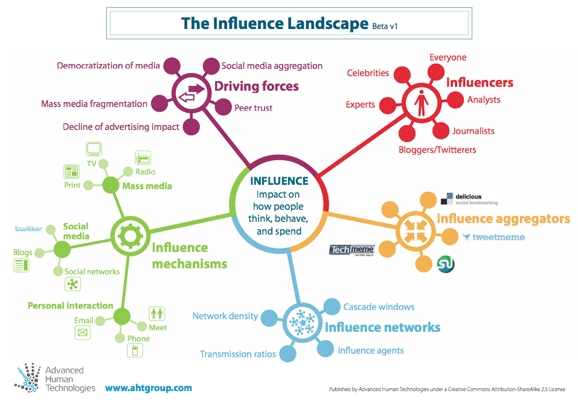
    I remember touching upon ‘social influencer relationship management’ (yes, there is actually a term for it) late last year, and the importance of trust. Influence, for me, has been a difficult thing to wrap my head around. There are so many factors erm, influencing it – time (specific and relative), context, trust (and objectivity) and the fast changing content platforms- each of which seems to add yet another layer. The complex structure has been well illustrated well in the chart below

    Influencer

    via ( a post similar to Mahendra’s, but more serious in tone ๐Ÿ™‚ )

    At least in the medium term, I think its only going to get more complex, primarily because the platforms are only evolving – Quora, the service I mentioned in the comment to Mahendra’s post, for example, can help in establishing context specific expertise and therefore trust. Facebook, when its QnA service starts, will try to establish it within a known network. Twitter has already tried it too, but I agree with Surekha. I’ve noticed that with web platforms, after a certain scale is reached, the culture starts resembling that of mass (media) and the ‘influencers’ as well as ‘influenced’ begin a relationship that’s familiar from a mass media era. What also complicates is that the ‘object’ of the relationship sometimes discovers that it too has a voice or can hire a ‘voice’ and attempt influence. This is one of the ways it is trying to adapt to new platforms. But while there might be flaws in each approach, I do feel the direction is right.

    At this point in time, as a user, I’m still evolving in terms of the platforms I use to establish networks of trust. The tools available still don’t allow me the freedom to aggregate and disaggregate at will in different contexts. That’s probably something brands can identify with too, thanks to the plethora of platforms and influencers across networks. Its perhaps the difficult transition state when brands have to manage traditional communication outlets, new media barons, their own content management systems that need to evolve, and a long tail full of influencers. More importantly, brand processes (like advertising, PR etc) had evolved in a mass media milieu and a struggle to adapt to the disruptions brought around by a two way communication mechanism is what we see around now. We’ll keep that for another post, and quickly jump to an aspect that intrigues me from the four influence factors I mentioned earlier- that of time.

    Long back, I wondered how we could juxtapose product and consumer life cycles. Let me address it in this context. Different consumers will ‘reach’ the product/service at different points in its lifecycle. There is a ‘time divide’ that separates the different sets of users. The motivations of this set would differ and therefore , its influencers will also be different, as will their motivations. Brands (using it as a blanket term, includes services too) these days are constantly in the hunt for early influencers, which is why I found this article, which discusses why gadget manufacturers should target late adopters, very interesting. This could apply to platforms as well. I wonder how this thought can affect when and how brands try to influence on new media platforms. Does it make sense to wait till platforms evolve to an extent where they can work better for the brands or is technology moving way too fast and lifecycles of all concerned behaviours becoming too small to wait?

    Meanwhile, what if the millions who have never used Facebook are influenced by the movie? ๐Ÿ˜‰

    until next time, in flux

    Bonus Read: I plan to riff on this soon, but in this context, you could check out pages 147-173 of this amazing document. (via Pluggd.in)

  • Watermark

    Sometime back, while trying recollect the name of a Chinese restaurant in Koramangala which existed circa 2003, I got stuck. Despite different mashups of the various terms used typically for Chinese restaurant names, nothing sounded right. It was a small mom-and-pop joint and since the net didn’t then feature all the resources it has now, I was well and truly stumped. It was quite disappointing since we’d had many a meal there. It didn’t help that I have this ‘thing’ about remembering such places, events and people. I feel as though I have betrayed them in some way. Yes, weird, thank you. :pย  The book, for once, couldn’t help either. I finally got the answer by checking with a friend who’d been in Koramangala long enough. Once I got the name, I even managed to get an image on the net – Szechuan Garden. ๐Ÿ™‚

    A few days later, I watched Pakal Nakshatrangal, a movie about a script writer – director played by Mohanlal. The narrative is from the perspective of his son, an author, who writes his father’s biography, and in the process tries to solve the mystery of his death. The movie begins with the demolition of ‘Daffodils’, the cultural hub of the previous era’s intellectuals and the scene of Mohanlal’s many exploits. There is a sequence in which a television newsreader reports this and we can see different people viewing it from different places reminiscing about their experiences there. A group of people connected by a place.

    A place or an event in that place – that means something to a set of people – something only they share. And when they cease to exist, the memory disappears. Its as though whatever they shared never existed. A bit like the Garden State quote that I often end up using “Maybe thatโ€™s all family really is. A group of people who miss the same imaginary place.”

    It reminded me of another Malayalam movie I’d seen a while back. Kerala Cafe, an anthology of ten short movies, with the place – Kerala Cafe, a coffee shop in a railway station, serving as the connection. But more than that entire movie, I remembered my favourite – Island Express, written and directed by Shankar Ramakrishnan. (Part 1, 2, seems unedited, and has incomplete subtitle help!!) [Spoiler] The story is about several people who were in some way affected by the Perumon tragedy in 1988, and their meeting at the fateful place a couple of decades later. Its narrated by Leon, whoย  lost a lot himself, but makes a photo-book of it after seven years of efforts. I realise that Leon’s phrase, that remained with me long after the movie, is what this thought is all about.

    As time passes, and life moves on, some of us are left holding the memories of these places, sometimes by choice, sometimes because we have no other choice, and sometimes by chance. But there’s no doubt about the transience of it all. Its after all, a matter of time. Perhaps the entire idea of a lifestream – the things I share here, and everywhere else is all about the phrase that Leon uses – ‘a memory with a watermark’.

    until next time, memories without shelf-lives