Year: 2010

  • Multi purpose content

    This post over at GigaOm, titled “Apple doesn’t target markets, it targets people” sparked a tiny debate between Mahendra and me, on the effects of ‘antennagate’ on Apple fanboys, though the article itself had little to do with this line of thought. I wondered, like I’d written here earlier (last two paras), whether the continuous dissing in the media and the product flaw itself would create skepticism among the fanboys and affect future purchases, Mahendra didn’t think so.

    The subject of influence has cropped up here earlier, but the focus was on new media platforms and people. The above conversation made me think about the challenges that brands face on content that’s created on multiple media platforms.

    Even as traditional media platforms are being unfavourably compared to new media thanks to their constraints, the abundance of content – the media tsunami, on the latter does make one wonder how much of consumption by the intended crowd really happens. Meanwhile, despite the constraints,  technically, the reach of the traditional media platforms is still significant. A brand’s consumers exist on/consume these media.

    That really poses interesting questions on the notions of brand imagery, consistency etc, which have been holy cows of a previous era. Take this video, for example. Its a massive hit on Facebook and YouTube

    httpv://www.youtube.com/watch?v=cTl3U6aSd2w

    “Where’s the Gillette logo?!”, if this were a traditional TV spot, and what’s the message here? A close shave? 😉 But at 5 million + views, surely this must count for something. But what? This fuzzy nature of social media content and the media on which its propagated is exactly what raises difficult  but important questions on brands’ participation in social media.

    The answers are obviously not simple ones, and would have to be adapted to each brand’s needs. But as these lessons from Old Spice would suggest,  an important requirement is to understand objectives and define roles for each platform. The challenge then would be to create a content strategy that not only uses the inherent strengths of the different media, but also understands the motivations, consumption habits and preferences of the different kinds of people who use them. Instead of blind adaption across various platforms, exploring content options and finer segmentation is perhaps the order of the day.

    Perhaps Apple’s success is because of what the original post says “It focuses on users. And Apple lets them decide how and where they’ll use its products.” I wonder how many brands use that kind of understanding in their communication and brand strategy.

    until next time, iWash 😉

  • Race Trace

    Anything is possible when you are young. Then you get older and the thing about getting older is that you don’t need everything to be possible anymore, you just need some things to be certain.

    For some reason, this line from Brick Lane (movie) stayed with me. Age might be a number, but we are alive for a finite time frame, and therefore it has its own significance. I think, more than age itself, it is to do with motivation. There does seem to be some relationship between age and motivation levels. Of course that’s quite a generic and simplistic statement, since there are many subjective factors that play important roles.

    At different stages we’ve different short term purposes. What these then also manage to give are specific motivations. From getting good grades to the bigger car to the fancy vacation and everything in between. Sometimes they serve as motivation and sometimes as means to the motivation. To reach somewhere or to remain somewhere. Sometimes we run the world’s race, sometimes we run our own.  In both cases, there is a certain amount of hard work that goes into the race. We can bring luck into this context, but I wouldn’t still like to trivialise the effect of one’s efforts. Like I wrote a while back, in the context of my friend R, it is difficult to grudge a person his success when you realise the toil that has gone into it. I read this excellent speech delivered by Yahoo co-founder Jerry Yang delivered about a year back, which dwells on efforts and doing what you love.

    But I’ve also seen that sometimes the efforts are made and the results don’t show. Maybe it has to do with the direction or the efforts themselves or maybe its to do with perseverance. What does one, them motivate the self with? I’ve also noticed, from experience,  that when one resets one’s ‘race’, and tries to figure out a purpose outside the parameters of routine and conditioning, motivation is quite a tough job.  A bit like trying to find an answer to a question you don’t clearly know. Motivation is after all, dependent on the purpose. Thankfully, there’s something else that Hugh MacLeod has captured beautifully.

    unfulfilled potential

    The mind can will itself to be free of others’ expectations, but can it hold its own against the ego, which has expectations of the self. The fear – if that goes, what motivation exists? Except for the need ‘for some things to be certain.’ And that somehow is existing, and not living?

    until next time, track shuffle?

  • Plan B

    Actually it was quite a Plan A, since we’ve been hearing good things about this place for a couple of weeks now. (She insists I heard it from her first) And when pork and beef are involved, we usually have less of planning and more of execution.

    Plan B is on the ground floor of the same building as Hae Kum Gang, on Castle Street. Here’s a map to help you get there. As always, remember that Castle Street is a one way, and you cannot enter it from the Brigade Road side. Parking is relatively a simple task.

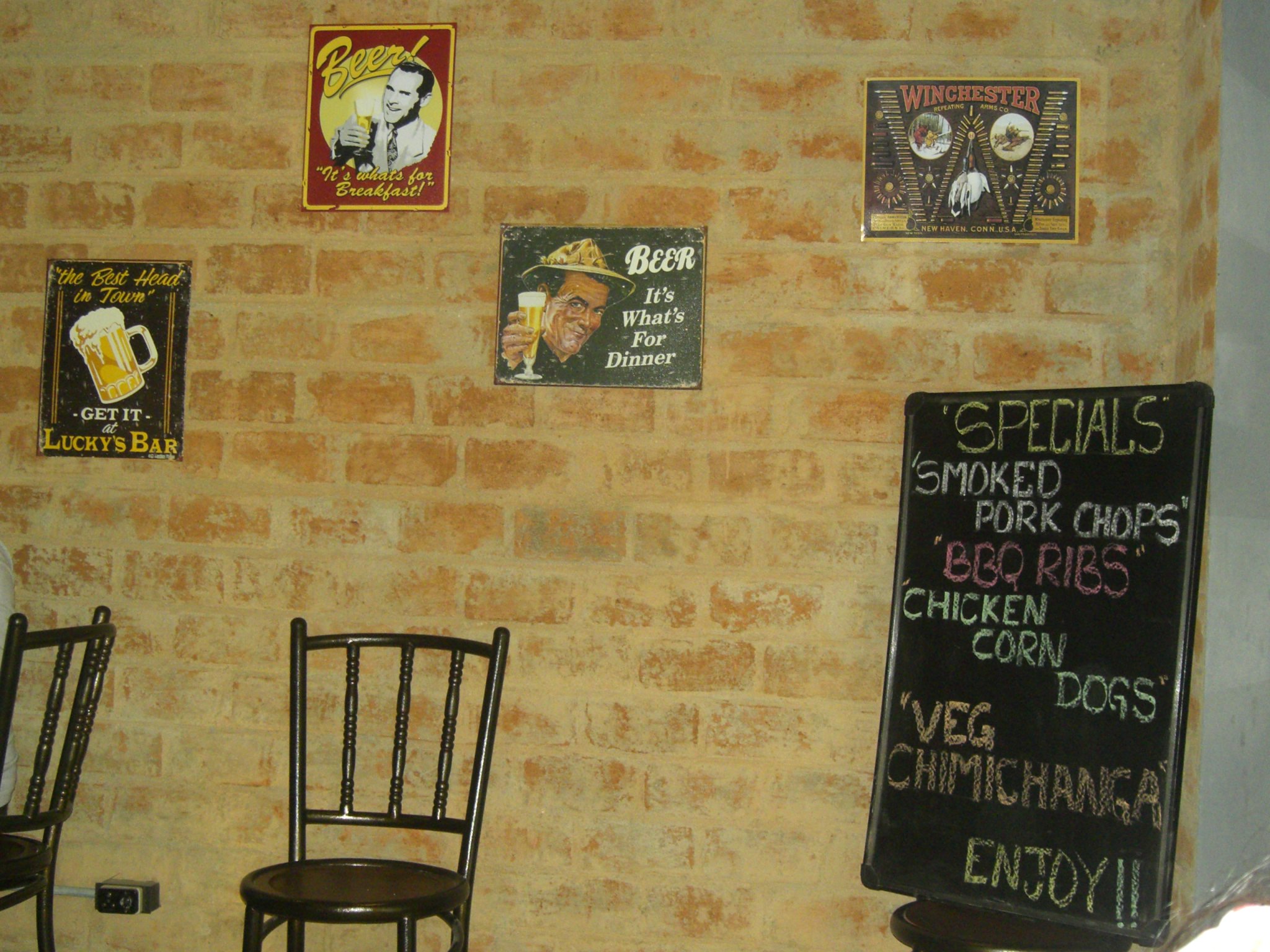
    Plan B has quite an attitude, and you can sense it as soon as you enter.  A lot of it is to do with the decor and those cool posters, and some of it is reflected in the nomenclature in the menu too. I was impressed enough to click a few snaps. (click to enlarge)

    I thought the branding behind the bar was done on a manhole cover, but I can’t be sure. The snap, unfortunately, didn’t turn out good. The place has a buzz about it, and its got less to do with Knopfler, REM or Axl Rose and more to do with the bright ambiance, and the people.

    This is the menu that ensured we got there. We were in a bit of dilemma on whether to start with pork or beef, but since pigging was the theme of the visit, Chilli Fried Pork it was. The soy sauce didn’t make its presence felt much, that was a good thing because the chillies could dominate. Excellent dish, I only wished it had been brought sizzling hot, we got it almost lukewarm.

    Meanwhile, we’d also (uncharacteristically) ordered a couple of interesting drinks. D ordered a Ruddy Mary (l) and I asked for a Diesel. (r) The Ruddy Mary has tomato juice mixed with beer with a dash of lime. Diesel is a mix of lager and cola. Interesting mixes, but in both cases, we felt the beer flavor proved to be too dominant. The drinks might have had more of a distinct character if the other flavours played a stronger role. But a good experiment, nevertheless.

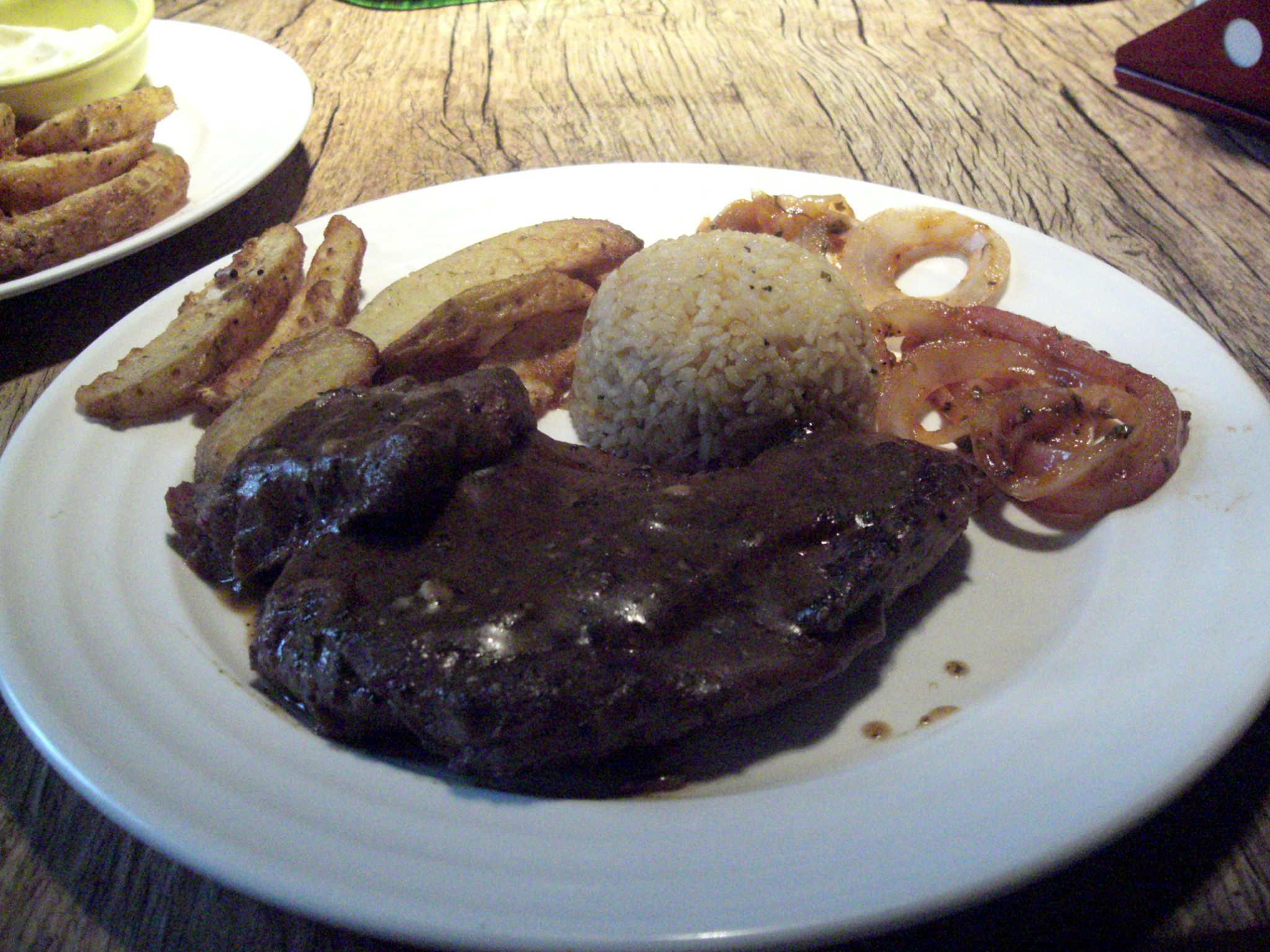
    In the main course, beef and pork shared points, and chicken, perhaps for the first time in this blog’s history, was completely ignored. D ordered a Grilled Pepper Beef Steak, which she was quite happy with. The rice seemed buttered and different from the regular kind, and went very well with the steak. The sauce had permeated the meat, and though it acted tough with the knife, chewing wasn’t a problem. Even though it was well done, I think a steak knife was warranted. Also, the pepper sauce was a little too subtle. But despite that, the dish is worth a shot.

    I asked for a ‘Pigs in a Thermal Blanket’, a cryptic crossword kind of name for cured, spicy pork in a burger bun. Spicy it was, and the mayonnaise provided with it complemented it brilliantly. Those with a thing for greasy food will love this one. I did. In both dishes, the fried potato was a stand out item. Thanks to all of the above, we were quite stuffed, and asked for the bill, declining dessert.

    And then that Chocolate Mousse neon repeatedly winked at me. D promised to share, and we ended up ordering one. It was quite decent, nothing spectacular, but that’s more because of my preference for really strong chocolate than anything else.

    The service is prompt and generally excellent, and the owner does the rounds, adding to the casual and pleasant ambiance. Unfortunately, when he got to our table to chat, the pig and its greasiness prevented me from even offering a handshake.

    The meal cost us just less than Rs.1050, including a 5% service charge. I’d highly recommend a visit – for some awesome pork and beef, some neat experiments with beer, and a wonderful ambiance.

    Plan B, #20, Castle Street, Ashok Nagar. Ph: 9739902745

    Menu and photos at Plan B

  • Jump with a crowd

    ‘Jumping the shark’ is a phrase that has been jumping on to my face regularly, but something that got lost in the rigours of speed reading and processing. Thanks to Tom Fishburne’s excellent post on the subject in the context of brands, products and organisations, I got to think about it a little more. The quick definition would be (from the post), “the moment of downturn for a previously successful enterprise.” The problem with it? “The risk of jumping the shark isn’t getting eaten by the shark. It’s leaving your loyalists behind.”

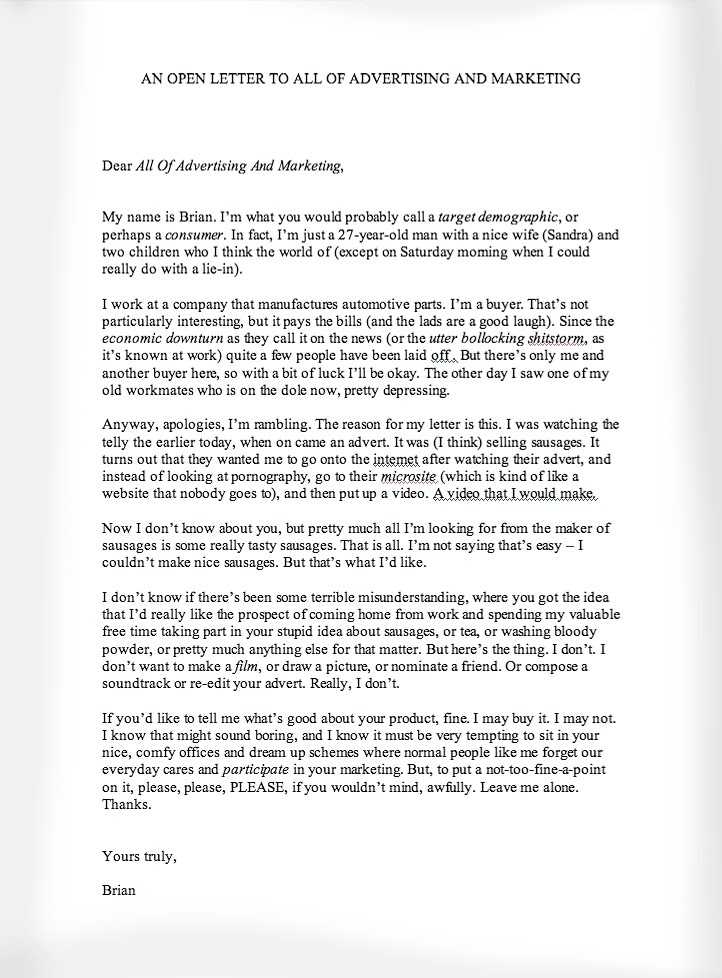
    I thought about it a bit, not in the context of brands or businesses, but more in terms of brand communication as a field, advertising specifically, and brands’ usage of the social web. Consumption patterns, media platforms available etc had pretty much created templates for creative agencies over a period of time. But the arrival of the web, social platforms and the democratization of media have managed to disrupt the ways of the one-way communication age. This post is a good one to read in that context, and talks about the change digital has made to campaigns, and the ‘role of the consumer’. But desperation, hype and the eagerness to get on board makes everyone concerned ‘jump the shark’. And unfortunately, the way I’ve seen many agencies and clients execute it (purely as a consumer), I’m quite inclined to agree with the author of this hilarious letter. (via PSFK)

    Clipboard01

    (click to enlarge)

    The job of the brand manager/creative agency is obviously a more difficult one now, and is made even more so thanks to the approach – of tool strategy. Like this (old but) excellent post states, ‘the technology that underpins social media is changing fast’, but its ephemerality ‘is a feature, not a bug’. It made me wonder whether brand communication/advertising, as a process (the way we see it now) had ‘jumped the shark’, mostly because the thinking process still sees  social platforms in the same light as traditional media and has not changed to be in tune with the former’s dynamics. In other words mistaking social media marketing for social media.

    Maybe they have to dig deeper, figure out the value that people are willing to pay for, and then find their ‘purpose idea + social object‘, and consistently. But that would mean a sea change in the way brands and creative agencies operate. Is adaption possible, or is complete disruption inevitable?

    I juxtaposed this thought with something that Seth Godin wrote recently, about the ‘red zone‘ – the joyless part of the learning curve. His graph also has a green dot, which represents ‘someone on the other side.. rooting us on, or telling us stories of how great it is on the other side’. Perhaps if brands can find from the existing consumer crowd a few who believe enough to play the ‘green dots’, they can adopt a more holistic approach to social platforms and carry the loyalists without it seeming like ‘jumping the shark’?

    until next time, safe jumping.

  • Collective bargain

    “The way they speak about dinosaurs now, a few years later, that’s how they will talk about the mill workers”, says a character in City of Gold, a Hindi film by Mahesh Manjrekar, adapted from a play by Jayant Pawar. Its based on the Great Bombay Textile Strike. A decent movie, with some great performances and with its share of stark realty, though parts of the second half had a Bollywood melodrama hangover. I guess the response at the multiplexes (many of which are ironically what the mills gave way to) wasn’t really great either. But it was a story that had to be told.

    The subject has interested me earlier too. To be precise, in 2005, my last official trip to Mumbai. The office was at Peninsula Center, and when I looked out through the windows, I could see a few chimneys. I wondered enough to come back and read up a bit. I was curious because amidst the RGV underworld flicks and the contemporary images I had of Mumbai, this seemed to be a part of history that had never figured in conversations. A legacy that seemed to be buried in the collective consciousness.

    A single movie might not really be enough to cover the individual lives that were affected, though it does try to portray a microcosm. But as the line in Frost/Nixon goes “You know the first and greatest sin of the deception of television is that it simplifies; it diminishes great, complex ideas, stretches of time; whole careers become reduced to a single snapshot.”

    Though it is said in a different setting, and context, the connect I sensed was legacy. How a person is perceived by a later generation. Artists have their paintings, actors/directors/crew have their movies, politicians, sportsmen/women have their auto/biography/memoirs, authors have their books, musicians have their music, they have a better chance at being remembered by a larger number of people, long after they’re gone, a better chance than us, the commons. A  collective’s legacy would be the place and time they lived in  – the larger picture, their collective actions, the people who became popular, the events that shaped the future. What happens if a collective chooses not to remember, or chooses to remember only parts? Who does it matter to then?

    until next time, decadent chronicles