Month: November 2010

  • Confessions of an Indian Woman Eater

    Sasthi Brata

    Amit Ray, the protagonist, starts off by leaving home and his hometown – Calcutta. In his own words, “a gesture, like goodbye notes from failed suicides”. Narrated in first person, this beginning, sets the tone of the book – a certain abruptness that pops up every now and them amidst the otherwise leisurely pace of the book.

    The book is actually more a lifestream, and is quite possibly autobiographical to a considerable extent. Justifying the title, the book chronicles his encounter with women of various kinds, across geographic locations, across relationship statuses, across situations ranging from tender to bizarre, and across time. All of this as he moves from one trade to another – shoeshine boy, reporter, lavatory attendant, engineer, and through most of this – writer.

    There is a certain study of humankind that happens throughout the novel – not just of the principal characters, but even the ones that provide the backdrop. At some points, I was reminded of Pankaj Mishra’s ‘The Romantics’, if only for the curious mix of fatalism and romanticism.

    The ending, much in character, is also abrupt, but it worked for me.

  • A social culture?

    Even as I write this, Titan is looming on the horizon – not Saturn’s moon, but Facebook’s purported mail service, which can (potentially) stake claim on another front that Google has made much advances in, though its still only #3. And so the thoughts from last week’s post continue – on whether culture is the key differentiator that sets apart the dominant player in an era and everything else from superior technology to better marketing evolves from it.

    The two posts I had linked to last time remain relevant in a Google vs Facebook  discussion – “Google’s real problem – GTD” at GigaOm and “Facebook and Google” at Piaw’s blog. Meanwhile, Robert Scoble wrote an excellent post last week titled ‘Why Google can’t build Instagram‘, which brought out a whole lot of other perspectives on what prevents Google from innovating at a rapid pace (also probably the reason why Facebook is stealing its thunder regularly) – organisational size (something we keep discussing here), controlling the scope of products/services, an infrastructure that’s not built for a smaller social scale, the necessity to support all platforms (because they’re Google, that’s expected of them, thought this holds true for FB too), the inability to use a competitor’s graph (in this case, Facebook), the need to ship a product/service that’s near perfect (because they’re Google!) and so on. Scoble also throws in a few pointers on how Google could still innovate, and I thought some of Android’s success could be attributed to one of those – sending it out and allowing developers to build on top of it. You can get another interesting perspective on Google and scale here. (via Mahendra)

    The other understanding I developed was that with scale, even the organisation’s vision could change, (though the reverse is what we see regularly) and that would affect everything from competitor landscape to culture. So the challenge is to keep people hooked on – employees and users.

    I’ve come across excellent posts on both these. The organisational aspect is the core theme of Gautam’s blog, and so its not surprising that I’ve seen two posts in the recent past that tackle this subject – Inspiring People, and Making Work Meaningful. The other must read in this context is the 2010 Shift Index, specifically the ‘Passion and Performance’ part. From a consumer perspective, few people can articulate it better (especially since a toon is usually more popular than a 1000 words) than Tom Fishburne, and again, two relevant posts – App  of dreams (as a devout Angry Birds player, I identify completely) and The Antisocial Network.

    Despite approaching it from two different sets of stakeholders, the common thread is easy to spot – that brands/organisations need to figure out a reason for existence that goes beyond their business mission and balance sheets. This would then help them identify the ‘something’ that people – both employees and consumers  can identify with and would want to belong to. Coincidentally, this is the drawing I got on my Gaping Void subscription today. 🙂

    (Hugh credits Mark Earls for first voicing this thought)

    Not very long ago, Google spearheaded a revolution of sorts, by creating an algorithm that connected a web user with the information he sought. The only thing that topped it was the business model they built on it. Many have attempted it before and after them, but there was only one Google. The world changing mojo seems to have been transferred to Facebook these days, and even to Twitter to a certain extent, as, in different ways, they connect us to people we know/want to know in various contexts. Information sharing then becomes one of the applications of this connection. This phenomenon is called (by) many names, including social media. 😀

    Perhaps brands and organisations fail to understand the philosophy of social platforms/interaction and get lost in the applications. A bit like wanting to build a social layer on top of everything you have created so far and meanwhile, firing an employee for telling the world he got a bonus and raise 😉

    until next time, titanic shifts 🙂

    Bonus read: The Heart of Innovation via Dina

  • Putting on an act

    For a while now, Renjith has been the gold standard (for me) in Malayalam cinema. Yes, he still disappoints occasionally, but his good works more than make up for it. So I had no hesitation in booking tickets at PVR for Pranchiyettan and the Saint. In addition to writing, directing and producing the film, Renjith also lends his voice to Saint Francis’ character, who starts speaking fluent Malayalam at the end of a hilarious sequence in which Mammootty questions whether the Christians of Kerala were being idiots by praying in Malayalam to a saint who couldn’t understand it.

    If someone had shared this script with me a few years back and told me to pick a lead actor, I’d say Mohanlal. But not anymore. The two superstars of Malayalam cinema have always been contrastive, on and off screen. Mohanlal earned his chops with portrayals of characters that we could either easily identify with or be in awe of. We laughed with him, cried with him, egged him on. In the mid nineties, he moved on to roles that had more serious shades. Less than a decade later, the actor in him died, leaving fans like me fighting discussion crusades that lacked heart. His last good performance was Thanmathra. When people talk about his supposedly superlative performances in films like Bhramaram, I wonder if they have lowered the bar, as a favour to their favourite actor.  I can understand that, most of his other releases make me cringe. I also wished movies like Pakshe and Pavithram hadn’t been made earlier, so that he could’ve done them now. His interviews make me wonder how this serious person with a philosophical perspective on even mundane things could ever have done those amazingly funny characters early in his career. Its a glimpse of the abundance of acting talent he possessed. Now he is just a superstar.

    Mammootty, on the other hand, I had never considered a brilliant actor, despite films like Thaniyavarthanam. It was his screen presence and the strength of characters that carried him. Cop, lawyer, CBI sleuth, he brought a special something to the role, which made him a star. But the thought of him doing comedy was funny, despite coming across in interviews as a very witty, fun loving person. Over the years, he has slowly scaled his repertoire. Now he dazzles us with films like Kaiyoppu, Loudspeaker and Paleri Manikyam, each a different genre and style, and even in utterly nonsensical films like Pokkiri Raja (a Tamil film made in Malayalam, go figure) he displays a comic timing that makes you forgive the movie. In an equally masala commercial movie called Daddy Cool, in one scene he references a character he played 13 years back! Instant Classic. At 56, the method actor has arrived.

    Mammootty is now extremely comfortable as an actor and is not afraid of even having fun at his own expense. The things the mimicry guys used to feed on – his dancing skills (lack, that is), hand gestures are all part of his own comic repertoire now. On the other hand, Mohanlal is a shadow of his former self. One can actually see the labouring that goes into his acting now, where, once upon a time, his portrayal of characters seemed so natural that we regularly forgot it was an act.

    I thought about both of them in the context of talent and passion – last week’s post. Having seen the above two, I have to wonder again whether passion commands more perseverance than talent.

    until next time, cut.

  • LifeMojo

    [scribd id=51587976 key=key-1q958gd49kyvyku2ff4h mode=list]

  • O! Ustaad

    This review was first published in Bangalore Mirror. This is a much modified account.

    Thanks to the Gateway Hotel, you could end your gastronomic journey on Residency Road with ‘Arre huzoor, wah Taj boliye’. But in case you were wondering how to begin, you now have hope, in the form of O! Ustaad, at the other end. This is right after the St.Marks Road/Residency Road junction and placed under a certain Purple Haze, literally. Here’s a map. (the arrow mark is the right location) Parking should not be too difficult, since you have Hayes Road/ Convent Road also nearby.

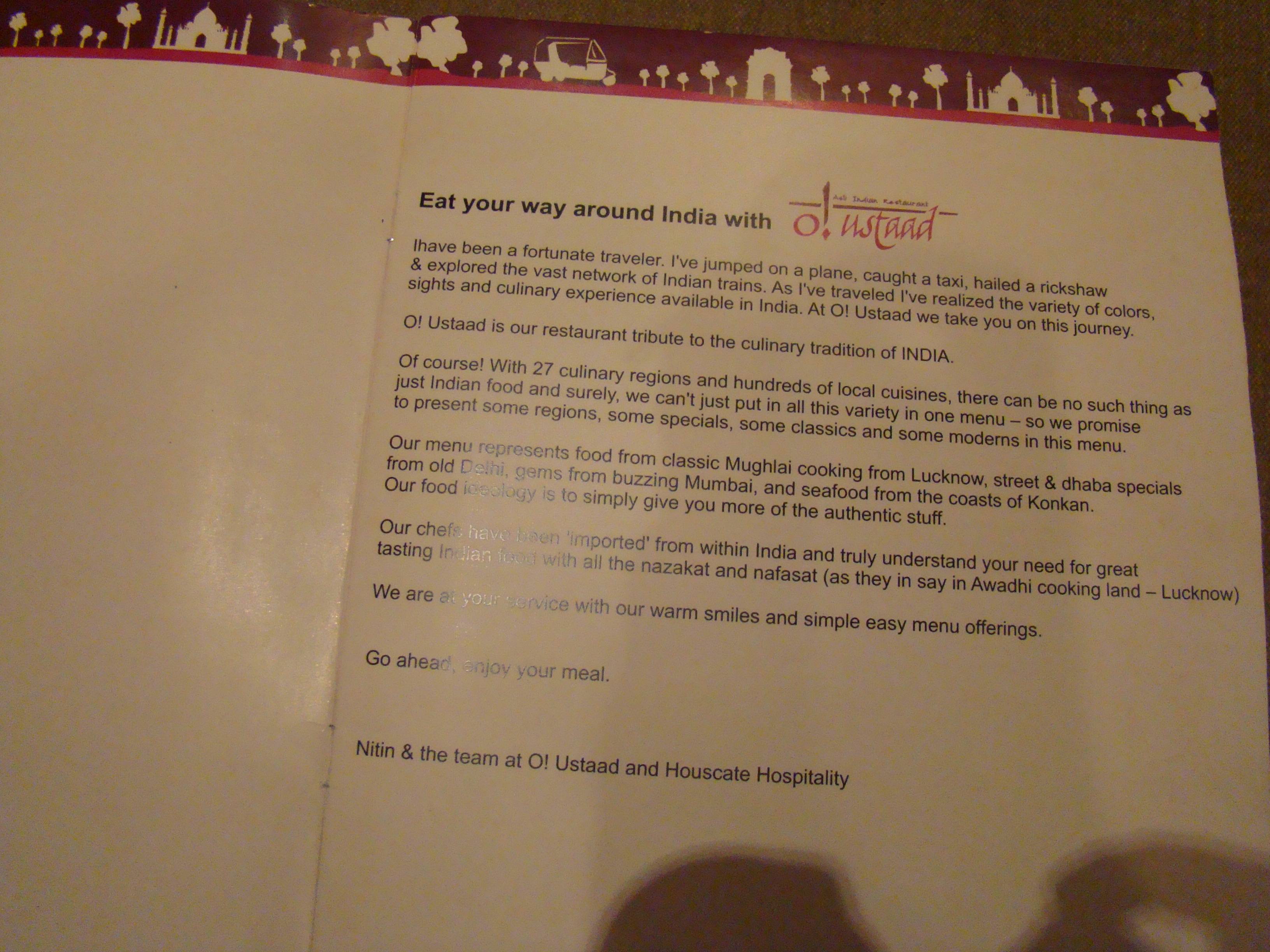
    O! Ustaad claims to be an ‘asli Indian restaurant’, serving you the best fare from Lucknow to Mumbai and Delhi to Konkan with nazakat and nafasat, but we journeyed from the delight of Wah! Ustaad to the despair of Waah! Ustaad.

    This is one of the places where you shouldn’t go by outside appearances, because though the frontage might seem a tad dingy, the interior is bright and peppy. O! Ustaad definitely serves up an attitude and has a penchant for wordplay, judging from ‘Facebhook’ and ‘LaLoo’. The photographs of street food, and an eclectic mix of music from Junoon to classic rock, all add up to a unique character. So much for the mahaaul, now for the real haul.

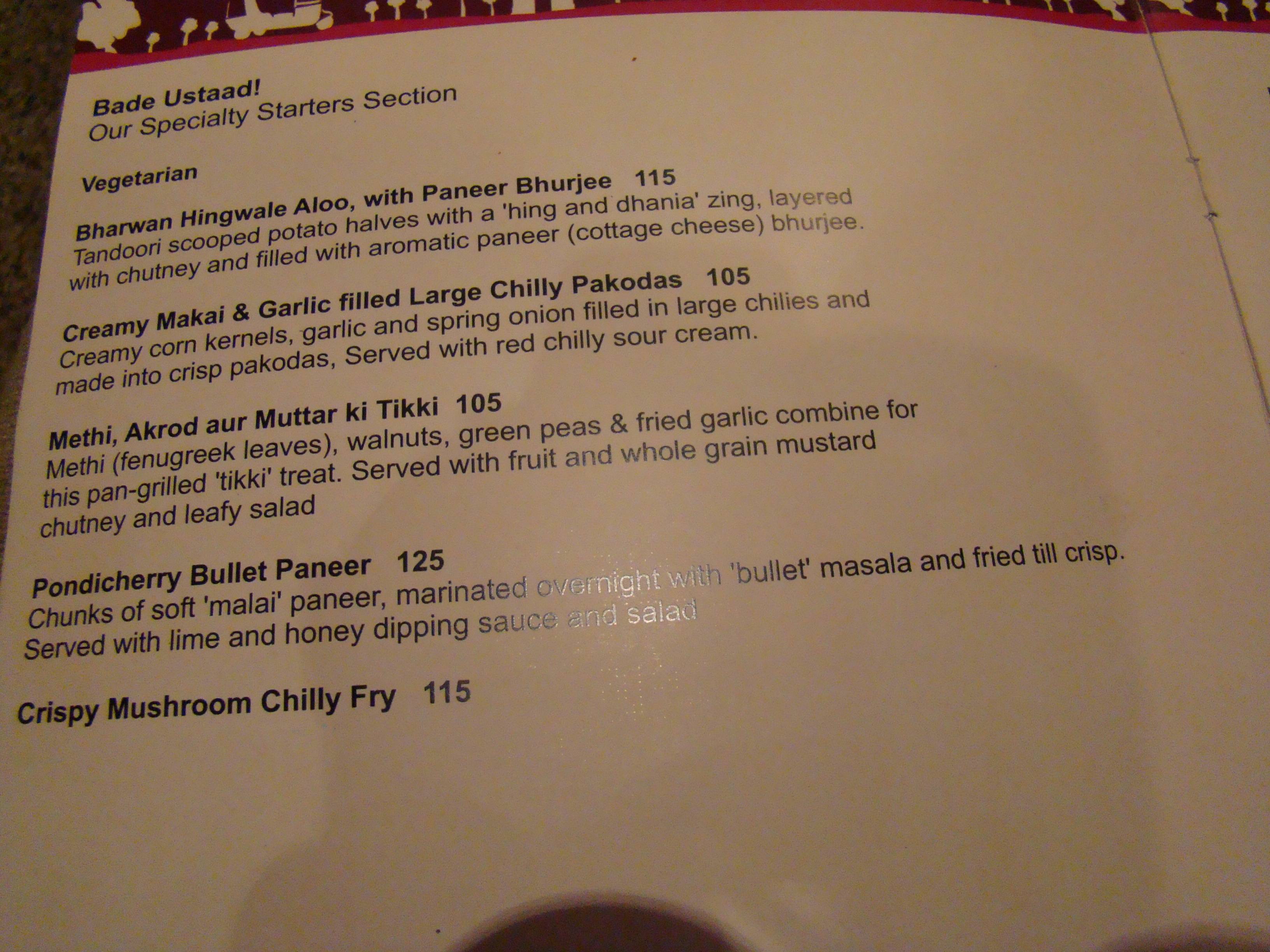
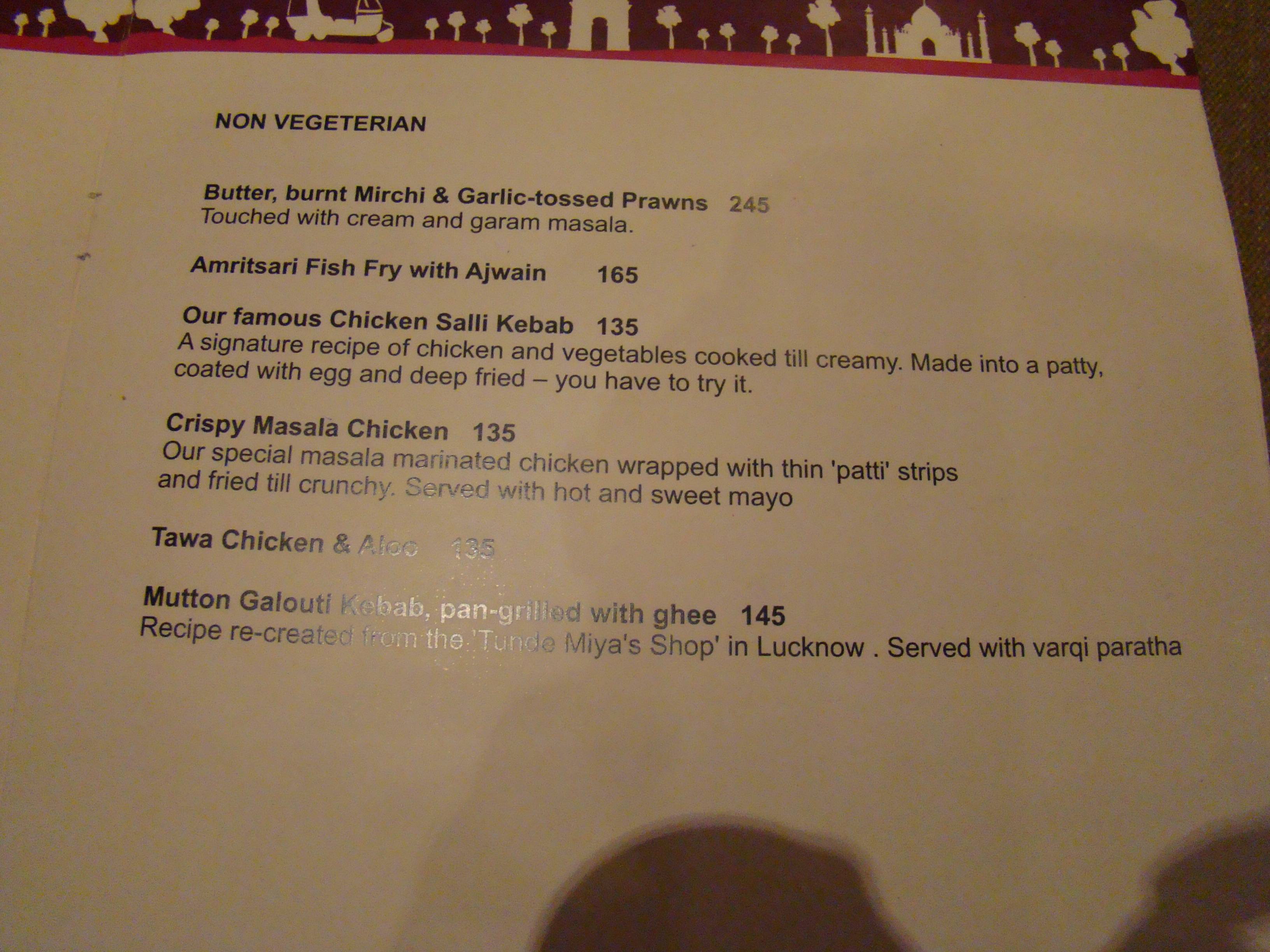
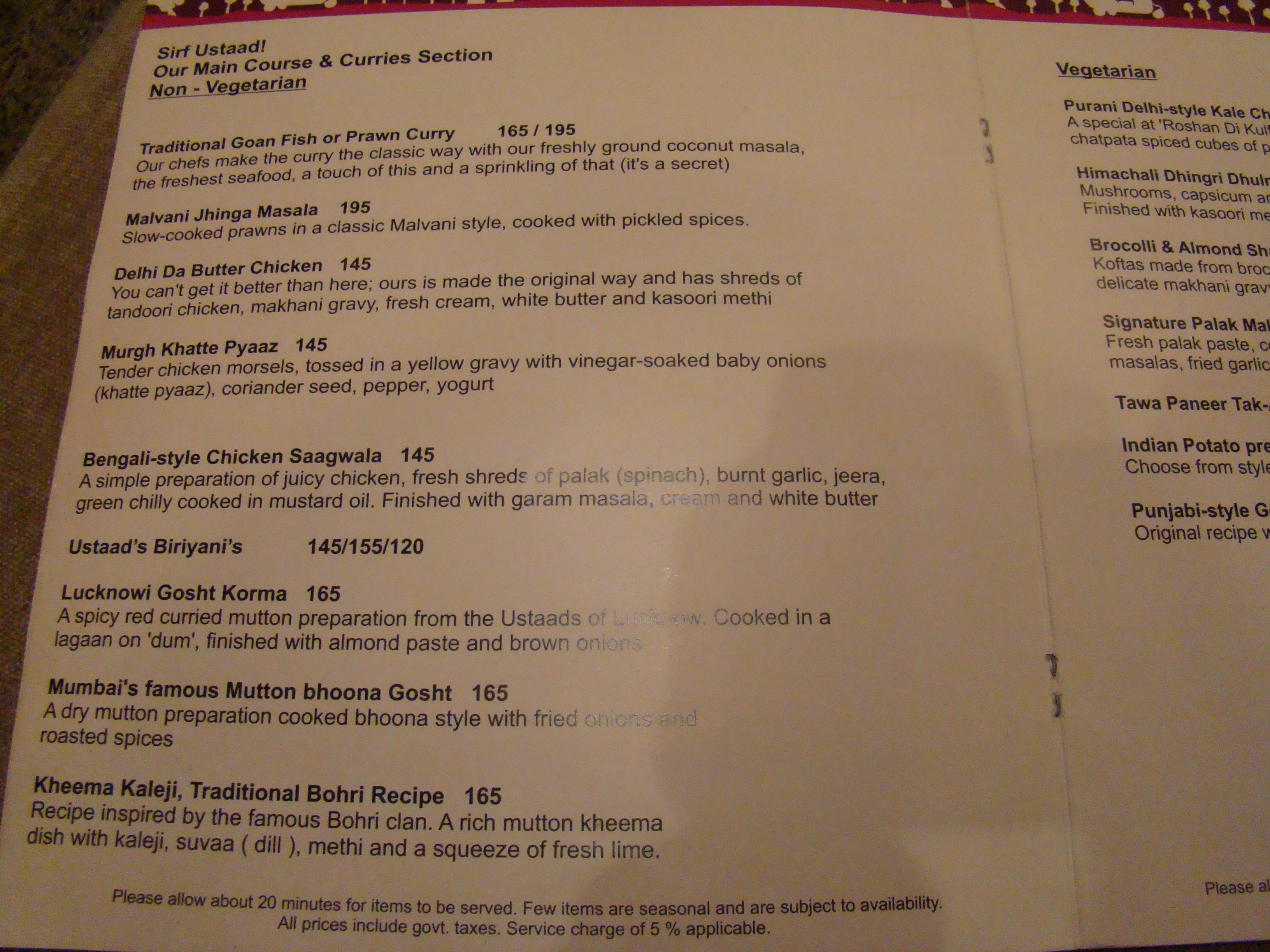
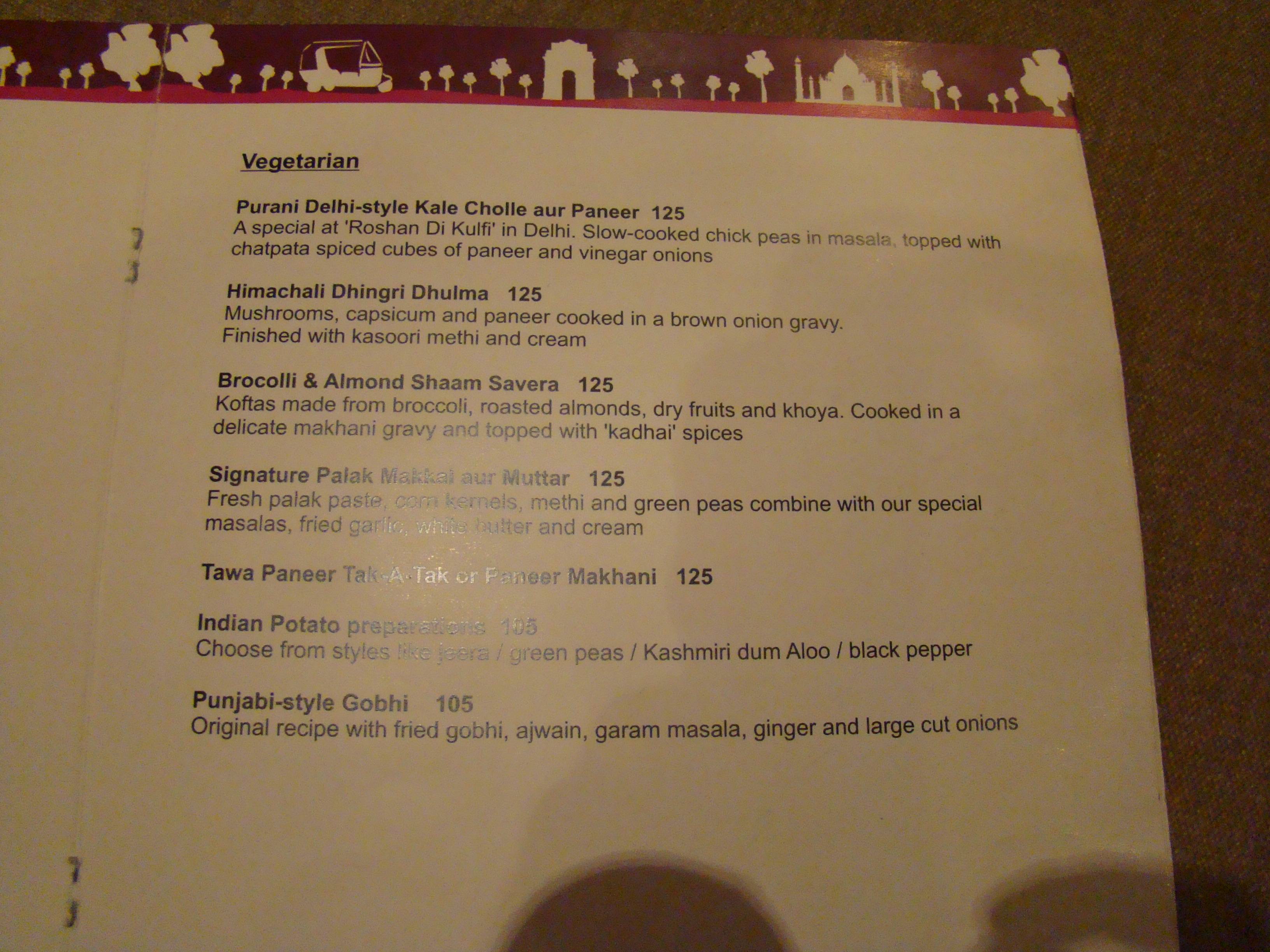
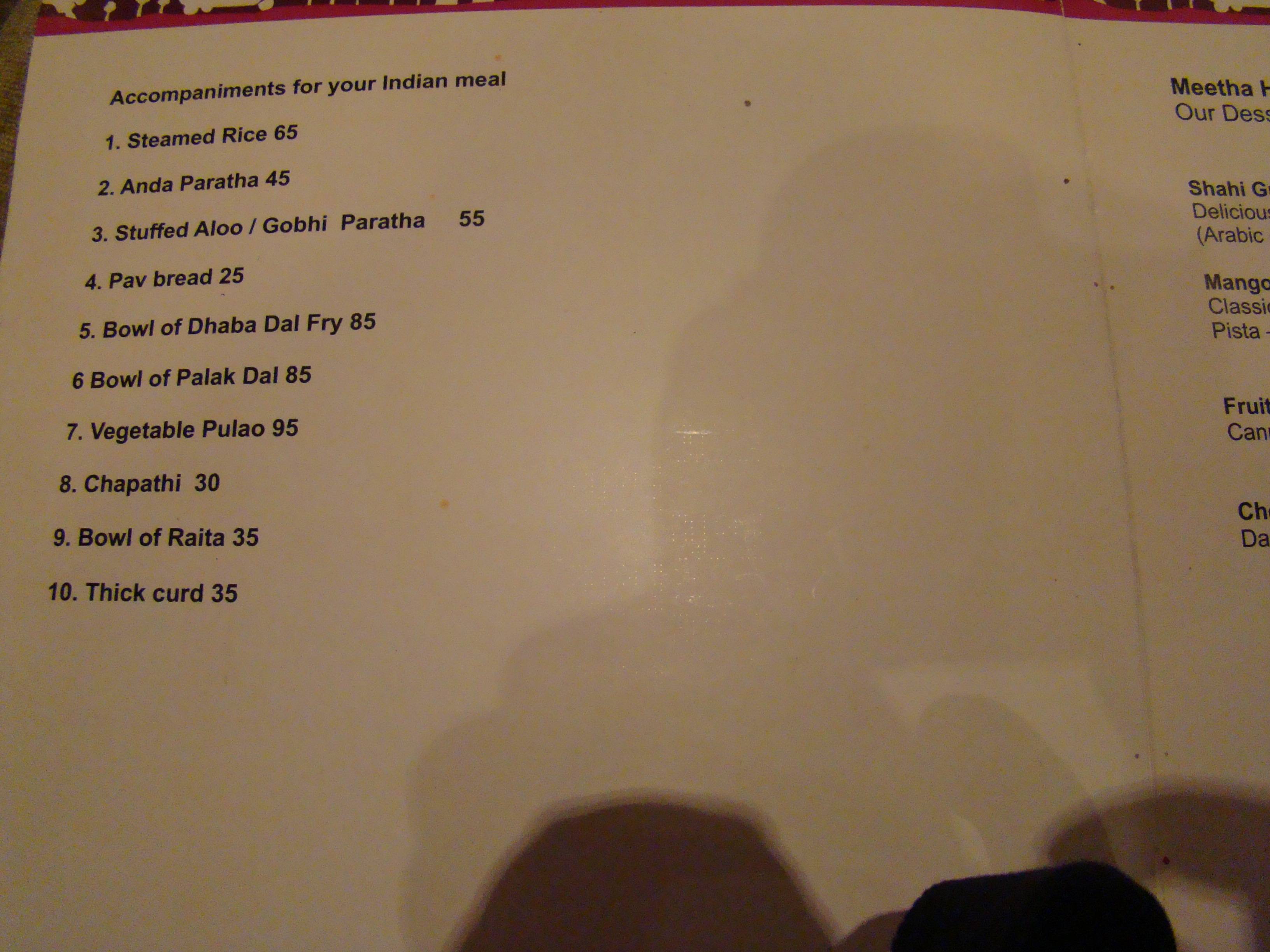
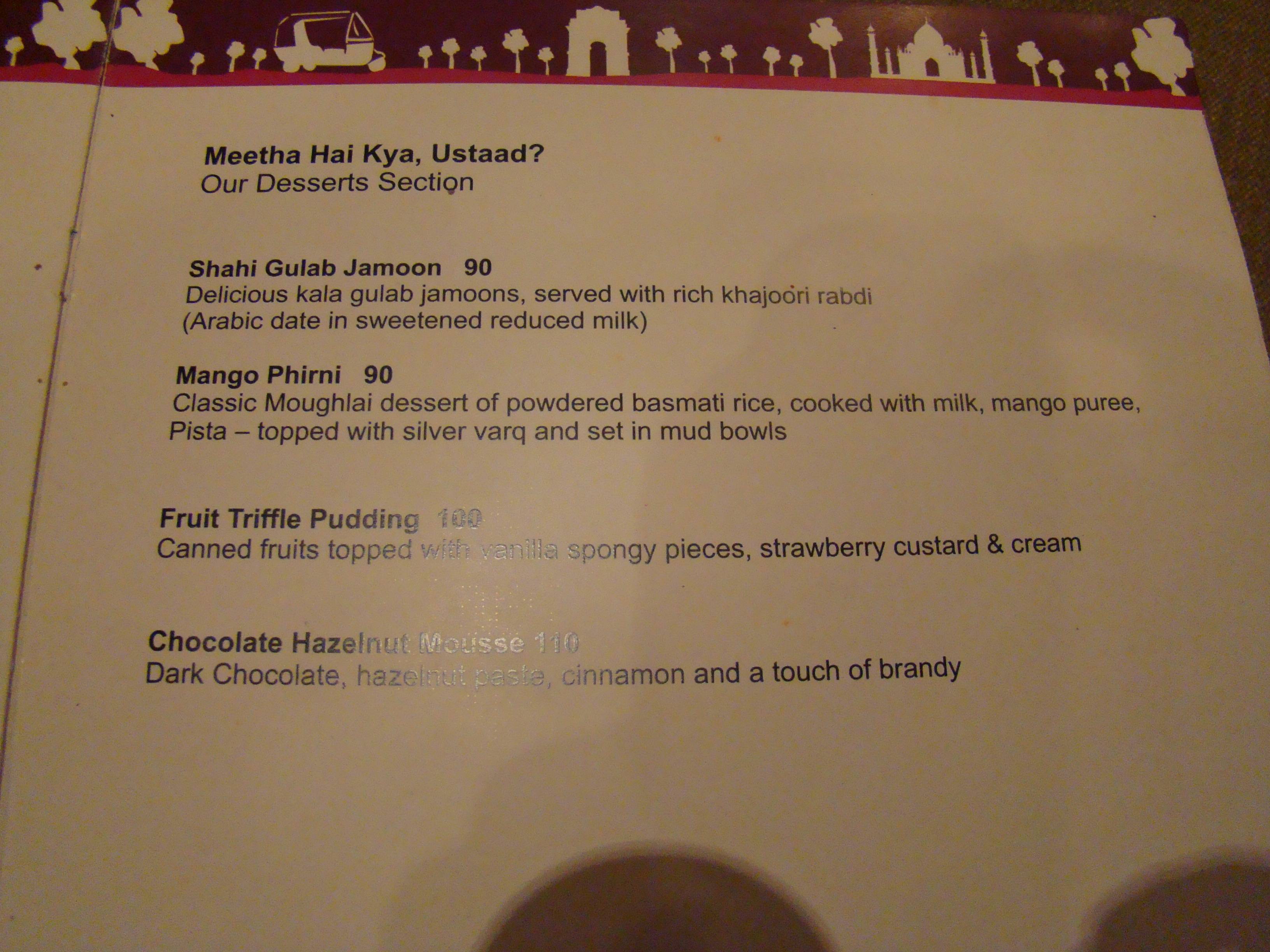
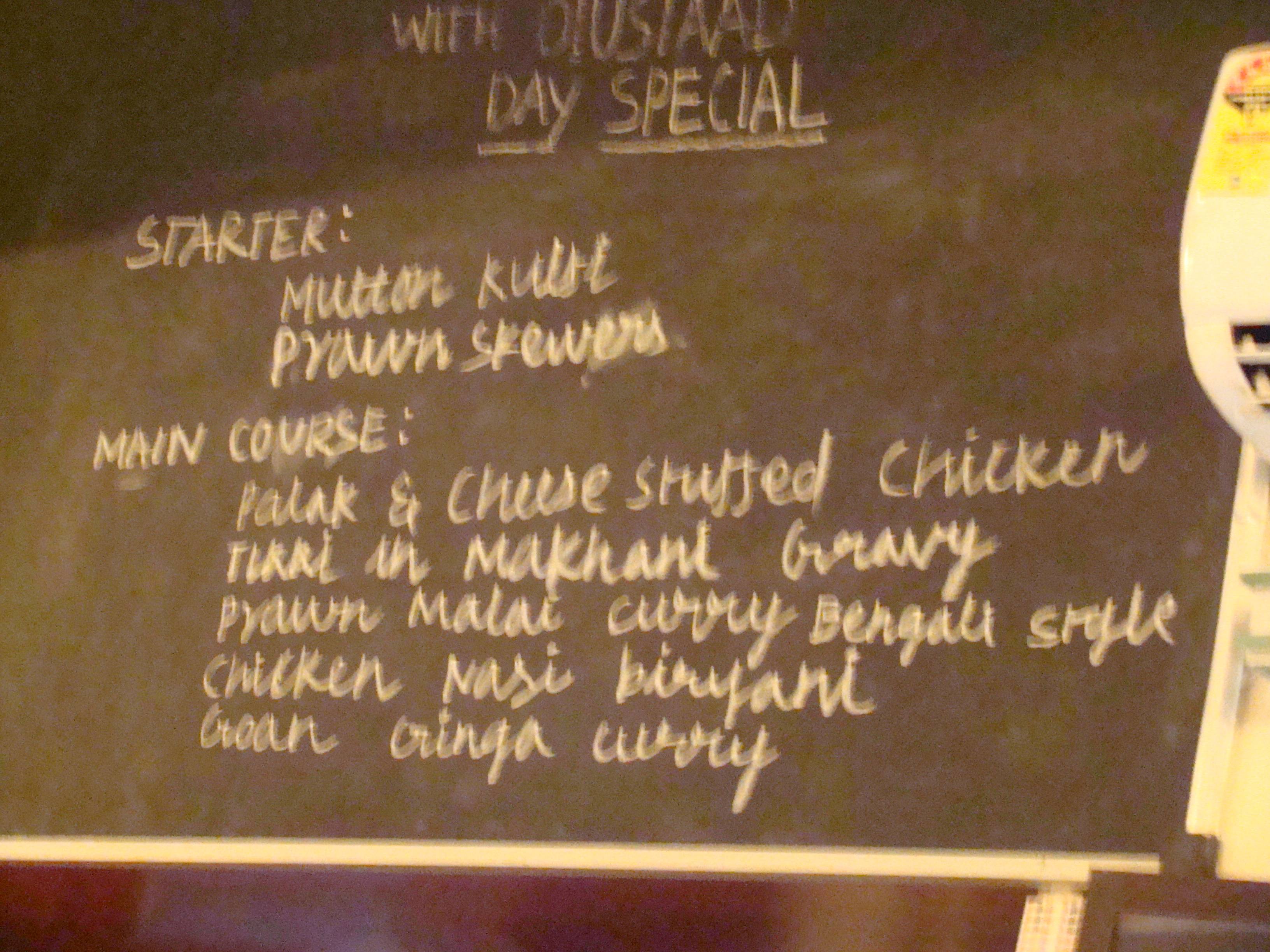
    The menu may not be spread over a lot of pages, but it covers much ground in terms of geography. Kebabs from Lucknow, fish dishes from Goa and Bengal, vegetarian fare from Himachal and Punjab, and Old Delhi specialities, together ensure that both vegetarians and meat eaters are kept happy. Add to this the uniqueness of many of the items and the day’s special dishes and you’ll find that there’s no dearth of choice. Take a look. (click for larger image)

    From the 3 starters we tried, the Mutton Kulfi (one of the Day’s specials) was easily the best. The combination of melt-in-the-mouth mutton and a green chilly laden coating made it a unanimous favourite. The two starters we ordered from the regular menu were disappointing. The Pondicherry Bullet Paneer had no proof about the bullet or Pondicherry, and one of my friends had to be pacified as she felt she’d been conned into buying a Paneer Pakoda! The accompanying honey-lime dip didn’t make a good combination either. The ‘famous’ Chicken Salli Kebab was more potato than chicken.

    Himachali Dhingri Dhulma Lucknowi Gosht Korma Prawn Malai curry Bengali style Anda Paratha

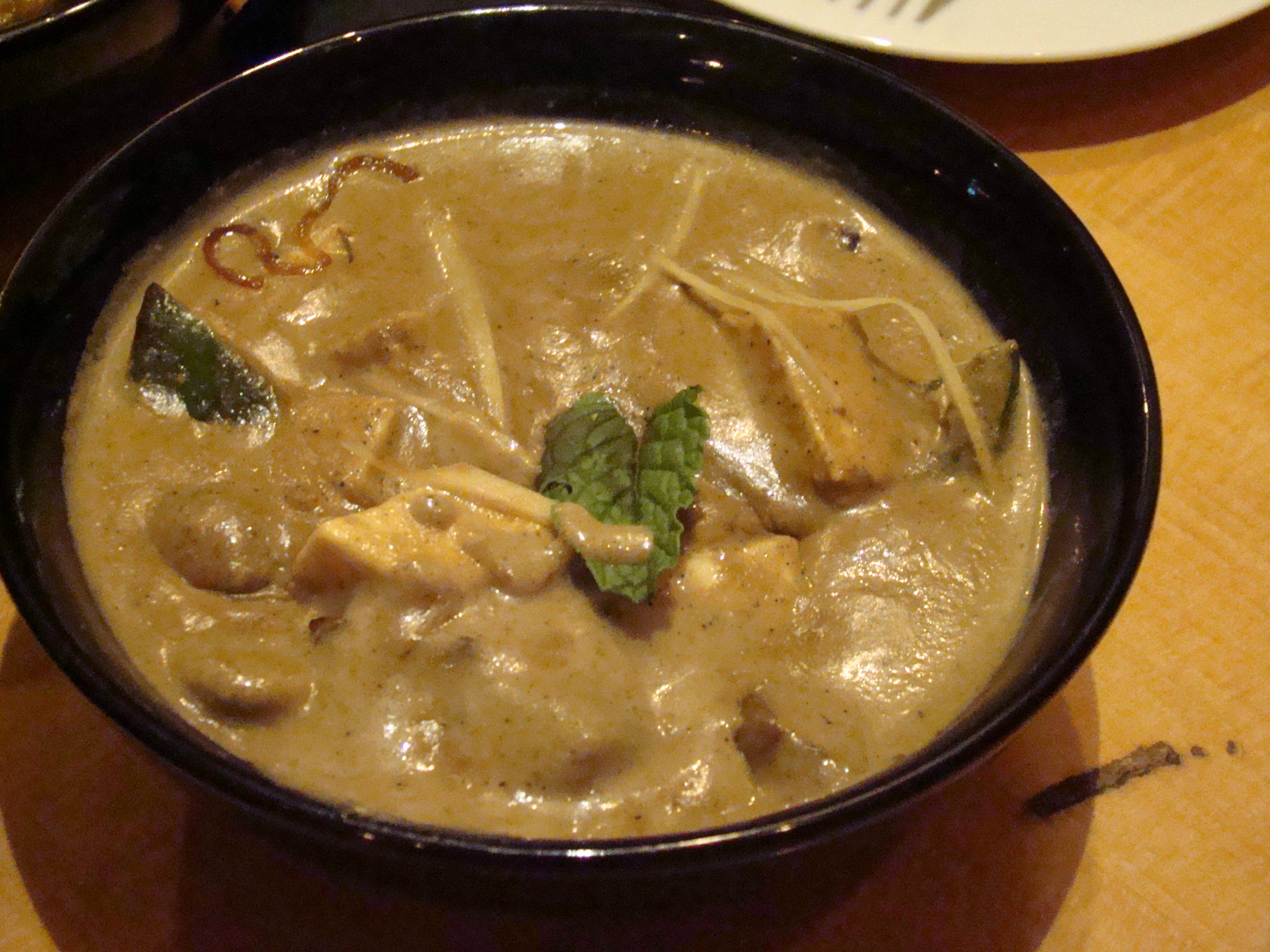
    In the main course, the ones that impressed were the Murgh Khatte Pyaaz, with its unique gravy of vinegar soaked onions, pepper and yogurt, and the Himachali Dhingri Dhulma, with mushroom, capsicum and paneer in a slightly spicy gravy. The Lucknowi Gosht Korma, though decent, was lost in the bargain. The Anda Paratha is definitely worth a try too, and though the Gobi Paratha had an extra helping of chillies, it was still reasonably good, as was the Aloo Paratha. The Prawn Malai curry Bengali style had an excellent creamy gravy which was ruined by the overcooked, rubbery prawns. The Chicken Nasi biriyani, which was another Day’s special, was, as one of my friends put it, Tomato rice with chicken. Somewhere in the kitchen, a cooking oil well has been discovered, judging by the liberal usage. Though the menu lists 4 desserts, which we were eager to try, we were told that they weren’t available. The apple and chocolate pies we were offered instead were both quite avoidable.

    The service was quite prompt, and Jitesh, who looks after the Bangalore outlet, did a good job of helping us choose the dishes, especially since the day’s specials didn’t have explanations. O!Ustaad is worth a visit when you’re in that part of town.  A meal for two would cost about Rs.800. Though some of the dishes fell short of expectations, the uniqueness of the menu and a cheerful ambiance should make up for the shortfall. They also have lunch buffets which seemed reasonably priced.

    O! Ustaad, Below Purple Haze, 17/1, Residency Road, Bangalore – 560025 Ph: 080 41518147