Month: May 2010

  • Golmaal Paratha

    No, I didn’t make that up. There is actually a restaurant in Koramangala by that name, a couple of buildings before Tunday Kababi, and almost immediately after Coconut Grove. (map) The bright green board is difficult to miss, parking isn’t too difficult. We got there by around 7.30 and were the first customers, but by the time we left, many more tables were filled up. The color theme inside the restaurant might make the non vegetarians and Martian paradnoids uneasy. If you are a super-heroes fan, you’d be pardoned for wondering if you’d stepped into the Green Lantern’s/ Riddler’s secret lair. People who’re fond of green might have to be restrained. Yep, it is that overwhelming! But non-green people, don’t worry, you can focus on the food.

    The menu has 99 items, and has been uploaded by the wonderful Roopashree, on Burrp. For once, the vegetarians have a clear advantage, while the non vegetarians have about a dozen choices. But to be honest, there are so many veg options that those with a less steely resolve might buckle. Greens, beans, chinese, cheese, pepper combinations, hot’n’spicy, ginger, corn, potato, green chutney – these are some of the few… sections! Yep, you read that right, you have choices within these!! Now, even with a dozen options, the non vegetarians might find it a little difficult to narrow down, and after a few rounds of discussion, we chose a Chicken Kadai Masala Paratha and a Mutton Pepper Masala Paratha. An entire page is devoted to drinks too – lassi, milk shake, butter milk, coolers, fresh juices, jaljeera.. So we also ended up ordering a Mango lassi and a Mint & Ginger Lime juice.

    The Mint & Ginger lime juice arrived first and was quite tasty though the mint overshadowed the ginger completely. The Mango lassi, we were quite sure was made of Slice (or some such) and not fresh mangoes, and that was quite a disappointment. We were told that the chicken paratha would take a while. There was heavy traffic, so it must’ve been difficult for it to cross the road. Ok, sorry 😀

    The parathas arrived a bit later, and no, they weren’t green :p . Each paratha comes in a thali-plate with curd, pickle, chana, onion and a couple of chutneys. The hot’n’sweet red chutney is quite good. I started with the mutton paratha, and it was quite spicy. It didn’t help that i decided to try out the chilly too. The pepper was a bit unevenly distributed and the salt was a shade above what was required. The chicken paratha was very good, though you should avoid it if you don’t like capsicum. Unlike the mutton, which was minced, this one even had tiny pieces of chicken, and was only moderately spicy. The parathas are much larger than the regular size, so unless you’ve been fasting all day or are especially aggressive with food, one should be adequate.

    The service is quite pleasant, they check if your paratha was good and also have a good feedback form. The first place where someone actually asked my opinion too. Usually they convey their opinion of me by giving  D the form and ignoring me. Here, they gave us two forms, and even ask about the music, which was quite decent. In my excitement, I forgot to add that one possible option they could add (they ask for that) was egg parathas.

    The meal cost us just below Rs.350. Drop in for a unique menu, and decent food at very reasonable prices.

    Golmaal Paratha, 1st A Cross Road, KHB Colony, 5th Block, Koramangala. Ph: 42085757

    PS. The place has WiFi, but requires a code.

    Menu at Zomato
  • Go-to-social media

    A few weeks back, I’d mentioned Tac Anderson’s ‘3 types of social media strategy‘ . To quickly summarise, the first is the ‘toe-in-the-water’ approach (not really a strategy), the second is ‘optimising social media for business’ and the third is ‘optimising business for social media’. That happens to be the decreasing order in terms of current practices, probably because its also the increasing order, in terms of thought, effort and time required.

    I am quite a fan of the third approach and saw this excellent presentation by David Cushman, a few days back, which showed why ‘optimising business for social media’ is perhaps the best way in the long run. In fact, it does it in such a way that it almost seems like an afterthought. On the way, it addresses the much maligned combination of words – ‘social’ and ‘media’, and the subject of ROI.

    Like I said, I don’t require any convincing on the third approach too, but the more I interact with clients, I begin to understand that with all the hype, the expectations of social media are akin to the other forms of media, and the stereotyped Facebook page and Twitter account are much sought after in the strategy presentation. And that forces me to think whether we can start with approach 2, and move towards approach 3.  The feedback from open social channels slowly creating a change within the organisation and making it view everything with a different perspective. That’s quite a change from asking for perfect products and services which could ‘withstand’ social media. 🙂

    Meanwhile, I looked at it from another perspective when I chanced upon the new IndiGo Airlines ad, thanks to a post by L.Bhat. The spunky ad, which you can view here, is shot extremely well and showcases IndiGo’s dedication to being on time. Bhat raised a valid point that this punctuality might actually be beyond their control, in some cases. I completely agree, but like I commented, I’ve used IndiGo several times, and have never had a reason to complain. All the people who’ve commented on YouTube seem to agree.

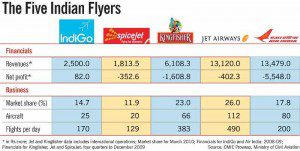
    I have to confess, there’s a style to Indigo that I’m quite a fan of. Right from the way they have communicated this data  below (do note the revenues, number of flights, market share, and compare)  inside the flight, to the menu items to their stickers and even their barf bag, they are quite unique, they have an attitude and are not afraid to show it.Check this out. (thanks @gkjohn)

    Clipboard01

    (Source: Outlook)

    DSC03160 DSC03161

    (Can’t remember other airlines, I know Spicejet has quite plain stuff, anyway I liked these enough to keep a copy 😀 )

    No, i wasn’t digressing. From what I read, IndiGo is hardly a major player in the social media space. But I think the TVC is a good way of approaching what would have been ‘strategy 2’, with a conscious design of reaching strategy 3. All that, without social media. A purely communication  (internal and external)+ organisational culture based approach to  creating a social business. That may not be Indigo’s strategic intent, but it does make me think. Is it possible? 🙂

    What can be done to this with social media, is a different discussion altogether.

    until next time, thoughts in the air

    Bonus: “Culture eats strategy for lunch” via Gautam Ghosh.


    httpv://www.youtube.com/watch?v=kiFMJfrCO_0

  • When Man was God…

    A few days back, I read this amazing article ‘Why everything you’ve been told about evolution is wrong‘, thanks to Surekha. Though it begins by rubbishing ‘creation by God’, it thankfully moves soon enough into Darwin’s theory of evolution and the epigenome (the protective package of proteins around which DNA is wrapped), which plays a role in deciding which genes get to express themselves in a creature’s traits and how much. It talks further of how a change in the surrounding environment for even a relatively small time can affect the way genes express themselves in future generations. This raises a question mark on the ‘random mutation + environment filtering’ basis of Darwin’s theory, and suggests that the environment had a hand in creating those ‘random’ traits. Lifestyle alters heredity.

    (Kindly read the remainder of the post before confronting your grandparents)

    I don’t have a hard stance against anything to do with God/faith, because I find around me many things that are not really explained, many dimensions which we haven’t been able to crack. Maybe, we will, in the future, but that doesn’t mean I will be arrogant about science now. There are so many wonderful things around me that awes my mind because of the mix of complexity and simplicity, that I like to have faith in a system/being at a higher level.

    But the article made me think about the way we have reached where we are, and our concepts of God and evolution. And that’s how I wondered whether man was ‘God’ at some far off point, and had some fun. A half-ass thought. For this scenario I’m accommodating both versions – i.e. God created man in his image OR nature threw up enough random genes to create a version of man with super powers.

    So at some point a long way back, we have a set of humans on the planet, all of them with superpowers – lifespan, various controls over elements etc, and thanks to that, a complete disregard for everything around them. The system (God or evolution/epigenome) realises this is a bad thing and starts turning down the super powers slowly. Or maybe they fought amongst themselves and turned off each others’ powers, until only a few had them. Their lifestyle tampered with their heredity. In later generations, they appeared in patches, say in a few  who are now known as rishis/sadhus/saints. These generations however, knew that earlier beings had superpowers and begin to regard them as Gods. They also began to fear the power of nature as they experienced calamities and lost things and people that were dear to them. Man now thinks that he should be beyond the control of nature. Technology  makes its entry and is man’s weapon against everything that nature can throw at him.

    Where does it go from here? Maybe nature is working to a plan – pushing man to increasingly rely on technology until the point he can no longer think for himself. And then attack man with all it has got when he’s at his most vulnerable.

    until next time, a 20:20 vision we might never have 🙂

  • The Time Traveler’s Wife

    Audrey Niffenegger

    It is easy to treat this book as a simple love story, with the added twist of time travel, but it goes much beyond that, and in that lies the magic. The love story of Henry DeTamble and Clare, who meet when when she is six and he is thirty six, though he’s only elder to her by eight years. They get married when she’s twenty two and he’s thirty.

    That doesn’t even begin to describe the story of a man, whose genetic disorder causes him to time travel unpredictably. So, without warning, he finds himself disappearing from his present and appearing in some time in the past or the future, stark naked. It is only his love for Clare that keeps him going as they try to lead a normal life.

    If it had continued this way, it would just be a good story, what actually makes it a wonderful read is the wonderful way the climax has been developed. Sadness, hope and an appreciation for things that really matter. (the last matches my perspective)

    I wouldn’t consider science fiction and romance a natural pairing, and so, the author must be credited for blending it superbly. While these two are definitely the themes, the sheer lack of control in two lives which so desperately want to be together, makes one ask deeper questions on the nature of life and human existence.

  • Online Segmenting and segregating

    We’ll start the thought from the easiest place. Facebook. 🙂 From industry leaders quitting Facebook to TC stating that media attacks on FB are getting out of hand, to Facebook deciding to launch ‘simplistic’ privacy options, there’s a ton of reading material out there. (I liked Danah Boyd’s ‘rant‘ quite a bit) But let’s get to the scope of the post, before i digress way out.

    I think it might be safe to assume  that we are different persons to different people. To the large set of siblings, friends, relatives, acquaintances and the various people we interact with, we share different aspects and versions of our personality, depending on the nature, time, depth, even expectations of our interactions and relationships. So, in a Facebook context too, we would like to retain different levels of sharing and communicating too, in spite of Mark Zuckerberg thinking that having two identities shows a lack of integrity. I think this might be the core of the current tussle – a failure to understand the need to segregate connections, and therefore the content that gets distributed to them.

    When i read Adam Singer’s take on Chris Brogan’s post, I was completely in agreement, because I think HE has nailed a universal truth about normalisation. The last part of the post also mentions how we write basis the kind of audience we’d like. That is a kind of content segregation too, and it is necessary now more than ever, because of content abundance.

    It’s not just to do with publishing, it is also to do with the kind of communities we become a part of. The net provides tools which allows us to aggregate  people like ourselves – basis interests, attitudes, beliefs, and if everything else fails, even location 😀  My point, there’s segregation all around.

    Which brings me to the usual suspect – brands. I started on this last week, and found myself thinking of it during the recent UTV Bindass scuffle. Now, if we go by UTV’s brand communication, its clearly a youth brand. I’ve realised that ‘Youth’ is a very flexible segmentation, and people my age might argue that its all in the mind etc, but it was interesting to see that the average age of opinion sharers was on the erm, riper side of 30. I wonder if the brand would want this audience segment as its viewers.

    It reminds me of the Facebook user’s need for segregation choices. While the net gives the brand tools to find users in a desired segment/demographic, and the brand can limit itself to engaging them specifically, there really is no way to prevent interactions coming from/happening outside the segment. In an earlier era, it was easy, because it was mostly one way communication. Now, what does a brand do if its dragged into a conversation? The non-open options (protected tweets, invite-only community etc) are not really great. Now some would say that this thought approach is close to advocating control for brands – which is a strict no-no as per the tenets of social media 🙂 – but I can’t help but think of the choice that the brand might want in terms of the discussions they want to be part of.  In a case like Bindass, will “Thank you for the feedback, but we all know that different audience sets have different needs and likes. Hope to have some programming that you’ll like, soon.” really cut it?

    In Facebook’s case, while i can perhaps understand Zuckerberg’s version of how radical transparency will make us all better, I’ll still make a case for it to be a user’s choice, unhindered by beguiling ToS and changes to it. Similarly, in a scenario in which mobs and brand-baiting are rapidly on the rise, I’d say there should be a freedom of choice for brands too. How brands use it is a different discussion altogether.

    until next time, the answer, my friend, is flowin in the stream 🙂

    PS: Noted that Hippo, which is doing some excellent work on Twitter, replied to Tony’s Hippo-crates wordplay, (reply) but ignored the (same) one which i’d tweeted a couple of days earlier. (btw, he usually beats me to most wordplay stuff and more importantly, gives credit to original tweets when he doesn’t) Anyway, smart segmentation, Hippo knows i almost never snack.

    PPS: Its got nothing to do with the fact that Tony is almost a decade younger, okay? 😉