Month: April 2010

  • Sikkim Day 1 – Uninstall Driver.. please

    As my friend Partha Jha (who has made it a habit to get into my vacation posts) would agree, there are many ways to see kim. ‘Off for some GangTalk’, said my status message on 15th, and that’s where it would start. That’s also where we end the silly wordplay, almost. 🙂

    Two flights took us over 2500 km from Bangalore, and landed us in Bagdogra in West Bengal, the nearest airport, about 120 kms from Gangtok, an estimated road journey of 4 hours, that began at 3.30 pm. At the airport, we noticed this father’s touching concern for his daughter’s health – never too early to start exercising..

    httpv://www.youtube.com/watch?v=zvgaaYZsi8g

    We crossed Siliguri, and stopped at a roadside shop for some much needed nutrition. Sivok served us a decent chaat and chai. That’s the name of a place, by the way. 🙂

    The climb began slowly as we uneventfully crossed Rambi (no Stallone jokes okay!) and Teesta. There was a minor roadblock at Malli, at the bazaar, but thankfully all was well in a few minutes. Darkening sky, mountains looming in the distance, the lights of the dam construction on the Teesta river, twisting roads, small roadside temples, perfect time for a small nap when suddenly the car stereo began playing ‘Ek Haseena thi’, from Karzzz. I asked D if she had anything in mind, and she told me not to drive her crazy at the beginning of a vacation.

    The drive was quite a learning experience, as D and I now know ‘Kamini ki dastaan’ (the lyrics of the song above), and the Bachna ae Haseeno title track completely. There were a couple of others too, but for my own good, my brain seems to have cordoned off the area. We heard these about 5 times each, as they mimicked the looping mountain roads. Just when I was about to sing along and scar the driver for life, some primal instinct made him turn it off.

    At Rangpo, where Sikkim began, the driver asked us to answer with a nearby town’s name if the cops asked us where we were from. When I asked him the reason, he said they were strict about not allowing in people from Nepal. D and I looked at each other to confirm our features and skin tone, and nodded to acknowledge the driver’s supreme intellect. We pretended to be asleep when we stopped at the border, in case we answered in Nepali accidentally.

    To distract him from playing more music and havoc, we quizzed him on the various places in Gangtok we planned to visit, and he confidently gave us the respective distances from our hotel. It turned out later that the joke was on us – he was the one distracting us from his utter lack of knowledge of where the hotel in Gangtok was!! That meant that we took an extra hour to reach Mintokling, our campaign headquarters. Sometime during the journey, we were informed that due to heavy rains, our Day 2 plan of Nathula, and Tsongpo lake would not happen. Since we had one more day in Gangtok, we asked for the Day 2 and 3 plans to be interchanged.

    Mintokling turned out to be an excellent place to stay, and we were thankful for its small restaurant. We ordered dinner, starting with momos and including a special Sikkim dish to go with the rotis. We confirmed that the dish had a gravy, and were met with an enthusiastic “yes, thick gravy“. The small detail that wasn’t mentioned was that the ‘thick gravy’ was enclosed in a super momo structure. A branch of peace was offered in the form of dal, and we left it at that.

    The day ended on a high, as I found 2 Malayalam channels on the telly. It is somehow comforting to hear many people speak one’s language, when one has had an eventful day like the one above.
  • Endurance Models

    I’d ended last week’s post wondering about the role of durability in the design of communication and organisational structures. Dina has continued the discussion on her blog, adding on some very pertinent questions. Do visit and add on to this very interesting thought flow.

    I got myself three threads of thought in her post. One, the dependency (of one product on another’s durability) factor, highlighted by the classic example of Twitter, where app developers have been flummoxed by recent events. (Twitter buying out Atebits and making Tweetie a free app for iPhone). Two, brands needing to create enduring, sustainable relationships, and being agile and flexible, because neither consumers nor their relationships are ‘static’. And therefore, three, durability is morphing.

    Before we dig into all of them, a small point of view. While one one hand, Twitter buying out services/competing with them could be seen as very Google like, and something that kills innovation in my book, I do have faith in Twitter and believe it won’t go the way Google has. (Simplistically) Unlike Google, which practically kills (eg. Dodgeball, jaiku), Twitter has just removed one entry barrier (paying for the service) for Tweetie’s adoption. As for Fred Wilson’s post, i can only remind you (again) of Godin’s description of Twitter – a protocol, and that’s why I completely buy the argument in the post on creating something entirely new on top of Twitter. (a contra view on Twitter being a protocol, informative read)

    This, you would notice, is a thought that continues from Dina’s point on dependency. But there’s a link to the second point as well – creating enduring, sustaining relationships and being flexible. The services which (to quote Fred Wilson) were ‘filling holes’ were (IMO) way too dependent on twitter. They were only providing a value, which Twitter had not deemed as a priority at a particular point in time. Not sustainable.

    Now, social gaming is one of the opportunities that Fred Wilson notes. So, look at Zynga. Their creations acquired massive adoption because of Facebook. They keep making more games, running them on Facebook, but simultaneously, also made farmville.com, with integrated FB Connect, and offers them more flexibility to provide more value. More importantly, the genre is perhaps not something FB is likely to get its hands dirty in anytime soon. Slightly more sustainable. Look at Foursquare. Standalone, but with Twitter and Facebook integrated very well. A level higher on sustainability. So the point is, the durability would be a function of how these platforms are used, dependency is proportional to the value provided.

    Morphing. Though the usage of social media by organisations is a subject that is discussed often (including on this blog), I thought this post by Tac Anderson articulated it extremely well. He discusses three strategies used by the enterprise – the one off approach that isn’t integrated with any existing system/process; optimising social media for business – with clear resources, roles and responsibilities; optimising business for social media. The first and second areas are where most companies operate. The third is a business organisation optimised for social media (technology and culture). He points out that Netflix, Google, Amazon have built businesses optimised for the web, and doesn’t see a business that has successfully implemented it wrt social media. He does say that it may not make sense for a company to throw out an existing strategy and build another around social media, but the ones with the third approach will be the next Google/Amazon. Another good read on the subject is Tom Fishburne’s ‘The new product waterfall‘.

    It is debatable whether an organisation can move from approach 2 towards 3.  But I do think that the morphed versions of durability will emerge from business structures that are built to be comfortable with and are therefore in a position to take advantage of the tools and platforms of social media. That is most likely the way to create enduring, sustainable relationships in a scenario of changing consumer and communication dynamics.

    until next time, the durability of this thread on the blog ends here 🙂

    PS: Won’t have to endure a post next week. Back in a fortnight 😉

  • Backlash

    “Ooh, seventh anniversary coming up”, says I, my eyes straying over the dates.
    No response.
    “Seven year itch..”, I remind her.
    “For now, you scratch my back and I, yours”
    “Isn’t it more to do with affairs behind your back?”
    “Easily solved if I scratch your eyes out first. I’ll promise to watch your back”

    until next time, start from scratch?

    PS. Back in a fortnight 🙂

  • Rolls United

    No, its not a post on my stomach, and the consolidated er, six pack. Rolls United is a restaurant in Koramangala 1st block. You can find the map here. (its actually at the corner where the road takes a natural right, when coming from the 1st Block junction). Parking shouldn’t be too difficult since there are many side lanes nearby. Note that its on the same road as Cafe Thulp, so don’t look to the left. Distraction would be easy, as our friend Eveline would agree. 🙂

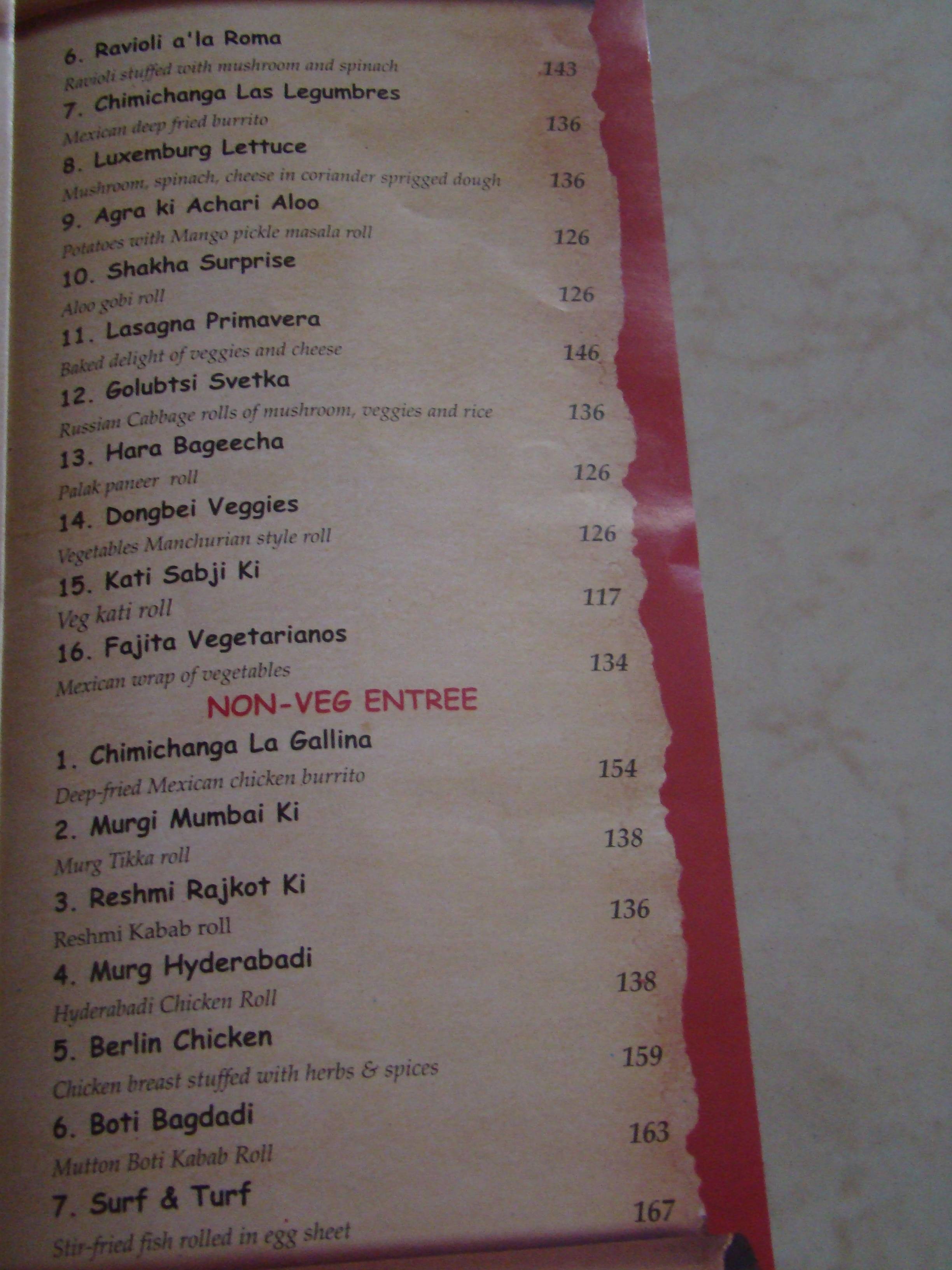
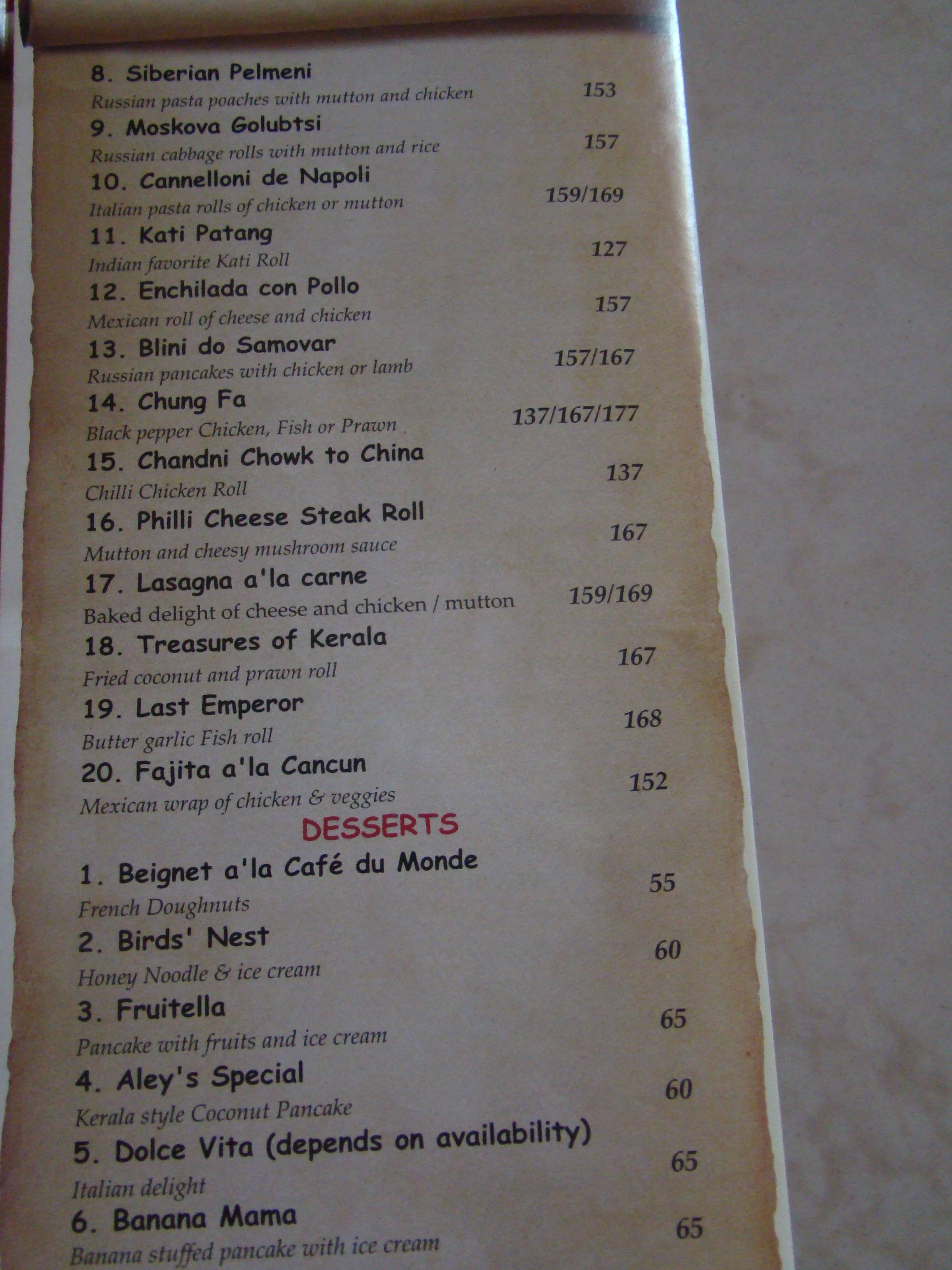
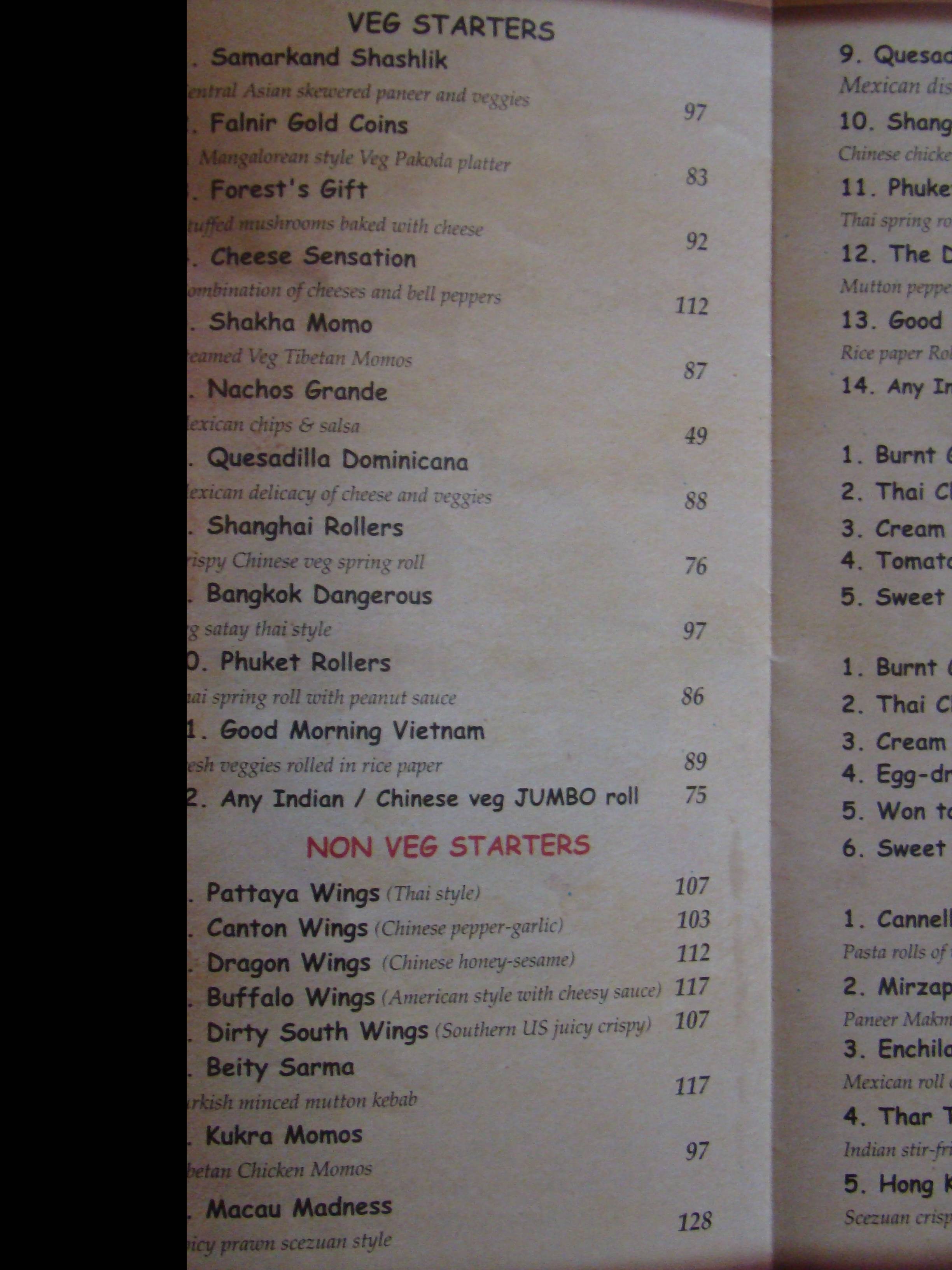
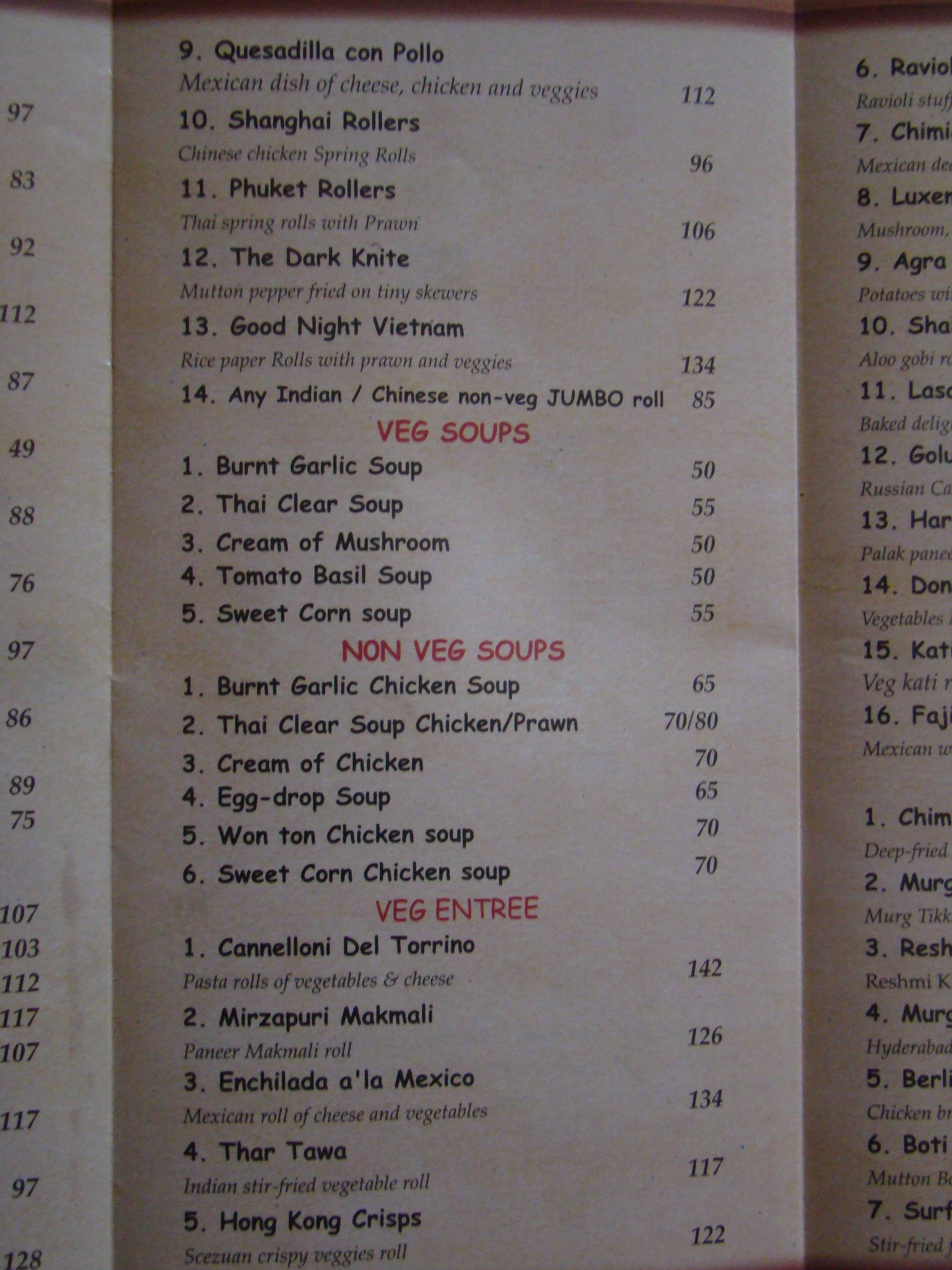
    The ambiance is pleasant and unpretentious, and somehow conveys a homely warmth. Of course, I am a bit biased because in the roll of honour (‘rolls united’ in various languages), there’s a separate panel added at the end for Malayalam. 😀 I must admit that I always thought the place was only about rolls, until I read a few Burrp reviews. It is a lot about rolls, but as the menu (below) would suggest, there are other things that play a role too. This is the home delivery menu (below – click for larger image), and in addition to this, they also have quite a collection of mocktails. (You can find that here  – page 7 onwards)

    1 2

    3 4

    Though the reviews at Burrp had mentioned large portions, the soups and starters were too tempting for us to ignore either. We started with a Cream of Chicken soup, which was so good that I think it worked on the soul too, as some book titles would suggest. It was very creamy, with a sweet tinge to it (coconut cream/milk?) and loads of chicken chunks and mushrooms. I think its the best we’ve had in a long time. Up next was the ‘Quesadilla con Pollo’, which is ‘baked cheese dish with chicken and bell pepper, served with sour cream and salsa’. Another good choice, though 1 slice (out of 4) had a goeey base. The sour cream complements the taste, though I felt it could’ve been more spicy. The salsa didn’t help on that front either, but the dish is good enough to still warrant a try.

    For the main course, we ordered a Siberian Pelmeni, “Russian favourite pasta poaches with the mixture of mutton and chicken that melts in your mouth together with the spicy paprika sauce and original Russian salad” and a Surf & Turf, “stir fried fish rolled in an egg sheet”. The former seemed to be the Russian version of momos, and while it did indeed melt in the mouth, it was a bit too bland for my taste. The sauce served was definitely not paprika. The fish dish was much better, mildly spicy, and was served with french fries and vegetables. The fries weren’t that great though. I have a feeling that we chose perhaps the wrong dishes. All of the above cost us a little less than Rs.500.

    I’d still ask you to give it a shot. The soup was excellent, the starter was good too, and there are enough choices in the menu for you to experiment with. The service is very good, maybe you could ask them for a bit of help in selecting the right stuff. They also have executive lunch combos, which, on paper, looked like great value for money.

    Rolls United, #15, 1st Main Road, 1st Block, Koramangala. Ph: 41314847

    Menu at Zomato

  • In duress

    A few days back, when I met Balu and Conall, we happened to talk about the lifecycles of services (Twitter and Foursquare was the context) and then discuss whether product lifecycles were being compressed too. It is interesting because let’s say an organisation has invested in a new technology and brought out a product. If they price it high, adoption will be slow, and it may never become mainstream. If they subsidise and price it low, they may lose out if a better technology arrives before they  break even. Mobile phones (feature compatibility and obsolescence), content storage devices (VHS to Blu-Ray) were some of the examples discussed.

    Dina wrote a couple of good posts (Part One, Two) recently on durability,and whether it is losing its power as a consumer driver. The plethora of brands advertising in the youth category would seem to agree (best expressed in Fastrack’s ‘Move On’ campaign), but as pointed out by Goutam Jain in the post, in many cases it would be intrinsic to the brand’s value. The rise of ‘good enough’ in the real time era is not helping the durability cause either. We could go from fidelity in devices to that in human relationships and the cause/effects in consumption, but maybe we should get Dina to do it later. 🙂

    The second post is also a great read and is based on the comments on the first, and introduces some excellent dimensions to the original thought.  Convenience + cost of exit, opportunity cost of not entering the next ‘upgrade’ are things that I’d like to add to that.

    Brand equity is something that falls naturally into the scope of this discussion. But what i was more interested in its impact on the content that brands create, including their communication. Look at say, print ads, whose physical durability is perhaps one day (equity created might probably last longer), or radio jingles and television commercials., with a slightly larger shelf life. On the internet, it can exist ‘forever’. But there are costs involved in all of these, and in terms of durability, they might not really deliver in this era of content abundance, fleeting attention spans, and the constant search for the next ‘wow’. Also, on a smaller scale, what happens when you design say, applications for a particular platform/device like a Facebook/ iPad, and it doesn’t prove to be durable? It is many ways, a gamble.

    So, when I read Clay Shirky’s amazing post ‘The collapse of complex business models‘, I sensed a tangential connection. To broadly summarise, the post uses Joseph Tainter’s ‘The Collapse of Complex Societies’, in the context of TV content producers’ inability to cut expenses below revenues, and explains how at some point, the level of complexity added to a system fails to add to the output, and becomes just a cost, because the different levels extract more value than the total output. Also, by this time, the system is too large and too interlocked for it to adapt quickly and change. Then ‘collapse is simply the last remaining method of simplification.’

    The post throws light on what is most likely the ‘tripping point’ for contemporary media. With increased connectivity between individuals thanks to various platforms, more ideas are being formed and honed. As new products and services arise, consumption patterns change, new needs are discovered and a disruption (which is perhaps another way of  describing simplification) always seems around the corner. I see this as a message to brands, many of whom have evolved their organisations, products and services on the basis of older ways of communication. How much has durability of products been a factor in the design and structure of communication and organisational processes? Or was it a result?  As durability ceases to be a major factor, is the new imperative flexibility?

    until next time, we still call it consumer durables 🙂