
Month: March 2010

  • Effective Cause

    The Pepsi Refresh project is something I keep bumping into, inside this blog, as well as conversations outside. I admit to a bias towards it, because I somehow sense a sincerity in its approach. Some time back, Surekha shared with me a document on which we debated a bit. From what I’ve been reading, Pepsi hasn’t given (at least clearly) this project a CSR label, so the debate over whether CSR money has been spent well or not is a little pointless. Besides it was more on crowdsourcing CSR .

    But thankfully, the national animal ensured that we continued the debate. Aircel’s ‘Save the Tiger’ has also not been given a label, but it does give a good handle to convey my thoughts on CSR, especially since there are at least a couple of good posts on it already, by L.Bhat and Karthik. Harish’s ‘Branding with a cause‘ is a more general, but very relevant read in this context. Aircel’s high decibel campaign ensured that most of everyone knew there were only 1411 tigers left. If awareness was the objective, as stated, it’s been done, especially since the slacktivist generation has retweeted and facebook-fanned it so much that even the tigers must know now. They haven’t been asked whether they want to be saved in a planet full of us, but that’s a different debate. So is the debate whether Aircel should complete the loop, after all why can’t we? (and maybe there’s another phase anyway) But I digress, and generalise. Sorry.
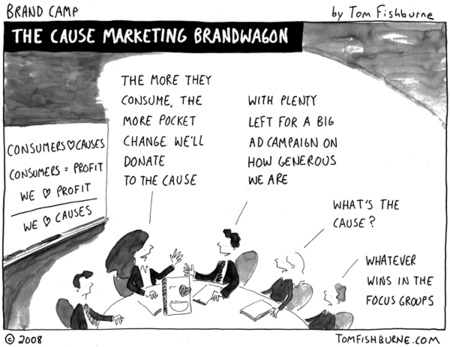
    Clipboard02

    (Image Courtesy: Tom Fishburne)

    The questions I have are these. Should CSR be related to the business domain or not? Aircel’s was not, but as Surekha rightly pointed out, they chose a topic that would connect with their target audience. My problem with that, though it helps stand out from the clutter in a commodity category, is the lack of context. With Pepsi, though one could say the project has nothing to do with sugared water, there was always a ‘youth’ context, which was established long ago. Now, if it were connected with the business, and it is possible with say, the pepsi project (surekha gave me at least 2 excellent ideas) I would turn around and say, vested interests, and doubt the sincerity of their efforts. ‘The big corporate giving us eyewash’ view. It would also bring in ROI measures etc, which I find hard to associate with CSR. Roshni put it succinctly when she said ‘sort of like proclaiming, hey, we did charity’.

    In trying to find a solution, I remembered a post by Umair Haque on ‘Great to good, which, perhaps unwittingly, made me think of a similarity between social media and CSR. As mentioned in my last post, the piecemeal approach to social media is something I dislike. Its as though it exists stand alone inside a box, I think I have a similar problem with CSR as a label. So, (simplistically put), what if the label were to be taken of and every process was carried out with an inbuilt csr approach – from creating environmentally friendly, sustainable products/projects and choice of partners/vendors to eco friendly packaging and everything in between? Oh yes, practical business considerations. I forgot. 🙂

    until next time, with great responsibility comes great power?

    Relevant Read: Cause Effect

    PS: JK cement deserves appreciation for its support of an unrelated, but worthy cause – bikinis 😉

    PPS: While on tigers, this one, by my good friend Blues, is a killer read 😀

  • Fire Drill

    A few years ago, 3 to be precise, I might’ve been in the thick of it. The fire at Carlton Towers. My visiting card then carried this – Mid Day, 301, Carlton Towers…. No, I wouldn’t have been tweeting, because twitter would come into my life only three months later. But perhaps this was the reason the entire scenario bothered me, even as I sat watching the Twitter stream and the reactions. At first, i thought it was some minor mishap, and even cracked a mallu pun at TGIF’s expense. (@mixdev reminded me of that yesterday) But later, of course, I realised it wasn’t.

    I don’t watch news channels, so I was spared the repeated shots (a good post by my friend Nishant) of those tragic jumps. I was watching the stream though, and kept seeing retweets of @jackerhack , who was stuck in the building. I read about people jumping from the windows, and my first reaction was what the hell was wrong with them? What did they expect, a bloody bed of roses??!! And then I realised that there was no way I could even imagine, let alone understand what they must’ve felt in those moments. The closest I could get to is perhaps when I have trouble breathing. Now these are very very minor asthmatic attacks, but even then I know the intense desire to get one lungful of air. And that’s perhaps just a decimal percentage of the trauma those poor poor souls must’ve gone through.

    Trivialisation bothers me. I still read Malayala Manorama daily, and my biggest grouse with them is the way they capture deaths. Not events like the above, but individual deaths. Though I realise its perhaps a way of communicating to those who might not have known, reducing a life (and its end) to a few column cms with a matter-of-fact headline bothers me. Perhaps its some sort of block towards mortality. When @jackerhack ‘s (okay, he has a ‘real’ name, and its easier to type – Kiran), so, when Kiran’s tweets were retweeted by everyone who had access to an enter button, it somehow reminded me of the above. After some time, when he tweeted about not panicking, I was even mildly irritated. (Sorry!) If it was meant for the twitter audience, i was wondering whether the majority of the audience cared for him enough to panic, and for those who did care for him, I wondered if the words would do any good. Was the twitter crowd mature enough not to panic, or not to see this all as a “ok, big event happening, let me part of it” thing? Are we really so different from the media we claim to hate?

    Now he bloody obviously had reasons to do what he did, which he has articulated very well on his blog. I read and re-read and even before that, could empathise. And so, this is not so much about him as it is about us. Us, the crowd which blocked the roads there to take a look, us who sat watching on the tube or the stream, us the viewers and readers, us the voyeurs, and definitely me, who writes a post. Death makes a good story. With apologies to the few who don’t look at it that way, I wonder if being part of the excitement has taken a whole new turn when we’ve become the media on Twitter. Unlike the case with other media, when the crowd creates and consumes, who can complain? Yes, there are many cases in which relief and charity work have been augmented by Twitter, but this wasn’t such a case. Hopefully, all this is just me 🙂

    until next time, false fire alarms?