
Year: 2009

  • The evolution of Content Marketing

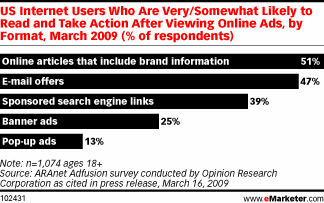
    A few weeks back, the eMarketer released some statistics about the kind of web advertisements that elicit reactions from readers.
    emarketer

    Clearly, the crowd likes to see ‘advertisements’ within content – I think advertorials would be a subset of that. This trend is all the more prominent in the younger audience, when the demographic profiles of the respondents are considered. (check out the statistics here)

    The graph shows that advertising in content is also ahead of sponsored search links, perhaps because the human writer would obviously have a larger sense of context than the ad serving Google. More importantly, there is a trust factor involved when the ‘advertising’ comes from a ‘known’ blogger/writer. There have always been debates about bloggers ‘selling out’ and plugging products/services, but sponsored posts are a reality, and so long as the disclaimers and the disclosures are in place, I am quite okay with that. I’m quite sure that if the concerned blogger gets greedy, the crowd will straighten him out in time.

    Content marketing is definitely different from traditional marketing/PR and raises interesting scenarios for all three parties involved – advertisers, publishers and consumers. Before you go further, I’d suggest reading up Chris Brogan’s (slightly old but) informative post about content marketing.

    The advertisers could range from large brands – products or services, to those serving niche sections. Trendwatching had written recently about sellsumers

    SELLSUMERS: Whether it’s selling their insights to corporations, hawking their creative output to fellow consumers, or renting out unused assets, consumers will increasingly become SELLSUMERS, too. Made possible by the online revolution’s great democratization of demand and supply, and further fueled by a global recession that leaves consumers strapped for cash, the SELLSUMERS phenomenon is yet another manifestation of the mega-trend that is ‘consumer participation’.

    Advertisers would have to figure out if they want to establish and maintain their own content marketing platform, or rely on on a network of entities like sellsumers – that could be individuals or a content marketing service that aggregates independent websites/bloggers, or encourage their regular consumers (/prosumers) to speak about a brand they use, or just support activities/communities and hope for good word of mouth. Perhaps it could be a combination of any or all of the above, with a different objective (a brand goal or a sales goal),  and different measurement criteria for each. In any case, this could prove a great way for brands to explore their long tails of products/services and communication too. It would also mean that brands would have to work harder to ensure that they reach the desired audience in the desired way, in an increasingly fragmented media landscape.

    Publishers, as mentioned above, could be the brands themselves or sellsumers  – individuals or a network. Perhaps newspapers could explore this as a revenue stream, since they’ve always been content aggregators with specialist columnists. The existing social networks are trying to evolve a revenue model out of this. Celebrities could build up an audience across social networks and create an endorsement 2.0 version. For any of the above, the key would be to establish and maintain a set of users, with whom they have an equity- a social capital, to whom they can provide a value, even when they’re doing content marketing. In essence, while the old publishers used their reach for any advertiser who could pay the required price, the new publishers would have to be focused and would have to live with the involvement of consumers in who they sell the reach to, and how.

    The end consumers will seek out networks they can trust, ones which can provides non intrusive ways of connecting them to the product/service they might have an interest in. They would play an active role in creating and maintaining relevant publishers and networks, by ensuring that they are trustworthy sources of information.

    Going forward, it is possible that all the entities we see on the web now, including us, will play all these roles at various times. Unlike the clearly demarcated advertiser-publisher-consumer system we have now, the new systems would be more fluid, with flexible options for all parties. The standards and norms of content marketing need to evolve. Perhaps the disruption we are seeing now, with the decline of traditional media and rise of social web is a prelude to this flexible system.

    until next time, role play

  • Rakabdar

    One of the side effects of the vacation was the discovery of a restaurant in (almost) our backyard. We saw a write up of Rakabdar in the Jet in-flight magazine, and as always checked it up on Burrp before deciding on it. Rakabdar is located exactly opposite Forum Mall on the Christ College/Dairy Circle side. That, I assume, also takes care of your parking queries. 🙂

    A ‘Rakabdar’ is a master chef of the royal courts of Awadh and Lucknow, so now you know what cuisine to expect here. They were considered “alchemists of cuisine”, as they sought to better their recipes every time they served it. No, they are master chefs, and so there’s no reason to feel that they’re experimenting on you. 🙂

    The restaurant is on the second floor, and we were escorted there after a tiny halt at the reception on the ground floor. We had reserved in advance, but since its a new restaurant, that proved to be unnecessary, as there was only one other group during the entire meal. So we got to choose a nice cosy corner. They have a couple of  seating options which could’ve offered a Forum facing view, but for some reason they’ve chosen to have no windows there. Wonder why.

    We decided to skip the shorba options and asked for a starter recommended in the menu – the Seekh Kabab Imtiazi,  “skewers wrapped with lamb mince mixed with cassia powder, mace and kashipur chilli and char grilled”. There were a lot of veg starter options, and quite some in sea food too, though the latter are quite expensive. While we waited for the starter to arrive, they gave us a complimentary kulcha with dal and chana gravies. That was quite a different take from the regular papads. 🙂 The starter was excellent and fairly large in terms of quantity. The chutney given along with it did complement the taste, but I felt it could’ve been better.

    For the main course, we again went for two dishes recommended in the menu – Achari Paneer, “paneer simmered in a tangy gravy of pickled tomatoes” and Murg Rizala, “boneless chicken stuffed with herbs and green chillies, dum cooked in a gravy of yoghurt with a hint of almond and garnished with egg”. We asked for the paneer dish to be made spicy, since the chicken gravy was bound to be bland. To go along with that we ordered an Aloo & Pyaaz Kulcha and a missi roti. Again, there were lots of vegetarian and meat (chicken, and a few lamb) options for the main course, but only one seafood option. (prawn). Our choices were a bit of a downer though. I’ve never been a fan of ‘achari’ dishes, but this one had sounded different. However, it suffered from an overdose of what we figured was a cumin flavour. So we didn’t like the paneer dish much, though that could be due to our taste preferences too. The chicken dish was better, though the bones were conspicuous by their presence. (as against what was printed on the menu). When we asked them, they insisted  it was a menu mistake and not a cooking mistake. 🙂 The gravy was quite good, very creamy and thick, but some parts of the meat were undercooked. The kulcha was good, and the roti,  just okay.

    We were quite stuffed and so couldn’t check out some special kulchas we haven’t seen anywhere else. (zattar and cheese, for instance). While on the subject of missing out, here are a few items you could consider. If you’re the seafood and shorba type, there’s an interesting shorba made of prawn, calamari, salmon, ginger, lime leaves and orange juice. You could also try out the biriyani, since dum b is an awadhi speciality too. You can judge how stuffed we were from the fact that we even skipped dessert. Other than the usual suspects – phirni, gulab jamun and rasmalai, there was also a Shahi Tukra and something we hadn’t seen earlier – Qubani ka meetha.

    They seem to have an extensive beverage menu – lots of white and red wines, martinis, single malt, cognac, apertiffs, and a decent selection of mocktails and cocktails, among other things. Your parameter of reference is as always KF beer – thats at Rs.150, and the bottled water is at Rs. 40. 🙂

    The service was quite good, and they even took us on a tour of their lounge – aira, on the third and fourth floors  of the same building. The fourth floor option seemed quite a nice place to lounge around, excellent cityscape views – in a small way reminded me of 13th Floor.

    Our meal cost us Rs. 1165, and that includes a service charge at 10% and the taxes.

    Try the place if you’re in the mood to splurge on a slightly different cuisine, especially if you want a change from the nearby excellent but usual options of Sahib Sind Sultan and The Taste of Rampur.

    Rakabdar, 7, Bhuvanappa Layout, Hosur Road Ph: 43431111, 43431100

    Menu at Zomato

  • First Proof

    Penguin – Compilation

    I’m a few years late in reading this, so it’s no longer ‘new’ writing. But that doesn’t take away much from a decent collection of fiction and non-fiction. A book which can be read from both ends (Fiction and Non fiction start from opposite ends) and consists of 17 works of fiction (including a trippy graphic one) and 13 works of non fiction. I liked the former, and not just because of my reading preferences.
    A few of the non fiction works are particularly relevant now – Nirupama Subramanian’s piece on the LTTE supremo Prabhakaran, and Saba Naqvi Bhaumik’s, Edna Fernandes’ and Smita Gupta’s works on the nature of contemporary Indian politics. Also worth mentioning is ‘Boarding School’ by Andre Beteille.
    My favourite fiction work would easily be ‘Kopjes at Serengeti’ by Arun John, and his awesome description in the ‘Notes on Contributors’. Indrajit Hazra’s Post-mortem is an interesting tale, so are the stories by Rana Dasgupta and Mita Ghose.
    I do believe that an anthology with more ‘breadth” (kinds of themes and writings) is possible, perhaps Penguin is doing it in the following volumes. (this is an annual project)

  • Social Connectivity

    Just yesterday, I read about AOL launching Social Thing for websites. Adding the service to your website gives you a navigation bar at the bottom of the page, users can sign in with their AIM/AOL/Bebo/ICQ ids and comment. They can also chat/IM, check out what their buddies are doing, and share stuff with them. According to Mashable, “Authentication goes through AOL’s Open Authentication API, which is being extended to include support for a single sign-on from Facebook, Google, Yahoo, OpenID and other services.”

    As TechCrunch mentions in its article which talks about Facebook opening its stream API to developers, the conversation wars are heating up. Facebook Connect and its potential is something I’ve written about several times before. Broadly, as a site owner, the implementation of FB Connect allows me to broadcast my content to my Facebook audience, and if they comment using FB Connect, it gets added to their stream thus multiplying the reach. As a commenter, I can share my activities on other sites on my FB stream. The opening of the API enhances the potential for FB stream conversations to happen outside FB.

    Meanwhile, a few days back, there was also a news about Twitter Connect. Obviously, since Twitter has very less profile data as compared to FB, it need not be seen as a competitor to FB Connect, but seen from a “conversation  platform choice” perspective, i’d say it still is. For those interested in how each of these Connect services work, this is an excellent detailed read.

    And what Connect conversation can be complete without the omnipresent Google. Before we get to Friend Connect, a detour. Google recently decided to give us more control of how we would be seen in a search result page – Google Profiles will now be part of search results and we can edit it. In addition to regular data, you can showcase links to your profiles on services like Facebook, LinkedIn, MySpace and so on. While Google claims its just responding to users’ needs, its obviously aimed at getting more user data. However, the profiles will only be shown at the bottom of the search pages, and will not ‘save’ you if you’ve been making news otherwise. 🙂 I assumed that the Profiles so created would be in sync with what gets displayed on Google Friend Connect, but apparently its not so. But you can have a vanity url (google.com/profiles/your name) so long as its connected to your gmail id. You can get a detailed report on the new Profiles here.

    Back to Google Friend Connect, once implemented on your site, it allows users to log in using GMail/Open ID/Yahoo/AIM . Users can comment, rate etc (depending on the gadgets you’ve added), engage with other users, and invite their friends from other networks to check out the site. There are many related things I am thinking of – will Profile and Friend Connect be made to work in sync, and is Google doing the opposite of what FB has done? FB created a social network first and then decided to connect other sites with it and thus enhance its own lifestream. With Google’s many services, it has a ‘disaggregated’ social network in place – YouTube/Picasa/Blogger/(even) Reader. At some point will Profile be just the equivalent of the ‘Info’ tab on Facebook and something like iGoogle (or God forbid Orkut) serve as the aggregator of one’s conversations across the web, not just across Google services, but the sites in which one logs in using Friend Connect. Google is always hungry for more data on users, so it can build more (and truth be told, sometimes better – like the proposed new Google News) products and get more data and obviously find more ways of making money.

    Of the four, Facebook is now using its Connect on popular sites to add more layers to its existing user data  and increase the conversations on Facebook. The opening of the stream API should get us some interesting apps. We’ll have to see what AOL does with its new service, how it ties it with Bebo etc. Twitter Connect is in many ways a different animal altogether, its simplicity and existing third party applications throw open many possibilities (as always) The data just goes back to Twitter, and it can be argued both ways whether Twitter Connect can be used effectively to increase a site’s visibility in the open yet ‘noisy’ stream, but the commenting using Twitter login would be useful to quite a few people  (a wild thought – maybe Twitter should just buy Friendfeed and make that its base social network). Google Connect is easy to implement and interesting gadgets are sure to happen. The possibilities of aggregating  it into a network remain. Now I wonder if Microsoft will find new ways to connect, or will they just Vine? As for Yahoo, maybe they’ll connect with Microsoft finally!! What will be interesting is what handle you would use to connect.

    until next time, connecting people ain’t just Nokia’s job no more

    PS.  6 years of blogging. A week’s break. 🙂

  • The Real and the Virtual

    He got married on April 24th 2003, to the woman he had loved for six years. He noted that somehow it all seemed to add up to 6. And so, on the sixth day he created ‘manuscrypts‘. From then on he was in seventh heaven. It’s been six years.
    It would’ve ended there, but manuscrypts was tempted to finish his sixth year with sixty six words.

    until next time, six degrees of separation 🙂

    PS: Next post, in about 7 days. 🙂