Year: 2009

  • Gorky Park

    Martin Cruz-Smith

    Gorky Park is the first of the Arkady Renko series – 2 others set in the Soviet era, and three after the fall of the Soviet Union.
    The book is as much a story about people and places as it is a crime thriller. The book starts with 3 bodies found in Gorky Park, in Moscow, with their faces and fingertips cut off. The investigation is led by Arkady Renko, who, after initial attempts to pass the case on to the KGB, sets out in dogged pursuit of the killer.
    Renko, the son of a famous general, battles his own demons as he plods through a bureaucracy that is rife with politics and corruption. Through the characters, the author manages to bring to life the character of Russia itself, from Moscow to Leningrad to Siberia.
    In a milieu where even a slight tone of dissent causes a person to be labeled as mentally disturbed, and procedures to be carried out on him to cement the case, Renko’s tenacity and his stubbornness to not let go of the case until the killer is brought to justice, ensures that he makes powerful enemies, who try everything to take him out.
    And while the mystery gets solved, we also find the human yearning for freedom and the paradox of wanting to be in a place where one belongs.

  • Social Office

    A couple of days back, I happened to read this report by Jakob Nielsen (via RWW) on social networking on intranets, that throws light on the enterprise use of 2.0 tools. From the RWW article

    Neilsen’s 168-page report includes case studies from 14 companies in 6 countries, including Sprint, Sun, Intel, IBM, and Johnson & Johnson. Several times throughout the summary, he points out that when he asked these companies about their enterprise 2.0 strategy, they told him to come back in a year.

    The report, a result of research done across 14 companies in 6 countries, highlights the pitfalls of both the quick adoption as well as slow track methods of using web 2.0 in the enterprise – risk to corporate culture and loss of employees who expect quick adoption respectively. The study points out that while the tools are important, it is what it lets people do and how it helps them solve business problems that actually matter, an emphasis on the sometimes forgotten fact that the new shiny object on the www need not be of use to the organisation and even the reverse – an old tool might work best for the intent/objective. It also highlights the different aspects that need to be taken care of, while implementing the tools in the enterprise – content, training, encouraging the community, speed of integration, open communication, the need for corporate communications to adapt to the reality of real-time and so on.

    And in the end, were raised two things that I thought were the most important components in this discussion – the change in corporate culture it entails (especially the ‘knowledge is power’ tenet) and the time the implementation would take, precisely because of that (and hence the need to start right now).

    The social media strategy (if any) of many companies is either the brand’s Twitter/Facebook presence and the ROI discussions for the same, or the use of these and networks like LinkedIn for actual sales (yes, broad generalisation). When compared to the corporate culture change discussed above, these are tactical uses of social media – utilising tools, for (usually and unfortunately) broadcast or direct selling. Yes, in some rare cases, the channels are used for two way communication too. (a story on Indian IT firms)

    While many efforts are commendable, in many ways, the tactics resemble a building with a gleaming facade whose insides truly reflect the state of affairs – peeling paint, bad plumbing, poor service etc. These are bound to come out. As the Ad Contrarian wrote a couple of years back in his post titled ‘Brand Tinkering‘,

    ……………tinkering with the brand is way more fun than solving real business problems. Solving problems requires unpleasantness. Floors have to be swept and walls have to be painted. People have to be fired. Systems have to be changed. Products have to be redesigned.

    The need for a more comprehensive approach to social media, and the need for internal change is something we often discuss here. On one of the LinkedIn groups I am part of, Pallavi Bhardwaj asked a question recently. It happens to be quite pertinent to this post, albeit in a tangential way. The question was ” Do you keep a track of employees’ personal blogs?” And its not just blogs these days – microblogs, social/business networking sites, and a tribe of self expression and sharing platforms that grows daily.

    It made me wonder if this is related to the enterprise not keeping pace with the evolution of the web and its tools? Assuming that a company monitors employee activities, does it then (in addition to/instead of) ‘deal’ with the employee or question why something was posted/shared, and address that? Does it again show the need for control, rather than understanding the need for a change in the way business is done? A short term view instead of real strategic vision? I’m not saying that the immediate ‘fire’ does not need to be handled, but is a thought being spared for what lies ahead? Maybe, if the enterprise had a thriving communication and sharing network, and an efficient response mechanism, the need for ‘policing’ would be drastically reduced? As one of my favourite Dilbert strips says,
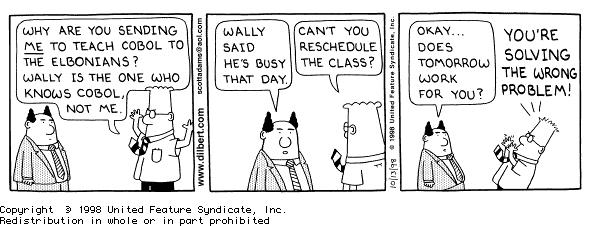
    wrong-problem

    (meanwhile, down with the syndicate!!)

    Perhaps, the brands who are just listening on the tools like Twitter, and using the information to change the fundamentals of how they do business are the ones who stand to gain more in the long term. As part of this, they could also be creating a culture, where each person is aligned to the organisation’s goals, rather than only the narrow focus of the department he works in. We really need more like Zappos, and more ‘culture creators‘.

    until next time, enterprise..start the trek 🙂

     

  • Truth and Friction

    The ghost of last week’s post lurks. I read a few days back that the NBA had been called to discuss the issue of obscene questions being asked by Rajeev Khandelwal on Sach ka Samna. Ha! Gotcha. This NBA is the National Broadcasting Association. 🙂

    According to the news report, Brinda Karat said that such shows outraged the modesty of women. The woman in question, of course, must’ve been tortured for several days before she agreed to be part of the show. Quite possible also that they threatened to send her to Rome, and specifically “Putin’s bed“, if she didn’t agree. She really musn’t have had any choice. I can understand how politicians and truth serum manufacturers would have a problem if speaking the truth became some some sort of an epidemic. What if people spoke the truth by default? Gah. I’d written a post sometime back, provoked by the original show – The Moment of Truth, in which I’d spoken about the evolution of a transparent culture, much like the subject of last week’s post.

    But now I really am at a loss as to what is delivering me (U,B added because its subjective) the bigger WTF – the television shows or the politicians. There was the RSS (Rakhi Sawant’s Swayamvar) show, in which guys went lattoo over Rakhi while Ram Kapoor lustily looked on at the object of his affection – the box of laddoos. The nation climaxed as the NRI got the girl and the rest got rakhis. I think there is definitely a scope for another season, possibly with a tie-up with some matrimonial website to register participants. Or maybe a spin off with Ram Kap titled ‘Shaadi ke Laddoo ke side effects’? (Update: Rahul Mahajan is going to be swayamvared in the next season) Then there are celebrities being housed in a jungle – ‘celebrities’ like Fiza, whose claim to fame is her previous show with Chand – ‘Is Junglee se mujhe bachao’. There is a marriage happening inside a show to which real people – viewers, are invited, and who can ignore Balika Vadhu, which I had initially thought was a spin off from the Hanuman show, centering around Bali’s wedding, but which I now like for its layered acronym – BV. (yep, i’ve seen a couple of episodes of each) Speaking of BV, this is also a show that our politicians had a problem with – claiming that it promoted child marriage.

    The politicians who seem to have addressed all the nation’s problems soon after getting elected, are now taking a break and sampling the pleasures of Indian television.  They are actually wondering what we are teaching our children and are talking about the Mahabharata, though i’m damn sure that if the series ran now, they would be claiming that Draupadi’s disrobing was promoting rape attempts, and Krishna’s number of wives, polygamy. I could give more examples, but you get the drift.

    Where is all this going? Not the politicians, but I wonder about this oxymoron called a reality show. As each channel tries to trump the competition, would the boundaries between truth and fiction blur more? In effect, though scripted, a lot of shows operate in the private spaces of individuals and their families. How does all of this affect the reality fabric – of family, relationships, society, pop culture etc? How far will we go to escape from ourselves? How many steps away are we away from seeing death – real last moments, on TV?

    Think about it, while I conceptualise this kids reality show, in which children will be left in a jungle, and every day, they take polygraph tests. If they are truthful, they get laddoos, else they have to spend a day in parliament. The winner of course, gets married off.

    until next time, tube toppers…

    PS. Sheer coincidence this time, that Rakhi had to make her presence felt in a post on Rakshabandhan Day, unlike the previous years. 1, 2.

  • Cornucopia

    Cornucopia is part of a ‘cricket homestay’ called ‘The Bat and Ball Inn’, supposedly owned by Sreesanth, Uthappa, Charu Sharma and one other partner. No, you won’t find appams here, the place serves Continental and Italian fare. 😀

    Here’s a map that will show you how to get there. While you can access it from Hosur Road, its easier to get there via Richmond Road. On Richmond Road, take a left turn immediately after TNT (opposite Citibank) and then take the first right. You’ll see the place on the right. It also hosts a cafe called ‘Silly Point’, and a boutique (which I think is) called ‘Dressing Room’. (It was about to rain, so my focus was on getting inside, especially since we had lost much time in trying to figure out the location, and had a movie to catch) From what we saw there, you don’t really need to reserve.

    There are two seatng options, one a regular restaurant closed setting, and the other behind this, which is a bit more open. On the way to the latter, you have a passageway lined with framed caricatures of cricketers. I half expected to see staff in cricket gear, but they haven’t gone that far with the theme. 🙂

    The menu has a lot of options, both veg and non veg – Continental and some Italian too. You can take a look at the entire menu here. There are soups, starters and salads, in addition to the main course options and desserts. We started with a ‘Spiced chicken and corn soup with lemon grass’  (cream of chicken and corn kernels with spring onion, coriander, chilly and lime). The soup was extremely good, probably the best we’ve had in a long time. It was moderately spicy and on a chilly Bangalore night, was a perfect start. If you’re planning a long leisurely meal, you might want to check out the starters too.

    For the main course, we ordered a Stuffed Chicken Breast Nanterre (chicken breast stuffed with minced pate and mushroom grilled and served with a red wine, green chilly and cheese sauce) and a Poached Chicken Breast Clemenceau (chicken cooked in wine and mushroom, finished with cream, herbs and crushed peppercorn). You have to order mashed potato separately, though they didn’t bill us for the bread and flavoured butter. Both the dishes were extremely good, with distinct flavours that I could detect even with my taste buds being retired hurt (thanks to a bad cold). The chicken was done well, and not undercooked (like in many places that serve Continental stuff) and the sauces were simply superb. Both dishes highly recommended.

    We were too stuffed for dessert, so that’s been left for the next time we drop in. Thankfully, the end of the meal also brought a mini shot of chocolate and coffee, in a semi liquid state, with chocolate just managing to edge out the coffee flavor. Coffee takes revenge by not allowing the mix to get too sweet. I refuse to intercede because I’m busy convincing myself  that its dessert. 🙂

    All of the above cost us just below Rs.800. With desserts and starters, it would be around Rs.1000. The service deserves special mention because it was extremely prompt. You should drop in for a relaxed ambience, extremely good food and if I have to judge from that mini-shot, awesome desserts. 🙂

    Cornucopia, 3, Laurel lane, Richmond Town Ph: 41149495

  • Reading beyond the obvious

    As a regular user of Google Reader, I was happy to see that a couple of weeks back, Google deemed it important enough to carry out a few changes – a ‘like’ button, the ability to follow specific people (using Reader Search), and friend groups (with customisation options of who sees what content). The public nature of the ‘Like’ button meant that sharing on reader got a lot more social, though it had its share of detractors too.  Many complained about not wanting to see “likes from the unwashed masses”, Google corrected it by adding an option in the Settings, so that if you so desired, you could only see the ‘Likes’ by people you followed.

    As a regular user, I’d say that people who give only partial feeds stand to lose out a bit on the ‘Like’ part. It would also be great if the time lag between publishing and the post appearing on Reader could be reduced. As a publisher, I wish Google would tie these social features in Reader with Google Analytics, so that I can know who shared/liked my posts. One way to know the number of ‘like’ is to subscribe to your own blog, but I’m sure that Google can make it easier if they want. Then maybe a plugin that can show these details on my post (at the site). Much like the Tweetmeme plugin I have installed on my other blog.  Speaking of Tweetmeme, according to Venture Beat, the button is now shown more than 50 million times a day across the web. It has its share of competitors, and is even threatening to sue one.

    That number gives a rough idea of why Google want a piece of the sharing pie. In fact, this chart, created by AddtoAny (the same guys who gave us that awesome widget at the bottom of my posts) shows how sharing happens on the web. Facebook leads, followed by email and Twitter. Google, though dominant in search, would be looking closely at specific competition – the Yahoo-MS deal and how Bing’s interesting games shape up. But more importantly, it also has to keep an eye on how generic search and sharing (social) are changing and shaping each others’ future. Twitter just got itself a new homepage, and ““Share and discover what’s happening right now, anywhere in the world”  clearly shows the intent. I thought it even answered, to a certain extent, the oft heard question – “But what do i do on Twitter”. Call it discovery/recommendation/trend, but it is just a different perspective on search. And its not just Twitter, Friendfeed recently added a feature – ‘recommend friends’. No, silly, not the Orkut/LinkedIn type, if you feel your subscriber would also like the feed of someone you subscribe to, you can share it easily. Though its nothing radical, its helpful for new folk.

    The Nielsen Global Online Consumer Survey shows recommendations (from known people) as the most trusted source of advertising, at 90% and consumer opinions posted online at 70% next. Among Indian audience, recommendations top, but editorial is placed second. A post on Six Pixels of Separation blog talks about how the next ‘Google’ will be a referral engine, which ranks website not basis text optimisation, but basis what people have said and done there, and how the information there has been used by people. But there are challenges there too as such a system needs to incorporate relevance, immediacy, trustworthiness and have an interface that will display it in the most intuitive, easy manner possible. This post on RWW discusses the concept of Social Relevancy Rank, with five layers, where search results on streams (like Twitter, which already have real time) will be arranged basis relevance to your social graph. Friendfeed does this and provides more options in Advanced Search. The post also suggests ‘friends of friends’ as the next layer of results, and a concept of ‘taste neighbours’ (a mining of ‘people who liked this also liked’) after that. The last two layers are made of influencers and the crowd aggregate. In fact, I thought, maybe a possible visualisation would be to actually have all five layers arranged vertically side-by-side and a thumbs up/down button by the side of each search result, so that each user can contribute to filtering. Is this a perfect method? No, but then neither is Google’s Page Rank, as the author says. Which perhaps is why Google, while it is master of the algorithmic search, needs to experiment with Reader and see if it can create a social layer on top of its Page Rank search system. A new system that also incorporates the data from likes and shares beyond the optimised keywords, and is able to operate in real time too. Possible? That would be fun, and would even take Ad Sense to a whole new level. 🙂

    So what does this mean for brand and marketing? Beyond mastering the algorithm, optimising all the queries, mining all the data and connecting it, how does differentiation happen, other than the obvious product possibilities? This very interesting article (via @vijaysankaran) discusses the battle between art and algorithm. Amidst the quest for perfect targeting, and the smoothing out of our search experience, we might be losing out on serendipity. The  author goes on to say that in this ‘end of surprise’ is the opportunity for marketing – to deliver revelation along with relevance. The perfect  of left brain analytics and right brained creativity and emotions, which seemed to have been lost somewhere in between.

    until next time, search and socialise 🙂