Month: December 2009

  • #In Business

    In spite of being the gold standard in business networking, I’ve always felt that LinkedIn has been a bit slow in adapting to the needs of its audience. Quite some time back, I’d written about the ‘news’ and ‘groups’ features, and had asked for an RSS feature for groups. That feature was incorporated earlier this year, but I thought there were several other possibilities which could’ve been incorporated, specifically in company web pages – multimedia support, aggregation etc. My benchmark of comparison was Social Median (acquired by Xing, a competitor to LinkedIn). I’d also wondered if it’d make sense for LinkedIn to perhaps acquire or at least have an association with Yammer.

    Just when I was ready to give up on LinkedIn’s possibilities (completely agreed with this), they seem to have caught a new wind. First came the redesign, with significantly better navigation, a cleaner look and lesser scrolling!! And then came the sync that everyone had been waiting for. Twitter was Linked #in (or#li) with an option to selectively share tweets on LinkedIn. Good timing, I’d say, judging by a few studies. A Palo Alto Networks study stated that enterprise usage of twitter was up by 250% in 6 months. (FB at 192%) Another report (can be classified as dipstick from the number of responses) , by the 2.0 Adoption council, seemed to indicate that social computing was making its presence felt in the enterprise.

    Most importantly, LinkedIn finally opened up its platform to developers. Bring on the apps!! (no, not Link farm ville 😐 ) RWW has a good post on the good and bad news and a few possibilities. Tweetdeck, Posterous, Ribbit, JobDASH, Box.net, all have integrations happening. The wishlists have started too. As RWW mentions, a ‘people you might know from other networks’ and filtered status updates would be great. Sandeep Gautam has a ‘Follow Friday’ like mechanism and @mentions in status updates in his list.

    On that note, I wonder whether the sync would mean that the twitter system of hashtags would become popular on LinkedIn, and a status search would find a place among the current crop of searches available on LinkedIn. An open platform would indicate that LinkedIn updates could appear on outside search. Also (like FB Connect) people would be able to interact with a site using their LinkedIn account, and the content could be taken to LinkedIn.

    A few twitter tools whose LinkedIn version I’d like to see –

    • Mr.Tweet (recommendation to connect) basis current network, interests etc
    • Alerts – not just recruiter, people and events that currently exist, but more options
    • Twitturly – to track the URLs that are being talked about
    • Trends (which might initially be a subset of Twitter trends?)
    • Twitter lists + Groups – It would require identification of Twitter list members on LinkedIn and then an option to add list members – create new groups/ add to existing groups

    The two places where I hope for a lot of action are groups and Company Pages. With an open platform, an integration of delicious and friendfeed can’t be ruled out. Company (and UGC 😀 ) videos and photos via YouTube and Flickr? And while we’re at it I’d like to have LinkedIn in the Google Reader ‘Send to’ (officially) and in future the option to choose a group/page with which a particular  link can be shared.

    With the integration of twitter and an open platform, LinkedIn has the content and context to provide better interaction between the various stakeholders of the enterprise – employees, vendors, business partners and even consumers. I see a lot of potential for LinkedIn to become a key player in the social business design (a Dachis Group concept) we keep talking about these days. Let’s hope to see more updates soon. 🙂

    until next time, business tweets 🙂

  • Aftermath…..

    ‘Intrigued’ might seem an insensitive word, but as the nation observed the first anniversary of 26/11 last week, I was intrigued by the reactions of different segments towards it. Bloggers, microbloggers, all forms of media, brands, everyone had a take on it, and their own ideas. Yes, nobody forgot, but this is year 1. Doesn’t count.

    I got few mails asking me for my opinions on everything from government apathy to the twitterverse on 26/11 – the POV of a blogger. I hardly had any, and whatever I had, I usually share here, like this. (my views haven’t changed) But I had been thinking about my feelings on the day, and what, to others, and perhaps even a part of me, might seem to be apathy, until I read this well written post. (thanks to Balu) And that set me thinking on standards and ‘Who decides?’, and then on to a tangent.

    Who decides what is to be done and how?

    A nation is formed. Its popular leaders, elected by the people, decide the way the country should be run. From sectors that should be open to private investment to tax slabs and from infrastructure to relationships with neighbouring countries, a few individuals, representative, some would argue, steer the fate of the country. In a few years, the policies and processes set up to aid the smooth functioning of the conduit – between the representatives and the represented- starts to work against this desired objective, because the balance of power between the objective and the processes have shifted. In a few more years, even the objectives which should have perhaps been reviewed, have been taken a step further, and promptly forgotten.

    Humans get together and aggregate, communities are formed, communities agglomerate, society is formed (in the original usage, not the housing kind :|) The society builds in conformation. Even with the non conforming kind, there is an understanding. Belief systems evolve, religions are formed, and rules are made. Do’s and don’t s are established in societies and sub societies. Popular culture is created and social ethos are formed. In a few years, the reasons for why things are done, and in the way they are, get forgotten, a mindless following ensues. Non conformists emerge, but then, we’ve been there before. Trading one system for another.

    A few people get together and form an organisation, knowing that they can create a better product/service than the places they have been working in. The founders have a vision for their work place, they set up systems and processes to achieve this, they hire more people, who can implement these. In a few years, a conglomerate is formed, the founders are at the top of the heap, there is a new breed that manages daily affairs, the process diktats are in place…. you know where I am going with this  🙂

    In all these cases, there would probably be a disruption at the end, and the start of a new cycle. It is what seems to be expected. In general, nations will sit up and take collective notice only when they are themselves under attack. The travails of another city, much less country are viewed only through the prism of how it would affect us. Society will take up cudgels when they feel a threat to the status quo. Those in power will want to retain it. Organisations collapse when they are unable to see macro changes and lack the foresight to adapt. When they begin to get affected, and they react, in many cases, its too little too late.

    The common factor is the LCD, no, not the screen kind, the kind you learned in primary school – lowest common denominator – the human. Recently, when taking some personal decisions, I tried watching my own mind work, drilling down from the seemingly obvious reasons to the unstated ones, and from there, down to the foundations of why i thought the way I did, and therefore did the things I did. Belief systems, created and maintained by experiences, peer metrics etc, and thought structures, the changes to which were only superficial with time (contrary to expectations), they were all there, with the reasons buried under multiple layers built over time. My experiences, my perspectives, so I decide, on hindsight, objectivity was perhaps impossible.  Autopilot. This is perhaps what gets reflected in everything that I am part of – organisations, society, nation.

    The realisation was pretty simple. Standards and decisions are on auto pilot, though they seem otherwise. Humans. Us. Living in bubbles, deciding objectives and setting up structures to get there, and then forgetting why.  Even when I think I am deciding, what is deciding for me is the baggage of the past.

    I thought of the poor souls in Leopold, Taj, Nariman House on that fateful day….who till then had built a structure and process to their life. Is that what it takes to get one out of autopilot? A cataclysmic moment – the moment when beliefs and structures scarily slip away, and the illusion of control becomes exactly that – an illusion. In the aftermath, calculated scenarios mostly don’t count.

    until next time, deciding the questions

  • (Non) User Generated Content

    World AIDS Day – a humble contribution

    condom

    Much to the brand’s credit, they RT ed my work, on Twitter.

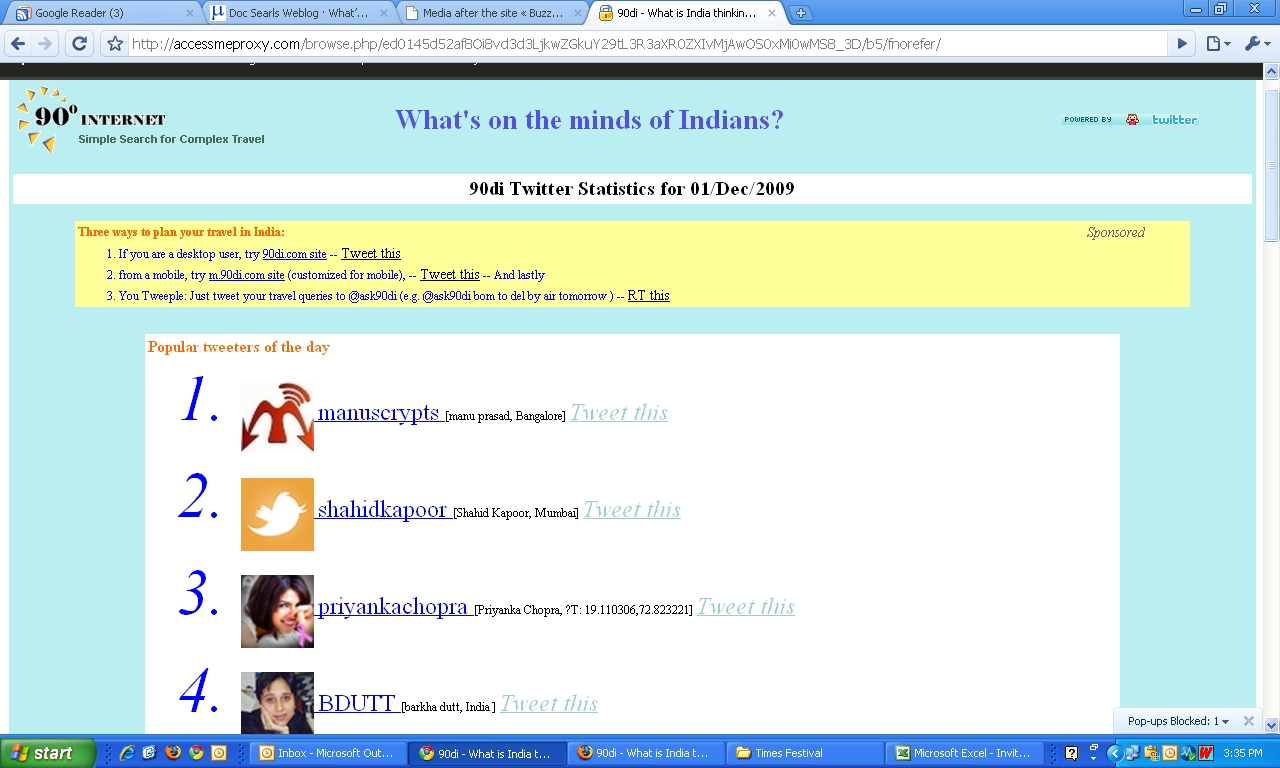
    And that little stunt led to the image being viewed some 2000+ times and my 15 seconds of fame as India’s most popular twitterer for a brief few hours, thanks to more than a 100 RTs from the twitterati. I also got a Samsung Galaxy from Tata Docomo. Ok, I made that last one up. :}

    Twitterer #1

    Yes, yes, don’t worry, I’ll still be posting here :p