
Month: December 2009

  • Test

    This is a restructuring exercise. brants has now moved to www.manuprasad.com/blog

  • Newsmakers

    Its ironic that I have to start the post this way, but

    Disclosure: I work with The Times Group 🙂

    There was some amount of Twitter buzz a couple of days ago on the article carried in the (city edition) Times about Arindam C’s new book selling a lakh of copies in 10 days. This also appeared in a post at “Don’t trust the Indian media”, in the context of ‘paid-for news’. The post dealt with the TV medium primarily, but also noted that in the coming years, consumption will be not be medium specific.

    Like I’ve written before in the context of content marketing, the key factor, irrespective of platform, amidst the changing nature of advertisers, publishers and consumers and the relationships between  them is trust.  In a sense regular advertising is also paid-for news, but its form is such that one immediately knows its paid for. With the influx of advertorials and paid-for news, the lines began to blur fast, with  credibility beginning to suffer.

    In an increasingly user generated environment (almost all of social media is just that) advertisers (brands) now have a way to source positive content without paying obscene amounts for it. They can find relevant spokespersons who have their niche, but contextually relevant fan following. Of course, on the flip side, finding them is still a task. But they already have a name for it – ‘social influencer relationship management’ 😀 The other point is that even the nature of sharing – blogs/microblogs/statuses are in a constant state of flux. Meanwhile, like Shefaly pointed out in the comments, it is still relatively easy to get away with non-disclosure on the web.

    But despite all that, and the fact that I believe in the loop of objective-> idea/strategy-> medium, I’d say that the web is more advanced than other media in terms of content marketing, primarily because user generated content, and discontent, has been an integral part of its evolution. Users, potential users, all talk to each other, and trust evolves. A crowd is involved, conversations happen. Also, with more and more lives being lived with an audience in mind, and people becoming conscious of how they’re perceived online, hopefully it will ‘become too costly to be evil’ (non disclosure)

    And that’s why its erm, refreshing, when I see brands making a strategic commitment to the digital space. Pepsi recently junked Super Bowl for the first time in 23 years and has included $20 million in grants for the Pepsi Refresh Project. Some say, its a risk, but to me its about as risky as putting a 30 sec ad that might get trashed. Moreover, its not an isolated thing. I recently read about Pepsi using Foursquare to fund a youth mentoring program called Camp Interactive, which helps youth explore technology and environment. Consistent efforts like this will get them unpaid editorial space and buzz at least in the online space.

    Closer home, Nokia is using a digital dominated strategy for N97, in its first 4 months of launch. I liked it because of the reasons stated – “Digital media blends very well with the product features of N97 Mini. Also, the audience to be targeted is all available online.” That sounds like its reasoned out well, though I’d also like to see a similar approach to execution too. There are a couple of things I am hoping for in addition to the obligatory display advertising – that Nokia not make this a short term venture, because though this product might become non priority for them in a few months, the poor sod who bought it will still want to connect with them online. The second hope is that they experiment with content marketing, and go a little beyond the ‘over-the-counter’ blogger outreach stuff.

    In the case of Pepsi, its a concept, an idea. In the case of Nokia, they have a product based strategy. In both cases, there is a potential for natural buzz, which to me is the way it should be. Buzz should be a result of a good product/strategy, too many time it IS the strategy, and that is what has caused things like ‘paid-for content’. The bigger hope in all this, of course,  is that an increasing commitment to the evolving digital space will force advertisers and brands to be on the ball, and in that, a better mindset will evolve, one that believes in a two way communication approach, as opposed to blind advertising and paid-for content.

    Its interesting that on one hand, networks, brands and individuals are trying to carve out a niche based on trust, using digital media for reach, and on the other hand, we have the news media, the original custodians of trust,  despite guilt , oops,  guild feelings, using their massive reach to push one way communication.

    until next time, news making

    PS: See you in a fortnight 🙂

  • Time Off

    In an earlier post – “Brood Mode“, I’d written about expectations, and how sometimes, they cannot be met. In the context of that post, Austere had commented thus “Is it the instant-ness demanded of the response that puts one’s brain to a side?” I messaged her on Twitter, that ‘the time construct’ was something I’d planned to write on next.

    Our response time has been shrinking on a continuous basis, twitter, FB etc are a manifestation of that – real time, but the changes have been happening much before that, probably with every advancement we made, not just in communication, but even things like transportation. So, the thought is, if we had more time on our hands, would we be behaving differently with people?

    When I was chatting with Meeta recently, we started discussing this, in the context of relationships with people. It started with me saying that the traffic during the daily commute to work, made me forget all the rules I make for myself, because with all the lane cutting and parking woes, its easily a scenario in which you’re either aggressive or you end up on the road, literally. So I wondered if it would be different if there were no time constraints.

    Despite only a superficial similarity, I was reminded of another construct – money. What started out as a tool of convenience has enslaved many and managed to dictate their actions. Much like the things we create to crunch time. The similarity ended there. Time is not money. Quite obviously, time exists with or without us, though the latter can force one to ask “Who does it exist for then? So let me put it this way, it is a construct that’s still not fully understood, whereas we made the money construct. But for the fun of it, imagine what you would’ve done if your life wasn’t dictated by time. What if you had all the time in the world. Would you be a different person? Would you behave differently with people?

    As it regularly happens these days with me- by sheer coincidence, the day after I had this discussion with Meeta, I came across this work from Hugh MacLeod, which puts it so well
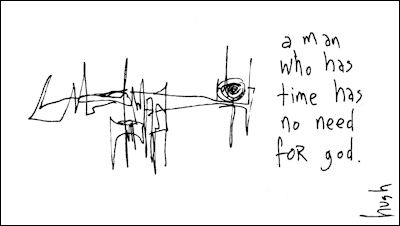
    time

    until next time, timed out for a fortnight 🙂

  • First Proof 2: The Penguin Book of New Writing

    The second edition of Penguin’s annual anthology, this one has poetry in addition to fiction and non-fiction.
    There are 11 works of non fiction, though some of them, I thought, would have made more sense in the fiction set!! My favourite would have to be Arunava Sinha’s “Apna Desh, Apna Blog”, the evolution of a blog and the blogger, more so because I could easily identify with it. His wit is evident not just from the piece, but also in the ‘Notes on contributors’. Dilip D’Souza’s “Night in the city”, ‘an ordinary Bombay story’ is also a good read, that reflects not just contemporary society, but also its sense of law and justice.

    “Roy’s quest”, by Samrat Choudhury is a cute read about a schoolboy’s crush. “Family”, by Salman Haidar and “Delhi’s last conquerors”, by Ranjana Sengupta give us great glimpses of history.

    A dozen works of fiction, and picking a favourite in this section is more difficult. So we’ll go in the order of appearance. “Karim”, by Anushka Ravishankar is an excellent take on organised religion, and its effects on daily lives, as seen from a child’s perspective. “An Indian Porn director’s speech to his hesitant leading lady”, by Altaf Tyrewala is bizarrely hilarious. “Luck” by Dhruba Hazarika is also an interesting read about a pigeon called Luck and the changes it brings about in its owner’s life. “Stupid”, by Sonia Faleiro is another good read with a neat pragmatic/cynical/sad ending.

    If I had to choose a favourite, it would be C.Sriram’s “A matter of faith”, which deals with the mystery of existence, and how we adapt it in accordance with our own needs. “Mrs. Anand”, by Manreet Sodhi Someshwar is a touching piece that captures the different roles that a woman plays in a family and society, the losses she quietly accepts, and the brief moments of understanding from another person that allows her to give in to her grief and shed a few tears. The last work of fiction is from Kanishk Tharoor (yep, not a very common surname 🙂 ), its interesting in a unique way.

    You’ll have to look elsewhere for the poetry review, because that’s something I’ve never been able to relate to.

  • Trust & Context

    The Tiger Woods saga continues. And though I have had fun (like this) at his and Accenture’s expense, the entire series of events did make me wonder again on endorsements, especially after Accenture dropped Woods. The topic of endorsements is something I have written about earlier too – of how blogging/tweeting ambassadors would react to uncomfortable questions about their brands (Big B – Cadbury’s worms), and the effect of celebrity micro-bloggers even on brands they don’t endorse. But this is on a slightly different note.

    “As perhaps the world’s ultimate symbol of high performance, he serves as a metaphor for our commitment to helping companies become high-performance businesses.”, the Accenture site had said earlier. Like we discussed on Twitter, a lot of the audience are not just fans of a celebrity’s attributes, but even assume that he is equally good or flawless in every other facet of his life/character too. Its perhaps a wrong expectation, not just from the audience, but from brands too. (high performance on the course) Lack of context.

    That brings me to the subject of the connections we make on social sites, most notably Twitter, because (for me) only a small percentage of following/followers are made of people who we knew from before. The connections, while they may evolve into relationships later, are built on trust, developed over time and actions, and in my case have a contextual nature to it too. I rely on specific people for expertise on specific matters. I am guessing many others do too, many Twitter lists are a manifestation of that. The recommendation economy, consumer ambassadors, and micro ambassadors posts I have written earlier are variations of the same premise of trust.

    When I look at entities like newspapers, which were built on a trust model, I wonder how the newly formed trust relationships will shape up. Newspapers and later other platforms owned the power of dissemination..distribution. The net disrupted that. In the age of unlimited content and trust agents, the new networks start playing crucial roles in trust relationships. And that is why, the ‘url shortener’ war that is in its early stages now – Facebook, Google, bit.ly interests me.  Reach, trust and context. Who will you trust all your data with? How much of data mining can be done with the links we share and consume, and how much context can be gleaned from it? Which network gives you the maximum reach? While FB and Google can integrate with their own networks, bit.ly is Twitter’s default shortener, and for now, it is doing things to maintain its lead.

    And its not just this. These days I’m seeing more and more manifestations of power play around me – among people, organisations, communities. When Twitter plans to add ‘contributors’ to business accounts, and allow multiple users to be identified in a single handle, it means that the different people will have different levels of trust from their audience, it would also allow context. But when Marissa Mayer describes Google as “omnivorous” in its quest for indexing data, and when Facebook changes its privacy stance, I wonder whether a trust economy built among individuals and relying on networks for the reach, will get overshadowed by the networks themselves, and the way they use our data.

    Tiger Woods might have been used by advertisers out of context with his permission. With unlimited data on you and fuzzy privacy settings, will you, without your knowledge, become a micro ambassador for something you have no expertise in, and thereby erode your trustworthiness? Silicon India profiles, Facebook Ads stating X friend has used an application, random RTs…..Paranoid? perhaps, but then, we share so much online, that maybe I can justify it. 🙂

    until next time, deprived of privacy