Month: October 2009

  • Social Inside

    There’s quite a funny video that has got almost 50,000 views by now on YouTube. It is titled ‘The Social Media Guru’, and in case you haven’t seen it by now, you should take a look, though you might want to keep the audio levels down thanks to the language

    httpv://www.youtube.com/watch?v=ZKCdexz5RQ8

    While the video does generalise and could cause some heartburn among some who work on social media and do good work, the reason I found it funny was because I see around me, a lot of what is shown in there – a preoccupation with the tools/platforms in vogue, and the lack of something as basic as an objective. As always, the tools are less important than the philosophy of sharing, collaborating, and 2 way communication that’s happening not just on social media sites, but across the web, though the former, because of their inherent nature, have taken it to a different level altogether. The combination of a client who has decided his brand needs to be on twitter, thanks to some article he read somewhere (or an even more vague reason) and the social media guru whose answer to any client is a templated Facebook page + twitter account + you tube, is quite lethal – to two sets of people – the agencies/individuals who are doing/interested in some genuinely useful work on the social media platforms and the brands who decide not to take the plunge basis the results of the poorly thought through/executed programs of other brands. It doesn’t help that the medium is still in its nascent stages and everyone is still learning.

    While social media practices and practitioners might be fewer in India, as compared to the US, the challenges faced show very little such skew. I read two posts recently on the subject. Karthik wrote about ‘selling social media engagement in India‘, where, with the experience of working in a PR firm and pitching social media, he looks at the changes he’s seen in the acceptance of social media among clients over the last couple of years, and the key attributes for making the sale. He mentions how an existing communications partner has a ‘door opener’ advantage as compared to say, an exclusive social media agency, which helps them get the right  people from the client side involved in the pitch, and the need for proper articulation and simple guides which could be used by the client team to sell to their bosses.

    In another extremely interesting post, Sanjay writes about “Advertising Agencies and Social Media: The Challenges“. He notes fundamental differences in the way an advertising agency looks at communication, and how communication actually happens in social media. The observations on ‘campaign’ focus, the obsession with perfection (copy), the mechanics of how communication is rolled out, are all spot on, and something that I too have experienced several times while dealing with creative agencies. He ends by mentioning that in the current scenario, agencies keep treating these platforms as broadcast media. That last thought is something I keep deploring regularly here, so I completely agree.

    Now the thing is, while these are all perfectly valid points, I was looking at it from a different perspective. I wonder if, in the entire spiel, social media’s proximity to marketing/communication/brand as a function completely overshadows the cultural transition required by the client organisation. Does it get discussed at all? Even in my post rant some time back, I had only emphasised the usage of social media in the PR, research, advertising disciplines and the different stages of the product life cycle – including sales, customer care etc, and barely mentioned the culture change.

    The subject of a shift in culture is something I have written about in several contexts – from basic thoughts on transparency in organisations and controlling employee communication internally and with the outside world, to the need for organisations to understand themselves and the value they provide before going overboard with listening and acting on consumer feedback, to whether the size and scale of the organisation dictates its culture and its internal and external communication processes,  and the necessity to tackle business problems and look at it as something that needs to be addressed at an enterprise level too and not just at a brand level. The Dachis Group presentation – ‘Social Business by Design‘ illustrates this extremely well.

    I examined it further in the framework of the Awesomeness manifesto, which i regard as an excellent set of fundamentals for organisations, if they want to operate profitably in the evolving business scenario, and in all four of its pillars, I could see the need for a more holistic approach to social media. Its obviously easier said than done. It involves a vision, the zeal and guts to translate that into internal and external business practices- from environment to employee friendliness, training of personnel, readjustment of business goals, hiring people who understand this new design – like say, P&G’s technopologist, who can operate across functions to evangelise it and help apply it in different contexts. And that’s just a few things. Look at an application of this across your organisation, and you’ll see how massive an endeavor it is. Maybe only a few organisations are thinking about it now, but I think it might become an imperative very soon, decided by external forces beyond the organisation’s control. Whether this is spearheaded by the organisations themselves or an external agency would be a decision based on several subjective parameters. Maybe then, organisations will be able to figure out the ‘gurus’ better. 🙂

    So while, it is good to see great social media efforts from brands, I wonder whether more needs to be done to integrate it more fundamentally within the organisation.

    until next time, social nirvana 🙂

    Bonus Reads:

    Customer Twervice by Social Media Explorer (10 examples of companies using social media for customer service)

    Social Media Policy Database (Via Six Pixels of Separation)

    Why its time to do away with the Brand Manager 🙂
  • A lot can happen over coffee

    Part 2 of last week’s post. Contrary to what the title might suggest, this has nothing to do with Coffee Day. Well, almost.

    I waited outside Fresco’s for the next meeting and this caught my eye. Coffee, destinations and experiences.

    httpv://www.youtube.com/watch?v=oTYh6OSnAIY

    And just as I finish erm, shooting the above, she zooms in and after parking the car, chides me for not responding to her first wave from inside the car, until I point out to her that from where I stood, I could barely make out that its her inside the car. I also tell her that it might be unwise to wave at people of the opposite gender when one’s unsure… I was meeting her after a few months, and was yet again, struck by the precociousness. She’d called me to discuss a website idea of hers. She is all of 22, and has a knack of making me feel ancient, though unwittingly. We agree that the place demands that we concentrate solely on the chocolate desserts, but then we compensate by (me) arguing that the Oreo’s cream in her pastry was just wasting space that should’ve been taken by more chocolate. I pointed out my unadulterated ‘Chocolate Demise’.

    I ask her about her new idea, and out comes the story that its happening thanks to the money made from another business of hers, that’s apparently quite a success. She informs me that the idea for the first business came about from an earlier meeting we’d had. She explained, and when I heard it, I felt like a favourite character of mine – Forrest Gump!! Meanwhile, her book is already with the agent, she tells me its been 5 months, and maybe its time to check out another agent. I tell her that’s a hell of a lot of things to be doing at 22. She finds it worrisome that she might be trying out too many avenues, too many side lanes, which might take her focus off the main road, and i tell her about the number of posts I have written about the paths not taken. After we’re through with our chat, I tell her that I’m very happy for her, the way she’s handling her life, and not to stop.

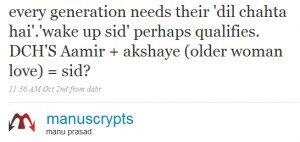
    I wondered about the stuff I’d been doing when I was 22. One week later, I watch ‘Wake Up Sid’. (I Saw, Puked, in case you like anagrams)  After the movie I tweet,

    Clipboard02

    Dil Chahta Hai was released in 2001. I was 23 then, close enough to 22 when one looks back now. Not then, of course.  Business management and beach bumming. There’s no comparison. 🙂

    A thought on WUS vs Lakshya before we move on.  Both are ‘coming of age’ movies, and that’s where the comparison ends, for me. Lakshya had an individual who got himself something to focus on, Sid just becomes relatively more mature. Movies work differently for different people, in fact I identified more with Lakshya than Sid, but to me, the comparison itself is perhaps unfair, because it means equating coming of age to focus. In my book, they are not the same.

    Though WUS did remind me of DCH, it was another comparison that gave me food for thought. Konkona plays someone who’s older than Ranbir, by about 5 years. She comes to Mumbai, focused about what she wants to do. Ranbir is barely trying to figure out what he wants to do. Two different approaches to life.

    I wondered if the age difference explained it, or was it the individual character, or their different circumstances. In many posts, I have explored each of the three separately. I have wondered whether today’s generation has many more choices than I had, and whether that’s the reason why I am constantly thinking about roads not traveled. I have wondered whether people are just made differently, in terms of aggression, risk taking mentality etc. I have wondered about how one’s circumstances, and the people one is surrounded with, influence one’s destiny. I have even wondered  about the combination – whether society has changed and has helped the young of today by giving them freedom to experiment, to make their own responses to choices, and thus made them smarter along the way, and helped them build confidence.

    And then i remember the coffee choices I’d seen as I stood in front of Fresco’s. Choices have always been there, maybe lesser, but there. I could have the coffee on the roadside or inside the CCD. They’re completely different experiences, and any judgment of one being better or worse than the other is simply a matter of perspective, based on time, person, place and so on. It perhaps isn’t even about the journey, its about how  one sees the journey, and what one wants to make out of it. 🙂

    until next time, ennui anyone? 🙂

  • Chalo Punjab

    ..for dinner, that’s what we thought, after D had spotted it on her way back from work last week. No, she doesn’t work in Punjab, this is version 2.0 of what used to be called ‘Dal Roti’ in Koramangala, located just before the Sony World junction, on the left, when coming from the National Games Village direction, opposite the IBP petrol pump.

    Dal Roti used to be the value-for-money North Indian joint we used to frequent in our first round of stay in Koramangala. Coincidentally, I remember mentioning the last time we had been there, that it was time for a renovation, and that seems to be exactly what happened. So Dal Roti is now ‘Chalo Punjab’ with a ‘fine dining’ tag to boot. We reached there just after 8, and easily got a table. I think that can be attributed to this being the first weekend (I think) after the re-launch.

    Though the seating arrangements remains roughly the same, the ambience is must better, with more Punjabi flavor thrown in, in terms of props. I still wouldn’t classify it as fine dining, though its definitely a couple of steps above the initial version.

    The menu is more elaborate though, and if anything, we were spoilt for choice. You could start with sherbets/shikhanjvi/thandai/khatte aam ka panna or chaas/lassi or even an ice cream doodh sheikh (they’ve had  quite some fun with the spellings and the names), about a dozen options priced between Rs.40-80. If you’re the shorba kind, you could try ‘loveleen de tandrust shorbe’ – 3 veg and 2 non veg options, priced at Rs.70/80.

    There are more than a dozen veg starters including the Rawalpindi Railway Gobi and Peeo de Cheesy Palak rolls, at Rs.130/140. The non veg options would be about double of that, most of it in chicken (Rs.160/170) and about 4-5 options each in mutton (Rs.210) and fish (Rs.220) and a couple of prawn options too (Rs.250). For the main course, the grass eaters get to choose from about half a dozen dishes each of dal and paneer (including Major Patrick da paneer tiranga!!), in addition to over 15 other dishes, like ‘Simple di subz keema’, ‘marie memsaab di ishtew’, and ‘garima di gajjar methi malai’, priced between Rs.120-160!! There are about 8-10 options each in chicken and mutton (Rs.230-270) and 3-4 options in fish, prawn (Rs.230-270) and eggs (Rs.130-160).

    To go with that, you could have paratha/roti/kulcha/naan, priced between Rs.35-65, or biriyani/pulao/rice (like the Punjabi Times Chicken Fry rice!!) They also have thali options on weekdays – Rs.140/180 for veg/non veg. Now, you get what I mean by elaborate menu. Phew!!

    We skipped the shorba and started with a Chandigarh Chicken Cake (C3) 😀 That’s “generously spiced minced chicken cupcakes shallow fried served with a dash of coriander and chat patta masalas”. Its a perfect starter, complemented  well by the mint chutney, though 6 pieces in one portion meant that the stomach was filled a little more than we’d liked, especially when a glass of lassi was also used to wash it down. For the main course, we ordered a Kartarpuri Kajuwala Kukkad Kadi, “chunks of tender chicken simmered in a rich cashew gravy mildly spiced”, a Mardaan di Meat di Feast (!!), “a delicious recipe of tender juicy cuts of mutton slow cooked in a rich onion yoghurt & tomato, enriched with steamed spicy mutton koftas swimming in mouthwatering minced mutton gravy”, and to go along with it, a wheat naan and a cheese chilly naan. The chicken dish was more brown than white, but simply awesome, and I’d recommend it very highly. Thick and mildly spicy, it was done extremely well, so much that the elaborate mutton dish was reduced to second place, though those koftas were quite good.

    I’d have liked to try some dessert too, but was completely stuffed. I think just reading that menu fills half your stomach!! There are about a dozen dessert options (Rs.50-120) – the regular North Indian stuff – phirni (though this is Pammi ji’s!!), kheer, kulfi, rabdi, gaajar halwa, gulab jamun, and even a Mango Dolly ice cream!! Mind it!!

    All of the above cost us just over Rs.800. The service was excellent, and except for a tiny delay in bringing back my credit card (hmm), it was extremely prompt. The price may perhaps not be justified by the ambience, but its more than compensated by the tasty food, great service, and the phenomenal amount of choice.

    Chalo Punjab, 906/1, GNR Plaza, 80 ft Road, 6th Block, Koramangala. Ph:41105666/777

    Menu at Zomato

  • Wavering

    My twitter stream over the last weekend and to a certain extent this week too, was dominated by Wave. People asking for invites, writing about their first impressions, cracking one liners and so on. The entire activity reminded me of how brand custodians try to create ‘virals’. From making ‘viral’ a part of the strategy, to announcing on the day of the release that they have ‘launched’ a viral, there are stories and stories. For me ‘Wave’ was a viral. Google has done this before with GMail. This time too, there was hardly any advertising. It was banking on the brand and product equity of Google, and the (potential) awesomeness of the product. It made me think on both fronts.

    Google’s brand identity has been dominated by search. For most people, it is their starting point on the web. But its not just that. From the iconic, simplistic, patented home page and the doodles it exhibits there, to its attempts to disrupt the real time conversation domain that is dominated by Facebook and Twitter with Wave, Google is many things. GMail, Orkut, Picasa, Blogger, YouTube, Maps, all operating on different domains, and brands in their own right. And they only make up one part of what Google is today. (link to an informative analysis of Google) Currently valued at $100 billion, and rising. Though wary of it, the brand has my respect, and for me, Google has been awesome.

    Awesomeness. Umair Haque had an extremely interesting post about awesomeness recently. He wrote that innovation is passe, that it is ‘what is commercially novel’, doesn’t create anything fundamentally new, and that awesomeness is the new innovation. He lists ethical production, insanely great stuff, love, and thick value as the four pillars of awesomeness. Arguable, right from a semantics/ new buzzword premise. But I tend to agree, especially when I see the stuff being passed around as innovation.

    Now, some of you might be aware of this, but for those who don’t, Google has a ten point corporate philosophy. An extremely interesting set of things, which you must take a look at.#10, I thought, was related to awesomeness. It goes “Great just isn’t good enough.” Google believes that great is just a starting point, and their “constant dissatisfaction with the way things are becomes the driving force behind everything we do.”

    They obviously felt that the entire domain of real time communication, search, sharing and collaborating could do with some disruption, that would explain Wave. And from the time I saw the video, I’ve thought that it would be a game changer, and wrote as much. But the feedback so far has been less than encouraging. From productivity killer to RSS, The sequel, it has been called quite a few things. The opinions are from guys who know what they’re talking about.From the little I have tried it out, I’ve to admit it can totally knock off productivity, but then again so can Twitter. Its less fun if there aren’t many around. Twitter in 2007, for me. Most are still learning, because it IS quite different. Seth Godin called Twitter a protocol (yes I keep saying that because its absolutely apt), I still figure that Wave has the potential that it showed in the video, the potential to create its own protocol. After all, there must be a reason why they call it a preview.

    But it did make me wonder about Google and awesomeness. Is Wave awesome, as opposed to an innovation? What if the idea is too advanced/difficult to provide ‘thick value’ now, does it still deserve to fail? Does that mean that sometimes innovation is better than awesomeness? How does ‘failure’ feature in the awesomeness manifesto? What does this do to the overall brand equity of Google? Or is brand equity an excuse/surrogate for thin value, and exist only in theory, or until the last good product?  But maybe Mitch is right when he says that we’re killing it before it begins. More after I play more with it.

    until next time, a wave new world

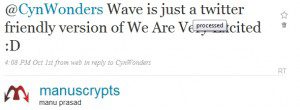
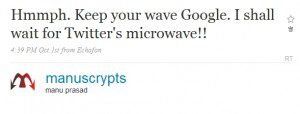
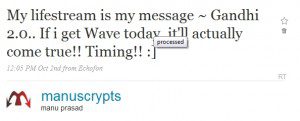
    PS: a few of my Wave tweets below 😉

    Clipboard02Clipboard03Clipboard04

  • Tea and multiplicity

    We sat in Infinitea, sipping green tea and munching fried momos. It was her first visit to Bangalore, and as my contribution to her introduction to the city, I had given her the experience of navigating the one ways of the city on a two wheeler. It was less than a month since we’d been first introduced to each other, and that turned out to be the subject of the conversation, at least the lion’s share of it. Of how technology had reached a point where one could perhaps land up in any city and have such conversations, because of the connections that pre-exist. No pre-exist for years or even months, but just a few days, thanks to the people we trust, who connect us. We perhaps have nothing in common culturally, but we can still relate to each other in terms of ideas and thought streams. Communication protocols are changing, and with that, relationships too. We discussed the subject of my post a fortnight back – evolution, and she told me the story of a guy who had a camera fitted into his glass eye!!

    She’s traveled a lot and shared anecdotes of places and experiences. Her stories reminded us of how destinations have become like trophies, simply to be collected as part of a journey which we no longer appreciate, much like the beautiful sights that nature has created. We compared notes on clicking images versus capturing it in the mind’s eye. I could totally relate to that as I remembered the Leh trip from earlier this year and told her of how I paused before I took the step into the plane that would take me back, knowing that it perhaps was the last time I’d see the place. After all, there are so many places to see, never mind the trophies, because there may be some I haven’t even heard of yet.

    I think that I might have come across as an absolute anti-capitalist, because at least twice I said that the only thing that stopped us from enjoying life fully was money, because it tends to become an end in itself, and we make the things it can buy, the things that hold value to us. If money wasn’t a constraint, I’d travel all over the world, write about the things I saw and be happy with the five odd people who read it. But it is, and so one has to save up, and choose from destinations, and hope one has made the right choice.

    We debated a bit on what I thought was a paradox of sorts. She said that many people felt lonely when they landed in an alien city (work,not vacation), and they yearned for a taste of their own culture. I said that, with increasing connectivity, we were all moving towards global citizenship, where the individual cultures had blurring boundaries, or rather, the differences seemed to be becoming less important. Typical example being how we were able to converse on a range of subjects without getting bored. (though we have only my word for it) And how with each passing generation, traditional customs were getting packaged to suit lifestyles…until they will become ‘user agnostic’. (much like the platform agnostic technologies) But yes, that is more futuristic than present, though I may have more in common with a London based Twitter user, than my next door neighbour, on several fronts.

    We spoke about the great divide that technology was creating, and how the human race has perhaps yet not identified that as one of our greatest challenges. A real time battle against time. Which made us realise that both of us were getting late for our (respective) next meetings.

    I drop her back at the hotel where she’s staying. We have to take a convoluted route, thanks to the one ways that dot Bangalore. Its funny because in terms of actual distance its really close by. I wonder if the roads are a good metaphor. We bid each other goodbye. Its easy to remain in touch, connected. After all, geographic distances don’t really matter. Sometimes its the divide in the immediate vicinity that is more difficult to bridge.

    until next time, a lot can happen over tea too 🙂

    PS: The day had two wonderful conversations, and as I start out to share the other, I realise I am trying to short change the next one and crunch the content. That’s unfair, so we will do a Part 2 soon 🙂