Month: June 2009

  • Characteristics

    There are nearly seven billion people on this planet. Each one unique, different. What are the chances of that? And why? Is it simply biology, physiology that determines this diversity? A collection of thoughts, memories, experiences that carve out our own special place? Or is it something more than this? Perhaps there’s a master plan that drives the randomness of creation, something unknowable that dwells in the soul, and presents each one of us with a unique set of challenges, that will help us discover who we really are.

    We are all connected, joined together by an invisible thread, infinite in its potential and fragile in its design. Yet while connected, we are also merely individuals, empty vessels to be filled with infinite possibilities, an assortment of thoughts, beliefs, a collection of disjointed memories and experiences… Can I be me without these? Can you be you?

    And if this invisible thread that holds us together were to sever, to cease, what then? What would become of billions of lone, disconnected souls? Therein lies the great quest of our lives, to find, to connect, to hold on. For when our hearts are pure, and our thoughts in line, we are all truly one, capable of repairing our fragile world, and creating a universe of infinite possibilities.

    Thus spake Mohinder Suresh in”An Invisible Thread”, the season finale of ‘Heroes’.

    And as if on cue, a large number of conversations and experiences popped up as conversations inside my head. Yes, those nice voices in the head. 🙂

    I remembered the conversations that Mo and i keep having on the subject of identity, purpose, character and other stuff that she completely gets. Okay i get too, but muddled up. 🙂 I remembered how, when I was reading Archer’s ‘Sons of Fortune’..again, I suddenly figured out why he is my favourite author. In addition to that amazing gift of story telling he has got, its his characters, and their character. Good or bad, they seem to have a moral code. They are noble – noble heroes and noble villains. (remember that word, shall come back to it in a while) Even when they come in contact with their character’s grey areas, they have a rationale they can apply to the situation. They make you aspire for such clarity in thought and deed, in being true to themselves and their character.

    Meanwhile, I see around me, a lot of young people eager to emulate – even things that I hoped would question and better. And as i keep a watch on that, I sense that they do it to belong, at any cost. They are willing to take their lessons from second hand accounts – not accounts of mistakes, which could be argued as a good thing, but enriching experiences that would shape their character. Of course, not every young person I know is like that. I also come across quite a few who have more character and maturity than many people double their age. But I do see more of the first kind. It is a different kind of conforming than what i was have seen earlier – a  need to fit into their peer group’s collective terms.

    On twitter and Facebook and all the services which connect us, I see this set, and more coming in every day to add to their number. And in this collective consciousness, I glimpse the desperation in the need to belong at any cost – even  at the cost of a character that is still being formed. A shared identity and a strong character, can it co exist? I wonder, if in this age of possibilities, they will be satisfied with this belonging, I also hope that they will not wake up, one day, years later and rue this conformity that they created for themselves.

    And then, I remember what a smart young lady from that age group once told me “Manu, this is so archaic. Only you could use the word ‘noble’ in conversation”. So, I wonder whether there is something in this connectedness that I don’t understand, whether the ‘plan’ requires all kinds of characters – with or without a strong character, to maintain the balance,  or whether the kind of disconnectedness that I’m feeling now is one that characterises that thing we all do – ageing. 🙂

    until next time, time for adages?

  • Broken News models

    The Iran crisis once again brought the present day tools of news gathering into the limelight, even while highlighting the inadequacies of traditional media. From real time tools like PicBrk to spoof ads and stories, the tools became the focal point of the protests. It was as much about changes in news gathering as it was about the ability to share, both in real time, a skill that traditional is yet to pick up, in spite of ‘breaking news’ on television. The significance of Twitter’s contribution can be gauged from the fact that the US government asked Twitter to postpone its scheduled maintenance so as not to disrupt the flow of news from Iran. The inability of traditional news gathering and distribution systems to come to terms with real time media consumption, and their usage of social media as yet another broadcast medium was highlighted at the 140 Characters Conference (#140conf). All this makes me consider, yet again, the future of traditional media systems and conglomerates, especially newspapers.

    A few days back, I read about the Associated Press issuing social media guidelines to its staff – not to show political affiliations, or post views on contentious issues among other things. The ‘best’ part is that they also have to monitor their profile to ensure that comments by others do not violate AP standards!! Ahmadinejad Press? Here’s the policy in its awesome entirety.

    It’s been quite a fun week, with a speech by Dow Jones Chief Executive Les Hinton – also the publisher of the WSJ, adding to the amazing show of perspective. He described Google as a giant vampire that was sucking the blood of the newspaper industry. Now, I have reasons enough of my own to be cross with the omnipotent Google, but  even assuming that it is a vampire, who showed them the “X – blood here” sign in the first place? While Google states that its mission is to give readers more perspective by aggregating news from different sources, and even directs clicks to the newspaper sites. Newspapers argue that these clicks are nowhere near to the visits (and revenue) that they’d have gained if people came directly to their websites. They also have a problem with ads appearing on the side when people search for news. (Source) I have actually not come across those, and Google News definitely doesnt have them anyway.

    That is context enough for an interesting article I saw on Adage – ” Why ‘Going Galt’ isn’t the solution for newspapers”. The article is in light of the digital startegy of The Newport Daily News in Rhode Island, that’s closing its ad supported site and selling digital subscription only. John Galt, meanwhile, doesn’t need introduction for Ayn Rand readers, but if you are asking “Who is John Galt”, catch up here. In this context, it means that newspapers stop creating content for aggregators to pick up and make money. As the article points out, its chances of success is only when it deals with news that’s not commodity – could be specific locality/genre where there aren’t competitors. Its quite easy for newspapers to stop Google from taking its content – a 2 line code, as has been pointed out regularly.

    Cody Brown has an excellent article which shows the inherent differences between print and online, in terms of how news is processed. To summarise, print uses batch processing, where news and rumours are sifted through, verified and reverified and the crux is the final output and the credibility of the publication. The web, uses real time processing, it works like a gigantic wiki, everyone contributes, the crowd corrects, and the final output is of relatively less importance. The flaws of one become the benefits of the other. Batch processing finds few takers in the age of real time, and as this article points out so correctly, Twitter is the fastest way to get informed, or misinformed. This explains why I see stuff on my networks, and immediately move to a rediff/Google News to immediately verify from a trusted source.

    So newspapers face a double whammy. On one hand, its news creation is facing obsolescence in the face of changing media consumption habits, and on the other hand, it cannot find ways to make enough revenue out of the content that it ‘painstakingly’ produces. There are of course, traditional players who are bucking this, but as this article makes a case for, there can only be one Apple, who is an un-Google. I am still trying to fit in this understanding with the David – Goliath model. Apple operates so differently from Google, that it would be easy to summarily dismiss them as non-competitors, but there’s more to it. That’s for later, but the idea seems to be not to be a better Goliath, but to be the best David and play by rules that would take Goliath enough time to figure out, for David to finish the game.

    A small note on the Indian scene.  We are perhaps a few years away from the mess that US newspapers are in,   But consider, a Galt stance would’ve been possible a few years back, but with players as diverse as Rediff and Instablogs having a mechanism of reporting, it would be a folly to even try now. Rediff has built services and business models that doesn’t leave them to the mercy of making money out of news. Instablogs is also figuring out revenue models, at obviously lesser costs. Technology and faster news delivery platforms will appear, its inevitable. Newspapers in india  need to replicate their real world credibility online very fast, understand ‘real time’ game rules, and evolve radically new business models if they don’t want to repeat the US scenario. For ““News doesn’t break, it tweets”, the TC article credits Paul Saffo as saying.

    until next time, notice how many newspapers have ‘Times’ in their name? Real time? 😉

  • Little Home

    It is quite an apt name for this little restaurant in Koramangala, for during our first innings in Koramangala, a few years back, this used to be our regular take away joint. Of course, the primary reason was the awesome beef roast, and that’s been my beef with them for some time now, they have stopped serving erm, beef. Anyway, to get there, take the road from Sony World (on the Koramangala – Indiranagar Intermediate Ring Road) towards Koramangala 1st Block. You’ll find it on the left after Umerkot. Here’s the map, ‘B’ is the correct location. Parking is a small problem, and you will have to find some space in one of those small lanes that dot the area.

    This is the place to head to, when all the three conditions are met – you are in Koramangala, you want to pig on Mallu food (and want a break from the Empire/Imperial/Paramount trimurtis) and you don’t really care about the ambience. So, while the menu claims North indian and Chinese, with soups and kebabs and even a chopsey (sic) ignore all that and stick to God’s own food.They have thalis (Rs.55 and Rs.90 for veg and non veg respectively) and ‘Meals’ (Rs. 55 for veg, and Rs. 75 for chicken, and fish) but these options are only for lunch. Ditto for kappa and meen curry (tapioca and fish), that was a disappointment, especially for D, who takes her sun sign very seriously. [Why isn’t there a sunsign for chicken or chocolate, I’d get serious too 🙂 ]

    So we took long hard looks at the menu and found quite a few chicken dish names that we haven’t encountered anywhere else – kakanadan, tawakiran, tamiya etc!! We chose to be eh, conservative, and ordered half portions of  chicken stew and chicken roast, an avoli (pomfret), and to go along with that a plate of appam and a plate of Kerala porotta. We’d have liked some kallumakkai (mussels) too, but they didn’t seem to have it  yesterday. At some point of time, when the initial excitement of all this stuff had passed, and we were wondering what next, we overheard a conversation about kaada (quail) and asked for a kaada roast too, and another plate of porottas. Ask for the takeaway menu, since that is more updated and you can find stuff like kaada and rabbit, duck etc too.

    The food was just as we remembered, fantastic. I’d advise half portions because you can then try out more stuff. The stew was well made, with no stinginess on the coconut milk. The chicken roast has a paste like gravy that’s quite spicy, so if you aren’t a fan of stuff that sets your tongue on fire, stay away. The kaada roast is similar in consistency, and in terms of spice, starts off from where its chicken counterpart left off. Quails have crunchy bones,  and you really can’t separate the meat easily, so you could order one plate and figure out if you like it.  The pomfret was excellent, fried just right, well cooked yet soft. The porottas were a bit flaky, but soft enough, so I won’t complain. The appams were also made well, and it was really a tough call when we had to choose the stuff to go with the quail.For the record, the beef would’ve made the meal unforgettable, sigh…

    All of the above cost us just under Rs.400 😀 I assume, you get the USP of the place – awesome food at VFM prices. Don’t expect a fine dining experience, but when choosing a place for Mallu food, this one should easily be a front runner.

    Little Home, No 1015,1st Block,Hosur Road, Koramangala. Ph: 25631504

    Menu at Zomato

  • Seedy Saanp tales

    Disclaimer: This is one of those trippy posts written purely for indulging the self. 🙂

    It all started when we realised that we could never find Nagraj when work had to be done. Some even said he never responded anyway. And that’s when I suggested that we get a been, so that he would be forced to respond. And then I wondered if a been came with a been bag.

    I nagged him about why he went missing. He said he was a movie buff and held the job only to pay bills. His favourite actress was Nagma. He slithered out to watch Bollywood snake videos on YouTube. That was his escape from the snake pit we called office. He called it his cobra pause.

    Nagraj obviously had a bean bag, which he refused to lend. I challenged him to a game. Whoever got snake eyes first in a game of dice wins it. I was a charmer, but Nagraj was a hood. Punch me he did. He kept the bean bag, and I could never be a has been.

    until next time, been there, done that

  • Beyond run-of-the-mill

    ..and I took a look at the last few posts and realised, that the excitement of the Facebook -Google- Twitter three way fight was making me obsessed, and I figured you guys would like a break from that too. Thankfully, I came across two activities, that I thought showed a fundamental way of approaching the internet as a medium.

    At a basic level, the internet (and mobile) differ from say, print, OOH, television and even radio (in spite of call ins) simply because it allows two way expression. And if we go meta on that, even the internet, like other media, is after all a tool, as far as brands go. Its just that in many cases, its a much better enabler than the others because of its features. So, Facebook, Twitter etc are only tools – I have to keep reminding myself of that. The two examples below have shown how to use the web to increase the utility and value they are offering consumers. I liked these two all the more, because while they have presence on the usual suspects, these activities do not use the services.

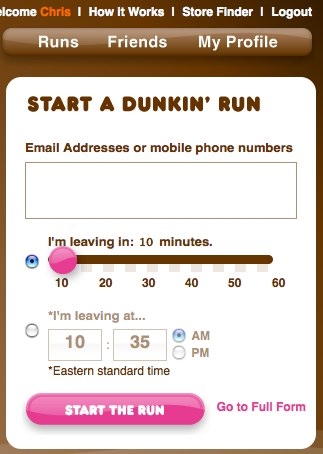
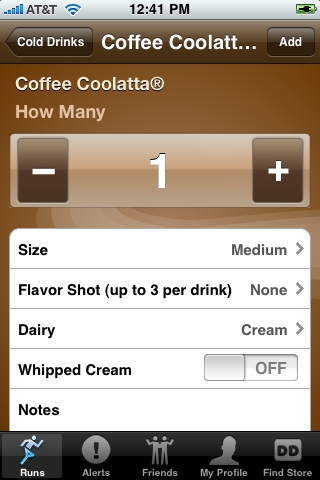
    Some of you would’ve read about the Dunkin’ Run iPhone app and website by now. For those who haven’t here’s the gist. Going out for coffee? Want to get your friends something too, but can’t be bothered to remember their order? You become the ‘Runner’, and use the app/website to initiate a group order. Your friends/colleagues ( a list you’ve made, and you can make different ones) get an interactive alert, and they can place the order online/app. If they’re registered users, they can even pick from their favourites/ previous orders. Once the list is made, take a print out/show it on the phone. Oh, okay, you can display the run status on facebook too. This is how the app looks on the phone

    dunkin dunkin1

    (Thank you, Chris Brogan, Mashable)

    ‘Run’ seems to be the operative word since the second example is to do with a product and activity right in that space. Nike. On Wired, I read about this excellent service called Nike+, which is now helping users track personal metrics and thus adding value. By using a sensor, and syncing an iPod to the website, (after the run) users can now track distance run, time taken, calories burned, weight lost etc and over a time period. These are displayed visually, on their profile, and it can be shared, and for extra motivation, users can even take up a challenge or set individual goals, and if that’s not enough, you can even create a list of people who could motivate you for completing it. They are updated about your progress. When i visited the India site, I could see a ticker that showed updates about various runners.

    According to Wired, “Nike has attracted the largest community of runners ever assembled—more than 1.2 million runners who have collectively tracked more than 130 million miles and burned more than 13 billion calories.” It has not only helped the users, but think about all that data Nike has, which it can use to provide even more value for customers and build better products. Amazing, I think I just might end up doing this stuff!!  Oh, okay, there’s a twitter app too – Twiike.

    Two ideas, which use the concept of sharing without needing the tools that I keep discussing here. A good reminder that while the tools race for users, and web domination, brands can quietly use the philosophy of web 2.0 and build communities around users through simple ideas and wonderful execution.

    until next time, Just Donut it 😉