Month: April 2009

  • Driven to it..

    The driver ahead, talking on the mobile,  was disrupting traffic…irritating him. And then he saw the sticker. At the junction, he knocked on the window and said “Thanks for the warning sticker, ma’am, but your responsibility doesn’t end there. You should also realize that the baby on board is too immature to drive you around”

    until next time, hit and run

  • Google noose?

    The A.P. will work with portals and other partners who legally license our content and will seek legal and legislative remedies against those who don’t. We can no longer stand by and watch others walk off with our work under misguided legal theories.”

    That’s what Associated Press Chairman William Dean Singleton said, in what is obviously a salvo against news aggregating services like Google. The ‘misguided legal theories’ here refer to the ‘fair use’  legal doctrine that news aggregators and search services have been using to use snippets of articles. AP’s concern is that many of these services have been making revenues out of packaging these stories. Also, while AP does have deals with Google and several other engines for some of their content, apparently search throws up material not covered by these agreements.

    Interesting to note that AP had sued MoreOver (Verisign) for snippeting and linking to its news, and Google had signed a deal with AP 2 weeks prior to that. That case was settled, though I have not yet been able to get details. AP now has plans to launch own news site – a “new search pages that point users to the latest and most authoritative sources of breaking news”.  It suggests a system to track content – one that would create, in effect, “fingerprints” of content that could track usage and links. Journalism Online is another entity that wants to help newspapers and magazines charge for their content online.You can read the interview with Steven Brill, who has started it with two others, here.

    Google’s contention is that they’re directing a lot of traffic to the news sites, and any newspaper that doesn’t want to be part of Google News can do just that. Scott Karp says at Publishing 2.0, Google has played to its strength and wrested control of the distribution of news. Interesting comments too. Google allowed users to find content that they wanted, and became the start page when people wanted to find something on the web. That’s something media companies still aren’t doing right, and in between, Google managed to push in the ads, and make a few dollars. Erick Schonfeld, at TechCrunch has an interesting take on this – he points out that (in the US) Google News is behind Yahoo News as well as the sites of the NYT, and Google is actually exposing news, and helping other sites make money too. He argues that while Google does play a part in getting traffic to sites, ultimately it is the content that gets readers and sets the price. Jackie Hai explains how the “The AP syndication model works in an economy of information scarcity, whereas the web represents an economy of abundance.” I recently read about Google Web Elements, which allows Google products to be added to any website. That includes Google News and takes distribution to a whole new level.

    Though the AP issue is mostly an American one, there are similar sentiments being echoed in Europe too. According to NYT, Belgian Danish and British newspapers want Google to reach agreements with them before using their content. Though each country will have its own dynamics as far as news distribution and maturity of media platform goes, these cases are sure to set precedents.

    The media landscape is changing. Its not just that old media is changing rules to figure out revenue models. Its about an airline becoming a content ‘publisher‘, individuals becoming advertising mediums, services like TwitterGrep popping up to utilise the instancy of Twitter… and so on. As Jackie Hai mentioned in his article, the participatory web has blurred the lines between content producer, distributor and consumer. We play all three at different times.

    The measures that newspapers have or are making to earn revenues on the web seem to be insufficient. That includes online advertising, micro payments etc. I increasingly feel that a repair might not be enough. Perhaps a complete overhaul is the ask. The fingerprinting does spark a thought about the role of individual journalists, and the importance they should have in the new system. The web is increasingly becoming a relationship based medium where personal equity and trust are currencies. Perhaps the corporate newspaper needs to be replaced with a more human and humane network, perhaps it should create a core competency on the web in specific news sections – these could be geography based, maybe there is an opportunity for an aggregator in the challenges of hyperlocal news.  Perhaps it can even be category or genre based. Traditional concepts, but built with a social web perspective. Perhaps they should build a legion of citizen reporters who are paid according to the quality of their contributions . After all there is always a need for quality driven and trustworthy news and analysis. The need remains, but the readers’ wants of delivery platform, timing etc have changed.

    The recent (and sometimes) drastic measures taken by Indian newspapers shows that its not as impervious as it was considered. That gives more reason to prepare for a changing landscape. To start figuring out consumption patterns ,  multimedia possibilities, cost implications, distribution dynamics and revenue streams on digital platforms. Maybe they’re all waiting for PTI to fight Google, or is it Yahoo Buzz 😐

    until next time, a new sprint

  • A plus cases on Twitter

    Last week, @aplusk beat @CNNbrk in the race for one million followers. In plain English, Ashton Kutcher, an actor, challenged CNN on Larry King Live – who would get to a million followers first – to prove a point that an individual could have a reach equal to a large network on Twitter. Twitter joined in the fun, because unlike the norm, users couldn’t unfollow either of the parties, of course smart tweeps found a way out anyway.  Point taken, AsKu, though the irony was that until a  week back, the CNN account was not run by them, though for sometime they’ve been managing the account through the person who created it.

    For more than two years, the CNNBrk account (for breaking news) had been created, maintained and run by a 25-year-old British Web developer who just wanted a way to beam short news alerts to his cellphone.

    And that’s the beauty of this user driven service. Something that I fear might change with the ‘mainstream’ spotlight and the rush of real celebrities. Its only a matter of time before a new celebrity thinks of a new stunt. But it is to be noted that  Kutcher is donating 10000 mosquito nets worth $100000 to a charity. In fact, one week before that, I’d read about Hugh Jackman’s donating AUS $100,000 to charity via Twitter, the charity to be selected via Twitter pitches.

    Now, I’ve always maintained that users should figure their own comfort levels and use the service accordingly. But I also feel that a sudden influx of people with no intent other than rooting for a celebrity might be the kind of inorganic growth that will work against the service and its more regular users. This could range from a disruption of the service due to the load to a change in the ‘culture’ of the service.

    Kutcher’s point was about getting a reach higher than a media giant. I’ve always had a problem with numbers – followers, updates etc as a means of measurement on Twitter. I find it a paradox for a place which became popular because of a qualitative measure – conversations. CNN will deliver breaking news regularly, and (as someone suggested on Twitter) Kutcher followers will just have to wait for those occasional Demi photos. Reach has been an index to sell traditional media space, is that the benchmark Twitter wants to take forward?

    There was a very interesting post on Tech Crunch on whether Twitter should remove its follower count. Like I tweeted, I’d agree. Once upon a time, it was a medium to share an instant – something you thought/read/saw/felt to make others smile/think/share their own expressions. With growth came the ‘how a tweet might cost you a job’ and ‘5 ways to increase sales with Twitter’ theses, and the instant was lost. Perhaps you will ignore that as a subjective grumble. But think of the times you see the ‘need 5 more followers to get 500. please RT’ and what you feel then. What happens when that’s the norm and the service changes to accommodate and encourage that culture because that’s what helps them make money. [Note: I’d love for Twitter to make money, but I’m sure they’ll find better ways]

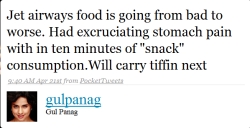
    While on celebrities and Twitter, closer home Gul Panag has been quite active on Twitter the last few days. The Twitterverse has had its share of imposters and has been trying to ensure there’s no ‘identity crisis’ this time, so much that poor GulP might have one soon. This tweet of hers caught my attention. (Oh, okay the dimples too!!)

    gulp1

    Spicy Jet news. Poor them. It reminded me of a post I’d written sometime back on ‘Social Ambassadors‘ – what would happen when the transparency of social media met celebrity bloggers? In this case, micro bloggers. In fact, micro blogging is even more ‘dangerous’ since the interaction is real time, and not like a PR draft that can be posted on ths site, and replies given in a few hours or even days. This becomes all the more important if celebrities use social media as a personal broadcast medium to their fans. Of course, brands can use the media to their benefit too – for example, create conversations between celebrities (a Twitter conversation between Aamir and Gul basis their Tata Sky TVC would be fun), use celebrities to communicate beyond the obvious advertisement etc.

    The challenge is for celebrities too. Perhaps it will also make celebrities more responsible when making endorsement choices. (It would be fun to ask SRK/Aamir why they switched soft drink brands in between.) Also, can celebrities retain their ‘interestingness’ when they are in touch with the fans all the time, unlike a traditional system when news about them was less abundant?

    On an aside, when celebrities move to direct-to-crowd platforms, what happens to the go-between media for whom they were the news makers, and we were the news consumers? And what happens to the micro celebrities on Twitter? 🙂

    until next time, when twitter streams meet mainstream

  • Moult

    Two new malayalam movies watched in a fortnight. Nothing special in that, you’d think. What does make it special is that they brought back characters from the past.

    “2 Harihar Nagar”, the official sequel to a movie, after 19 years, has four characters who’d set a benchmark in comedy at that time. [Priyadarshan, as he regularly does with decent Malayalam movies, screwed it up in Hindi as Dhol]  Handled by a capable director and an extremely good screenplay, these guys managed to pick up right where they left off. They had us in splits this time too, and add to that, sprinkles of nostalgia and some good suspense, this movie was a treat. It was amazing to watch their chemistry, intact, or perhaps rekindled, after so many years, more so, because their ‘image’ has changed quite some in the years that have passed. A couple of them play character and villain roles now, and popular ones at that; one had some time in the limelight, even being anointed the “common man’s hero”, before making an idiot of himself in inconsequential roles and TV shows, and the last flirts with the screen once in a while. But what we saw in the movie was a transformation, and a pleasant surprise.

    “Sagar alias Jackie”, the director claims, is not a sequel to any film, but merely  uses the hero (and one more character) of an earlier one. On hindsight, that makes a damn good disclaimer. The original movie ‘Irupatham noottandu’, made in 1987, starring Mohanlal as an enigmatic ‘smuggler with a conscience’ , was one that in no small way contributed to his rising stature in the industry. Over the years he has proved his acting skills time and again, until recently. These days he is more of star, and scripts pander to this. He is easily the best actor I’ve seen, and though I used to be a fan of the superhuman avatar in the initial days, when it used to be backed by excellent screenplays, these days his roles are quite indistinguishable from each other. More stylised, this one proved to be the same fare, unfortunately.

    Both scripts used the equity of iconic characters. While one set of actors broke their current moulds, and recaptured the feel of their original characters, another actor was caught in a mould and couldn’t come close to the original character. One could argue that the scripts made the difference, but maybe the difference was in acting, and one set proved better because they stayed true to character, and the portrayal automatically fell into place?

    It made me think whether this also applies to us too. Over a period of time, do some of us get cast in a ‘have to be’ mould, arising from others’ and self expectations, or a ‘want to be’ mould because of our own aspirations? Do these moulds take us away from what we originally are, is there an original mould, and would reclaiming it and living with it give us the joy we seek? The choice is an intriguing one.

    until next time, casting lots with the self

  • Video Night in Kathmandu

    Pico Iyer

    Set in the mid 80’s, Pico’s travel writing worked on two levels for me – one, in terms of his destinations, and the other, in terms of time. Right from the first page, with his interpretation of the Rambo phenomenon in Asia, his sharp wit makes this book a great read.
    He uses individual characters in different places (India, China, Tibet, Nepal, Burma, Thailand, HongKong, Japan, Philippines) to describe the place’s character. In some cases, the stereotypes are reinforced, but in a lot of others, he manages to fit in and yet observe objectively.
    He discusses the influence of the West on the East and tries to show each of the places he has visited have reacted to it – some by shunning it, some by completely absorbing it, and some by adapting it and making it their own.
    I felt that throughout the book he stayed true to his observations, though the perspective was tinged with a favouritism for the east.